Introduction
DevOps is experiencing explosive growth because business speed depends entirely on software delivery speed. High-performing engineering organizations now deploy code multiple times per day, compared to traditional setups that manage deployments once a quarter. This shift requires a massive infrastructure rewrite, making skilled DevOps professionals highly sought after across the globe. The challenge isn’t finding a certification; it’s choosing one that actually holds weight in a technical interview. Many professionals fall into the trap of collecting baseline, multiple-choice certificates that only validate vocabulary definitions. They spend time and money memorizing terms, only to freeze when a senior engineer asks them to debug a broken production deployment or fix a failed pipeline during a live assessment. A random collection of certificates won’t fix a broken career trajectory. Infrastructure engineering requires a systematic roadmap. You need to prove you understand how different layers interact: how code moves through a continuous integration pipeline, how containers are orchestrated, and how infrastructure is written as code. This comprehensive guide breaks down the industry’s top credentials, details their target career roles, provides explicit exam expectations, and maps out step-by-step pathways to transition from theoretical knowledge to real-world deployment skills. Best DevOps Certification
Why DevOps Certifications Matter
In infrastructure engineering, a certificate rarely acts as a golden ticket that bypasses a technical loop. However, a well-chosen, performance-based certification serves three critical career functions:
- Structured Learning Paths: The biggest hurdle for beginners is knowing what to learn next. A structured exam curriculum forces you to break out of your comfort zone. If you are a developer, it pushes you into networking and system administration; if you are a sysadmin, it forces you to write code and manage delivery pipelines.
- Skill Validation Under Pressure: Performance-based exams prove you can actually solve problems in a real-world terminal. When a hiring manager sees a lab-validated credential, they know you didn’t just memorize an answer key—you successfully configured live systems against a clock.
- Alignment with Cloud-Native Trends: Enterprise technology has shifted decisively toward multi-cloud architectures, Infrastructure as Code, containerized workflows, and rapid continuous integration and continuous deployment (CI/CD) pipelines. Preparing for these certifications directly exposes you to the core tools and strategies used by top-tier modern engineering teams.
Who Should Read This Guide
This guide avoids generalized fluff and focuses on clear, actionable steps tailored for specific engineering paths:
- Freshers & Grads: Looking for a practical, step-by-step blueprint to enter the cloud infrastructure domain without getting lost in abstract computer science theory.
- Developers & Software Engineers: Aiming to break down the wall between their application code and production systems by mastering automated delivery pipelines.
- Linux/System Administrators: Transitioning from manual server configurations and bash scripting to scalable cloud automation and platform engineering.
- Cloud, DevSecOps, & SRE Engineers: Seeking to validate specialized skills in container environments, security compliance, observability, and high-availability operations.
Types of DevOps Certifications
Before investing in study materials, let’s categorize the available credentials based on their educational focus.
                  +---------------------------------------+
                  |  Types of DevOps Certifications       |
                  +---------------------------------------+
                                      |
       +------------------------------+------------------------------+
       |                              |                              |
+--------------+               +--------------+               +--------------+
| Foundation   |               | Tool-Based   |               | Cloud Devops |
| Essentials   |               | Specialist   |               | Platforms    |
+--------------+               +--------------+               +--------------+
| Conceptual   |               | Hands-On Lab |               | Provider-    |
| frameworks   |               | validation   |               | Specific     |
| & terminology|               | (K8s, IaC)   |               | ecosystems   |
+--------------+               +--------------+               +--------------+
       |                              |                              |
       +------------------------------+------------------------------+
                                      |
                      +-------------------------------+
                      | Specialized & Advanced Tracks |
                      +-------------------------------+
                      | DevSecOps, SRE, GitOps, MLOps |
                      +-------------------------------+
Foundation Certifications
These focus purely on high-level frameworks, cultural principles, agile integration, and terminology. They are excellent for project managers, product owners, and non-technical stakeholders who need to understand engineering workflows, but they do not require writing code or managing systems.
Tool-Based Certifications
These are highly practical credentials that focus intensely on a single, industry-standard tool or platform. They validate that you understand the underlying mechanics of critical DevOps building blocks, such as containerization with Docker, container orchestration via Kubernetes, and Infrastructure as Code with Terraform.
Cloud DevOps Certifications
Offered directly by major cloud vendors like Amazon Web Services (AWS), Microsoft Azure, and Google Cloud Platform (GCP). These exams evaluate your ability to architect, secure, and manage automated deployment pipelines specifically within that vendor’s proprietary cloud ecosystem.
Specialized & Advanced Tracks
These focus on specialized disciplines within the broader infrastructure space:
- DevSecOps: Validating security testing automation directly inside the software development lifecycle (SDLC).
- SRE & Operations: Focusing on platform reliability, system telemetry, automated scaling, and production incident management.
- Advanced Paradigms: Exploring GitOps delivery patterns, MLOps machine learning operations, FinOps cloud cost optimization, and Platform Engineering roadmaps.
Best DevOps Certifications at a Glance
The following overview matches key credentials to their appropriate engineering level and primary industry focus.
| Certification Name | Best For | Level | Difficulty | Main Skills |
| DevOps Foundation | Beginners / Managers | Beginner | Low | Core culture, frameworks, basic workflows |
| Docker Certified Associate | Container Fundamentals | Intermediate | Medium | Image creation, container lifecycles, networking |
| Certified Kubernetes Administrator (CKA) | Cluster Management | Intermediate | High | Live cluster administration, networking, logging |
| Terraform Associate | Infrastructure as Code | Beginner | Medium-Low | HCL syntax, state files, multi-cloud modules |
| AWS DevOps Engineer Pro | AWS Cloud Automation | Advanced | High | CodePipeline, Service Catalog, Systems Manager |
| Azure DevOps Engineer Expert | Enterprise Microsoft Stacks | Advanced | High | Azure Boards, GitHub Actions, CI/CD design |
| GCP DevOps Engineer | Site Reliability Engineering | Advanced | High | Anthos, Cloud Build, SRE operations, monitoring |
Detailed Certification Analysis
1. Certified Kubernetes Administrator (CKA)
What It Is
The Cloud Native Computing Foundation (CNCF) gold-standard credential. This is a fully performance-based exam where you work inside a live Linux terminal to configure, manage, and troubleshoot active Kubernetes clusters.
Who Should Take It
Ideal for intermediate cloud engineers, system administrators, and developers looking to validate production-grade container orchestration skills.
Best Career Fit
Kubernetes Engineer, DevOps Engineer, SRE, and Platform Engineer.
Difficulty Level & Career Scope
High Difficulty. Because it lacks multiple-choice questions, it commands immense industry respect. Organizations scaling cloud-native infrastructure actively look for this validation on resumes.
Skills You Will Learn
- Installing and configuring production-ready clusters using
kubeadm - Managing application workloads, rolling updates, and rapid rollbacks
- Configuring pod network policies, CoreDNS, and Ingress traffic via Gateway API
- Allocating persistent storage via Persistent Volumes (PV) and Claims (PVC)
- Troubleshooting broken nodes, cluster components, and container log streams
Tools Covered
Kubernetes (kubectl, kubeadm, kubelet), Docker/containerd, Linux CLI, CoreDNS.
Exam Details
- Format: Performance-based tasks in a live terminal
- Duration: 120 minutes
- Passing Score: 66%
- Validity: 2 years
- Cost: Varies by provider
Study Roadmap
- Master fundamental Linux administration and container basics (Docker/containerd).
- Take a dedicated, lab-heavy course focusing on the explicit CKA domains.
- Build a Kubernetes cluster completely from scratch on local virtual machines.
- Practice speed-running cluster commands using
kubectlimperative commands rather than writing clean YAML files by hand.
Real-World Use Cases
Engineers use these skills daily to patch underlying node operating systems without causing application downtime, configure auto-scaling rules to handle traffic spikes, and debug microservice connection failures.
Pros: Highly respected; validates real terminal skills; completely bypasses exam memorization.
Cons: High cost; intense time pressure during the test; steep learning curve for pure beginners.
Best Recommendation
Choose it if you intend to work on any modern cloud-native stack. Avoid it if you do not yet understand basic Linux file systems, text editors, or fundamental IP networking.
2. HashiCorp Certified: Terraform Associate
What It Is
A provider-agnostic certification validating your foundational knowledge of Infrastructure as Code (IaC) principles using HashiCorp Configuration Language (HCL).
Who Should Take It
Perfect for cloud practitioners looking to automate infrastructure creation instead of clicking through web consoles manually.
Best Career Fit
Cloud Engineer, DevOps Engineer, and Cloud Consultant.
Difficulty Level & Career Scope
Medium-Low Difficulty. This is a highly accessible, cost-effective exam that delivers immediate value by validating the modern industry standard for provisioning multi-cloud infrastructure.
Skills You Will Learn
- Understanding the core benefits of Infrastructure as Code
- Mastering core Terraform commands (
init,plan,apply,destroy) - Managing state files, state locking, and secure remote backends
- Writing reusable modules to deploy infrastructure across development and production environments
- Understanding HCP Terraform (formerly Terraform Cloud) features and capabilities
Tools Covered
Terraform CLI, HCL Syntax, HCP Terraform, Git integration.
Exam Details
- Format: Multiple-choice, multi-select, true/false, fill-in-the-blank
- Duration: 60 minutes
- Passing Score: Scaled score (Pass/Fail)
- Validity: 2 years
- Cost: Varies by provider
Study Roadmap
- Download the Terraform binary onto your local machine.
- Write a basic configuration file to launch a single virtual machine in a cloud vendor’s free tier.
- Study state management commands carefully, specifically how to import existing manual resources.
- Review the official HashiCorp documentation paths for community open-source versus enterprise features.
Real-World Use Cases
Used to write clean, version-controlled code templates that can spin up an entire production environment across multiple regions in minutes, ensuring complete configuration consistency.
Pros: Exceptional return on investment; provider-agnostic value; clean, clear exam blueprint.
Cons: Validates foundational knowledge rather than advanced, production-scale architecture.
Best Recommendation
An absolute must-have for anyone working in cloud infrastructure. It represents one of the easiest ways to add a validated, highly sought-after skill to your resume early in your career path.
3. AWS Certified DevOps Engineer – Professional
What It Is
An advanced, comprehensive certification verifying your ability to automate, secure, and manage large-scale deployment workflows natively within the Amazon Web Services cloud platform.
Who Should Take It
Designed for experienced engineers who have spent significant time inside the AWS platform.
Best Career Fit
Senior AWS DevOps Engineer, Cloud Architect, and Release Manager.
Difficulty Level & Career Scope
High Difficulty. The questions are notorious for presenting long, complex enterprise failure scenarios where multiple answers are technically correct, but only one matches optimal architectural best practices.
Skills You Will Learn
- Building multi-stage CI/CD pipelines natively using AWS CodePipeline and CodeBuild
- Advanced infrastructure automation with CloudFormation and AWS CDK
- Deploying and scaling applications on Elastic Beanstalk, ECS, and EKS clusters
- Configuring multi-account governance via AWS Organizations and Control Tower
- Advanced automated logging, monitoring, and event-driven remediation using CloudWatch, EventBridge, and Systems Manager
Tools Covered
AWS CodeSuite, CloudFormation, CloudWatch, Systems Manager, AWS CDK, IAM.
Exam Details
- Format: 75 multiple-choice or multiple-response scenario questions
- Duration: 180 minutes
- Passing Score: 750 / 1000
- Validity: 3 years
- Cost: Varies by provider
Study Roadmap
- Ensure you have a solid grasp of AWS Associate-level concepts (Solutions Architect or SysOps).
- Build multi-account development and production deployment strategies using cloud templates.
- Study complex deployment patterns meticulously, including blue-green switches, canary routing, and rolling rollbacks.
- Take high-quality, scenario-focused practice exams to build stamina for the 3-hour test window.
Real-World Use Cases
Engineers use these skills to build fully automated, compliant infrastructure pipelines that automatically prevent deployment changes if security vulnerability scanners flag an active threat.
Pros: Deep enterprise authority; commands high industry respect; validates advanced architecture skills.
Cons: Platform-specific lock-in; long, exhausting exam format; expensive registration fee.
Best Recommendation
Choose it if your target companies run heavily on AWS infrastructure. Avoid it if you are looking for general, open-source tool-based skills that can be used across any cloud vendor.
4. Microsoft Certified: Azure DevOps Engineer Expert (AZ-400)
What It Is
An expert-level certification focusing on combining people, processes, and products to deliver continuous enterprise value using Azure DevOps tools and GitHub ecosystems.
Who Should Take It
Tailored for engineers working inside corporate infrastructure backed heavily by Microsoft technologies.
Best Career Fit
Azure DevOps Engineer, Build/Release Engineer, and Enterprise Platform Architect.
Difficulty Level & Career Scope
High Difficulty. Requires a solid prerequisite foundation—you must already hold either the Azure Administrator Associate (AZ-104) or Azure Developer Associate (AZ-204) credential to claim the expert badge.
Skills You Will Learn
- Designing comprehensive branching and version control strategies using Git and GitHub
- Configuring build and release pipelines via Azure Pipelines and GitHub Actions
- Implementing shifting-left security monitoring using dependency scanning and code analysis tools
- Managing enterprise project tracking structures with Azure Boards
- Designing comprehensive application telemetry using Azure Monitor and Application Insights
Tools Covered
Azure Pipelines, GitHub Actions, Azure Boards, Git, Azure Monitor, Application Insights.
Exam Details
- Format: Multiple-choice, drag-and-drop, case studies
- Duration: ~120-140 minutes
- Passing Score: 700 / 1000
- Validity: 1 year (Requires free annual online renewal)
- Cost: Varies by provider
Study Roadmap
- Complete either the AZ-104 or AZ-204 core certification path first.
- Spend significant time setting up self-hosted build agents and configuring secure connection endpoints.
- Master YAML pipeline syntax for both Azure Pipelines and GitHub Actions workflows.
- Review enterprise artifact version storage methodologies and package dependency structures.
Real-World Use Cases
Used inside large enterprise teams to orchestrate sprint tracking, secure corporate source code access, and automate server deployments across global Azure cloud regions.
Pros: High enterprise demand; deep integration with modern GitHub workflows; streamlined renewal.
Cons: Strict prerequisite path required; shorter validity period requires annual upkeep.
Best Recommendation
Excellent choice if you work inside or consult for traditional enterprise companies migrating their infrastructure stacks onto Microsoft Azure cloud services.
DevOps Certification Comparison Table
The following side-by-side breakdown helps you contrast the core focus areas, testing structures, and difficulty curves across the top credentials.
| Certification | Best For | Level | Main Focus | Difficulty | Recommended Role | Link |
| DevOps Certified Professional (DCP) | Core Lifecycle Automation | Foundational | CI/CD, Git, Jenkins, Core Workflows | Low | Junior DevOps Engineer | View Course |
| DevSecOps Certified Professional (DSOCP) | Pipeline Vulnerability Scanning | Advanced | Shift-Left Security, SAST/DAST, Compliance | High | DevSecOps Engineer | View Course |
| Site Reliability Engineering (SRE) | System Resiliency & Observability | Advanced | SLOs, Error Budgets, Chaos Engineering | High | Site Reliability Engineer | View Course |
| Master in DevOps Engineering (MDE) | End-to-End Enterprise Strategy | Expert | Architecture Design & Production Release | High | Senior DevOps Architect | View Course |
| Master in Azure DevOps | Microsoft Ecosystem Specialists | Advanced | Azure Pipelines, Boards, Repos Setup | Medium | Azure Cloud Engineer | View Course |
| AWS Certified DevOps Professional | Amazon Web Services Architecture | Advanced | AWS Developer Tools, CloudFormation, Auto Scaling | High | AWS Infrastructure Engineer | View Course |
| Master in Python Programming | Infrastructure Automation Scripting | Intermediate | Scripting, Custom CLI Tools, API Automation | Medium | Automation Engineer / Developer | View Course |
| Certified Kubernetes Administrator (CKA) | Production Container Orchestration | Advanced | Cluster Architecture, Networking, Troubleshooting | High | Kubernetes Specialist | View Course |
| Docker Certified Associate (DCA) | Application Containerization | Intermediate | Image Optimization, Container Runtimes, Volumes | Medium | Systems Administrator | View Course |
| Google Cloud DevOps Engineer | Google Cloud Native Platforms | Advanced | GKE Administration, GCP Operations Suite | High | GCP Cloud Engineer | View Course |
| Master in Data Science | Enterprise Data Engineering | Advanced | Statistical Analytics, Scalable Data Pipelines | High | Data Infrastructure Engineer | View Course |
| Hashicorp Certified Terraform Associate | Multi-Cloud Infrastructure as Code | Intermediate | Declarative State Files, Module Management | Medium | Cloud Automation Specialist | View Course |
| Master in Artificial Intelligence | Intelligent System Automation | Advanced | Neural Networks, Automated Model Training | High | AI Operations Specialist | View Course |
| Master in Deep Learning | Advanced Model Topologies | Advanced | Complex Layer Compute, Topology Deployments | High | Deep Learning Engineer | View Course |
| GitOps Certified Professional (GOCP) | Declarative Continuous Delivery | Intermediate | ArgoCD, Flux, Git-Driven Cluster State | Medium | Platform Engineer | View Course |
| Envoy ISTIO Certification Training | Microservices Service Mesh | Advanced | Traffic Splitting, mTLS Encryption, Sidecars | High | Network Infrastructure Architect | View Course |
| Prometheus with Grafana | Cloud-Native Systems Monitoring | Intermediate | Time-Series Metrics, Dashboard Visuals, Alerting | Medium | Monitoring & Operations Engineer | View Course |
| MLOps Certification Training Course | Machine Learning Pipeline Scale | Advanced | Model Lifecycle Automation, Data Versioning | High | MLOps Engineer | View Course |
| Master in Machine Learning | Predictive Operational Algorithms | Advanced | Supervised/Unsupervised Modeling Deployments | High | ML Infrastructure Engineer | View Course |
| Master in AppDynamics | Enterprise Performance Tracking | Intermediate | APM Dashboards, JVM/CLR Code Diagnostics | Medium | Application Support Engineer | View Course |
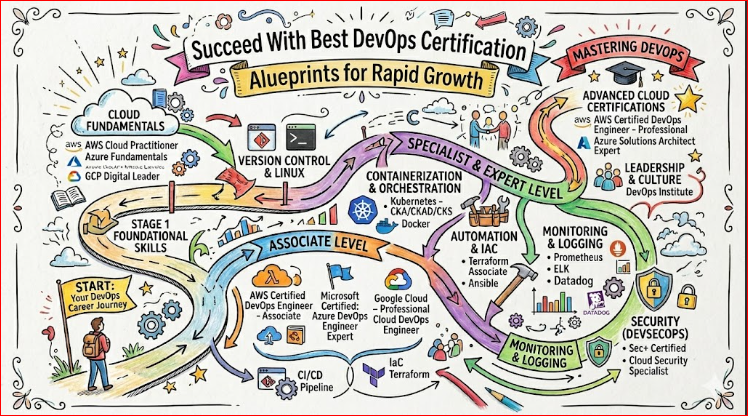
DevOps Certification Roadmap
A strategic approach to building infrastructure skills relies on layered progressions. You should master foundational system concepts before moving on to complex orchestration tools.
+---------------------------------------------------------------------------------------------------+
|                                  THE DEVOPS CERTIFICATION ROADMAP                                 |
+---------------------------------------------------------------------------------------------------+
|                                                                                                   |
|  [STAGE 1: THE FOUNDATION] ----> [STAGE 2: THE BUILDING BLOCKS] ----> [STAGE 3: THE INTEGRATION]  |
|  - Linux Administration          - Containerization Basics            - Advanced Kubernetes Certs |
|  - Git Version Control           - Infrastructure as Code (IaC)       - Vendor Cloud DevOps Pro   |
|  - Core Networking Essentials    - Continuous Integration (CI/CD)     - Specialized SRE/Security  |
|                                                                                                   |
+---------------------------------------------------------------------------------------------------+
Stage 1: The Core Foundation
Before pursuing any vendor badge, you must feel comfortable working inside an isolated terminal environment.
- Core Concepts: Linux directory manipulation, file permissions, shell configurations, basic Git branch management, and core networking principles (such as IP allocation, DNS resolution, and HTTP status codes).
- Suggested Entry Point: DevOps Foundation or focused, hands-on terminal practice labs.
Stage 2: The Core Building Blocks
Once you can manage single servers manually, transition to managing infrastructure configurations through code templates and container environments.
- Core Concepts: Writing clean Dockerfile configurations, managing container storage volumes, declaring architecture states using Terraform HCL scripts, and setting up localized automation pipelines.
- Suggested Entry Point: HashiCorp Certified: Terraform Associate.
Stage 3: The Production Integration
The final tier shifts from provisioning individual resources to managing resilient, scaled, multi-region production enterprise ecosystems.
- Core Concepts: Live production cluster orchestration, enterprise policy compliance gating, deep telemetry monitoring, auto-remediation architectures, and cross-account access controls.
- Suggested Entry Point: Certified Kubernetes Administrator (CKA) followed by your chosen cloud platform’s Professional DevOps credential.
Recommended Certification Path by Role
To maximize your time and budget, align your certificate choices directly with your current career background and target professional goals.
The Clear Engineering Pathways
- The Beginner Pathway: DevOps Foundation $\rightarrow$ Terraform Associate $\rightarrow$ Associate-Level Vendor Cloud Certificate.
- The Cloud Infrastructure Pathway: Associate Cloud Certificate $\rightarrow$ Terraform Associate $\rightarrow$ AWS DevOps Professional or Azure DevOps Expert.
- The Cloud-Native & Container Specialist Track: Linux Essentials $\rightarrow$ Terraform Associate $\rightarrow$ Certified Kubernetes Administrator (CKA).
- The Site Reliability Engineering (SRE) & Platform Track: Certified Kubernetes Administrator (CKA) $\rightarrow$ Cloud Professional DevOps Certificate $\rightarrow$ Specialist Monitoring/Observability credentials.
Real-World Career Scenarios
These real-world examples illustrate how professionals can pivot their technical skills into DevOps roles.
Scenario A: The Manual System Administrator
- The Profile: Has managed bare-metal Linux or Windows servers manually for years, writing basic local backup scripts, but feels trapped by manual deployments.
- The Strategy: Skip entry-level definitions. Study the Terraform Associate curriculum to move toward automated infrastructure tracking, then tackle the CKA to shift from traditional virtual machine management into modern container architectures.
Scenario B: The Pure Software Developer
- The Profile: Writes functional application code daily, but has no clear visibility into how that code is compiled, secured, or provisioned onto production servers.
- The Strategy: Focus on automation delivery systems. Study the Azure DevOps Engineer Expert (AZ-400) or AWS Certified DevOps Engineer path, prioritizing pipeline automation, secure container image creation, and artifact repository configuration.
Common Mistakes to Avoid
- Tackling Kubernetes Orchestration Too Early: Many beginners attempt the CKA exam because of high market demand, completely ignoring the fact that they do not yet understand basic Linux package managers, system resource limits, or core IP routing principles. This often leads to frustration and failed exam attempts.
- Collecting Badges Without Building Portfolio Projects: Passing multiple-choice exams by memorizing test prep material creates a false sense of security. If your resume features five distinct certificates but your GitHub account is empty, technical interviewers will spot the gap within the first five minutes of conversation.
- Overlooking Fundamental Systems Networking: Automated deployment engines rely heavily on foundational networking components like secure reverse proxies, load balancing rules, SSL certificate generation, and domain routing. If you treat networking as a black box, your production pipelines will break frequently.
Hands-On Portfolio Projects
To turn your certifications into a compelling resume, build out these practical, real-world portfolio projects:
1. The Multi-Stage Automated CI/CD Engine
- The Build: Set up a source repository that triggers a containerized build process every time you commit code changes. It should automatically pass through code linting, run unit tests, build a secure container image, and push that image into a secure repository.
- Why It Matters: This project proves you can automate code compilation and verification without relying on manual human intervention.
2. Full Multi-Cloud Infrastructure via Code
- The Build: Write a clean, modular Terraform configuration that sets up a secure, isolated network across two separate cloud providers (such as AWS and Azure). The configuration should spin up virtual networks, define explicit inbound firewall rules, and provision a scalable virtual machine tier.
- Why It Matters: It demonstrates your ability to manage infrastructure using code templates that can be tracked, peer-reviewed, and safely rolled back.
3. The GitOps Git-Driven Deployment Pipeline
- The Build: Configure a Kubernetes cluster that uses a GitOps delivery agent (like ArgoCD or Flux). When you update your application deployment configurations inside your Git repository, the cluster should automatically detect the changes and update itself to match the repository’s state.
- Why It Matters: This showcases your understanding of advanced production patterns, where your code repository serves as the absolute source of truth for your infrastructure’s active state.
Tools and Free Learning Resources
You can build a highly competitive technical skill set using high-quality, free learning resources available across the web:
- Interactive Sandbox Environments: Use free cloud playgrounds like Killercoda or Play with Docker to practice live terminal commands directly inside your browser without incurring unexpected cloud bills.
- Official Learning Paths: Platforms like Microsoft Learn and the AWS Skill Builder offer free, high-quality, comprehensive documentation paths tailored exactly to their certification blueprints.
- Local Open Source Tool Testing: Install open-source utilities like Minikube, Kind, or the core Terraform binary on your local machine to build, break, and debug infrastructure environments completely free of charge.
How to Choose the Right DevOps Certification
When deciding where to invest your learning time and budget, evaluate options against these practical constraints:
- Assess Your Current Technical Baseline: If you can’t read basic script structures or comfortably navigate a terminal via the command line, start with foundational system administration concepts. Do not jump straight into complex, multi-layered cloud engineering paths.
- Analyze Regional Job Market Demand: Before paying registration fees, open local job boards and look at active job postings in your target area. If most positions in your region ask for AWS infrastructure expertise, prioritize that platform over competing cloud vendor badges.
- Factor in Upkeep and Renewal Effort: Keep in mind that specialized credentials require regular maintenance. Vendor tracks like Azure require annual review completions, while certifications like the CKA expire every two years. Choose paths you can commit to maintaining over the long run.
Frequently Asked Questions (FAQs)
1. Which DevOps certification track is best for absolute beginners with zero cloud experience?
The Hashicorp Certified Terraform Associate combined with a fundamental track like the DevOps Certified Professional (DCP) offers the cleanest entry path. This combination allows you to understand the high-level cultural frameworks of continuous delivery while mastering the basics of writing infrastructure as code without getting immediately bogged down in complex, platform-specific cloud architectures.
2. Is investing the time and effort into a performance-based Kubernetes certification actually worth it?
Yes, absolutely. Because the Certified Kubernetes Administrator (CKA) is a fully practical, live-terminal exam rather than a multiple-choice memory test, it carries immense weight with hiring managers. Holding a CKA proves to technical interviewers that you can actively configure, maintain, and troubleshoot microservice clusters under a ticking clock.
3. Which cloud vendor certification path holds the highest industry market value for DevOps engineers?
The AWS Certified DevOps Professional track generally commands the widest market share due to Amazon Web Services’ global public cloud dominance. However, if your target job market or enterprise environment relies heavily on traditional enterprise corporate systems, the Master in Azure DevOps pipeline provides equally competitive corporate leverage and high-paying roles.
4. How long does it typically take to prepare for and pass a high-tier infrastructure certification?
For an IT professional already familiar with fundamental system administration, a realistic timeline is six to eight weeks of focused, daily laboratory practice. This provides ample time to transition from theoretical reading to mastering the quick muscle-memory configurations and terminal debugging strategies required by live testing setups.
5. Do infrastructure and DevOps engineers need to master deep software programming languages?
You do not need to build complex software algorithms or application logic, but you absolutely must master core automation scripting. A path like the Master in Python Programming ensures you can seamlessly write custom infrastructure automation scripts, interact with cloud provider APIs, and parse structured configurations like JSON or YAML.
6. Is a Docker certification still relevant now that Kubernetes dominates the orchestration market?
Yes, container fundamentals are essential because orchestration engines cannot manage broken containers. The Docker Certified Associate (DCA) validates that you understand core image optimization, secure microservice runtimes, and storage layer allocations, preventing common application deployment failures before they reach the cluster level.
7. How do specialized “Master” level training tracks differ from single tool-based certificates?
Tool certifications are purely tactical, validating your skill inside one isolated technology like Git or Jenkins. “Master” programs—such as the Master in DevOps Engineering (MDE)—are highly strategic, training engineers to stitch multiple independent automation tools together into a seamless, highly secure, and cost-efficient software delivery ecosystem.
8. What specific organizational value does a certified GitOps specialist bring to a cloud engineering team?
A specialist holding a GitOps Certified Professional (GOCP) credential helps transition an enterprise to an ultra-secure pull-based deployment model. This ensures your code repository stays as the single, absolute source of truth for your infrastructure, drastically reducing configuration drift and allowing your team to recover from outages with a simple Git rollback.
9. Why is there a sudden surge in industry demand for DevSecOps certifications?
Traditional deployment practices often treat security as an afterthought, leading to critical bottlenecks and late-stage vulnerabilities. Earning a credential like the DevSecOps Certified Professional (DSOCP) proves you know how to build security compliance, vulnerability scanners, and automated secrets management directly into the delivery pipeline so that audits happen automatically on every code push.
10. How does a Site Reliability Engineering (SRE) certificate change a team’s approach to uptime?
Traditional operations teams work reactively, resolving issues only after production breaks. An Site Reliability Engineering (SRE) Certified Professional approaches system design with a software engineering mindset, using automated telemetry tools, error budgets, and predictive dashboards to fix minor performance bugs before they ever transform into customer-facing downtime.
11. Can a professional transition into advanced MLOps and AI operations without a traditional data science degree?
Yes, because the most difficult challenge in AI today is not building the models, but deploying and scaling them reliably. Tracks like the MLOps Certification Training Course train infrastructure engineers to build the data pipelines, model storage systems, and automated testing layers required to keep enterprise machine learning workflows running predictably.
12. Are certifications alone enough to guarantee a top-tier DevOps job in today’s market?
No, certifications act as a powerful filter to get your resume past HR screening blocks and validate a baseline of technical knowledge. To secure elite roles, you must back up your credentials with a public portfolio (like a GitHub profile) that showcases real, working examples of multi-stage pipelines, monitoring stacks, and written infrastructure code.
Final Recommendation
To maximize your career growth and organizational efficiency, stop chasing isolated certification badges and instead adopt a strategic, roadmap-driven approach to your learning. If you are just starting your cloud journey, establish a rock-solid baseline by mastering Infrastructure as Code with the Hashicorp Certified Terraform Associate to automate environment provisioning cleanly. Once you understand declarative configurations, immediately bridge into advanced container orchestration by tackling the performance-based Certified Kubernetes Administrator (CKA), which validates real terminal troubleshooting skills that hiring managers heavily respect. Ultimately, back these credentials up by building comprehensive, production-grade portfolio projects—such as multi-stage automated CI/CD engines and GitOps deployment pipelines—proving that you can architect resilient, scalable, and secure cloud-native ecosystems from the ground up.