Introduction
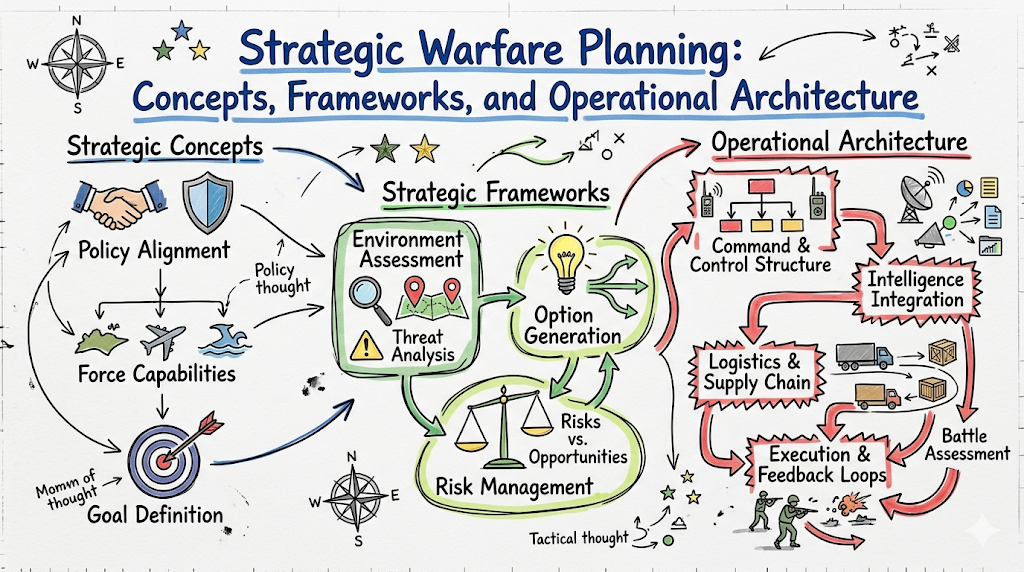
Strategic warfare planning serves as the foundational architecture for modern national defense and comprehensive security studies. At its core, strategic warfare planning represents the systematic process by which nations and military organizations align long-term national objectives with available resources, technological systems, and operational deployments. It moves beyond the immediate actions of individual units on a battlefield, focusing instead on the broader harmonization of national power over extended timelines and vast geographical spaces.
       [ National Security Objectives ]
                     │
                     ▼
       [ Strategic Warfare Planning ]
                     │
         ┌───────────┼───────────┐
         ▼           ▼           ▼
   [Intelligence] [Logistics] [Command & Control]
         │           │           │
         └───────────┼───────────┘
                     ▼
       [ Operational Coordination ]
For comprehensive educational resources, curriculum guides, and foundational analyses on defense paradigms, students and researchers can explore the materials provided by WarOpsX, an educational platform dedicated to breaking down defense operations management.
What Is Strategic Warfare Planning?
Strategic warfare planning is the high-level art and science of utilizing national resources to achieve defense objectives. It involves analyzing long-term variables, anticipating security shifts, and designing flexible frameworks that can adapt to changing environments. Unlike immediate crisis response, strategic planning operates on a macro level, focusing on prevention, deterrence, and institutional readiness.
The evolution of military strategy reflects broader human technological and social changes. Early strategic thought, recorded by classical thinkers like Sun Tzu and Carl von Clausewitz, emphasized the psychological, political, and philosophical aspects of conflict. Sun Tzu focused on achieving objectives through deterrence and minimal direct conflict, while Clausewitz emphasized that military actions are inherently extensions of political policy. As industrial capacities and communication technologies advanced, the definition of strategy expanded to include the mobilization of entire industrial economies, the management of global supply chains, and the integration of advanced technology.
To understand this field, one must clearly distinguish between strategy and tactics:
- Strategy focuses on the long-term, large-scale goals and the overall orchestration of resources across multiple regions or domains. It answers the question: Why are we allocating these resources, and what is the ultimate long-term objective?
- Tactics deals with the specific, short-term actions and techniques used by units to accomplish localized tasks within a broader plan. It answers the question: How do we secure this specific point or navigate this immediate environment?
In defense operations management, operational coordination serves as the vital link between these two levels. It translates high-level strategic goals into actionable directives that smaller units can execute. The core philosophy of defense operations management rests on balancing efficiency with resilience. Planners must design systems that optimize resource use during peacetime while maintaining the necessary redundancy to withstand unexpected disruptions during a crisis.
Why Strategic Warfare Planning Matters
The practical application of strategic warfare planning extends far beyond theoretical discussions; it directly impacts resource preservation and institutional survival. Effective planning addresses several critical areas:
Resource Optimization
No organization has unlimited resources. Strategic planning ensures that personnel, equipment, and financial investments are allocated efficiently. By analyzing potential challenges in advance, planners avoid over-extending assets and ensure that critical areas receive appropriate support.
Operational Coordination
Modern defense involves thousands of independent organizations, including transport units, communication teams, and medical groups. A structured strategic plan establishes common operating procedures, ensuring these diverse entities work toward shared goals rather than cross-purposes.
Risk Management
Every major operation involves uncertainty. Strategic planning uses structured risk assessments to identify potential failure points—such as supply line disruptions or communication failures—and creates actionable backup plans before operations begin.
Intelligence Gathering
Raw data is only valuable when analyzed and contextualized. Strategic planning sets clear priorities for intelligence teams, focusing data collection on critical geographical areas and technological vulnerabilities rather than irrelevant information.
Supply Chain Logistics
An operation cannot succeed without a reliable supply chain. Planning establishes robust procurement networks, strategic storage centers, and transport lines capable of delivering fuel, spare parts, and medical supplies over long distances.
Communication Systems
Clear lines of communication are essential for maintaining organizational alignment. Strategic frameworks outline how data flows between different levels of leadership, ensuring that critical updates reach decision-makers without being distorted by bureaucratic delays.
Decision-Making Processes
During complex operations, leaders must make high-stakes decisions quickly. Strategic planning provides pre-arranged decision frameworks, reducing hesitation by establishing clear authorities and pre-planned responses for specific scenarios.
Mission Effectiveness
Ultimately, strategic planning maximizes the likelihood of achieving long-term objectives. It helps organizations maintain focus on the desired end state, preventing them from becoming distracted by minor, short-term setbacks.
Historical Context: A classic historical example of strategic planning is the Allied logistics and coordination effort in Western Europe during World War II. The success of these operations depended entirely on long-term supply chain management, complex cross-channel shipping schedules, and total communication synchronization across multiple nations—months before any personnel reached the destination.
Core Principles of Strategic Warfare Planning
Intelligence Gathering
Intelligence gathering is the foundational element of any strategic framework. It involves the systematic collection, evaluation, and analysis of data regarding geographical terrain, environmental conditions, and institutional capabilities. Modern intelligence relies on multiple sources, including satellite imagery, signal interception, and open-source data analytics. Planners use this information to build a comprehensive picture of the operational environment, turning raw data into actionable insights that inform future decisions.
Logistics Management
Logistics management is the process of planning, implementing, and controlling the efficient flow and storage of goods, services, and information from the point of origin to the point of need. In defense planning, logistics governs the movement of personnel, sustenance, fuel, and medical equipment. Without meticulous logistical mapping, even the most sophisticated strategic goals remain unattainable, as operational endurance is directly limited by supply line capacity.
Command & Control
Command and control systems form the central nervous system of defense operations. This principle establishes clear hierarchies, lines of authority, and explicit responsibilities within an organization. A well-designed command and control structure ensures that strategic directives flow downward smoothly, while real-time situational reports move upward efficiently, enabling leaders to maintain organizational cohesion under stress.
Risk Assessment
Risk assessment is the formal process of identifying, analyzing, and mitigating potential threats to an operation. Planners evaluate variables such as environmental hazards, technological failures, and resource scarcities. By calculating the probability and potential impact of each risk, organizations can implement preventive measures and establish realistic contingency frameworks.
Operational Coordination
Operational coordination ensures that disparate units—whether they are ground transportation teams, maritime cargo networks, or aviation support groups—work together harmoniously. This requires standardized communication protocols, shared timelines, and mutual understanding of the overarching mission objectives, preventing organizational friction and duplicated effort.
       [ Central Command Node ]
         │                │
         ▼                ▼
   [ Logistics ]    [ Intelligence ]
         │                │
         └───────┬────────┘
                 ▼
     [ Operational Coordination ]
                 │
         ┌───────┴───────┐
         ▼               ▼
     [ Unit A ]      [ Unit B ]
Resource Allocation
Resource allocation involves distributing budgeting, personnel, and equipment based on strategic priorities. Because assets are finite, planners must make objective choices, balancing immediate operational needs against long-term readiness and maintenance requirements. This principle prevents over-commitment and ensures organizational sustainability.
Battlefield Communication
Battlefield communication focuses on the secure, resilient transmission of data across active operational areas. This requires using encrypted channels, redundant networks, and robust hardware capable of operating in harsh environments. Reliable communication ensures that updates travel rapidly between field personnel and command centers.
Defensive Planning
Defensive planning focuses on protecting critical infrastructure, supply networks, and personnel from external disruptions. This involves constructing physical fortifications, implementing digital security protocols, and designing decentralized operational frameworks that can continue functioning even if central nodes are compromised.
Situational Awareness
Situational awareness is the ability to perceive, analyze, and comprehend the active dynamics within an operational environment. It requires continuous monitoring of geographical factors, weather changes, and resource statuses. High situational awareness allows planners to detect emerging trends early and adjust strategies proactively.
Mission Execution
Mission execution is the final translation of strategic planning into direct action. It relies on the precise timing, discipline, and adaptability of field units. Successful execution requires that personnel understand not just their specific tasks, but the overall strategic intent, allowing them to make informed adjustments when unexpected challenges arise.
Strategic Warfare Planning Workflow & Architecture
The execution of strategic warfare planning follows a structured, iterative workflow designed to manage complexity and minimize uncertainty. This process runs continuously, adjusting constantly as new information arrives.
1. Intelligence Collection & Analysis
The workflow begins with continuous environmental scanning. Intelligence analysts gather data from diverse sources, verifying its accuracy and evaluating its strategic relevance. This phase produces foundational documentation regarding environmental conditions, infrastructural capacities, and potential regional challenges.
2. Mission Definition & Objective Setting
Once the baseline environment is understood, leadership defines clear, measurable strategic goals. These objectives must align with broader institutional policies and resource constraints, establishing what constitutes a successful outcome.
3. Resource & Logistics Mapping
With objectives set, planners map the required assets. This includes calculating required supply volumes, identifying transport routes, scheduling maintenance cycles, and determining optimal positions for supply depots.
4. Strategy Formulation & Contingency Design
Planners draft the primary operational framework, outlining timelines, command structures, and communication channels. Simultaneously, they develop alternative plans to address specific risks identified during the assessment phase.
5. Deployment & Execution Tracking
The approved plan moves into the deployment phase, where resources and personnel move into their designated positions. Throughout execution, data collection systems track progress against established benchmarks.
6. Continuous Monitoring & Adjustment
As operations proceed, command centers monitor real-time data feeds. If environmental conditions shift or logistical disruptions occur, planners modify the framework to keep the operation aligned with the primary objectives.
7. Post-Operation Evaluation
After the mission concludes, analysts conduct a comprehensive review. They compare actual outcomes against initial projections to identify successes, document failures, and refine planning methodologies for future operations.
Military Operations Lifecycle
The management of a military operation moves through distinct operational phases, each requiring specific technologies and producing measurable outcomes.
| Stage | Purpose | Technologies Used | Real-World Outcome |
| Intelligence Collection | To build an accurate picture of the operational environment. | Satellite imagery, signal sensors, open-source data platforms. | Verified regional data and comprehensive threat assessments. |
| Strategic Planning | To establish clear goals, command lines, and resource allocations. | Predictive analytics software, digital mapping tools. | Approved operational blueprints and risk mitigation plans. |
| Logistics Preparation | To position supplies, fuel, and medical assets along routes. | Supply chain management systems, automated inventory tracking. | Functional supply lines and stocked distribution hubs. |
| Resource Deployment | To move personnel and hardware into designated areas. | Secure transport networks, asset tracking hardware. | Forces positioned and ready to begin planned operations. |
| Operational Execution | To perform the primary mission tasks according to the strategic timeline. | Real-time command and control software, encrypted radio networks. | Achievement of core strategic goals and milestone completion. |
| Monitoring | To maintain real-time awareness of ongoing operations. | Unmanned aerial observation vehicles, sensor arrays. | Dynamic updates and immediate detection of environmental changes. |
| Risk Mitigation | To resolve unexpected complications or asset shortages. | Automated alert systems, pre-arranged backup communication channels. | Operations stabilized and secured against active disruptions. |
| Post-Operation Analysis | To evaluate institutional performance and document lessons learned. | Data reconstruction software, structured debriefing databases. | Updated operational protocols and improved training guidelines. |
Modern Military Technologies & Systems
Modern strategic planning relies heavily on advanced technological infrastructure. These systems convert raw information into actionable data, protect institutional communication, and streamline complex supply chains.
Communication Systems
Contemporary operations use secure, decentralized communication networks designed to withstand interception and disruption. These systems utilize software-defined radios, advanced encryption algorithms, and mobile infrastructure nodes to ensure that data flows uninterrupted between command centers and remote units.
Intelligence Platforms
Modern intelligence platforms integrate data from satellite constellations, airborne sensors, and ground observations. Advanced data-processing tools filter this information, using pattern recognition to highlight significant environmental changes or logistical movements, which helps analysts save time.
Logistics Technologies
Managing global defense supply chains requires automated inventory and transport tracking systems. These platforms monitor resource depletion rates in real time, predict future maintenance needs, and automatically schedule replenishment shipments, preventing supply shortages in active zones.
Monitoring & Surveillance Systems
Continuous surveillance uses a mix of fixed sensor arrays, radar installations, and unmanned aerial platforms. These technologies provide a real-time view of vast geographical spaces, allowing planners to track weather patterns, maritime traffic, and border activity with high precision.
Cyber Defense Platforms
Because modern operations depend on digital infrastructure, protecting networks from cyber threats is critical. Cyber defense platforms monitor institutional networks for unauthorized access, isolate compromised nodes, and protect the integrity of strategic data.
Operational Coordination Tools
These software suites combine maps, resource trackers, and communication feeds into a single interface. This gives leaders a unified view of the operational area, facilitating faster decision-making and closer coordination between different organizational branches.
Defense Technology Categories & Complexity
| Technology | Purpose | Complexity | Operational Usage |
| Satellite Communication Arrays | Provides globally available, encrypted data transmission channels. | High | Connects distant operational nodes with central command facilities. |
| Automated Logistical Inventory Tracking | Monitors supply levels and automates reorder schedules. | Medium | Streamlines supply chains and reduces depot overhead. |
| Unmanned Aerial Surveillance Units | Collects high-definition video and sensor data over designated zones. | High | Provides local units with real-time situational awareness. |
| Network Intrusion Detection Platforms | Identifies and blocks unauthorized attempts to access operational databases. | High | Protects command networks and critical database systems. |
| Geographic Information Software (GIS) | Generates detailed terrain maps and environmental models. | Medium | Evaluates terrain accessibility and supports route planning. |
Real-World Applications of Strategic Warfare Planning
Strategic warfare planning principles apply directly to a wide range of state and international operations:
                  [ Strategic Warfare Planning ]
                                │
        ┌───────────────────────┼───────────────────────┐
        ▼                       ▼                       ▼
[ Border Security ]   [ Peacekeeping Missions ]  [ Disaster Response ]
  - Sensor integration  - Multilateral logistics  - Asset deployment
  - Route monitoring    - Buffer zone safety      - Resource distribution
Historical Military Campaigns
Analyzing major historical events highlights the long-term impact of strategic planning. For instance, the successful mobilization, transport, and maintenance of allied forces across vast ocean distances during the twentieth century demonstrated that long-term logistical frameworks are often more decisive than immediate tactical victories.
Border Security Operations
Nations apply strategic planning to secure long borders by integrating static radar installations, mobile surveillance assets, and rapid-response teams. Planners analyze terrain vulnerabilities to place resources where they can monitor activity efficiently and respond to incidents effectively.
Peacekeeping Missions
United Nations peacekeeping operations require complex strategic coordination among multiple nations. Planners design frameworks that govern shared logistics, establish rules of engagement, and maintain communication across diverse languages and organizational cultures to stabilize volatile areas.
Humanitarian Logistics Operations
During international crises, military logistics systems are frequently used to deliver large-scale aid. Strategic planners map regional transport limits, establish distribution points, and manage supply lines to deliver food, clean water, and medical care to affected populations.
Disaster Response Coordination
When natural disasters strike, defense assets often assist civilian authorities. Strategic operations frameworks guide the rapid deployment of transport aircraft, heavy engineering machinery, and mobile medical clinics, ensuring orderly resource distribution in chaotic environments.
Naval Operations Management
Managing maritime operations requires coordinating assets across millions of square miles. Strategic planning governs fleet deployment schedules, refueling paths, and international shipping lane monitoring, keeping maritime trade routes open and secure.
Air Operations Management
Airspace management requires precise timing and coordination. Strategic frameworks oversee airspace monitoring, refueling aircraft placement, and transport flight scheduling, ensuring safe, efficient air operations without overworking flight crews or airframes.
Cyber Defense Operations
Nations protect their digital infrastructure through continuous cyber planning. This involves mapping critical infrastructure dependencies, establishing secure data backups, and running simulated network attacks to prepare defense teams for real-world incidents.
Benefits of Strategic Warfare Planning
Implementing structured strategic planning offers significant organizational advantages:
- Better Coordination: It breaks down institutional barriers, ensuring that land, air, maritime, and digital teams operate with a shared understanding of mission goals.
- Improved Resource Management: It reduces waste by aligning procurement directly with long-term strategic needs, ensuring equipment and personnel are utilized efficiently.
- Faster Decision-Making: Pre-arranged decision trees and clear command lines allow leaders to respond to changing situations without bureaucratic delay.
- Reduced Operational Risks: Thorough risk assessments allow organizations to build backup systems and alternative plans, minimizing the impact of unexpected disruptions.
- Improved Situational Awareness: Integrated intelligence streams provide leaders with a clear, verified picture of the operational area, reducing uncertainty.
- Stronger Logistics Management: Meticulous supply mapping ensures lines of communication remain open, delivering fuel, food, and medical supplies reliably.
- Better Communication Efficiency: Standardized communication protocols reduce data distortion, ensuring critical alerts reach their destinations quickly.
- Mission Reliability: Ultimately, comprehensive planning builds organizational resilience, making it much more likely that missions achieve their long-term goals despite challenges.
Challenges & Limitations
Despite its benefits, strategic planning faces several persistent challenges and limitations:
- Communication Failures: Technical malfunctions, atmospheric interference, or cyber disruption can break critical communication lines, isolating field units from command centers.
- Intelligence Inaccuracies: Strategic plans are only as good as the information they are built upon. Outdated data or misinterpreted reports can lead to flawed resource allocation.
- Logistics Disruptions: Extreme weather, infrastructure collapse, or targeted supply line interference can stall operations by cutting off fuel, food, and medical supplies.
- Technological Complexity: Relying heavily on sophisticated digital systems introduces vulnerabilities, as minor software errors or hardware bugs can disrupt large-scale operations.
- Cybersecurity Threats: Modern command and control networks are constant targets for digital disruption, forcing organizations to invest heavily in continuous defense tracking.
- Human Decision-Making Limitations: Stress, fatigue, and cognitive biases can lead decision-makers to ignore intelligence warnings or hesitate at critical moments.
- Resource Shortages: Unexpectedly high consumption rates or budget cuts can drain material reserves, forcing planners to scale back or abandon strategic goals.
- Rapidly Changing Environments: The strategic landscape can shift incredibly fast due to political, economic, or environmental factors, making rigid plans obsolete overnight.
Career Opportunities in Strategic Operations & Defense Analysis
The academic study of strategic planning prepares individuals for a variety of analytical and operational careers within the public and private sectors:
Defense Analyst
Defense analysts evaluate national security policies, military capabilities, and defense budgets. Working for government agencies or research institutions, they use quantitative and qualitative data to write comprehensive reports that help policymakers make informed strategic decisions.
Strategic Operations Planner
Operations planners design high-level frameworks for large organizations, ensuring resources are positioned efficiently to meet long-term goals. This role requires deep expertise in project management, risk analysis, and inter-departmental coordination.
Intelligence Analyst
Intelligence analysts collect and evaluate data from multiple sources to identify emerging trends and regional risks. They interpret complex political developments, environmental changes, and technological shifts, providing actionable summaries to organizational leadership.
Logistics Coordinator
Logistics coordinators manage complex global supply chains, overseeing the transport, storage, and distribution of critical materials. This career demand spans across defense organizations, international aid groups, and large commercial corporations.
Cyber Defense Specialist
These specialists protect critical communication infrastructure from digital interference. They design secure network architectures, monitor data traffic for anomalies, and develop response frameworks to handle potential security breaches.
Security Researcher
Working within academic institutions or think tanks, security researchers study historical trends, geopolitical shifts, and emerging technologies. Their published research forms the theoretical foundation for future strategic doctrines and public policies.
Policy Analyst
Policy analysts examine how government legislation impacts national security and international relations. They evaluate the effectiveness of existing programs, propose new policy initiatives, and analyze the socio-economic impacts of defense spending.
Career Pathways & Educational Requirements
| Role | Core Skills Required | Preferred Educational Background | Primary Employers |
| Defense Analyst | Quantitative data analysis, report writing, policy evaluation. | Master’s in Strategic Studies, Public Policy, or Economics. | Government agencies, research think tanks, defense consultancies. |
| Intelligence Analyst | Data verification, pattern recognition, regional expertise. | Degree in International Relations, Security Studies, or History. | Security departments, international organizations, corporate risk firms. |
| Logistics Coordinator | Supply chain mapping, inventory management, operations research. | Degree in Logistics, Supply Chain Management, or Systems Engineering. | Humanitarian aid agencies, transport ministries, defense logistics commands. |
| Cyber Defense Specialist | Network architecture, cryptography, digital incident response. | Degree in Computer Science, Cybersecurity, or Information Technology. | Critical infrastructure providers, technology firms, public sector networks. |
Beginner Roadmap for Learning Strategic Warfare Planning
Building expertise in strategic planning requires a step-by-step approach that combines historical study with technical analysis and practical simulation exercises.
[Phase 1: Foundations]  ──►  [Phase 2: Core Dynamics]  ──►  [Phase 3: Integration]
 - Historical Analysis        - Logistics Architecture       - Cybersecurity Basics
 - Strategic Studies Theory   - Command & Control Systems     - Simulation Modeling
Phase 1: Foundational Learning
- Historical Analysis: Begin by reading detailed case studies of major global conflicts. Analyze how resource constraints, terrain, and leadership choices influenced outcomes over extended timelines.
- Strategic Studies Theory: Study classical strategic texts along with modern defense literature to understand how strategic concepts have evolved alongside technological advancements.
Phase 2: Core Operational Dynamics
- Logistics Architecture: Learn the principles of supply chain management, focusing on resource procurement, transport limits, and the mathematical formulas used to schedule regular replenishment cycles.
- Command & Control Systems: Study organizational charts and operational structures to see how information moves through large institutions during crises.
- Intelligence Analysis Methodologies: Practice filtering, verifying, and synthesizing open-source data to create concise, objective situation reports.
Phase 3: Advanced Integration
- Cybersecurity Basics: Learn how modern digital networks are structured and understand the basic security protocols used to protect critical infrastructure from interference.
- Simulation Modeling Exercises: Use tabletop exercises or digital simulation tools to test strategic choices against changing environmental variables and resource constraints.
- Academic Research Projects: Write structured essays analyzing contemporary security challenges, forcing yourself to balance theoretical strategy with real-world resource limits.
Certifications & Training
Professional certifications help students and researchers validate their skills, gain practical expertise, and prepare for careers in defense analysis and strategic planning.
| Certification / Program | Level | Best For | Skills Covered |
| Strategic Studies Graduate Certificate | Advanced | Aspiring defense analysts and policy researchers. | Geopolitical analysis, strategic theory, defense policy formulation. |
| Certified Supply Chain Professional (CSCP) | Professional | Individuals entering strategic logistics and procurement roles. | Supply chain design, end-to-end inventory management, logistics optimization. |
| CompTIA Security+ | Beginner | Students pursuing careers in cyber defense and network security. | Core network security principles, threat mitigation, secure data management. |
| Project Management Professional (PMP) | Professional | Operations planners managing complex institutional projects. | Resource scheduling, risk management, stakeholder communication. |
When preparing for certifications in digital defense, operational risk analysis, or systems configuration, platforms like WarOpsX offer foundational training materials, structured reading lists, and mock scenario resources to help you build core operational competencies.
Common Beginner Mistakes
- Confusing Tactics with Strategy: Beginners often focus on immediate, localized actions—like a single technology choice—while losing sight of long-term logistical and organizational goals.
- Ignoring the Critical Role of Logistics: It is common to focus entirely on advanced hardware while forgetting that operational capacity is strictly limited by fuel availability, supply lines, and regular maintenance.
- Overlooking Communication Infrastructure: Many assume data flows perfectly between units, ignoring how easily technical failures or terrain can disrupt communication lines.
- Focusing Exclusively on High-Tech Systems: Relying too much on advanced technology can lead to vulnerabilities when systems fail or face unexpected environments, underscoring the need for simple, low-tech backup options.
- Ignoring Historical Lessons: Forgetting past operational failures often leads to repeating the same mistakes, particularly regarding geographical challenges and supply chain limitations.
Best Practices in Strategic Operations Planning
Comprehensive Planning Before Execution
Before deploying resources, spend sufficient time drafting detailed operational blueprints. Define clear milestones, assign specific responsibilities, and ensure all team leaders understand the primary objective.
Continuous Environmental Monitoring
Never treat a plan as rigid. Set up automated tracking systems and regular intelligence reviews to monitor changing weather, terrain conditions, and resource levels constantly.
Systematic Risk Assessment
Conduct formal risk assessments early in the planning process. Identify potential failure points—such as broken supply lines or hardware failures—and create actionable backup plans for each scenario.
       [ Draft Operational Plan ]
                   │
                   ▼
       [ Run Risk Assessment ] ──► (Identify Vulnerabilities)
                   │                          │
                   ▼                          ▼
       [ Build Contingency Plan ] ◄───────────┘
                   │
                   ▼
       [ Final Approved Blueprint ]
Clear and Redundant Communication
Establish simple, standardized communication protocols. Ensure teams use multiple, independent communication channels so they can stay connected if their primary systems fail.
Continuous Resource Optimization
Track resource use constantly to prevent waste. Position supply storage centers where they can easily serve multiple areas, and maintain a clear log of all equipment and spare parts.
Meticulous Documentation
Document every phase of the planning process, including initial data, risk calculations, and adjustment choices. Clear records prevent confusion and provide valuable lessons for future planning.
Future of Strategic Warfare Planning
The field of strategic warfare planning continues to evolve rapidly, driven by emerging technologies and shifting global security dynamics.
AI-Driven Operational Analysis
Artificial intelligence platforms are changing how planners process complex data. These tools analyze satellite imagery, sensor feeds, and environmental data to highlight potential anomalies and suggest optimal transport routes, accelerating the planning process.
Cyber Warfare Preparedness
As digital systems become central to defense, planning increasingly focuses on protecting data networks. Future strategies will treat digital networks as primary operational zones, prioritizing the defense of cloud communication channels and automated logistics systems.
Autonomous Monitoring Systems
Unmanned aerial, maritime, and ground observation systems will provide continuous surveillance over wide areas. These platforms reduce the need for manual monitoring, feeding real-time environmental data directly into command centers.
Predictive Intelligence Systems
Using historical data and real-time inputs, predictive analytics tools help planners anticipate resource bottlenecks and infrastructure failures before they occur, allowing teams to address vulnerabilities proactively.
Real-Time Battlefield Analytics
Integrated data systems consolidate information from individual units, sensors, and weather networks into a single dashboard. This real-time visibility allows leadership to coordinate operations with high accuracy across multiple regions.
Space-Based Communication Systems
Low-Earth orbit satellite constellations are providing high-speed, low-latency communication networks that reach remote areas, ensuring command centers can stay connected with field operations globally.
Digital Defense Transformation
Organizations are replacing paper-based records and isolated databases with integrated digital management platforms, making it easier for different branches to share data securely and efficiently.
Advanced Operational Simulations
Planners use high-fidelity digital sandbox simulations to test strategic choices against complex, changing environments before deploying resources, helping them identify hidden flaws in their plans safely.
FAQs
1. What is strategic warfare planning?
Strategic warfare planning is the high-level process of organizing and allocating national or institutional resources over long timelines to achieve long-term defense and security goals.
2. What is the difference between tactics and strategy?
Strategy focuses on large-scale, long-term objectives across multiple regions, while tactics involves the short-term actions and techniques localized units use to complete specific tasks.
3. Why is logistics important in military operations?
Logistics ensures that vital supplies, such as fuel, food, and medical equipment, are delivered reliably. Without effective logistics, operational units cannot sustain themselves over time.
4. What role does intelligence play in defense planning?
Intelligence converts raw environmental and situational data into verified, actionable insights, helping planners identify risks and make informed decisions.
5. Can beginners study military strategy academically?
Yes. Many international universities and research think tanks offer foundational courses in strategic studies, international relations, and public policy for beginners.
6. What technologies are used in modern operations?
Modern operations utilize secure satellite communications, automated inventory tracking software, unmanned surveillance platforms, and robust cyber defense tools.
7. What careers exist in defense analysis?
Graduates can pursue careers as defense policy analysts, intelligence researchers, global logistics coordinators, cyber security specialists, or academic security researchers.
8. How long does it take to learn strategic studies?
Foundational concepts can be learned in a few months of academic study, but mastering the field requires years of continuous research, historical analysis, and practical experience.
9. What is command and control in defense planning?
Command and control is the organizational structure that establishes clear lines of authority, communication channels, and decision-making responsibilities across an institution.
10. How do environmental factors affect strategic planning?
Weather patterns, terrain limits, and regional infrastructure directly impact resource movement and communication stability, requiring planners to design flexible frameworks.
11. What is a contingency plan in operations management?
A contingency plan is a structured alternative framework designed to guide an organization if primary plans are disrupted by unexpected events or resource shortages.
12. How do cyber operations impact modern strategic planning?
Cyber operations require planners to secure critical digital infrastructure from unauthorized access, ensuring communication networks remain integral and operational.
13. What is situational awareness?
Situational awareness is the continuous process of perceiving and understanding the active dynamics, risks, and resource statuses within an operational environment.
14. Why do planners study historical military campaigns?
Historical campaigns provide valuable case studies that show how resource limits, geographical challenges, and planning decisions affected outcomes in real-world scenarios.
15. What is the purpose of post-operation evaluation?
Post-operation evaluation compares actual mission results with initial projections, helping organizations document lessons learned and improve future planning frameworks.
Final Thoughts
Mastering strategic warfare planning requires developing a disciplined, analytical mindset rooted in long-term strategic thinking. True strategy goes beyond immediate actions or relying solely on advanced technology; it centers on the sustainable coordination of resources, clear lines of communication, and organizational adaptability under stress.
For students and researchers entering this field, historical analysis serves as an invaluable guide. Studying the resource constraints, environmental challenges, and organizational choices of the past helps clarify the core patterns that continue to shape modern global security. Academic progress relies on looking past sensationalism to focus on the practical, methodical realities of institutional management, logistical endurance, and systematic risk mitigation.