Introduction
Imagine trying to navigate a dense, unfamiliar forest in total darkness without a flashlight, a map, or a compass; every step you take would be a high-stakes gamble, which is exactly why defense forces rely heavily on structured intelligence to eliminate guesswork, reduce uncertainty, and secure mission success. In the complex world of national security, reliable information serves as the absolute foundation for effective planning and situational awareness, turning chaotic raw data into actionable insights before any physical resources are deployed. By exploring the fundamental concepts of how intelligence guides military operations—from the continuous feedback of the intelligence cycle to the integration of modern tools like artificial intelligence and satellite imagery—this guide on WarOpsX.com will break down these vital systems using simple historical and modern examples tailored for complete beginners and defense studies enthusiasts alike.
What Is Military Intelligence?
At its core, military intelligence is the collected, evaluated, and analyzed information that defense organizations use to understand potential threats, operational environments, and strategic opportunities. It is not just about spying or uncovering secrets; it is about building a clear, factual picture of the world to help leaders make the best possible decisions.
The primary purpose of intelligence is to eliminate guesswork. In defense studies, it is crucial to recognize the profound difference between raw information and processed intelligence:
- Information: This is raw, unverified data. It includes things like a stray piece of radio chatter, a single satellite photo of a truck, a rumor on social media, or a weather report. On its own, raw information can be misleading, incomplete, or overwhelming.
- Intelligence: This is what happens when raw information is verified, analyzed, and placed into context. If analysts look at that single satellite photo, compare it with radio reports, verify it with historical data, and conclude that a transport route is being established, that raw data becomes actionable intelligence.
Without this crucial process of analysis, data is just noise. Intelligence turns that noise into clarity.
Why Intelligence Matters in Military Operations
Intelligence is the nervous system of defense operations. Without it, physical resources cannot be used effectively. Here is why it plays such a pivotal role:
- Better Situational Awareness: It allows leaders to know what is happening across an environment in real time, preventing surprises and helping teams anticipate changes.
- Informed Decision-Making: Instead of relying on gut feelings or assumptions, commanders can base their plans on thoroughly vetted facts and realistic assessments.
- Risk Reduction: By identifying potential hazards—such as dangerous terrain, severe weather, or structural obstacles—intelligence actively protects lives and assets.
- Resource Planning: Defense operations require massive amounts of supplies, fuel, and medical equipment. Intelligence helps logisticians place these resources exactly where they will be needed most, preventing waste.
- Mission Effectiveness: When objectives are backed by solid data, operations are executed more smoothly, precisely, and with a much higher likelihood of achieving their goals.
- National Security: On a broader scale, intelligence acts as an early warning system, helping nations identify and defuse threats long before they escalate into open conflicts.
The Intelligence Cycle
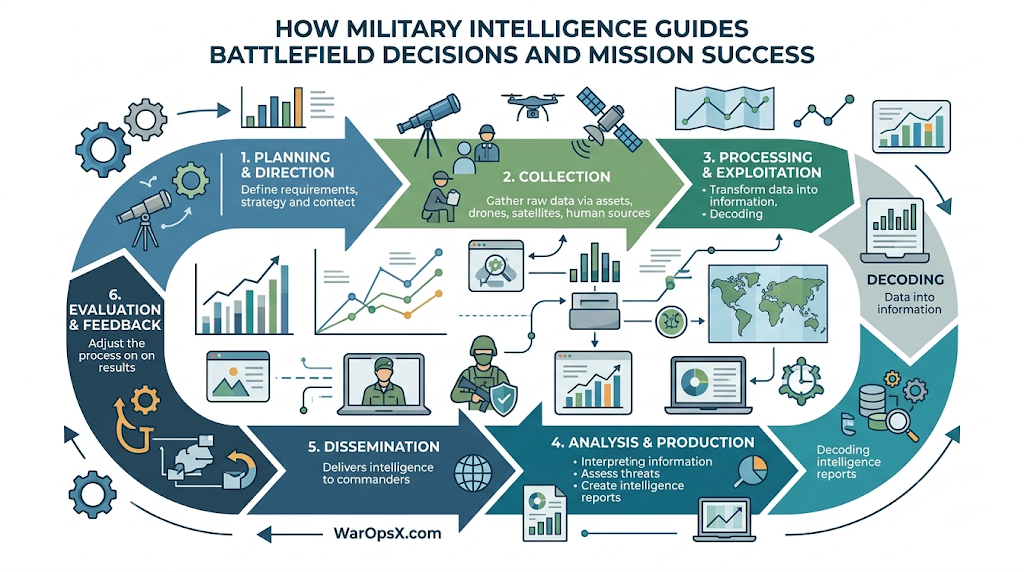
To ensure that information is trustworthy and useful, defense organizations use a standardized, repetitive process known as the Intelligence Cycle. This cycle ensures that raw data is systematically converted into reliable knowledge through six distinct stages:
[1. Planning & Direction] ➔ [2. Information Collection] ➔ [3. Processing]
           ▲                                                    │
           │                                                    ▼
[6. Continuous Feedback] ◄─── [5. Dissemination] ◄─── [4. Analysis]
1. Planning and Direction
The cycle begins with a question or an objective. Decision-makers identify what they need to know—such as the condition of a flood-damaged bridge before a humanitarian mission. Analysts then plan how to find that specific information.
2. Information Collection
Once the goals are set, teams begin gathering raw data using various sources. This might involve taking aerial photographs, monitoring public news broadcasts, or reviewing historical maps.
3. Processing
Raw data is rarely ready to use. In this phase, the collected information is organized. Foreign languages are translated, encrypted messages are decoded, and thousands of images are sorted so analysts can view them easily.
4. Analysis
This is the heart of the cycle. Expert analysts look at the processed data, look for patterns, cross-reference multiple sources, and interpret what the information actually means. They turn the “what” into the “why” and “what next.”
5. Dissemination
The finished intelligence product is delivered to the leaders who requested it. It must be presented clearly, concisely, and quickly enough to be useful for their current planning needs.
6. Continuous Feedback
The cycle never truly ends. Once leaders receive the intelligence, they evaluate it. If they have new questions or if the situation has changed, they issue new directions, and the cycle begins all over again.
Types of Military Intelligence
Intelligence is categorized by both its operational scope and the methods used to gather the information. Understanding these divisions helps clarify how different pieces of the puzzle come together.
The Scope of Intelligence
- Strategic Intelligence: This focuses on the big picture. It deals with long-term national security, global trends, political stability, and the overarching capabilities of foreign nations. It helps top-level government officials formulate national policies.
- Operational Intelligence: This bridges the gap between grand strategy and daily tasks. It focuses on specific regions, looking at local geography, infrastructure, and regional logistics to support mid-level planning.
- Tactical Intelligence: Conceptualized at the local level, this is highly time-sensitive information. It focuses on immediate surroundings—such as the condition of a nearby road or local weather changes—to ensure safety during active daily tasks.
The Disciplines of Gathering Information
- Human Intelligence (HUMINT): Information gathered directly from people. This includes interviews with witnesses, debriefings of travelers, and reports from local observers on the ground.
- Signals Intelligence (SIGINT): Information gathered by intercepting electronic signals and communications, such as radio transmissions, radar waves, or telemetry data.
- Geospatial Intelligence (GEOINT): The analysis of imagery and geospatial data to describe, assess, and visually depict physical features and geographically referenced activities on Earth. Satellite photography is a prime example.
- Open-Source Intelligence (OSINT): Information collected from publicly available sources. This includes public television broadcasts, academic journals, newspapers, and unclassified government databases.
- Measurement and Signature Intelligence (MASINT): Highly technical data collected to identify the distinctive characteristics of specific objects or events, such as tracking the acoustic signature of a ship or the chemical composition of industrial exhaust.
Technologies Supporting Modern Military Intelligence
Modern technology has drastically accelerated the speed and accuracy of intelligence gathering. Today, analysts rely on a complex ecosystem of hardware and software to maintain situational awareness.
- Satellites: Orbiting high above the Earth, satellites provide constant, high-resolution imagery and communication links, allowing analysts to monitor changes across the globe without violating national borders.
- Drones: Unmanned aerial platforms offer a high-level overview of specific locations. They can hover over areas that are difficult or dangerous for humans to reach, sending back live video feeds.
- Radar Systems: Advanced radar can peer through thick cloud cover, dense fog, and total darkness, mapping out terrain and tracking movement across land, sea, and air.
- Secure Communications: Encryption technologies ensure that collected intelligence can be transmitted from sensors to analysts, and finally to decision-makers, without being intercepted or altered by outsiders.
- Artificial Intelligence and Machine Learning: With millions of data points arriving every minute, human analysts can become overwhelmed. AI and machine learning algorithms excel at scanning massive datasets to flag unusual patterns or highlight points of interest.
- Geographic Information Systems (GIS): GIS software layers different types of data—like elevation, population density, and road networks—onto a digital map, helping planners visualize complex environments.
- Data Analytics: Advanced software assists analysts by sorting, filtering, and cross-referencing information from hundreds of different sources simultaneously, saving valuable time.
Benefits of Intelligence in Military Operations
When structured intelligence is integrated into military operations, the overall efficiency of an organization improves dramatically.
- Improved Decision-Making: Leaders no longer have to guess. They can make choices based on verified evidence, leading to more realistic timelines and goals.
- Better Coordination: When different branches of service (like the army, navy, and air force) share a single, unified intelligence picture, they can sync their movements perfectly.
- Enhanced Situational Awareness: Knowing the layout of the land and the location of obstacles prevents accidental errors and keeps personnel out of harm’s way.
- Resource Optimization: Fuel, supplies, and personnel are expensive and finite. Intelligence ensures they are sent exactly where they will have the greatest positive impact.
- Reduced Uncertainty: While the future can never be predicted perfectly, high-quality analysis removes the “fog” of operations, turning unknown variables into manageable risks.
- Faster Response: In emergencies, such as natural disasters, rapid intelligence allows response teams to deploy instantly to the hardest-hit areas.
- Mission Planning Support: Every phase of an operation, from the initial departure to the final return, is mapped out using intelligence to ensure structural safety and feasibility.
Common Challenges
Despite incredible technological advancements, intelligence analysis is a difficult field prone to unique bottlenecks and vulnerabilities.
- Information Overload: Today’s problem is rarely a lack of data; it is too much data. Sifting through billions of data points to find one critical piece of information is like looking for a needle in a digital haystack.
- Data Accuracy: False information, misleading public reports, or simple human error can pollute a dataset. Analysts must constantly question the reliability of their sources.
- Rapidly Changing Situations: On the ground, a situation can change in seconds. An intelligence report that took three hours to write might become obsolete by the time it is read.
- Cybersecurity Risks: Because modern intelligence relies heavily on digital networks, protecting these databases from hackers, malware, and data breaches is a constant struggle.
- Communication Challenges: Even the best intelligence is useless if it cannot be communicated. Technical glitches, broken radios, or rigid bureaucratic silos can prevent vital updates from reaching the people who need them.
- Ethical and Legal Considerations: Balancing national security needs with privacy rights, international treaties, and open-source ethics requires careful oversight and strict adherence to organizational rules.
Best Practices
To overcome these challenges, defense organizations follow core, high-level guiding principles to ensure their analysis remains sound and responsible.
- Verify Information from Multiple Sources: Analysts use a technique called “triangulation.” They never rely on a single report. If a HUMINT source, an OSINT article, and a GEOINT satellite photo all point to the same conclusion, the reliability rating goes up.
- Encourage Collaboration: Breaking down communication walls between different agencies ensures that critical pieces of information are shared rather than kept hidden away in separate departments.
- Improve Analytical Skills: Technology is only as good as the person operating it. Continuous training in critical thinking, logic, and bias reduction keeps analysts sharp.
- Use Modern Technologies Responsibly: While AI and automation speed up data processing, organizations must ensure these tools are used as aids rather than replacements for human oversight.
- Maintain Data Quality: Keeping databases clean, organized, and properly updated ensures that algorithms and human researchers are always working with the best available foundations.
Historical and Modern Examples
History provides excellent, unclassified case studies of how intelligence changes the course of major events.
World War II Intelligence Efforts
One of the most famous examples of intelligence guiding operations occurred at Bletchley Park in the United Kingdom. Polish and British codebreakers successfully cracked the German “Enigma” cipher machine. The resulting intelligence, codenamed Ultra, gave Allied commanders advanced warning of logistical movements, helping them protect maritime supply convoys across the Atlantic Ocean.
Cold War Intelligence Developments
The introduction of high-altitude reconnaissance aircraft, like the U-2, changed strategic planning. During the Cuban Missile Crisis of 1962, aerial photography provided undeniable evidence of missile installations. This critical geospatial intelligence gave political leaders the exact information they needed to resolve the crisis through diplomacy, avoiding an escalation.
Peacekeeping and Humanitarian Operations
In modern times, intelligence concepts are vital for non-combat operations. During UN peacekeeping missions, open-source intelligence and satellite imagery are used to monitor ceasefire lines and track population movements. Similarly, during major international disasters—like earthquakes or typhoons—defense forces use geographic information systems (GIS) to map out destroyed bridges and roads, guiding search-and-rescue teams safely to isolated communities.
Future Trends
The field of intelligence gathering is evolving rapidly as we look toward the future. The next generation of defense studies will likely be defined by several major shifts:
- Advanced Predictive Analytics: Using historical data patterns, future software may help analysts forecast logistical bottlenecks or humanitarian crises before they happen.
- Autonomous Sensing Technologies: Small, automated sensors deployed in remote environments will be able to monitor environmental changes for years without needing maintenance.
- Satellite Advancements: The rise of mega-constellations of small, low-Earth-orbit satellites means that imagery of the entire globe will be updated almost continuously, reducing delay times to minutes.
- Cloud-Based Intelligence Platforms: Secure cloud computing will allow analysts scattered across different continents to work on the exact same dataset in real time, drastically speeding up collaboration.
- Data Fusion: This is the automatic blending of completely different data streams (like matching a public radio broadcast with a weather pattern map) into a single visual dashboard.
- Ethical AI in Defense: As AI tools become more integrated, developing strict ethical frameworks to prevent algorithmic bias and preserve human accountability will remain a top priority.
Types of Military Intelligence
| Intelligence Type | Primary Purpose | Information Source | Typical Strategic Value |
| Strategic | Long-term national planning and policy formulation. | Global news, political trends, national economic data. | High: Shapes international relationships and decades-long defense policies. |
| Operational | Regional planning and logistics coordination. | Regional maps, local infrastructure reports, weather trends. | Medium: Helps mid-level leaders organize resources effectively over months. |
| Tactical | Ensuring local safety and immediate situational awareness. | Local observations, short-range radar, immediate surroundings. | Immediate: Protects teams and ensures daily task efficiency. |
| OSINT | Cost-effective, wide-scale baseline background research. | Public media, internet forums, journals, newspapers. | High: Provides vital context without risking sensitive assets. |
Traditional vs. AI-Assisted Intelligence Analysis
| Feature | Traditional Approach | AI-Assisted Approach | Potential Benefits |
| Processing Speed | Hours to days; limited by human reading and sorting speeds. | Seconds to minutes; automated filtering of massive data feeds. | Drastic Time Savings: Speeds up response times in fast-moving emergencies. |
| Pattern Recognition | Relies entirely on human memory, experience, and manually built charts. | Uses machine learning algorithms to spot hidden anomalies across datasets. | Higher Accuracy: Detects subtle clues that a tired human analyst might miss. |
| Data Volumes | Can become easily overwhelmed by massive amounts of video or text. | Scales effortlessly to ingest millions of incoming data points simultaneously. | Prevents Overload: Keeps the focus on critical updates instead of white noise. |
| Final Decision | Human analyst interprets the data and signs off on the report. | AI flags anomalies; human analyst verifies and makes the final call. | Balanced Reliability: Keeps human judgment at the center of the system. |
FAQs
Q: What is the main difference between information and intelligence?
A: Information consists of raw, unverified facts or data pieces, such as a random photo or rumor. Intelligence is that exact data after it has been checked for accuracy, analyzed by experts, and placed into a meaningful context.
Q: Can complete beginners learn to understand military intelligence concepts?
A: Yes, absolutely. While the technology can be complex, the core concepts rely on basic logic, critical thinking, objective research, and structured problem-solving that anyone can learn.
Q: What is OSINT stand for in modern defense studies?
A: OSINT stands for Open-Source Intelligence. It refers to any useful data that is collected legally from public platforms, including newspapers, television broadcasts, public databases, and academic websites.
Q: How do drones help in intelligence gathering without being tactical?
A: Conceptually, drones serve as high-altitude eyes in the sky. They provide comprehensive aerial photography and map out large geographic areas, helping analysts study terrain safety from a distance.
Q: Why is the Intelligence Cycle drawn as a circle instead of a straight line?
A: It is a circle because the process never stops. When a decision-maker receives a finished intelligence report, that new knowledge naturally sparks new questions, which restarts the collection process.
Q: Does weather forecasting count as a type of intelligence data?
A: Yes. Weather data is a crucial part of geospatial and operational planning. Knowing if a heavy storm or a blizzard is arriving helps planners protect transport routes and resources.
Q: What does E-E-A-T mean when evaluating intelligence reports?
A: Borrowed from research principles, it represents Experience, Expertise, Authoritativeness, and Trustworthiness. Analysts use these same core concepts to judge whether an outside source is reliable.
Q: How does artificial intelligence help human analysts today?
A: AI acts like a powerful digital assistant. It rapidly scans millions of documents or images, filters out irrelevant background noise, and highlights specific anomalies for human review.
Q: What is the difference between strategic and tactical intelligence?
A: Strategic intelligence looks at long-term, global trends to help high-level government officials make policy decisions. Tactical intelligence focuses conceptually on immediate, local conditions to ensure short-term safety.
Q: Why do analysts use multiple sources to verify a single story?
A: Relying on one source is dangerous because that source could be mistaken, biased, or outdated. Verifying data across multiple independent sources ensures the final conclusion is highly accurate.
Conclusion
Ultimately, intelligence plays a vital role in helping military and defense organizations make deeply informed decisions, improve overall situational awareness, and support long-term national security. It acts as the anchor that keeps complex operations grounded in reality, transforming raw, chaotic data into clear, actionable roadmaps. As we look to the future, rapid advances in technology—from cloud networks to artificial intelligence—will continue to improve the speed and depth of intelligence analysis. However, no matter how advanced software algorithms become, responsible use, strict accuracy, rigorous ethics, and sound human judgment will always remain the most essential pieces of the puzzle. Technology can process the data, but it is human insight that truly lights the way forward.