In the chaos of modern combat, information is just as critical as ammunition. A military force can possess the most advanced hardware in the world, but without the ability to share data instantly, its operational effectiveness drops to zero. Battlefield Communication Systems serve as the nervous system of modern defense operations. They link individual soldiers, armored vehicles, drones, and command centers into a unified network, transforming isolated units into a cohesive, synchronized force. Historically, battles were won by the side with the strongest positioning or the heaviest firepower. Today, victory often belongs to the force that can gather, process, and securely transmit information the fastest. This article provides a comprehensive overview of how military communication functions, the technologies that drive it, and the security measures that protect it from sophisticated adversaries.
What Are Battlefield Communication Systems?
At its core, a battlefield communication system is a specialized network of hardware, software, and transmission protocols designed to send data across a combat zone. Unlike commercial civilian networks, these systems must operate reliably in hostile, remote, and highly contested environments.
Definition
These systems encompass all the tools and technologies used to transmit voice, video, text, and telemetry data between military personnel and platforms during operational deployments.
Purpose
The primary purpose is to establish and maintain a shared understanding of the operational environment. It ensures that commands flow downward from leadership smoothly and that critical target data moves upward from scouts on the front line.
Importance
Without reliable tactical communication, military units operate in a vacuum. A lack of connectivity leads to delays, missed opportunities, and a significantly higher risk of friendly-fire incidents.
History and Evolution
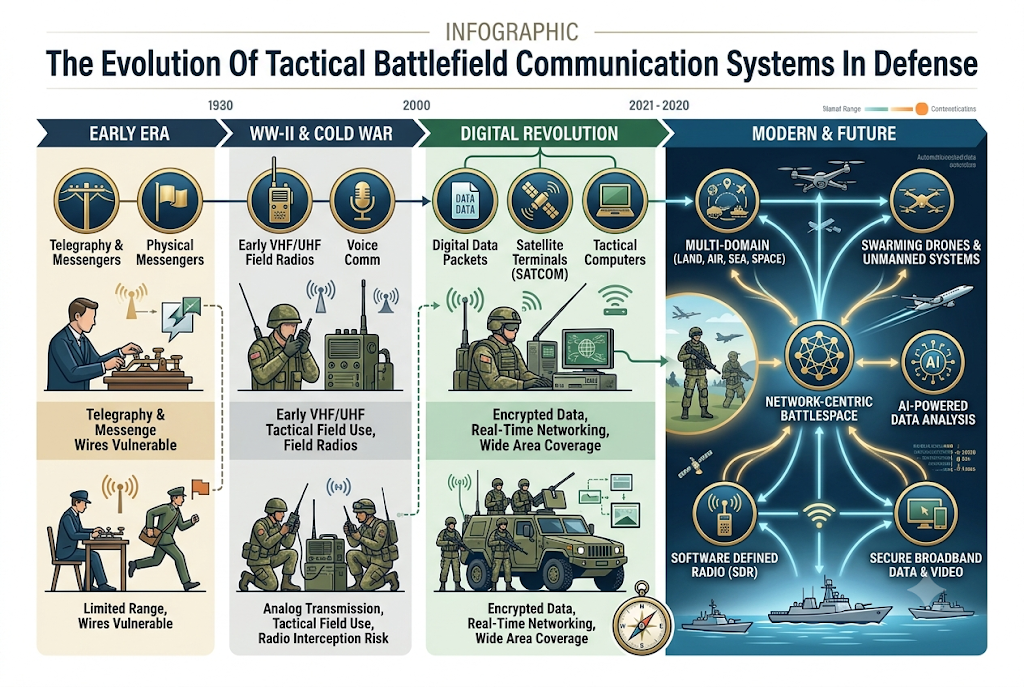
The journey of military signaling from primitive methods to modern battlefield networks highlights a continuous struggle for speed and security.
Early Battlefield Communication
For centuries, military leaders relied on visual and audible signals. Runners, horseback couriers, smoke signals, flags, and drums were the primary means of moving information. During the 19th century, the invention of the telegraph introduced electrical signaling, though it required physical wires that were easily cut by enemy forces.
The Rise of Military Radio Communication
The introduction of wireless technology in the early 20th century revolutionized warfare. Military radio communication allowed commanders to speak directly to moving units during World War I and World War II. However, these early analog radio systems were prone to interception, heavy static interference, and deliberate signal blocking by enemies.
Transition into Digital Military Networks
The late 20th century saw a massive shift from analog voice signals to digital data packets. This era introduced early computer networks into the military ecosystem, paving the way for encrypted text messaging, automated radar tracking, and initial satellite links.
Modern Unified Communication Systems
Today, defense forces use highly integrated, software-driven networks. Voice, data, video, and drone feeds are combined into a single digital architecture, giving commanders an unprecedented view of the entire operational space simultaneously.
Why Battlefield Communication Matters
Modern warfare relies entirely on the concept of network-centric operations, where information sharing creates a massive tactical advantage.
- Coordination Across Domains: Modern combat involves land, sea, air, space, and cyber forces. Unified communication allows an infantry platoon on the ground to instantly call for precise air support from a fighter jet miles away.
- Rapid Decision Making: By accelerating the flow of data, commanders can observe enemy movements, orient themselves, make a decision, and act before the adversary can react.
- Mission Success and Soldier Safety: Real-time updates prevent troops from marching into ambushes. If a unit encounters an unexpected hazard, they can alert nearby forces immediately.
- Enhanced Situational Awareness: Knowing exactly where friendly forces are located reduces confusion, eliminates duplicate efforts, and protects non-combatants in the area.
Objectives of Battlefield Communication Systems
To be effective in a high-stakes environment, these specialized networks must achieve several core operational goals:
- Interoperability: The ability for different military branches, as well as allied international forces, to connect to the same network without compatibility issues.
- Resilience: The network must remain active even if multiple communication towers, satellites, or vehicles are destroyed.
- Low Latency: Data must travel instantly; a delay of even a few seconds can render targeting information completely useless.
- Low Probability of Interception (LPI): Signals should be difficult for the enemy to detect, track, or eavesdrop upon.
Main Components of the Network
A robust tactical network requires a blend of physical hardware and digital backbone infrastructure to function seamlessly in the field.
- Radios and Tactical Antennas: Portable handheld, manpack, and vehicle-mounted units that form the primary point of contact for ground troops.
- Command Centers: Fixed or mobile hubs where incoming data streams are processed, analyzed, and visualized on large displays for commanders.
- Satellites: Orbiting spacecraft that provide long-range data transmission, connecting remote deployment zones to domestic headquarters thousands of miles away.
- Communication Vehicles: Specially armored trucks and command vehicles equipped with high-powered signal transmitters and satellite dishes to act as mobile network hubs.
- Encryption Devices: Dedicated hardware modules that scramble voice and data before transmission, ensuring that intercepted signals look like random noise to outsiders.
- Battlefield Servers and Data Terminals: Ruggedized, shock-resistant computers and field servers that store tactical maps, run coordination software, and process sensor data directly on the front line.
Types of Battlefield Communication Systems
Military forces utilize a diverse mix of communication channels, ensuring that if one medium fails, others can immediately fill the gap.
Radio Communication
Tactical radios operating on High Frequency (HF), Very High Frequency (VHF), and Ultra High Frequency (UHF) bands remain the baseline for short-to-medium-range voice transmissions among troops.
Satellite Communication (SATCOM)
SATCOM provides beyond-line-of-sight connectivity. It is essential for global deployments, naval fleets at sea, and long-range bomber aircraft operating far from home bases.
Tactical Data Links (TDL)
These are highly standardized, secure digital networks designed specifically for the automated exchange of tactical data between airborne, land, and naval platforms. They allow machines to talk directly to other machines, sharing radar tracking data without human intervention.
Wireless and Mesh Networks
Ad-hoc mobile mesh networks allow tactical devices to automatically discover each other and route data through neighboring nodes. If one vehicle moves out of range, the network automatically reroutes the signal through another nearby vehicle.
Fiber and Secure Wire Communication
When occupying fixed defensive positions or command bunkers, military forces prefer physical, buried fiber-optic cables. Physical cables emit zero radio waves, making them completely immune to remote electronic eavesdropping and radio frequency jamming.
How Battlefield Communication Systems Work
The lifecycle of a single piece of tactical data follows a strict, highly protected pathway from the moment a threat is spotted to the moment an action is taken.
[Sensor/Soldier Detects Threat]
               │
               ▼
[Data Captured & Digitized]
               │
               ▼
[Hardware Encryption Applied]
               │
               ▼
[Transmitted via Radio/Satellite/Mesh]
               │
               ▼
[Received by Command Hub]
               │
               ▼
[Decrypted & Displayed on Tactical Map]
- Data Capture: An infantry scout spots an enemy armored column and inputs the coordinates into a ruggedized handheld tablet.
- Digitization and Encryption: The tablet converts the text and coordinates into digital packets. The device’s internal security chip instantly encrypts the data using advanced cryptographic keys.
- Transmission: The encrypted packet is transmitted over the air via a military radio communication system, using rapid frequency-hopping techniques to avoid detection.
- Relay: The signal travels through a local mobile mesh network, bouncing from a nearby drone to a satellite, and finally down to a tactical command center.
- Reception and Decryption: The command center’s server receives the signal, decrypts it using matching keys, and plots the enemy’s exact location onto a digital map for the commander to see within seconds.
Modern Technologies Revolutionizing the Field
Technology updates are rapidly shifting how defense communication systems operate, making them smarter, faster, and much harder to disrupt.
- Software Defined Radio (SDR): Traditional radios were limited to fixed hardware frequencies. SDRs use software to change their frequency bands, modulation styles, and encryption protocols on the fly, making them incredibly versatile.
- AI-Assisted Communication: Artificial intelligence monitors radio traffic, automatically identifies the clearest available frequencies, detects early signs of enemy jamming, and prioritizes critical emergency messages over routine data traffic.
- Tactical Cloud Computing: Instead of relying on distant servers at home, local combat networks deploy mini-cloud environments directly in the field. This allows local units to process complex data rapidly without needing a constant internet connection back to head office.
- Combat IoT Sensors: Wearable health monitors on soldiers, fuel sensors in vehicles, and acoustic gunfire detectors are tied directly into the broader network to provide automated status updates.
Key Advantages
Implementing an advanced, digital combat network delivers distinct advantages to modern defense forces:
- Unmatched Operational Speed: The time required to locate a target and deploy assets is reduced from hours to mere minutes.
- Massive Reduction in Blue-on-Blue Incidents: Automated tracking loops continuously update the locations of friendly forces, preventing accidental engagements.
- Flexibility in Command: Leaders can direct operations from a safe distance while giving local commanders the real-time data they need to alter plans based on shifting field conditions.
- Data-Driven Overmatch: Gathering superior amounts of accurate information allows a smaller military force to outmaneuver a much larger adversary.
Core Challenges & Vulnerabilities
Despite immense technological sophistication, tactical networks face severe environmental and man-made threats on the modern battlefield.
- Electronic Warfare (EW) and Signal Jamming: Adversaries deploy powerful transmitters that flood military radio frequencies with noise, drowning out legitimate tactical messages.
- Cyber Attacks: Highly skilled hostile actors continuously attempt to inject malware, disrupt network nodes, or crack encryption keys to steal sensitive operational plans.
- Physical Interferences: Thick concrete urban environments, deep mountain valleys, dense jungle canopies, and severe sandstorms can easily block, weaken, or distort wireless radio signals.
- Network Fragmentation: If crucial relay vehicles or satellite links are physically destroyed, outer units can become isolated, breaking the unified network into helpless, disconnected pockets.
Security and Encryption
In military operations, an unsecure communication line is more dangerous than having no communication at all. If an enemy intercepts plan details, they can predict movements, set ambushes, and compromise entire operations.
To prevent this, secure military networks rely on a concept known as Communications Security (COMSEC). This involves rotating cryptographic keys daily, using advanced mathematical algorithms to scramble data, and utilizing spread-spectrum techniques where a signal continuously hops across hundreds of different frequencies every single second. Even if an adversary intercepts a fraction of the transmission, it sounds like meaningless static.
Real-World Military Applications
To understand how these concepts function in practice, look at their application across distinct mission profiles:
- Disaster Relief and Humanitarian Missions: When hurricanes or earthquakes destroy civilian cell towers, military forces deploy mobile satellite trailers and mesh networks to coordinate search-and-rescue teams, medical triage units, and supply drops across devastated zones.
- Multi-Domain Defensive Operations: During a coordinated border defense scenario, ground-based radar installations automatically share incoming threat vectors with naval vessels offshore and air superiority fighters overhead via tactical data communication links, building a unified wall of defense.
- Counter-Piracy and Maritime Security: Naval commandos boarding a suspected vessel maintain continuous encrypted video feeds back to their parent destroyer, allowing legal advisors and command teams on the ship to monitor the operation and provide immediate guidance.
Future Trends
The next decade will completely reshape how military forces exchange data under fire.
- Quantum Communication: Quantum mechanics will enable completely unhackable communication networks. Any attempt by an enemy to spy on a quantum-encrypted signal will instantly alter the data state, alerting the users and invalidating the message.
- Autonomous Drone Relay Swarms: Autonomous drone swarms will fly over difficult terrains like mountains or dense cities, acting as dynamic, self-healing communication relays that move automatically to keep ground forces connected.
- 5G and 6G Military Networks: Ultra-fast, low-latency cellular networks designed for military use will allow thousands of battlefield sensors, autonomous vehicles, and augmented-reality combat visors to share massive data loads instantly.
Best Practices
Maintaining an unbreakable communication posture requires discipline, constant training, and adherence to strict operational protocols:
- Enforce Strict Radio Discipline: Keep voice transmissions short, clear, and to the point. Unnecessary chatter gives enemy electronic warfare units more time to pinpoint your physical location.
- Utilize Alternative Communication Methods: Regularly practice operating under total communication blackouts or using backup methods like wired lines, ensuring troops can still function if primary networks fail.
- Frequent Cryptographic Updates: Ensure all encryption keys are regularly updated, and immediately isolate any terminal or radio that is captured or compromised in the field.
- Routine Equipment Maintenance: Protect antennas, cables, and power units from moisture, dirt, and physical wear, as hardware failure is just as disruptive as enemy interference.
Comparison Tables
Types of Battlefield Communication Systems
| Communication Type | Technology Used | Range | Advantages | Limitations | Best Use Case |
| Tactical Radio | VHF/UHF/HF Bands | Short to Medium | Portable, rugged, requires no infrastructure | Line-of-sight limits, open to jamming | Frontline squad coordination |
| Satellite (SATCOM) | L/Ka/Ku Satellite Bands | Global | Extreme long range, connects isolated areas | High latency, expensive, vulnerable space assets | Strategic command connections |
| Tactical Data Link | Standardized Digital Protocols | Medium to Long | Automated machine-to-machine sharing | Complex setup, high bandwidth demands | Air-to-sea targeting synchronization |
| Mobile Mesh Networks | Ad-hoc Wireless Routing | Short (Extendable via nodes) | Self-healing, no central point of failure | Range drops if nodes are spread too thin | Urban convoy movements |
| Fiber Optic Line | Physical Glass Cables | Fixed Distance | Complete immunity to jamming and intercept | Zero mobility, vulnerable to physical cuts | Permanent underground command bunkers |
Traditional vs Modern Battlefield Communication Systems
| Feature | Traditional Systems | Modern Systems | Operational Impact |
| Primary Data Type | Voice only, analog signals | Voice, video, text, telemetry, digital packets | Drastically increases the depth of information shared. |
| Security Measures | Manual codebooks, basic voice scrambling | Automated hardware encryption, frequency-hopping | Prevents enemy listening and decoding efforts. |
| Network Structure | Point-to-point, rigid hierarchy | Decentralized mobile mesh networks | The network stays active even if key nodes are destroyed. |
| Anti-Jamming Ability | Very low; easily disrupted by noise | High; uses smart software to dodge interference | Maintains command links during active electronic attacks. |
| Targeting Speed | Manual coordinate entry via voice | Automated digital map plotting and transfer | Cuts response time from hours down to seconds. |
FAQs
What is the primary difference between civilian and military communication systems?
Civilian systems rely on fixed, vulnerable infrastructure like commercial cell towers and public internet lines. Military systems are built to be self-sustaining, rugged, heavily encrypted, and capable of operating in hostile zones without pre-existing infrastructure.
How do military forces deal with signal jamming?
Modern systems use techniques like frequency-hopping, where the radio shifts its transmission frequency thousands of times per second across a wide spectrum. This makes it incredibly difficult for an enemy jammer to target and block the signal effectively.
What does E-E-A-T mean in the context of defense writing?
E-E-A-T stands for Experience, Expertise, Authoritativeness, and Trustworthiness. In defense writing, it means sourcing information from verified military doctrines, technical engineering manuals, and reliable industry experts rather than speculation.
Can tactical radios transmit data other than voice?
Yes, modern software-defined tactical radios routinely transmit digital data packets, including text coordinates, telemetry, files, and live video streams alongside traditional voice traffic.
Why is satellite communication vulnerable during major conflicts?
Satellites orbit on predictable pathways, making them targets for anti-satellite missiles, space-based cyber attacks, or specialized ground-to-space jamming systems deployed by advanced adversaries.
What is a mobile mesh network on the battlefield?
It is an ad-hoc network where every vehicle, drone, and soldier acts as a dynamic router node. Data hops from one node to another to find the best path, making the network self-healing if one node goes offline.
How do physical fiber cables help military command centers?
Physical cables do not broadcast radio frequencies into the atmosphere. This makes them virtually impossible for enemy electronic warfare planes to detect, locate, or jam from a distance.
What role will AI play in future battlefield networks?
AI will automatically manage network bandwidth, predict and route around enemy jamming attempts, filter out background noise, and flag urgent threat data for immediate command review.
What is interoperability in military communications?
It is the technical ability for different branches of the military, or different allied nations, to connect to the exact same communication network and share data seamlessly without compatibility barriers.
Are older communication methods completely obsolete?
No, traditional methods like wired field phones and physical signals are still kept as emergency backups because they emit no electronic signatures, making them invisible to modern electronic tracking systems.
Conclusion
Modern battlefield communication systems are far more than simple tools for talking; they are the ultimate force multipliers in modern defense architecture. By seamlessly blending tactical radios, secure satellite links, and advanced digital encryption, these networks give military forces the clarity and speed required to navigate the chaos of combat safely and effectively. As technology marches toward an era defined by artificial intelligence, autonomous systems, and quantum security, the ability to protect and maintain these lines of communication will remain the defining factor in strategic defense and national security.