Introduction
DevOps has become one of the most valuable career paths in modern IT because companies now depend heavily on automation, cloud infrastructure, and reliable software delivery. Organizations want faster deployments, lower downtime, and scalable systems, which increases demand for skilled DevOps professionals across almost every industry. One important reality in the DevOps market is that salary growth depends more on practical skills than certifications alone. Employers increasingly prefer candidates who can build pipelines, manage Kubernetes clusters, automate infrastructure with Terraform, and solve production issues efficiently. The demand for DevSecOps, Site Reliability Engineering, and platform engineering has also expanded rapidly. Companies are looking for professionals who understand cloud security, monitoring, observability, and automation at scale. This guide explains the best DevOps salary trends, high-paying roles, cloud platforms, certifications, and practical career strategies that can help professionals improve long-term salary growth.
Why DevOps Salaries Are Growing
Several major industry trends are driving DevOps salary growth worldwide.
Cloud Adoption
Organizations continue moving applications to AWS, Azure, and Google Cloud. This transition creates strong demand for engineers who understand cloud automation, scalability, and deployment workflows.
Kubernetes Growth
Kubernetes has become the standard platform for container orchestration. Companies need engineers who can manage production-grade Kubernetes environments, making Kubernetes engineer salary trends particularly strong.
Infrastructure as Code
Tools like Terraform and Ansible allow companies to automate infrastructure management. Businesses value engineers who can reduce manual operations and improve deployment consistency.
DevSecOps Expansion
Security is now integrated directly into development pipelines. DevSecOps engineers who understand automation and security practices are increasingly well-paid.
SRE and Platform Engineering
Large organizations now invest heavily in reliability engineering and internal developer platforms. This creates higher-paying opportunities for SREs and platform engineers.
AI-Driven Infrastructure Automation
Modern infrastructure management increasingly includes AI-assisted monitoring, incident detection, and automation workflows. Engineers who combine DevOps and automation knowledge are becoming more valuable.
Skill Shortage
There is still a shortage of experienced DevOps professionals globally. Companies compete for engineers with cloud, Kubernetes, networking, and automation expertise, which naturally increases salaries.
Factors Affecting DevOps Salary
Several factors influence DevOps engineer salary growth.
Experience Level
Experienced engineers who have handled production systems, incident management, and cloud migrations usually earn significantly higher salaries than beginners.
Cloud Expertise
AWS, Azure, and Google Cloud expertise strongly impact salary growth. Cloud-native experience is often one of the biggest salary drivers.
Kubernetes Knowledge
Kubernetes skills remain among the most valuable technical abilities in the DevOps market.
Automation Skills
Terraform, Ansible, Jenkins, GitHub Actions, and scripting skills help professionals command better salaries.
Linux and Networking
Strong Linux administration and networking fundamentals remain essential for advanced DevOps roles.
Certifications
Certifications can improve salary opportunities, especially when combined with practical project experience.
Industry and Company Size
Finance, SaaS, cybersecurity, and enterprise cloud companies often pay more than smaller organizations.
Real Project Experience
Hands-on experience with CI/CD pipelines, monitoring systems, and cloud deployments matters more than theoretical knowledge.
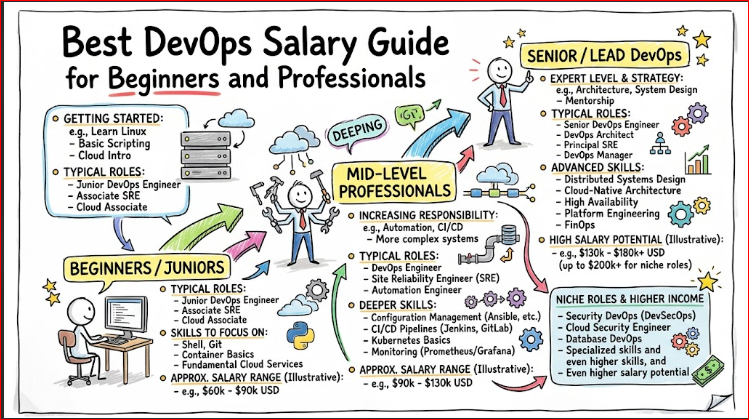
DevOps Salary by Experience Level
Fresher DevOps Engineer Salary
Entry-level DevOps engineers usually start with infrastructure basics, Linux administration, Docker, Git, and CI/CD tools.
Common beginner responsibilities:
- Managing basic deployment pipelines
- Supporting cloud infrastructure
- Writing automation scripts
- Monitoring applications
Beginner mistakes:
- Ignoring Linux fundamentals
- Learning only tutorials without projects
- Avoiding networking concepts
Freshers with practical cloud projects and Kubernetes exposure generally receive better opportunities.
Mid-Level DevOps Engineer Salary
Mid-level engineers are expected to manage scalable infrastructure and automation systems.
Important mid-level skills:
- Kubernetes
- Terraform
- CI/CD pipeline optimization
- Cloud automation
- Monitoring systems
- Infrastructure security
This stage often provides the biggest salary growth because companies need engineers who can independently manage production environments.
Senior DevOps Engineer Salary
Senior professionals focus on architecture, scalability, reliability, and leadership.
Senior-level responsibilities:
- Platform engineering
- Multi-cloud architecture
- Reliability engineering
- Disaster recovery planning
- Team mentorship
- Security integration
Senior engineers with SRE and cloud architecture experience usually access the highest-paying DevOps jobs.
DevOps Salary by Role
DevOps Engineer
DevOps engineers manage CI/CD pipelines, infrastructure automation, and deployment workflows. This remains one of the most in-demand cloud engineering careers.
Cloud DevOps Engineer
Cloud DevOps engineers specialize in AWS, Azure, or Google Cloud infrastructure. Their salaries are often higher due to cloud migration demand.
Kubernetes Engineer
Kubernetes engineers focus on container orchestration, scaling, and cluster management. Kubernetes engineer salary growth continues to rise because containerized applications dominate modern infrastructure.
Site Reliability Engineer (SRE)
SREs focus on reliability, uptime, observability, and incident management. Companies pay premium salaries for strong SRE expertise.
DevSecOps Engineer
DevSecOps engineers integrate security into CI/CD pipelines and cloud infrastructure workflows. Security automation skills significantly increase salary potential.
Platform Engineer
Platform engineers build internal developer platforms and infrastructure automation systems that improve developer productivity.
Infrastructure Automation Engineer
These engineers specialize in Terraform, Ansible, scripting, and automated provisioning systems.
Cloud Architect
Cloud architects design enterprise cloud infrastructure and large-scale automation systems. This is often one of the highest-paying DevOps-related roles.
DevOps Salary by Country
United States
The United States remains one of the highest-paying markets due to strong cloud adoption and enterprise technology investment.
India
India’s DevOps market is growing rapidly because of startup expansion, outsourcing demand, and cloud transformation projects.
Canada
Canada continues seeing strong demand for cloud engineers and Kubernetes professionals, especially in fintech and SaaS industries.
Germany
Germany’s enterprise modernization initiatives create opportunities for DevOps engineers with automation and cloud migration skills.
United Kingdom
The UK market shows strong demand for DevSecOps and SRE professionals in banking and enterprise sectors.
Australia
Australia’s cloud infrastructure expansion supports increasing salaries for experienced cloud and automation engineers.
Singapore
Singapore remains a major cloud and financial technology hub, creating high demand for DevOps and platform engineering talent.
Remote opportunities now allow many professionals to work with international companies, improving salary potential across regions.
DevOps Salary by Cloud Platform
AWS DevOps Salary
AWS dominates the cloud market, making AWS DevOps salary opportunities particularly strong. AWS certifications often help candidates enter cloud-focused roles faster.
Azure DevOps Salary
Azure is highly popular in enterprise environments. Azure DevOps engineers are in demand in large organizations using Microsoft ecosystems.
Google Cloud DevOps Salary
Google Cloud adoption is growing in data engineering, AI, and cloud-native startups. GCP expertise can provide strong niche opportunities.
Overall, cloud platform salaries depend more on practical deployment experience than certification counts alone.
Highest-Paying DevOps Skills
The following skills consistently improve DevOps salary growth:
- Kubernetes
- Terraform
- AWS
- Azure
- Google Cloud
- CI/CD automation
- Infrastructure as Code
- Monitoring and observability
- GitOps
- Security automation
- Platform engineering
- Reliability engineering
- Docker containerization
- Linux administration
- Networking fundamentals
These skills increase salaries because companies need scalable, automated, and reliable infrastructure systems.
Certifications That Can Increase Salary
Kubernetes Certifications
Kubernetes certifications help validate container orchestration skills and are highly respected in cloud-native companies.
AWS DevOps Engineer Certification
This certification is valuable for engineers working with AWS automation and deployment pipelines.
Azure DevOps Engineer Certification
Useful for enterprise cloud environments using Azure services and Microsoft tools.
Terraform Associate
Terraform skills are highly practical because Infrastructure as Code is now widely adopted.
Docker Certification
Containerization knowledge remains essential for modern DevOps workflows.
DevSecOps Certifications
Security-focused certifications help professionals enter high-demand DevSecOps roles.
SRE Certifications
SRE-focused learning improves understanding of reliability, monitoring, and incident management.
Certifications help most when combined with hands-on projects and production-level problem-solving experience.
DevOps Salary Comparison Table
| Role | Experience | Main Skills | Cloud Focus | Career Growth | Salary Potential |
| DevOps Engineer | Beginner to Mid | CI/CD, Docker, Linux | AWS/Azure | Strong | High |
| Kubernetes Engineer | Mid to Senior | Kubernetes, Helm | Multi-cloud | Very Strong | Very High |
| SRE | Senior | Monitoring, Reliability | Multi-cloud | Excellent | Very High |
| DevSecOps Engineer | Mid to Senior | Security Automation | AWS/Azure | Strong | High |
| Platform Engineer | Senior | Internal Platforms | Multi-cloud | Excellent | Very High |
| Cloud Architect | Senior | Architecture, Automation | AWS/GCP | Outstanding | Extremely High |
DevOps Career Roadmap for Higher Salary
Beginner Path
Start with:
- Linux
- Git
- Networking basics
- Docker
- Basic CI/CD
Focus on understanding infrastructure fundamentals before learning advanced cloud tools.
Intermediate Path
Learn:
- Kubernetes
- Terraform
- Jenkins
- Cloud fundamentals
- Monitoring tools
This stage usually creates major salary improvement opportunities.
Advanced Path
Develop expertise in:
- SRE practices
- Platform engineering
- Multi-cloud infrastructure
- Reliability engineering
- DevSecOps
Advanced engineers become valuable because they can design scalable systems.
Specialized Path
Explore:
- GitOps
- MLOps
- AIOps
- FinOps
- Advanced observability
Specialized expertise often leads to premium compensation and leadership opportunities.
Real-World Career Scenarios
Fresher Entering DevOps
A beginner learns Linux, Docker, Git, and basic AWS deployment workflows, then builds CI/CD projects to improve employability.
Sysadmin Transitioning Into Cloud Automation
A system administrator learns Terraform and Kubernetes, moving into cloud automation roles with higher salary growth.
Developer Becoming Kubernetes Engineer
A software developer shifts into cloud-native engineering after learning containers and Kubernetes operations.
Cloud Engineer Moving Into SRE
An experienced cloud engineer develops monitoring and incident management expertise to enter high-paying SRE roles.
Security Engineer Entering DevSecOps
A security professional learns automation and CI/CD security practices to transition into DevSecOps engineering.
Common Mistakes That Limit Salary Growth
- Ignoring Linux fundamentals
- Avoiding networking concepts
- Skipping Kubernetes learning
- Depending only on certifications
- Not building practical projects
- Ignoring Infrastructure as Code
- Weak scripting knowledge
- Avoiding cloud platforms
- Relying only on tutorials
- Ignoring monitoring and observability
These mistakes reduce practical problem-solving ability, which directly affects salary opportunities.
Hands-On Skills Employers Actually Want
Employers prioritize practical engineering ability over theoretical knowledge.
Important practical skills:
- CI/CD pipeline setup
- Docker containerization
- Kubernetes deployments
- Terraform automation
- Monitoring and alerting
- GitOps workflows
- Cloud infrastructure management
- Security automation
- Incident management
- Production troubleshooting
Real-world projects demonstrate engineering capability more effectively than certificates alone.
FAQs
1. What is the average DevOps engineer salary?
DevOps salaries vary widely based on cloud expertise, automation skills, location, and experience level.
2. Which DevOps role pays the highest salary?
Cloud Architect, Platform Engineer, and Senior SRE roles are often among the highest-paying.
3. Is Kubernetes good for salary growth?
Yes. Kubernetes remains one of the most valuable skills in cloud-native infrastructure.
4. Which cloud platform pays the highest salary?
AWS currently has the largest market demand, but Azure and Google Cloud also provide strong opportunities.
5. Do DevOps certifications increase salary?
Certifications help most when combined with practical cloud and automation experience.
6.Is AWS or Azure better for DevOps careers?
Both are valuable. AWS dominates startups and cloud-native environments, while Azure is strong in enterprise companies.
7. Which DevOps skill is most in demand?
Kubernetes, Terraform, CI/CD automation, and cloud infrastructure remain highly demanded.
8. Is DevOps a high-paying career?
Yes. Experienced DevOps professionals often receive competitive compensation due to automation and cloud expertise demand.
9. Can beginners get high DevOps salaries?
Beginners with strong practical projects and cloud skills usually access better opportunities faster.
10.How long does it take to become a high-paid DevOps engineer?
Most professionals require several years of practical infrastructure and automation experience.
Final Recommendation
The best DevOps salary growth comes from combining cloud expertise, Kubernetes knowledge, automation skills, and practical infrastructure experience. Professionals who continuously build real projects and improve troubleshooting abilities usually progress faster than those who focus only on certifications. Cloud-native engineering, SRE practices, DevSecOps, and platform engineering will likely remain strong career paths for years because companies continue investing in scalable and automated infrastructure systems. A roadmap-based learning approach works best. Start with Linux and networking fundamentals, then gradually move into cloud platforms, Kubernetes, Infrastructure as Code, monitoring, and reliability engineering. Long-term success in DevOps depends on continuous learning because cloud technologies and automation tools evolve rapidly.