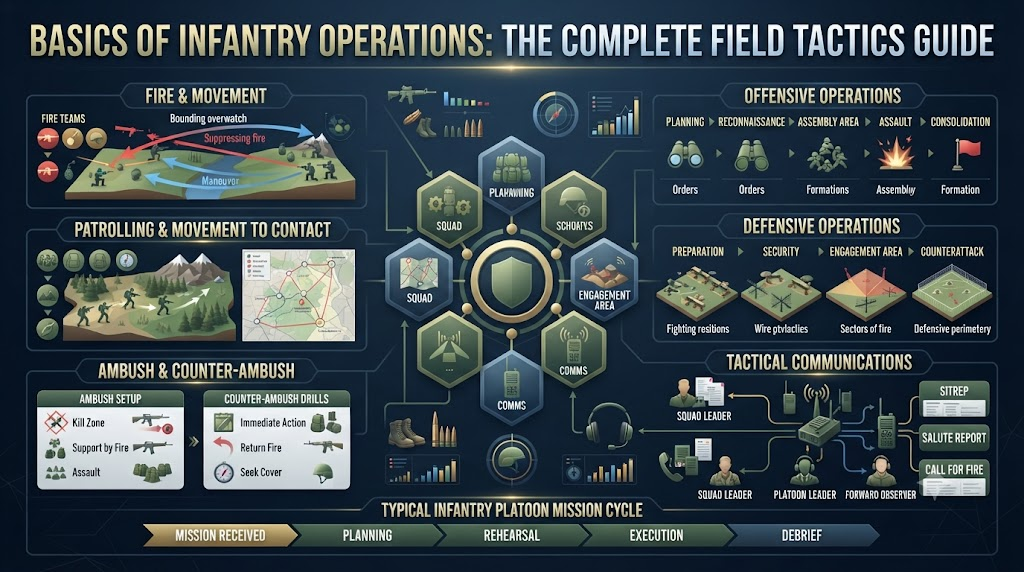
Modern ground combat moves fast and punishes confusion immediately. You cannot hide behind heavy armor when small arms fire traps your team in an open field. Equipment fails, digital signals drop out, and real stress clouds human judgment within seconds.
When plans fall apart, solid foundational doctrine saves lives. Teams that master basic battlefield habits stay alive and complete their missions. You can study deep mission planning models and operational frameworks directly at WarOpsX.com.
This technical field guide breaks down infantry fundamentals into clear, workable rules. We look at real combat field realities just like a systems engineer looks at site reliability. You will learn how small teams move, survive, communicate, and win ground objectives under extreme pressure.
What Are Infantry Operations?
Infantry operations are military actions carried out by armed ground troops on foot. These soldiers close with the enemy to destroy or capture them. They also hold physical ground and defend critical areas against attacks.
Technology changes fast, but machines cannot hold a city corner. Drones can watch from above, and artillery can strike from miles away. Yet, only physical troops can verify rooms, control civilians, and secure physical dirt.
Infantry forces form the baseline core of any combined ground force. They operate in woods, mountains, muddy trenches, and dense concrete towns. Their main job is converting raw firepower into lasting ground control.
The Core Mission of Modern Foot Soldiers
The main mission is simple to state but hard to do. Infantry teams find, fix, flank, and finish the adversary. Finding means spotting the threat before they spot you.
Fixing means pinning the enemy down with heavy, direct fire. Flanking means moving another element around their weak side while they stay pinned. Finishing means clearing the position and securing the immediate ground.
Every squad member has a role in this four-part loop. If one person stops doing their job, the entire unit loses speed. Speed and violence of action protect troops better than thick body armor.
Small Unit Structure: Squads and Fireteams
A standard infantry squad has nine to twelve soldiers. Leaders split this squad into two or three balanced teams called fireteams. Each fireteam functions as an independent striking and moving element.
A fireteam normally has four key members. You have the team leader who directs fire and picks movement routes. You have the automatic rifleman who provides heavy volume fire.
You also have a designated grenadier who punches past light barricades. Finally, the rifleman provides precision rifle fire and guards team flanks. Together, these four soldiers move like a single living organism.
Why Fire and Movement Governs All Combat
No single soldier moves without someone else covering them with a rifle. This basic rule is called fire and movement, or bounding. One element shoots to keep enemy heads down, while the second element runs forward.
If you run while nobody is shooting, the enemy aims freely and hits you. If you shoot without moving forward, you burn ammo and stay trapped. You must balance suppression with forward momentum to win.
Movement without suppression is pure suicide on modern battlefields. Suppression without movement is just wasted ammunition and noise. Smart units tie both actions together in steady, rhythm-bound steps.
| Operational Factor | Bounding Fireteams | Static Defensive Line | Mechanized Direct Assault |
| Movement Speed | Steady and deliberate | Zero forward speed | High speed across open ground |
| Cover Utilization | Maximum ground contour use | Prepared dirt bunkers | Heavy vehicular armor plates |
| Ammo Consumption | Moderate and controlled | High defensive volume | Extremely high burst rates |
| Vulnerability to Drones | Low visual footprint | High if positions are static | High heat and acoustic profile |
| Primary Risk | Flank exposure | Artillery mortar strikes | Anti-tank missile ambushes |
Understanding Cover Versus Concealment
Many new soldiers confuse hiding from sight with hiding from bullets. Concealment hides your physical body from enemy eyes. Tall grass, thin plywood walls, and shadows give you good concealment.
Concealment will never stop a speeding lead bullet or hot bomb metal. Cover hides your body and also stops incoming high-speed rounds. Thick dirt berms, large concrete bridge pillars, and heavy engine blocks give real cover.
Never rest behind mere concealment when real combat bullets fly. Always look for the next solid piece of cover before you start running. Run hard, drop fast, and roll behind real stopping mass every single time.
Visual Battle Rhythms and Patrol Formations
Squads pick their marching formations based on terrain and threat levels. The wedge formation is the most popular choice for open areas. It gives great fire to the front and protects both flanks evenly.
The file formation puts every soldier in one single line. Teams use files in dense jungles, narrow alleys, or marked minefields. Files move fast through tight spaces, but they limit forward firepower severely.
The line formation puts all rifles facing straight forward. Units use the line for final assault charges across open objectives. It delivers peak firepower forward, but leaves both flanks wide open to surprises.
Real-World Tactical Failures and Mission Friction
- A frontline communications hub went offline because teams ran out of fresh batteries during a rainstorm.
- A patrol squad bunched together at a road crossing and took heavy mortar shrapnel injuries instantly.
- An assault team pushed into an urban block without clearing blind corners and got trapped by hidden rifles.
- A supply team sent food and ammo down an unreconnoitered road and lost two light trucks to hidden mines.
- One fireteam opened fire too early from an ambush line, alerting the target column before the trap was sprung.
- An infantry squad mistook a civilian radio mast for an enemy observation post due to bad map reading.
- Troops failed to dig deep foxholes before sunset, leaving them exposed to night drone thermal sweeps.
- A machine gun crew burned out their primary barrel because they fired long, unbroken bursts without cooling cycles.
- A forward platoon lost digital mapping links during heavy jamming and had to use paper maps and compasses.
- Two neighboring units shot toward each other across an unmarked ditch because boundary markers were missing.
Weapon Systems Used by Modern Ground Squads
The individual service rifle is every soldier’s primary working tool. It fires intermediate cartridges accurately out to four or five hundred meters. Modern rifles feature clear optical scopes, flash suppressors, and laser aiming lights.
The squad automatic weapon fires the same bullet but feeds from large belts. It lays down continuous suppressive fire to keep enemy heads inside trenches. This weapon is heavy, loud, and draws immediate return fire from smart adversaries.
Under-barrel grenade launchers bridge the gap between rifles and mortars. They lob high-explosive rounds into dead space behind walls and inside rooms. Rocket launchers take out light trucks, log bunkers, and concrete wall corners.
The Art of the Tactical Pause
Continuous movement burns out human minds and bodies very quickly. Smart leaders take brief, ten-second tactical pauses behind cover. They drop to one knee, point rifles outward, look, listen, and smell.
This quick pause lets the team catch their physical breath. It allows leaders to check maps, inspect team spacing, and hear faint noises. You can hear distant diesel engines or radio chatter only when your own feet stop moving.
If something feels wrong, stop your team behind cover immediately. Reassess your sector, confirm your bearings, and scan the high trees. Taking five seconds to confirm a route prevents running headlong into an ambush.
Breaching and Clearing Enclosed Spaces
Urban warfare is the most dangerous environment an infantry soldier faces. Concrete walls bounce sound, limit visibility, and trap team members in tight chokepoints. Entrances like doorways and gates are known as fatal funnels.
Entering a fatal funnel without speed and clear assignments gets soldiers killed. Teams stack along the outside wall, out of the door’s direct sightline. Once the door opens, soldiers flood inside across different paths to dominate every corner.
Every soldier takes an opposite corner until all four corners are secure. Nobody stops in the doorway, even if they take direct fire. Move through the door, clear your sector, and shout your status clearly.
Communication Under Heavy Electronic Jamming
Modern electronic warfare units can jam civilian radios and military satellite dishes easily. When your headset goes completely silent, you cannot afford to freeze up. Teams must practice old-school visual arm signals and physical runner systems.
Standard hand signals show simple commands like halt, rally, wedge, or enemy spotted. Soldiers pass these signals down the patrol line from person to person. At night, infrared flashes or light taps on shoulders replace arm signals.
Always carry physical laminated maps, magnetic compasses, and grease pencils. Never rely solely on battery-powered handheld screens to navigate through unfamiliar territory. If the digital grid fails, your magnetic compass and pacing count will guide you home.
Night Operations and Thermal Concealment
Night turns chaotic battlefields into strange, high-stress cat-and-mouse games. Night vision goggles amplify faint moon and starlight into clear green or white pictures. Thermal sights detect body heat leaks through light foliage and canvas tarps.
Owning the night requires extreme discipline with light and sound. Never look at an unshielded white phone or flashlight beam in the dark. It blinds your adjusted eyes and marks your location for miles around.
Thermal sensors mean soldiers must hide their natural body heat signatures. Special thermal blankets, thick vegetation, and solid walls block infrared cameras. Move slowly through shadows, avoid open skylines, and step softly to avoid giving away your spot.
Casualty Care Under Direct Fire
Infantry operations require fast, aggressive medical care right where people fall. The first step of tactical casualty care is returning heavy fire at the enemy. The best medicine on any battlefield is gaining fire superiority over the threat.
Once the threat is pinned down, drag the wounded soldier behind solid cover. Never treat a patient in the middle of an open street under active fire. Once behind cover, slap a high-tight tourniquet on bleeding arms or legs immediately.
Major bleeding from blown limbs kills people in less than three minutes. Tourniquets stop arterial blood flow until field surgeons can repair the damage. Pack deep chest wounds with sterile gauze and seal sucking punctures with airtight tape.
| Tactical Phase | Primary Action | Medical Priority | Movement Speed |
| Care Under Fire | Return heavy rifle fire | Apply rapid limb tourniquets | Sprint to nearest solid cover |
| Tactical Field Care | Assess airway and breathing | Pack open wounds and seal chests | Stay low behind cover |
| Casualty Evac | Carry patient to vehicle | Monitor vitals and prevent shock | Rapid run to pickup point |
| Consolidation | Re-arm and reset perimeter | Distribute spare ammo and water | Slow and methodical scanning |
| Debriefing | Review mission outcomes | Log injuries and equipment losses | Static inside safe base camp |
Managing Soldier Load and Combat Weight
An overloaded infantry soldier is a slow, easy target on the battlefield. Soldiers often try to pack every comfort item, tool, and spare widget into their rucks. Carrying eighty pounds up a muddy mountain exhausts legs and ruins situational awareness.
Keep your fighting load strictly under one-third of your total body weight. Carry only essential items: ammunition, fresh water, medical gear, night optics, and basic radios. Leave sleeping bags, extra boots, and heavy ration boxes back in support vehicles.
When you pack light, you run faster, drop quicker, and climb higher without gasping. Your knees and lower back stay healthy over long, multi-week combat patrols. Speed, balance, and quick reflexes keep you alive far longer than a heavy backpack.
The Psychological Weight of Ground Combat
Infantry soldiers experience raw sensory overload that civilian life never prepares them for. Loud explosions, flying dirt, screaming team members, and dead bodies create massive internal panic. The human brain naturally wants to freeze up or run away from lethal danger.
Repetitive realistic training builds the mental muscle memory needed to beat panic. When real bullets snap past your head, training kicks in before fear takes over. You return fire, drop behind dirt, and check on your team automatically.
Leaders must watch their soldiers closely for blank stares and frozen reactions. Talk calmly to your team, give short, direct orders, and keep them focused on tasks. Simple physical jobs, like reloading a magazine or checking a sector, keep minds grounded.
Tactical Ammunition Conservation
Running completely out of bullets during a firefight is an absolute nightmare. New soldiers often panic and pull their triggers on full automatic mode. Firing on full auto empties a thirty-round magazine in less than three seconds flat.
Full auto looks dramatic in movies, but it hits nothing and wastes precious ammo. Fire single, controlled shots at clear targets you can actually see with your eyes. Use automatic fire only for short three-round bursts from your squad machine guns.
Always monitor how many full magazines you have left on your chest rig. When you drop down to three magazines, notify your team leader right away. Squad leaders will cross-level ammunition across the team so nobody runs empty during an assault.
10 Common Ground Operation Mistakes and Practical Solutions
- Mistake: Bunching up close together during movement.Solution: Keep a strict spacing of five to ten meters between every single soldier on patrol.
- Mistake: Walking on open road surfaces and dirt pathways.Solution: Move along covered ditches, tree lines, and low ground folds just off the road edge.
- Mistake: Stopping directly inside doorways or window frames.Solution: Clear the entranceway quickly and move along internal walls to dominate room corners.
- Mistake: Firing continuous long bursts on fully automatic mode.Solution: Use steady, single aimed shots to conserve ammo and hit targets accurately.
- Mistake: Silhouetting your body against the bright sky on ridge lines.Solution: Cross hills below the military crest so background dirt hides your outline.
- Mistake: Forgetting to post 360-degree security during brief rest stops.Solution: Drop into a tight security circle with rifles pointing in every outward direction immediately.
- Mistake: Staring only at eye level while searching for hidden threats.Solution: Scan high trees, upper building floors, roofs, and low drainage holes continuously.
- Mistake: Using white flashlights or open phone screens in dark combat zones.Solution: Use red lenses or night vision gear to preserve natural night vision adaptation.
- Mistake: Failing to dig defensive trenches deep enough before sleeping.Solution: Dig deep, narrow foxholes with overhead dirt cover immediately upon halting.
- Mistake: Breaking radio silence with long, rambling, unstructured messages.Solution: Use standard short operational words and speak only essential facts over open nets.
Integration with Air and Artillery Support
Infantry units rarely fight alone on modern high-tech combined-arms battlefields. They work closely with overhead drones, fighter jets, attack helicopters, and heavy field artillery. The infantry finds and fixes the target, then calls in big guns to destroy it.
Calling for fire requires extreme precision with map coordinates and distance markers. Giving bad grid coordinates risks dropping high-explosive shells right onto your own soldiers. Squad leaders must verify target locations twice before pressing the radio talk switch.
Once the artillery barrage ends, the infantry must rush forward instantly. Heavy artillery shocks, deafens, and disorients defenders inside trenches for only a few minutes. If you hesitate to move forward, the enemy recovers their senses and mans their guns.
Urban Fortifications and Defensive Positions
Defending a city building requires turning concrete rooms into tough fighting fortresses. Do not shoot from open window frames where your muzzle flash is easily spotted. Stand back in the dark shadows of the room to fire through small mouseholes.
Reinforce outer walls with heavy dirt bags, sand, and stacks of wet books. Remove flammable curtains, rugs, and wood furniture that could catch fire from explosions. Cut small escape holes through interior walls so you can move between rooms safely.
Always string tripwires, barbed wire, and warning noisemakers along dark approach paths. Force the enemy to enter through open streets where your machine guns have clear shots. A small, well-prepared squad can hold off a company inside a reinforced building.
Survival, Hydration, and Field Hygiene
A soldier who gets sick from dirty water is just as useless as a wounded soldier. Dehydration drops mental focus, slows physical reaction time, and brings on deadly heatstroke. Drink clean, purified water constantly, even when the weather feels cold and wet.
Carry chemical purification tablets or small pump filters inside your personal survival kit. Never drink untreated water from muddy streams or standing puddles near farm fields. Boiling water for three full minutes kills all dangerous bacteria and nasty parasites.
Keep your feet clean, dry, and powdered to avoid painful trench foot infections. Change into fresh, dry wool socks every single night inside your sleeping hole. Pack out your human waste and trash so enemies cannot track your squad’s patrol route.
Step-by-Step Implementation Roadmap for Small Unit Tactical Drills
- Gear Inspection: Check every weapon, optic, battery, tourniquet, and water bottle before leaving base.
- Mission Briefing: Review primary routes, backup rally points, map grids, and target assignments with the squad.
- Formation Setup: Align soldiers into a balanced walking wedge with proper five-meter spacing between members.
- Initial Movement: Step off quietly along covered routes, keeping rifles pointed outward toward assigned sectors.
- Contact Reaction: Drop behind solid cover instantly when bullets fly, shouting out the enemy direction and distance.
- Fire Superiority: Fire heavy, controlled bursts to pin the enemy down and stop their forward movement.
- Flanking Maneuver: Direct one fireteam to hold the front while the second team bounds around the side.
- Objective Assault: Push through the enemy position with aggressive, controlled movement and clear every corner.
- Consolidation and Security: Establish a 360-degree defensive perimeter, reload fresh magazines, and treat all wounded soldiers.
- After-Action Review: Gather the entire squad to review what worked, what failed, and how to improve next time.
1. What is the fundamental role of infantry in modern warfare?
Infantry forces close with the enemy on foot to destroy or capture them. They also hold physical ground, clear complex terrain like cities, and secure critical assets that aircraft and tanks cannot hold alone.
2. What is the difference between cover and concealment?
Cover physically stops bullets and shell fragments, such as thick concrete, rocks, or deep dirt mounds. Concealment only hides your body from enemy sight, such as tall bushes or thin plywood walls, but cannot stop incoming rounds.
3. How does fire and movement work during a ground assault?
One combat element fires continuously at enemy positions to keep their heads down and suppress them. While the enemy is pinned, the second element moves forward safely to a new piece of cover before switching roles.
4. What is a fatal funnel in urban combat?
A fatal funnel is a narrow choke point like a doorway, hallway, or gate that troops must pass through. Enemies focus their weapons on these openings, making lingering in them extremely dangerous for entering troops.
5. Why is soldier spacing critical during tactical patrol movements?
Maintaining five to ten meters between soldiers prevents a single bullet burst, mortar shell, or grenade from wounding multiple team members at the same time.
6. What is the primary weapon mix inside a standard infantry fireteam?
A typical four-person fireteam includes a team leader with a rifle, an automatic rifleman with a squad machine gun, a grenadier with an under-barrel launcher, and a standard rifleman.
7. How should troops handle casualty care while taking active fire?
Soldiers must first return heavy fire to suppress the enemy threat. The patient is then moved behind solid cover where a rapid limb tourniquet can be applied safely to stop major bleeding.
8. What is the military crest of a hill?
The military crest is an elevation slightly below the absolute top ridge of a hill. Moving along the military crest keeps soldiers from silhouetting their dark outlines against the bright open sky.
9. Why is automatic rifle fire restricted during long combat missions?
Fully automatic fire empties an entire magazine in just a few seconds and has poor accuracy. Firing single, aimed shots conserves ammunition and ensures rounds actually strike the intended targets.
10. How do small infantry units communicate when radios are jammed?
Troops fall back on visual hand-and-arm signals, physical taps, infrared markers, written runner notes, and pre-planned mission timing when electronic communication networks go down.
Final Recommendation and Next Steps
Mastering infantry tactics requires building strong physical habits through endless practice. High-tech equipment, aerial drones, and smart radios help, but basic ground skills keep teams alive. You must master fire and movement, cover selection, weapon maintenance, and clear team talking.
Start by training your unit on simple, basic tasks in open fields. Run bounding drills until your soldiers move together without needing loud verbal shouts. Build strict discipline around light control, field hygiene, ammunition counting, and rapid medical tourniquet use.
Take your training into difficult, broken terrain like thick woods and muddy ravines. Test your soldiers under cold, wet, and exhausting conditions to build real mental grit. Consistent, realistic practice turns nervous recruits into confident, reliable ground fighters who can handle any mission.