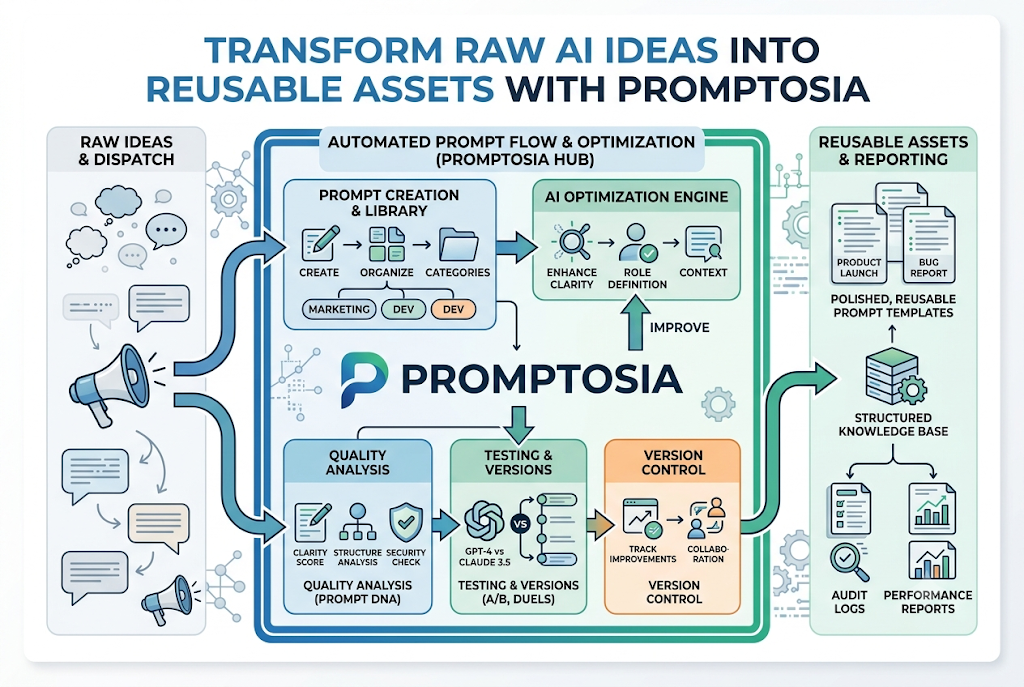
In the modern generative artificial intelligence ecosystem, the quality of your output depends directly on the structure of your input. As organizations, developers, and creators integrate Large Language Models (LLMs) into daily operations, managing prompts has evolved from a simple copy-paste habit into a core technical discipline. Many teams rely on fragmented text files, personal notes, or buried chat histories to save their best AI instructions. This scattershot approach leads to inconsistent output quality, lost engineering time, and repeated work. Without a centralized system, team members continually recreate prompts that colleagues have already perfected. Adopting a dedicated AI prompt management tool solves these operational bottlenecks. Centralizing prompt assets enables creators and enterprises to organize, analyze, test, version, and optimize their generative AI workflows.
What is an AI Prompt Management Tool?
An AI prompt management tool is a specialized software environment engineered to create, store, organize, analyze, test, and refine instructions given to artificial intelligence models. Instead of treating a prompt as a disposable line of text, prompt management platforms treat instructions as high-value digital assets.
  [ Raw Idea ]
       │
       ▼
┌────────────────────────────────────────────────────────┐
│              AI PROMPT MANAGEMENT TOOL                 │
│                                                        │
│  [Organize] ──► [Optimize] ──► [Analyze] ──► [Version] │
└──────────────────────────┬─────────────────────────────┘
                           │
                           ▼
              [ Verified AI Output ]
Why Prompt Management Matters
Without deliberate management, organizations suffer from “prompt sprawl.” When prompt engineering techniques remain trapped in individual employees’ chat windows, company-wide AI performance suffers. A unified prompt platform ensures brand voice consistency, reduces token consumption, and maintains strict output guardrails across departments.
Common Prompt Challenges
- Loss of Intellectual Property: High-performing prompts get lost in clear-history actions or unindexed personal notebooks.
- Inconsistent Results: Minor changes in phrasing produce wild variations in output quality without systematic tracking.
- Lack of Context: Prompts copied without variable definitions fail when executed by other team members.
Benefits of Organized Prompt Libraries
Maintaining a structured AI prompt library transforms isolated instructions into a shared corporate knowledge base. Team members instantly access, fork, and deploy field-tested prompts, eliminating guesswork and dramatically increasing daily operational velocity.
Understanding Prompt Engineering
Prompt engineering is the practice of structuring, refining, and designing text inputs to guide generative AI models toward precise, contextually accurate outputs. Leading research from OpenAI Documentation emphasizes that clear instruction hierarchy reduces AI hallucination rates and improves task completion accuracy. Using a dedicated prompt engineering platform ensures these structural standards are enforced automatically across every template.
┌──────────────────────────────────────────────────────────┐
│                   PROMPT ANATOMY                         │
├──────────────────────────────────────────────────────────┤
│ 1. Persona/Role   : "Act as a Senior DevOps Engineer"   │
│ 2. Context        : "Reviewing a Kubernetes deployment"  │
│ 3. Variables      : "{config_file}, {target_cluster}"    │
│ 4. Instructions   : "Identify security misconfigurations"│
│ 5. Formatting     : "Return findings in a markdown table"│
│ 6. Constraints    : "Do not invent non-existent flags"   │
└──────────────────────────────────────────────────────────┘
A well-architected prompt contains six core structural components:
- Role/Persona: Defines the perspective, tone, and domain expertise the model must adopt.
- Context: Establishes background details, project constraints, and situational data.
- Variables: Placeholders (e.g.,
{target_audience},{code_snippet}) that turn single-use prompts into repeatable templates. - Instructions: Direct statements defining what action the model must perform.
- Output Formatting: Explicit constraints outlining the desired structure (e.g., JSON, markdown, bulleted summaries).
- Constraints: Clear rules defining what the AI must not do, preventing off-topic or unsafe responses.
Building an Organized AI Prompt Library
A prompt collection without structure quickly becomes as chaotic as an unindexed hard drive. An effective AI prompt organizer classifies prompts using clear taxonomic frameworks so users find exact solutions within seconds.
Prompt Library
 │
 ├── Categories (e.g., Development, Marketing, Legal)
 ├── Tags (e.g., #Python, #SEO, #CodeReview)
 └── Dynamic Variables (e.g., {{ language }}, {{ target_tone }})
- Categories & Tags: Organize prompts by function (e.g., Marketing, Engineering, HR) and tag them by specific sub-skills (e.g.,
#Python,#ColdEmail,#SEO). - Dynamic Variables: Replace static inputs with parametric placeholders, allowing team members to execute prompts across varied datasets.
- Full-Text Search: Locate prompts by searching for core concepts, target outputs, or assigned tags.
- Prompt Collections: Group related prompts into end-to-end workflows, such as a “Product Launch Series” containing blog generation, social media rollout, and press release templates.
Organized libraries turn isolated techniques into standardized, scalable business capabilities.
AI Prompt Optimization
Raw user ideas rarely produce optimal AI results on the first attempt. Using an AI prompt optimizer enhances ambiguous commands into rich, structured prompts that maximize model capability.
[ Raw Prompt ] ──► [ AI Prompt Optimizer ] ──► [ Optimized Template ]
 "Fix this code"    Refines role, adds context,  "Act as Senior Developer.
                    defines variables, sets       Review {code} for memory
                    formatting boundaries        leaks in Markdown..."
As highlighted in Anthropic Documentation, LLMs perform better when given explicit framing, clear execution boundaries, and step-by-step reasoning directives.
| Optimization Area | Unoptimized Prompt | Optimized Prompt |
| Role Definition | “Write a blog about AI.” | “Act as an expert FinTech journalist writing an educational long-form article.” |
| Context | “Summarize this article.” | “Summarize this technical research paper for a non-technical executive audience.” |
| Formatting | “Give me marketing ideas.” | “Provide 5 campaign concepts in a structured markdown table with estimated budgets.” |
AI Prompt Analysis
Understanding why a prompt succeeds or fails requires detailed structural evaluation. An AI prompt analyzer dissects text inputs to expose structural gaps before model execution.
               ┌─────────────────────────┐
               │   AI PROMPT ANALYZER    │
               └────────────┬────────────┘
                            │
   ┌────────────────────────┼────────────────────────┐
   ▼                        ▼                        ▼
[ Goal & Role ]    [ Variable Extraction ]  [ Safety Assessment ]
Through comprehensive structural analysis, platforms like Promptosia generate a “Prompt DNA” breakdown. This diagnostic inspects inputs for:
- Goal & Role Precision: Validates whether the prompt clearly defines persona and task objectives.
- Variable Extraction: Detects unformatted text blocks that should be dynamic variables.
- Output Expectations: Ensures structural criteria like length, style, and layout are explicitly stated.
- Safety & Risk Assessment: Flags sensitive phrasing or missing ethical guardrails before execution.
Prompt Quality Checking
Relying on subjective guesswork to grade prompt quality causes unpredictable outputs across team workflows. Integrated prompt quality checker systems score prompts objectively against key architectural parameters.
  [ Prompt Input ] ──► [ Quality Scoring System ] ──► [ Diagnostic Score: 88/100 ]
                        - Clarity: 90/100
                        - Context: 85/100
                        - Reusability: 95/100
By grading prompts across six objective metrics—Clarity, Context, Output Format, Reusability, Safety, and Practical Value—quality checkers assign an aggregate score (e.g., 88/100). This score identifies structural weaknesses, helping engineers upgrade incomplete prompts into production-ready assets.
Version Control for AI Prompts
Large Language Models update frequently, and subtle adjustments to prompt instructions drastically alter output behavior. Treating prompts like source code using a dedicated prompt version control tool protects operational consistency.
v1.0 (Initial Draft) ──► v1.1 (Added Output Rules) ──► v2.0 (Refactored Variables)
     │                        │                             │
     └──► [ Restore Point ] ──┴──► [ Track Changes ] ───────┴──► [ Production ]
Version management enables teams to:
- Track Iterations: Record exact text changes, tone tweaks, and parameter adjustments over time.
- Restore Historical Versions: Roll back instantly to prior prompt iterations if a model update degrades performance.
- Collaborate Safely: Enable cross-functional teams to experiment with prompt variations without overwriting working production templates.
Testing AI Prompts
Validating prompt performance requires empirical evaluation across different model architectures. An AI prompt testing tool lets engineers run side-by-side experiments, comparing outputs from models like GPT-4, Claude 3.5, and Gemini.
                      ┌──► Model A (GPT-4)   ──► Output Evaluation A
                      │
[ Candidate Prompt ] ─┼──► Model B (Claude)  ──► Output Evaluation B
                      │
                      └──► Model C (Gemini)  ──► Output Evaluation C
Through A/B prompt testing, developers measure latency, token costs, structural compliance, and output variance. Systematically capturing test logs ensures teams deploy prompts backed by empirical performance data rather than anecdotal assumptions.
Reusable AI Prompt Templates
Designing prompts with dynamic variables creates reusable AI prompt templates that scale across operational teams.
"Act as an expert {role}. Draft a {content_type} addressing {target_audience}.
Focus on {key_benefit} while maintaining a {tone} tone. Return output in {format}."
Domain-Specific Use Cases
- Software Development: Standardize code reviews, bug reports, and refactoring scripts.
- Content & Marketing: Generate SEO outlines, ad copy, and email sequences matching brand guidelines.
- Research & Education: Summarize academic papers, compile study guides, and analyze qualitative research data.
- Customer Support: Create consistent, empathetic response frameworks for customer inquiry queues.
Promptosia for Different User Types
Promptosia offers tailored features for diverse professional domains:
Writers & Content Creators
Organize ideation frameworks, long-form content templates, and voice-matching style guides in a centralized workspace.
Developers & AI Engineers
Build production-grade prompt templates, maintain version control across model releases, and test outputs across custom API endpoints.
Marketers & Agencies
Maintain strict brand voice consistency across accounts by deploying pre-approved, variable-driven campaign prompts.
Researchers & Students
Synthesize complex literature, organize analytical query structures, and share academic templates safely.
Educators & Academic Teams
Design standardized assignment prompts, automated grading rubrics, and interactive tutoring frameworks.
Enterprise & Operations Teams
Eliminate redundant AI experimentation by establishing a secure, search-indexed corporate prompt vault.
Best Practices for Prompt Management
- Centralize Prompt Storage: Move prompts out of text editors into a searchable, indexed prompt repository.
- Standardize Variable Naming: Use clear syntax like
{{ variable_name }}for all dynamic fields. - Audit Prompt Quality: Grade inputs using quality analysis checks before sharing templates across teams.
- Document Intended Outputs: Define target audience, risk ratings, and usage guidelines for every prompt asset.
- Enforce Version Discipline: Log rationale whenever modifying production prompt instructions.
Common Prompt Engineering Mistakes
Vague Instructions ──► Hallucinated Outputs
Missing Variables  ──► Non-Reusable Templates
No Version Tracking ──► Unverifiable System Regressions
- Vague Directives: Broad prompts like “Write an article” yield generic outputs. Always define role, tone, context, and structural bounds.
- Hardcoded Input Values: Embedding static data directly into prompt instructions limits reusability.
- Ignoring Negative Constraints: Failing to specify what not to include increases hallucination rates.
- Skipping Model Testing: Assuming a prompt optimized for one LLM will perform identically on another model leads to formatting bugs.
System Comparison
| Feature Category | Manual Storage (Notes/Sheets) | Specialized Prompt Platform (Promptosia) |
| Organization | Unindexed folders, scattered files | Searchable libraries, categories, and tags |
| Version Control | Manual copy-pasting, risk of data loss | Automated history, rollback, and version logs |
| Search & Discovery | Limited keyword lookup across local files | Advanced filtering by variables, score, and tags |
| Testing & Evaluation | Manual execution across individual web chat windows | Built-in multi-model execution and test history tracking |
| Quality Analysis | Subjective human estimation | Objective structural scoring (Prompt DNA) |
| Collaboration | Disjointed email/chat sharing | Centralized team repositories and public creator profiles |
The Future of Prompt Engineering
Prompt engineering is shifting from manual trial-and-error toward systematic lifecycle management. Emerging developments highlighted by Google AI Research point toward automated prompt optimization, where machine learning routines iteratively refine inputs based on execution feedback.
As organizations adopt multi-agent AI architectures, prompts serve as foundational code instructions governing autonomous software behavior. Standardizing prompt libraries, maintaining rigorous version control, and establishing transparent quality metrics ensures enterprise AI systems remain safe, deterministic, and highly effective.
How Promptosia Builds Better AI Workflows
Promptosia transforms how creators and enterprises manage generative AI assets.
  [ Rough Idea ] ──► [ AI Optimization ] ──► [ Quality Score (Prompt DNA) ]
                                                       │
  [ Production System ] ◄── [ Version Control ] ◄──────┘
By unifying organization, AI-driven optimization, structural analysis, quality scoring, version history, and multi-model testing into a single platform, Promptosia turns isolated prompt ideas into production-ready digital assets.
Features like Prompt Passports let creators publish, share, and fork field-tested prompts while keeping underlying variable structures intact.
Frequently Asked Questions (FAQ)
What is an AI prompt management tool?
An AI prompt management tool is a centralized platform designed to store, organize, optimize, analyze, test, and version instructions used for Large Language Models. Instead of keeping prompts scattered across notebooks or chat histories, a prompt management tool treats instructions as reusable digital assets, helping individuals and teams maintain output quality and streamline AI workflows.
Why should I save and organize my AI prompts?
Saving and organizing AI prompts prevents lost engineering time and eliminates the need to repeatedly recreate working instructions. A structured prompt library allows creators to save optimized templates, tag them by function, add dynamic variables, and share them across teams to ensure consistent, high-quality AI outputs every time.
What is prompt engineering?
Prompt engineering is the process of structuring, refining, and designing text inputs to guide generative AI models toward accurate, contextually relevant outputs. It involves defining roles, providing clear context, establishing output constraints, and utilizing dynamic variables to transform broad questions into reliable, deterministic software commands.
How does prompt optimization work?
Prompt optimization refines rough or vague user instructions by adding essential structural elements like clear personas, background context, dynamic variable placeholders, and formatting constraints. AI-assisted optimizers rewrite incomplete inputs into clear, high-performing prompt templates that maximize generative model performance.
Why is prompt testing important?
Prompt testing validates how instructions perform across different models, inputs, and scenarios. Running comparative tests allows users to measure output accuracy, check formatting compliance, identify potential hallucinations, and evaluate model latency before deploying prompts into live operational workflows.
What is prompt version control?
Prompt version control tracks adjustments, text edits, and structural changes made to a prompt over time. Similar to source code management, version control allows creators to log changes, review edit history, compare model outputs across iterations, and roll back to prior prompt versions if model updates break output formatting.
How does an AI prompt analyzer help?
An AI prompt analyzer evaluates the underlying anatomy of a prompt, uncovering its core goal, recommended persona, required variables, target output format, and safety considerations. This structural review helps creators identify missing context or vague boundaries before running the prompt on an AI model.
What makes a high-quality AI prompt?
A high-quality prompt features clear role framing, detailed background context, explicit task instructions, dynamic variable placeholders, structural formatting guardrails, and defined constraints. It minimizes ambiguity, reduces token overhead, and yields consistent, accurate outputs across execution sessions.
Can teams collaborate on prompt libraries?
Yes, modern prompt management platforms support team repositories, shared workspace collections, role-based permissions, and public profiles. Centralizing prompt libraries enables organizations to maintain brand voice standards, share top-performing operational templates, and onboard new employees faster.
Who should use Promptosia?
Promptosia is designed for writers, software developers, marketers, researchers, educators, students, and enterprise teams who regularly use generative AI. Anyone looking to replace scattered text files with a structured, optimized, and testable prompt library benefits from using the platform.
Conclusion
Managing generative AI effectively requires moving beyond disposable chat inputs toward structured, repeatable prompt architecture. Adopting an enterprise-grade AI prompt management tool allows organizations and creators to convert isolated ideas into indexed, high-value assets that scale across teams. By combining organized prompt libraries, objective quality scoring, dynamic variable templates, and robust version tracking, users eliminate redundant effort and achieve consistent output quality. Investing in systemic prompt management ensures your workflows remain efficient, safe, and fully scalable as artificial intelligence models continue to evolve.