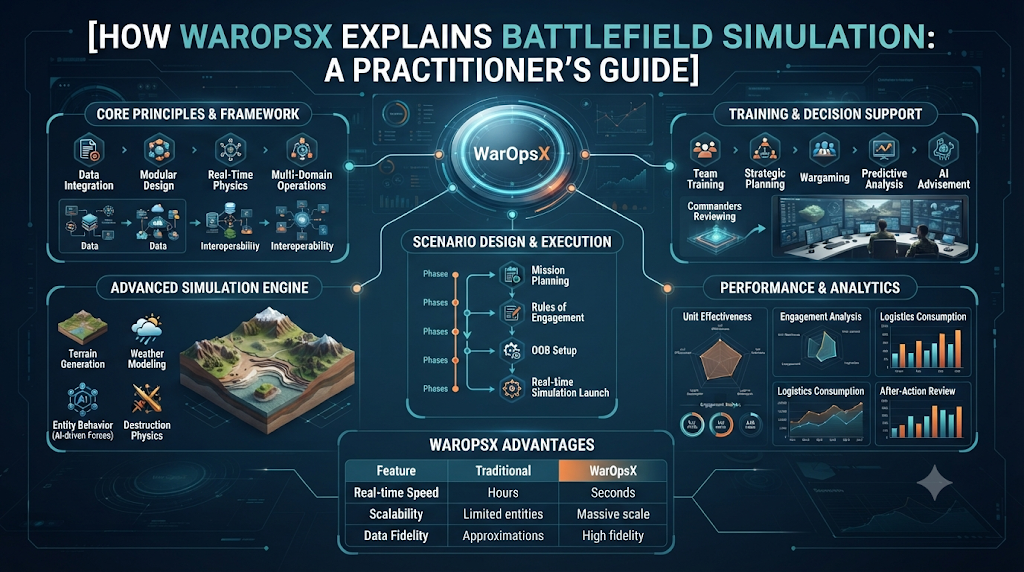
Modern military strategy, defense acquisition, and tactical doctrine development rely heavily on computational modeling. As defense ecosystems grow increasingly multi-domain—encompassing land, air, maritime, cyber, and space—traditional map-and-compass exercises or static linear planning models fall short. Platforms like WarOpsX bridge the gap between abstract theoretical doctrine and quantifiable operational reality.
Understanding how WarOpsX approaches battlefield simulation requires looking beneath the marketing interface to examine how high-fidelity combat outcomes are modeled, how stochastic variables are managed, and why modern defense analysts depend on these frameworks to stress-test tactics before real-world deployment.
What Is WarOpsX and Why Does Battlefield Simulation Matter?
At its core, WarOpsX is a conceptual and operational framework designed to model, execute, and analyze military engagements in synthetic environments. Battlefield simulation is not merely about rendering graphics or tracking unit positions on a grid; it is about computing the systemic friction of war—logistic bottlenecks, command-and-control (C2) latency, sensor-to-shooter timelines, and environmental interference.
Historically, wargaming was conducted manually on tabletop hex maps with paper dice rolls, heavily reliant on the subjective experience of the arbiters. While human intuition remains critical, modern conflict demands mathematical rigor. WarOpsX addresses this by codifying physical laws, weapon capabilities, and human behavioral approximations into reproducible simulation runs.
The Core Objectives of Advanced Combat Simulation
- Risk Mitigation: Testing high-risk operational concepts, electronic warfare (EW) countermeasures, and force postures in a synthetic sandbox prior to live-field trials.
- Doctrinal Validation: Assessing whether standard operating procedures (SOPs) hold up against asymmetric threats, congested spectrums, or disrupted supply chains.
- Resource Optimization: Evaluating the cost-to-benefit ratio of specific weapon systems, platform mixes, and logistics footprints under simulated stress.
How WarOpsX Models the Complexities of Modern Warfare
To understand how a platform like WarOpsX explains or executes a simulation, one must look at how it breaks down the operational theater into discrete, interacting layers. Combat is rarely deterministic; it is a complex adaptive system. WarOpsX utilizes a modular architecture to simulate this complexity across three distinct pillars: entity-level physics, algorithmic attrition, and information warfare.
1. Entity-Level Physics and Ballistics
Every asset in the simulation—from an infantry squad to an autonomous aerial vehicle (AAV)—possesses a defined vector, signature profile, and vulnerability index.
- Line of Sight (LoS): Rather than relying on simple radius circles, WarOpsX calculates terrain masking, atmospheric interference, and foliage density to determine whether a sensor can detect a target.
- Kinematic Modeling: Missiles, ballistics, and armored vehicles operate under real-world physics constraints, including fuel consumption curves, turn radii, and kinetic energy degradation over distance.
2. Attrition and Effectiveness Metrics
Simulating casualties and equipment destruction requires moving past simple hit-point subtraction. WarOpsX leverages stochastic modeling (often incorporating Monte Carlo methods) to account for variance in combat outcomes. A single engagement between two identical tank platoons will yield different results across multiple runs due to variables like crew fatigue, initial spotting advantages, and minor mechanical variances.
3. The Information Layer (C5ISR)
Perhaps the most critical aspect of modern simulation is the representation of information dominance. WarOpsX models the electromagnetic spectrum (EMS), data-link latency, and command decision cycles. If a force loses its satellite communication relay, the simulation does not just blind them; it introduces command friction, delayed orders, and isolated tactical decision-making.
Step-by-Step: Setting Up and Executing a Simulation Scenario
For defense analysts, operators, or researchers interacting with a combat modeling platform, setting up a simulation follows a rigorous, repeatable lifecycle. Here is how a standard engagement analysis is structured within a WarOpsX-style workflow:
- Define the Operational Scope and Objectives: Establish whether the simulation is testing tactical execution (e.g., a platoon-level river crossing) or strategic logistics (e.g., regional supply line endurance over 30 days).
- Configure Order of Battle (OOB): Input force structures, equipment parameters, munition types, and initial positioning for both friendly (Blue) and opposing (Red) forces.
- Incorporate Environmental and Friction Parameters: Define weather conditions, terrain elevation data, civilian density, and electronic warfare degradation levels (e.g., GPS jamming intensity).
- Execute Monte Carlo Iterations: Run the scenario multiple times. Single-run simulations can be misleading due to statistical outliers; robust analysis requires dozens or hundreds of iterations to identify median outcomes and tail-risk failures.
- Data Harvesting and Post-Processing: Extract telemetry logs, ammunition consumption rates, casualty accumulation curves, and bottleneck timestamps for review.
Advantages, Limitations, and When Not to Use Simulation
Like any analytical tool, battlefield simulation is subject to specific constraints. Relying blindly on synthetic outcomes without understanding underlying assumptions can lead to catastrophic strategic errors.
Advantages
- Scalability: Entire theater-level operations can be tested faster than real-time.
- Repeatability: Scenarios can be rewound and replayed with single-variable adjustments to isolate cause and effect.
- Safety: Allows the testing of hazardous operational concepts (such as chemical, biological, or extreme electronic warfare environments) without risk to personnel.
Limitations and Blind Spots
- The “Map is Not the Territory” Problem: No simulation can fully capture human psychology, panic, leadership brilliance, or extreme morale fluctuations.
- Garbage In, Garbage Out (GIGO): If underlying weapon performance metrics or intelligence estimates are flawed, the simulation outputs will reinforce false confidence.
- Over-Quantification: Analysts may fall into the trap of treating simulated probabilities as absolute certainties, ignoring unpredictable “black swan” events.
When NOT to Use Simulation
Battlefield simulation should not be used as a substitute for live-fire safety testing, nor should it be treated as a political decision-making engine. A simulation can inform how an operation might unfold under specific assumptions, but it cannot determine whether an operation should be undertaken from a strategic or moral standpoint.
Risks, Failure Modes, and Common Pitfalls
When practitioners utilize platforms like WarOpsX, several common technical and analytical failure modes frequently emerge:
- Over-Engineering the Model: Trying to simulate every microscopic variable (such as individual bullet wind drift in a theater-wide campaign) bloats computational time without adding meaningful strategic insight.
- Confirmation Bias: Operators frequently tune environmental parameters to validate preconceived tactical notions rather than stress-testing their weaknesses.
- Ignoring Latency and Bandwidth Limits: Assuming seamless, instantaneous communication between high command and frontline units in congested electromagnetic environments.
Prevention Strategy: Maintain strict baseline validation, conduct independent red-teaming of the simulation parameters, and always test scenarios under degraded, worst-case communication and supply conditions.
Validation: How to Know the Simulation Results Are Reliable
A simulation output is only as good as its verification and validation (V&V) pipeline. Analysts verify simulations through three primary mechanisms:
- Historical Matchback: Running historical battles (with known outcomes and friction points) through the simulation to check if the model approximates reality.
- Subject Matter Expert (SME) Review: Having veteran commanders evaluate whether unit behaviors and tactical reactions match field experience.
- Sensitivity Analysis: Systematically tweaking input variables to see if minor changes cause disproportionate, unrealistic leaps in output outcomes.
Frequently Asked Questions
Q1. What is the primary difference between constructive and virtual simulations in frameworks like WarOpsX? Constructive simulations involve computer-generated forces and automated models where human operators act primarily as commanders rather than direct actors. Virtual simulations involve human-in-the-loop operation, where personnel interact with hardware-in-the-loop mockups, flight simulators, or tactical consoles.
Q2. How does WarOpsX handle stochastic variance in combat outcomes? It utilizes probabilistic algorithms—such as Monte Carlo branching—to introduce variables like equipment failure rates, human reaction times, and variable munition lethality across multiple execution runs.
Q3. Can civilian organizations use battlefield simulation tools? Yes, variants of these platforms are frequently used by emergency management agencies, logistics firms, and academic researchers to model supply chain resilience, disaster evacuation, and complex multi-agent logistics under duress.
Q4. What is meant by “C5ISR integration” within a tactical simulation? It refers to the simulation’s ability to model Command, Control, Computers, Communications, Cyber, Intelligence, Surveillance, and Reconnaissance networks as a cohesive, vulnerable nervous system rather than isolated units.
Q5. Why are single-run simulations discouraged by defense analysts? Single runs are vulnerable to statistical anomalies and luck. Running a scenario hundreds of times reveals the probabilistic spread of outcomes, highlighting both median expectations and extreme risk tails.
Q6. How are terrain and environmental factors translated into simulation code? Digital Elevation Models (DEMs) and geographic information systems (GIS) data are imported into the engine to create three-dimensional topographical grids that directly affect line-of-sight, vehicle speed, and cover effectiveness.
Q7. What role does artificial intelligence play in modern combat simulations? AI is increasingly used to automate opposing force (OpFor) behaviors, allowing computer-controlled adversaries to adapt dynamically to player strategies rather than following rigid, pre-scripted pathing.
Q8. What are the hardware limitations when running large-scale theater simulations? Theater-wide simulations calculating thousands of individual entity vectors, sensor sweeps, and logistics paths require significant multiprocessing power and distributed cluster computing to maintain acceptable simulation-to-real-time ratios.
Q9. How do analysts prevent confirmation bias during scenario design? By enforcing independent red-teaming, where a separate team builds the opposing force doctrine and operational plan without input from the primary planners testing the scenario.
Q10. What is the next major frontier in battlefield simulation technology? The integration of real-world cloud architectures, quantum computing for complex combinatorial logistics, and real-time ingestion of live-sensor telemetry to synchronize synthetic models with live operational theaters.
Conclusion
Battlefield simulation platforms like WarOpsX transform military planning from an art dependent solely on intuition into a rigorous, data-informed science. By systematically modeling friction, physics, and information warfare, analysts can stress-test concepts long before they meet the realities of the physical theater. The key to successful simulation lies not in achieving absolute predictive perfection, but in uncovering hidden vulnerabilities, questioning tactical assumptions, and preparing forces for the inherent chaos of complex operations. To begin leveraging these insights, examine your current operational doctrines and identify your most critical tactical friction points to model first.