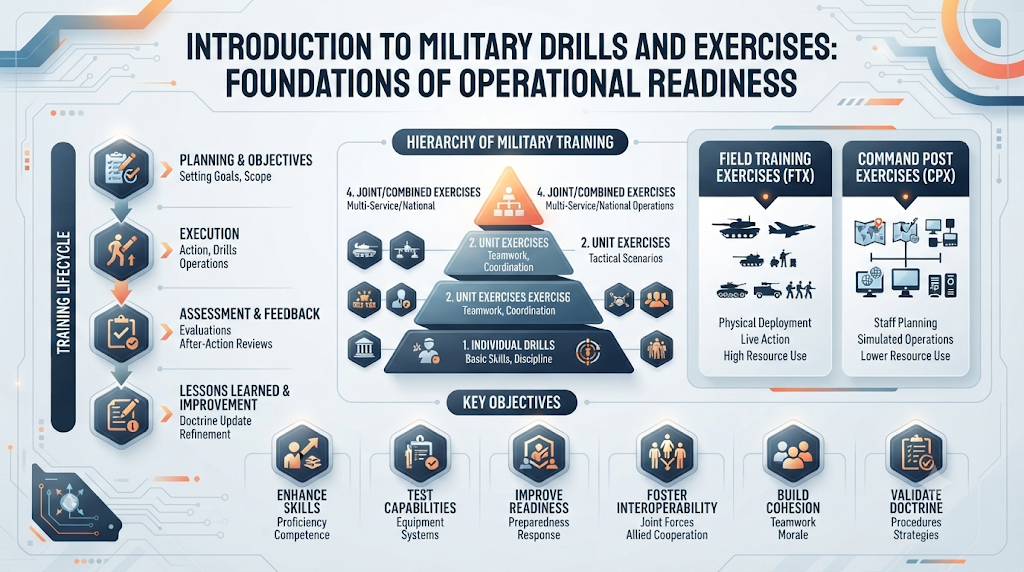
Military drills and exercises form the structural backbone of armed forces worldwide. While civilian sectors often rely on theoretical training and periodic performance reviews, military organizations operate in high-consequence environments where execution must be instantaneous, synchronized, and fault-tolerant under extreme stress.
Understanding military drills and exercises requires examining how armed forces transition raw recruits and complex equipment into cohesive tactical units. This guide explores the foundational components of military training, distinguishing between repetitive drills and large-scale exercises, and analyzing their role in achieving tactical proficiency.
The Core Distinction: Drills vs. Exercises
In military terminology, “drills” and “exercises” are distinct operational concepts, though they complement one another.
A drill is a repetitive, standardized physical or cognitive task practiced until it becomes second nature. The primary objective of a drill is muscle memory, speed, and precision. Examples include individual weapon handling, immediate action drills upon encountering an ambush, or vehicle recovery procedures.
An exercise, conversely, is a complex, scenario-driven event that tests planning, coordination, command and control (C2), and execution across multiple units, often integrating combined arms (infantry, armor, artillery, and aviation) and logistical support. Exercises validate whether individual drills and unit-level SOPs (Standard Operating Procedures) hold up under realistic, chaotic conditions.
+-------------------------------------------------------+
|                    MILITARY TRAINING                  |
+---------------------------+---------------------------+
                            |
         +------------------+------------------+
         |                                     |
         v                                     v
   [ DRILLS ]                            [ EXERCISES ]
   - Repetitive tasks                    - Scenario-driven
   - Muscle memory & speed               - Command & control (C2)
   - Standardized execution              - Combined arms integration
Why Military Drills Matter: The Science of Habituation
In high-stress combat environments, cognitive overload is a primary threat to survival and mission success. When personnel experience intense adrenaline spikes, fine motor skills degrade, and working memory shrinks.
Drills counteract this physiological response through habituation. By practicing a sequence of actions hundreds of times under controlled conditions, the response shifts from conscious deliberation to procedural memory.
Key Benefits of Rigorous Drills
- Reduction of Decision Fatigue: Troops do not need to invent a solution during contact; they execute a pre-rehearsed battle drill.
- Synchronization: Small units learn to move as a single organism, where every member knows their specific sector of fire or responsibility.
- Equipment Mastery: Operating radios, weapon systems, or medical kits without looking down allows personnel to maintain situational awareness of their surroundings.
Structuring Military Exercises: From Command Post to Field Training
Military exercises scale upward in complexity, generally categorized into three tiers:
- Command Post Exercises (CPX): These are staff-centric exercises focused on logistics, intelligence processing, communication, and decision-making. No tactical troops are in the field; instead, commanders and staffs manage simulated scenarios using map boards, digital C2 systems, and communication networks.
- Field Training Exercises (FTX): Troops, vehicles, and equipment deploy into training areas or simulation centers. FTXs test movement formations, tactical communication, navigation, and live-fire or force-on-force engagement.
- Joint and Combined Exercises: These involve multiple branches of a single nation’s military (joint—army, navy, air force) or multiple allied nations (combined). These exercises test interoperability, shared communication protocols, logistics chains, and coalition command structures.
Operational Constraints and Trade-Offs
Designing and executing military exercises involves navigating significant constraints. Practitioners must continuously balance realism, safety, and economy.
- Safety vs. Realism: Full-scale live-fire exercises with maneuvering armor carry inherent risks. Safety protocols, boundary controls, and range safety officers are mandatory, which can artificially constrain tactical freedom.
- Cost and Logistics: Moving mechanized battalions, deploying naval task forces, or flying tactical aircraft incurs substantial financial and environmental costs. Consequently, militaries increasingly utilize Synthetic Training Environments (STE) and simulation software to replicate complex scenarios digitally before committing physical assets.
- The “Training to the Test” Trap: Units can become overly optimized for specific training ranges or standard evaluation scenarios, leading to brittleness when faced with novel tactical environments.
Validation: How Militaries Assess Success
An exercise without rigorous evaluation is merely an expensive rehearsal. Modern military doctrine emphasizes the After Action Review (AAR) process, pioneered by forces like the U.S. Army in the late 20th century.
Unlike traditional top-down debriefs where a senior officer lectures subordinates, an AAR is a professional, open-ended dialogue attended by all participants. It focuses on four core questions:
- What was supposed to happen?
- What actually happened?
- Why did it happen?
- What needs to be improved next time?
In high-tech training centers (such as laser-engagement simulation systems like MILES or equivalent digital tracking systems), movements, engagements, and casualties are recorded digitally, providing undeniable data to support the AAR.
Common Mistakes in Designing Training Programs
When military units or tactical organizations plan drills and exercises, several common pitfalls can undermine readiness:
- Overcomplication: Introducing overly complex scenarios before basic drills are mastered leads to widespread failure and demoralization.
- Lack of Friction: Exercises that proceed entirely according to plan do not prepare personnel for real-world friction, such as communication jamming, logistical delays, or unexpected enemy resistance.
- Neglecting Maintenance and Sustainment: Focusing solely on the tactical phase while ignoring the logistical tail (fuel, ammunition resupply, casualty evacuation) creates a false sense of security.
Frequently Asked Questions
Q1. What is the difference between a battle drill and a standard operating procedure (SOP)?
An SOP is a comprehensive written guideline governing how a unit performs routine administrative and tactical tasks. A battle drill is a specific, rapid-action collective response to a dynamic combat situation (like a sudden ambush) that requires immediate, instinctive execution without waiting for formal orders.
Q2. How do modern militaries conduct exercises without using live ammunition?
Militaries utilize tactical engagement simulation systems—such as laser-based gear attached to weapons and vehicles—alongside computer-generated simulation networks that track troop movements, electronic warfare effects, and logistical flows in real time.
Q3. Why are After Action Reviews (AARs) considered more effective than traditional debriefs?
AARs depart from traditional top-down reprimands by encouraging frank participation from junior enlisted personnel, NCOs, and officers alike. By examining objective data and discussing root causes openly, units identify systemic flaws rather than assigning blame.
Q4. What role does muscle memory play in high-stress military operations?
Under high stress, cognitive processing power drops significantly as adrenaline surges. Muscle memory built through repetitive drilling allows operators to perform critical physical tasks—such as clearing a weapon malfunction or applying a tourniquet—accurately without conscious thought.
Q5. What is a Command Post Exercise (CPX) and who participates in it?
A CPX is a staff-focused exercise designed to test planning, communication, and decision-making command structures. It involves commanders, staff officers, and communication specialists operating command posts, utilizing simulated intelligence feeds and orders without deploying tactical field units.
Q6. How do coalition exercises handle language and communication barriers?
Multinational exercises rely on standardized tactical procedures, pre-agreed communication glossaries, liaison officers fluent in partner languages, and designated common operational languages (such as English in many Western-aligned coalitions) to maintain synchronization.
Q7. Can simulation software completely replace field training exercises (FTXs)?
No. While simulation software reduces costs and allows for safe experimentation with complex scenarios, it cannot fully replicate the physical exhaustion, friction, weather variability, and logistical friction of operating real equipment in the field.
Q8. What are the primary safety risks associated with live-fire field exercises?
The primary risks include friendly fire incidents, navigational errors leading units outside designated safety boundaries, mechanical failures of weapon systems, and heat or environmental casualties due to strenuous physical exertion in heavy gear.
Q9. How often should tactical drills be repeated to maintain proficiency?
Proficiency degrades over time without reinforcement. Tactical units utilize a continuous training cycle, performing basic individual drills weekly, small-unit collective drills monthly, and large-scale exercises annually or semi-annually.
Q10. What is the ultimate goal of a military training exercise?
The ultimate goal is to build operational readiness—ensuring that commanders, staff, and frontline personnel can function effectively as a cohesive, resilient unit under chaotic, high-pressure, and hostile conditions.
Conclusion
Military drills and exercises bridge the gap between abstract tactical theory and chaotic battlefield reality. By grounding units in repetitive muscle-memory drills and challenging them through scalable, friction-heavy exercises, armed forces build the resilience and synchronization required to accomplish missions successfully.