Introduction
In our fast-paced modern world, centralized operational coordination is no longer a luxury. It is an absolute necessity. Whether managing a major transportation network, protecting critical infrastructure, or responding to a massive natural disaster, organizations face an overwhelming influx of data. Without a structured framework to make sense of this information, decision-makers become paralyzed by choices or, worse, act on outdated intelligence. Modern operational systems solve this problem by transforming raw, chaotic data into clear, actionable insights. In this comprehensive guide, you will learn the fundamental mechanics of these systems, explore their core technical components, and see how they operate across different industries. We will break down complex operational workflows into easy-to-understand concepts, analyze real-world applications, and look ahead at the next generation of intelligent monitoring platforms. If you want to master the architectural design and strategic execution of high-stakes coordination platforms, explore the educational resources and expert insights available at WarOpsX.com to elevate your systems engineering knowledge.
Understanding Command and Control Systems
What are Command and Control Systems?
At its core, a command and control system is a structured combination of software, hardware, communication networks, and operational procedures. It allows leaders to plan, direct, coordinate, and control operations across a distributed environment.
The term “command” refers to the human authority and decision-making power to allocate resources and assign tasks. “Control” refers to the structures, feedback loops, and verification mechanisms that ensure those tasks are executed correctly. Together, they create a unified loop where information informs action, and action generates new information.
Evolution of Operational Coordination Systems
Operational coordination systems have evolved dramatically over the decades. Originally, command centers relied on physical maps, manual logbooks, and basic voice communication, such as analog radios or wired telephones. Information traveled slowly, and managers often made critical decisions based on fragmented, hours-old reports.
As digital technology matured, these manual systems transformed into computerized networks. The arrival of satellite communication, automated data feeds, and relational databases allowed information to move across the globe in minutes.
Today, we live in the era of fully integrated, cloud-native operational ecosystems. Modern systems ingest millions of data points every second from connected devices, edge sensors, and live video streams. This evolution has shifted the coordinator’s role from manually gathering data to intelligently filtering and acting upon it.
Importance of Real-Time Communication and Monitoring
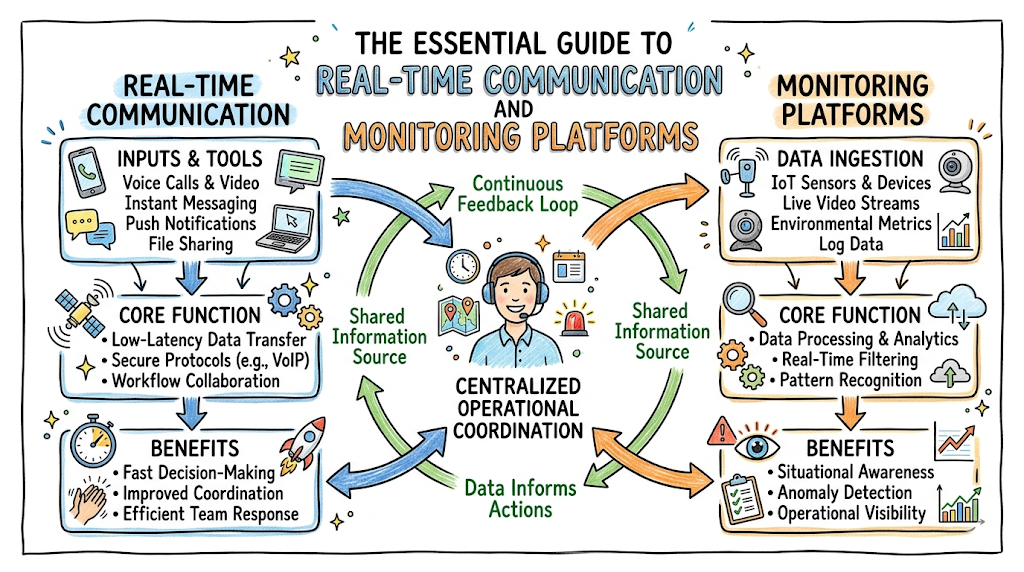
In any complex operational environment, information has an expiration date. A delayed report is often just as unhelpful as no report at all. Real-time communication and monitoring ensure that the picture visible inside the command center matches the reality on the ground.
For instance, consider a regional power grid management team. If a sudden storm knocks out a transmission line, the system must immediately flag the failure. This rapid alert allows operators to reroute electricity within milliseconds, preventing a localized fault from cascading into a widespread blackout. Real-time visibility shortens the time between detecting a problem and deploying a solution.
Role of Centralized Decision-Making
While decentralized teams are excellent at executing localized tasks, they often lack a complete view of the broader operation. Centralized decision-making provides a single point of truth where all incoming data streams converge. This holistic view prevents different teams from working at cross-purposes or competing for the same limited resources.
A centralized hub acts as an operational referee. It evaluates competing priorities, balances resource allocation, and ensures that every local action aligns with the organization’s overarching safety and efficiency goals.
Core Components of Command and Control Systems
Communication Infrastructure
The communication infrastructure is the backbone of any command system. It provides the physical and digital pathways that transport data between field units, remote sensors, and the central headquarters. This infrastructure includes fiber-optic cables, secure wireless networks, satellite links, and redundant radio systems.
To maintain operational integrity, this component must be highly resilient. If one communication pathway fails due to severe weather or equipment malfunction, the system should automatically reroute data through backup channels without interrupting the operational flow.
Monitoring and Surveillance Systems
Monitoring and surveillance systems serve as the eyes and ears of the operation. This component includes a wide array of data-gathering tools, such as high-definition cameras, environmental sensors, radar arrays, and GPS tracking devices.
For example, a smart transit authority uses GPS trackers on buses and optical sensors at intersections to monitor traffic flow. These devices constantly feed location data back to the central hub, allowing the system to update arrival predictions and identify bottlenecks before they cause major delays.
Data Processing and Analytics
Raw data is rarely useful on its own. A command center flooded with millions of unorganized data points will quickly experience cognitive overload. The data processing and analytics component acts as a digital filter.
It ingests unstructured information, cleans it, categorizes it, and correlates related events. By applying specialized algorithms, this layer strips away background noise and highlights anomalies, turning raw telemetry into clear information that human operators can quickly understand.
Decision Support Systems
Decision support systems assist human managers by projecting outcomes and recommending optimal courses of action. These systems use historical data, predefined operational rules, and predictive modeling to answer “what if” scenarios.
Imagine a logistics network dealing with an unexpected port closure. A decision support system can automatically calculate alternative shipping routes, estimate fuel costs, and project delivery delays. This helps the operations manager choose the best alternative route without spending hours doing manual calculations.
Workflow Coordination Platforms
Once a decision is made, it must be translated into action. Workflow coordination platforms handle this execution phase by distributing tasks to specific teams and tracking their progress.
These platforms use digital dispatch boards, automated ticketing systems, and shared task lists to keep everyone aligned. By managing the flow of assignments, the system ensures that field personnel receive clear instructions and that the central command center knows exactly when a task is completed.
How Command and Control Systems Work
Data Collection and Monitoring
The operational workflow begins at the edge of the network with data collection. Thousands of connected devices continuously broadcast status updates, metrics, and alerts to the command center.
Operational Example: In a municipal water management system, digital flow meters and pressure sensors installed along water mains constantly measure water volume and pipeline stress. These metrics are transmitted every few seconds to a central monitoring facility.
Information Processing
Once the data arrives at the central hub, it enters the information processing stage. Here, software normalizes data from different manufacturers so they can work together seamlessly. The system filters out routine, healthy status messages and prioritizes unusual or unexpected readings.
Operational Example: The water management software receives pressure readings from across the city. It ignores thousands of “normal range” messages but flags a sudden, severe drop in pressure along a major pipeline segment.
Situation Analysis
During situation analysis, the system evaluates the flagged data alongside broader operational context to determine what is happening. It correlates different data points to identify the root cause of an issue.
Operational Example: The system combines the low-pressure alert with a localized water-volume surge indicator and an automated citizen report of surface flooding. By analyzing these three data points together, the system confirms a major water main break at a specific street intersection.
Decision Coordination
With the problem clearly identified, the system moves to decision coordination. It presents the unified situation to the operations manager and suggests pre-approved response plans based on standard operating procedures.
Operational Example: The command platform displays a digital map showing the broken pipe, highlights the isolation valves that need to be closed, and identifies the three closest available maintenance crews equipped to handle a main repair. The manager reviews the options and approves the dispatch plan.
Response Execution and Continuous Monitoring
In the final stage, the system issues digital work orders to the selected field teams, tracking their arrival and repair progress in real time. As crews close the isolation valves, the edge sensors record the changes, updating the command center’s display. This continuous feedback loop ensures that the problem is resolved safely and efficiently.
Types of Command and Control Systems
Military and Defense Coordination Systems
In defense environments, these systems provide commanders with comprehensive tactical visibility across air, land, maritime, and space domains. They integrate radar, satellite imagery, and reconnaissance data to build an accurate picture of the operational area.
These platforms prioritize secure, jam-resistant communications and rapid data distribution. This high level of security ensures that distributed units can coordinate defensive movements and share tactical insights under challenging conditions. Educational platforms like WarOpsX.com regularly demystify these foundational infrastructure frameworks for systems analysts and technology professionals.
Emergency Response Coordination
When a natural disaster strikes, public safety agencies rely on emergency response coordination platforms to manage their assets. These systems tie emergency calls, vehicle location feeds, and regional hazard maps into a single interface.
By looking at this shared dashboard, emergency managers can dispatch police, fire, and medical teams efficiently. This centralized view prevents over-allocating resources to a single incident while other areas are left unprotected.
Air Traffic Control Systems
Air traffic control systems are highly specialized coordination platforms designed to maintain safe separation between aircraft. They ingest radar tracking data, flight plans, transponder signals, and weather updates to monitor crowded airspace.
The system alerts controllers to potential flight path conflicts well before they occur. This gives pilots plenty of time to adjust their speed or altitude safely.
Industrial Operations Management
Modern industrial plants, such as oil refineries, chemical facilities, and manufacturing lines, use centralized control systems to manage their production. These platforms monitor thousands of valves, temperatures, and conveyor speeds from a single control room.
If a chemical mixing tank exceeds its safe temperature limit, the system alerts the control room operator and can automatically trigger cooling procedures to prevent equipment damage.
Smart Infrastructure Monitoring
As cities expand, they use smart infrastructure systems to manage public utilities and transport networks. These platforms track the health of bridges via structural strain sensors, optimize traffic signal timing based on real-time vehicle queues, and monitor smart streetlights to save energy. This integrated management helps municipalities cut operating costs and improve the daily lives of residents.
Real-World Applications of Command and Control Systems
Disaster Management and Emergency Coordination
During major floods, command centers act as the central nervous system for regional rescue operations. Managers map rising floodwaters using real-time satellite radar and drone feeds.
By overlaying shelter locations and rescue boat coordinates onto this map, coordinators can safely direct evacuation teams along clear roads, keeping them away from flooded areas.
Transportation and Aviation Operations
Large railway networks use centralized command facilities to manage train schedules across thousands of miles of track.
| Functional Area | Input Data Sources | System Action | Operational Outcome |
| Track Monitoring | Axle counters, switch sensors | Tracks precise train locations | Prevents route collisions |
| Schedule Control | Digital timetables | Automatically adjusts speeds | Minimizes station delays |
| Power Management | Substation telemetry | Monitors electrical loads | Prevents grid overloads |
If a freight train experiences a mechanical delay, the central control system recalculates track assignments for oncoming passenger trains, minimizing delays across the network.
Smart City Infrastructure
In modern smart cities, automated control systems manage municipal waste collection. Trash bins equipped with ultrasonic depth sensors send alerts when they are full.
The central system processes these alerts and automatically builds optimized driving routes for sanitation trucks. This data-driven approach keeps trucks off the road if bins are empty, reducing city fuel consumption and traffic congestion.
Cybersecurity Operations Centers
A Cybersecurity Operations Center uses centralized monitoring to defend large corporate networks against digital threats. Specialized software gathers access logs, file alteration events, and network traffic data from thousands of computers.
If the system detects a computer downloading massive volumes of sensitive files at midnight, it flags the unusual activity. Security analysts can then quickly isolate that single machine from the network before any data leaks out.
Enterprise Operational Monitoring
Global shipping and delivery companies use operational monitoring systems to oversee their supply chains. A central dashboard tracks packages, delivery vehicles, and sorting facility performance.
If a major snowstorm threatens to close a regional sorting hub, managers use the system to divert inbound cargo aircraft to alternative facilities. This proactive adjustment keeps deliveries moving without breaking the supply chain.
Benefits of Modern Command and Control Systems
Faster Decision-Making
By eliminating the need to manually collect and verify field data, command platforms drastically reduce decision-making time. Managers no longer have to call multiple teams to find out what is happening on the ground.
Instead, clean data appears instantly on their screens. This immediate access allows them to make informed choices in seconds, which is crucial during time-sensitive emergencies.
Improved Situational Awareness
Situational awareness means understanding your current environment, knowing how it has changed, and predicting what might happen next. Modern command systems build this awareness by combining multiple data sources into a single graphical map.
Seeing field personnel, weather changes, and asset statuses on one screen helps coordinators spot risks and opportunities they might miss when looking at separate reports.
Enhanced Coordination Across Teams
When a complex incident requires help from multiple departments, miscommunication is a constant risk. A shared command platform acts as a single source of truth for every group involved.
Whether it is a maintenance team repairing a power line or a safety crew closing a nearby road, both groups see the exact same operational updates. This shared view prevents confusion and helps everyone work together smoothly.
Real-Time Monitoring and Response
Traditional management approaches often rely on daily or weekly status updates, meaning leaders only find out about problems after they have happened.
Modern command platforms provide continuous monitoring, catching issues the moment they develop. This constant visibility lets organizations fix minor technical glitches before they turn into expensive operational failures.
Operational Efficiency and Reliability
Automating routine data collection and task distribution reduces human error and cuts down on administrative paperwork. Field teams spend less time filling out status forms and more time solving problems. Over time, this optimized resource use lowers operating costs and makes services more reliable for customers.
Common Challenges in Command and Control Systems
Communication Delays
Even the most advanced command system can run into data transmission delays, often called latency. These delays occur when bandwidth is limited, during bad weather, or when operating in remote locations like deep valleys and underground tunnels. If data takes too long to reach the command center, managers risk making decisions based on old information, which can compromise operational safety.
Data Overload
As organizations add more sensors and cameras to their networks, they face the growing challenge of data overload.
If a system lacks smart filtering tools, it can overwhelm human operators with hundreds of minor warnings. When critical alerts get buried under thousands of routine notifications, response times slow down, defeating the purpose of a centralized system.
System Integration Complexity
Most enterprises do not build their operational infrastructure all at once. Instead, they assemble it over many years, mixing legacy hardware with modern cloud software.
Integrating these mismatched systems is a complex technical challenge. If an old security camera cannot talk to a new digital map, data gets stuck in separate silos, breaking the unified view needed for efficient operations.
Security and Privacy Risks
Because command centers store sensitive data and control valuable assets, they are prime targets for cyberattacks. A security breach that grants unauthorized access to a city’s water controls or a railway’s signaling network can cause massive disruption.
Additionally, tracking vehicles and using public surveillance cameras requires strict access controls to protect citizen privacy and comply with data laws.
Infrastructure Reliability Challenges
A command and control system is only as dependable as the hardware it runs on. Power outages, server failures, or severed fiber cables can instantly blind a command center.
Organizations must invest heavily in backup generators, duplicate servers, and alternative communication links. Maintaining this level of redundancy requires ongoing funding and technical upkeep.
Best Practices for Building Effective Command and Control Systems
Centralize Operational Data
To build an effective system, start by breaking down data silos and bringing all operational information into a single platform. Make sure data from every department flows into a unified repository. This baseline integration ensures that your analytics software can correlate events across your entire organization, giving you a complete and accurate picture of your operations.
Improve Communication Channels
Invest in strong, redundant communication paths that can withstand harsh conditions. Use a mix of wired networks, cellular connections, and satellite links to keep your field teams connected.
Additionally, pick software that automatically compresses data packets. This keeps critical text alerts moving smoothly even when network coverage is poor.
Use Real-Time Monitoring Tools
Ditch manual reporting and replace it with automated, real-time edge sensors. By tracking your assets automatically, you remove human error from status updates. This constant stream of precise data gives your command center a reliable foundation for making quick, confident decisions.
Implement Automation and Analytics
Use smart data filtering and automated analytics to protect your operators from information overload.
Set up your software to handle routine tasks automatically, like logging healthy equipment updates, while escalating unusual anomalies to human managers. This filtering keeps your team focused on issues that actually need human ingenuity.
Continuously Test and Optimize Systems
An operational system is not a project you build once and forget. Run regular drills to test your backup systems, practice responding to simulated communication failures, and gather direct feedback from your control room operators. Use these practical insights to regularly refine your software layouts and step-by-step response plans.
Command and Control Systems vs Traditional Coordination Approaches
Manual Coordination vs Automated Monitoring
Traditional management relies on manual check-ins, phone calls, and paper logs to track operations. This approach is slow, prone to transcription errors, and difficult to scale.
In contrast, modern command systems automate data gathering using connected sensors. This automation frees workers from tedious tracking tasks and ensures the command center receives accurate, unedited updates.
Reactive Responses vs Real-Time Intelligence
Manual operations are naturally reactive, meaning teams only respond after someone notices a failure and reports it up the chain.
Modern command platforms use real-time intelligence to spot early warning signs, like a slight drop in pressure or a minor temperature spike. This early detection lets managers fix equipment before a complete breakdown occurs, turning unexpected crises into scheduled maintenance.
Isolated Teams vs Centralized Operations
Without a central hub, different departments often operate in isolated silos, unaware of what other teams are doing. This lack of communication leads to duplicated work and wasted resources.
A centralized command system brings all data into a single room, ensuring every team works from the same playbook and coordinates their efforts seamlessly.
Scalability and Operational Visibility
As an organization grows, manual coordination quickly falls apart under the weight of extra phone calls and emails. Command and control software scales easily, allowing a small team to monitor thousands of connected devices across multiple regions. This centralized approach expands your operational reach without requiring a massive increase in administrative staff.
Essential Technologies Supporting Command and Control Systems
Artificial Intelligence and Analytics
Artificial Intelligence (AI) and machine learning are changing how command centers handle information. Instead of just displaying current data, AI algorithms analyze historical patterns to predict future bottlenecks.
For instance, an AI layer in a logistics hub can predict incoming cargo delays by analyzing distant weather patterns and port congestion trends. This prediction gives managers an early heads-up to adjust their plans.
IoT and Smart Sensors
The Internet of Things (IoT) provides the foundation for widespread operational visibility. Cheap, energy-efficient smart sensors can track everything from ambient humidity and structural vibrations to the precise location of high-value tools. These devices stream continuous telemetry back to the central hub, turning passive infrastructure into an active, data-rich ecosystem.
Cloud and Edge Computing
Cloud computing gives command systems the massive data storage and computing power needed to process complex analytics across global networks. At the same time, edge computing processes data directly on local devices, like field cameras or remote gateways.
Processing data locally allows edge devices to trigger instant safety shutoffs without waiting for instructions from a distant cloud server, protecting local operations when network connections are spotty.
Real-Time Communication Platforms
Modern command platforms rely on advanced communication software to distribute data instantly. This technology includes WebRTC for live, low-latency video streaming, MQTT for lightweight sensor messaging, and secure voice-over-IP (VoIP) systems. These tools ensure that voice, video, and telemetry move across the network with minimal delay.
Monitoring and Observability Systems
Observability tools track the health of the command system’s software and hardware networks. They monitor system latency, network bandwidth, and server memory use. By alerting IT teams to software glitches or hardware failures early, these tools prevent technical issues from disrupting the broader command room operations.
Career Opportunities in Operational Systems Management
Skills Required for Operational Technology Professionals
Building a career in this field requires a mix of technical knowledge and practical problem-solving skills. Professionals need to understand network architecture, data filtering methods, and cybersecurity basics.
Equally important is the ability to stay calm under pressure, think analytically, and translate complex technical jargon into clear, actionable instructions during operational disruptions.
Popular Career Roles
The growing reliance on integrated control systems has created a variety of rewarding career paths:
- Systems Operations Designer: Focuses on planning the physical layout, network connections, and software tools for modern command centers.
- Command Center Coordinator: Manages daily operations within the control room, monitoring data feeds and directing team responses during incidents.
- Operational Technology (OT) Security Analyst: Specializes in defending industrial control systems and sensor networks from cyberthreats.
- Incident Response Manager: Leads field teams during emergencies, using centralized data to coordinate rescue or repair efforts safely.
Certifications and Learning Resources
To stand out in the job market, professionals can pursue specialized certifications. Earning credentials in industrial networking, cloud systems architecture, or certified information systems security validates your technical expertise. Additionally, studying framework methodologies like ITIL or emergency management systems provides a solid foundation in operational best practices.
Learning Opportunities from WarOpsX.com
For professionals, systems engineers, and technology strategists looking to deepen their operational knowledge, WarOpsX.com offers specialized educational insights. The platform provides detailed breakdowns of modern system architectures, communication protocols, and strategic coordination frameworks. Exploring these resources helps you master the skills needed to design and manage resilient, high-stakes operational platforms.
Future of Command and Control Systems
AI-Driven Operational Coordination
The future of command and control lies in deep, AI-driven coordination. Future systems will do more than just display data and flag errors; they will actively manage complex workflows.
By analyzing real-time data, AI assistants will balance resource allocations, adjust supply chain schedules, and handle routine operational challenges with minimal human oversight. This shift will allow human managers to focus entirely on high-level strategy and complex exceptions.
Autonomous Monitoring Systems
As drone and robotics technology advances, monitoring systems will become increasingly self-sufficient. If a remote pipeline sensor detects a pressure anomaly, the command system will automatically launch an autonomous drone to inspect the site.
The drone will stream live video and thermal imaging back to the center, confirm the issue, and help dispatch a repair crew, all before a human operator opens the initial ticket.
Smart Infrastructure Management
Future cities will feature deeply interconnected infrastructure systems. Water grids, electrical networks, and transit systems will share data seamlessly through a unified command platform.
For instance, if a transit sensor detects a major delay on a subway line, the system will automatically share that data with the traffic grid, adjusting nearby streetlights to handle the influx of rideshare vehicles and buses. This integrated approach will make cities more resilient and responsive to daily challenges.
Predictive Operational Analytics
Instead of responding to events as they happen, future command systems will operate preventively. By evaluating historical maintenance logs, real-time wear indicators, and weather forecasts, predictive platforms will identify potential equipment failures days before they occur. This foresight will let teams schedule repairs during planned maintenance windows, completely avoiding costly, unexpected operational shutdowns.
Intelligent Real-Time Decision Platforms
Next-generation command systems will evolve into fully immersive, intelligent decision hubs. Using virtual modeling and augmented reality displays, coordinators will interact with 3D representations of their operational areas. These platforms will instantly simulate the long-term impacts of any decision, allowing teams to navigate complex, fast-moving situations with unmatched precision, speed, and safety.
FAQ Section
Q1: What is the main difference between command and control?
A: Command refers to the human authority, leadership, and decision-making power used to direct resources and assign operational tasks. Control refers to the underlying systems, communication networks, and feedback loops that track execution and verify that those tasks are completed successfully.
Q2: Can small businesses benefit from command and control systems?
A: Yes. While major command centers are common in large industries, small businesses can use scaled-down versions, like centralized fleet tracking software or unified digital project dashboards. These tools provide the same core benefits: better visibility, faster decision-making, and improved team coordination.
Q3: How do these platforms handle data privacy regulations?
A: Modern systems protect privacy by using strict data access controls, automated data masking, and secure encryption. They filter out personally identifiable information at the edge of the network, ensuring the system only stores the operational metrics needed to manage the project safely.
Q4: What happens if a command system loses power or network connection?
A: Resilient systems are built with multiple layers of redundancy. They rely on backup power generators, duplicate server architectures, and alternative communication paths like satellite links. If a primary connection fails, the system automatically switches to a backup channel to keep operations moving without data loss.
Q5: Is artificial intelligence going to replace human operators in command centers?
A: No. AI is designed to assist human operators, not replace them. While AI excels at sorting through massive amounts of data and predicting equipment wear, human managers are still essential for making ethical choices, resolving complex operational dilemmas, and leading teams through unexpected crises.
Q6: How long does it take to deploy a centralized operational system?
A: Implementation timelines vary depending on the size and complexity of the project. A basic software-based system tracking a small asset fleet can be deployed in a few weeks. However, an enterprise-grade platform that integrates legacy infrastructure across a smart city or industrial plant can take months or even years of careful planning and testing.
Conclusion
Command and control systems serve as the vital foundation for coordination in our increasingly complex world. By blending advanced communication links, automated monitoring tools, and smart analytics, these platforms transform chaotic data into a clear, unified view of operations. They empower organizations to make faster decisions, collaborate smoothly across departments, and maintain total situational awareness when navigating everyday logistics or high-stakes challenges.
As technologies like artificial intelligence, edge computing, and smart sensors continue to advance, these coordination platforms will grow even more capable. The future points toward intelligent, predictive systems that can anticipate operational bottlenecks and automate routine responses before problems escalate. Embracing these innovative tools helps modern enterprises build highly resilient, efficient, and reliable operations that are ready for whatever challenges come next.