Introduction
Modern defense landscapes require an unprecedented level of coordination, precision, and systemic agility. A single deployment involves thousands of moving parts, from personnel and equipment to real-time data streams. Understanding how military operations are planned requires looking past Hollywood stereotypes of sudden battlefield decisions and examining the rigorous, analytical processes that drive modern defense strategy. Every successful deployment relies on a careful balance of intelligence gathering, logistical support, and clear communication networks. Without these elements, even the most advanced technology cannot function effectively. For strategy enthusiasts, history students, and defense professionals, mastering these core principles is essential for analyzing modern defense environments. Educational platforms like WarOpsX provide structured frameworks to help learners understand these complex coordination systems. By studying the mechanics of military operations planning, you gain a clear perspective on how modern defense agencies manage risk, deploy resources, and maintain situational awareness in volatile environments.
What Is Military Operations Planning?
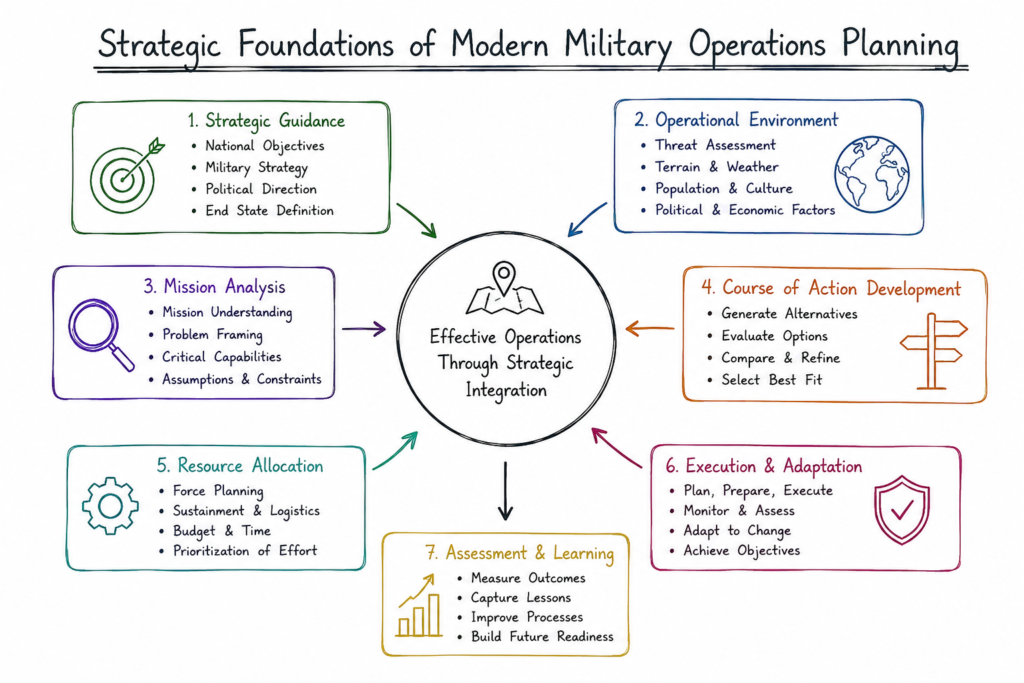
Military operations planning is the structured process of designing, coordinating, and preparing a defense initiative to achieve specific strategic goals. It serves as the vital bridge between high-level defense strategy and tactical execution on the ground. Strategy dictates what needs to be achieved, while operational planning outlines exactly how to achieve it using available resources.
Historically, planning relied heavily on fixed geographic maps and rigid schedules. Modern operational planning, however, is a dynamic, continuous process that accounts for shifting political landscapes, multi-domain environments, and rapid technological changes. It integrates land, sea, air, space, and cyber domains into a singular, cohesive framework.
The core philosophy behind coordinated defense planning rests on predictability, flexibility, and unity of effort. By establishing standardized operational procedures, multiple branches of service can work together seamlessly, reducing friction and ensuring all assets move toward a shared objective.
Why Military Planning Matters in Modern Defense Systems
Coordination of Large-Scale Operations
Modern defense involves integrating joint forces, which often include the army, navy, air force, and multinational allies. Operational planning ensures these distinct entities operate under a unified command structure, preventing conflicting actions and maximizing overall effectiveness.
Intelligence-Driven Decision Making
Plans are never built on guesswork. They rely on verified intelligence data collected from satellites, surveillance systems, and ground reconnaissance. This data-driven approach allows planners to understand environmental challenges, identify potential risks, and make informed decisions before deploying resources.
Resource and Logistics Management
An operation cannot succeed without sustained logistical support. Planning determines the exact requirements for fuel, medical supplies, maintenance parts, and rations. It maps out supply chains to ensure materials reach their destination precisely when needed, preventing operational bottlenecks.
Communication and Command Efficiency
Clear lines of authority are critical during complex operations. Planning establishes robust command and control architectures, outlining who holds decision-making authority at every stage. This clarity prevents confusion and keeps teams aligned during rapidly changing situations.
Risk Reduction and Operational Preparedness
Unforeseen variables are an inherent part of defense environments. Thorough planning involves building detailed risk matrices and contingency options. By identifying potential failure points early, planners create backup procedures that protect personnel and ensure mission continuity.
Technology Integration in Defense Systems
Modern operations rely on a massive network of digital assets, from secure communication channels to automated tracking software. Strategic planning integrates these technologies directly into the workflow, ensuring that hardware and software components work together without system conflicts.
Key Principles of Military Operations Planning
Intelligence Gathering
Effective planning begins with comprehensive data collection. Planners analyze terrain maps, weather forecasts, and electronic signals to build a detailed picture of the operational environment.
Strategic Objective Setting
Every plan requires a clearly defined, measurable, and achievable goal. Planners establish these objectives early, ensuring that every subsequent tactical decision directly supports the high-level mission.
Logistics and Supply Management
Logistics dictates the limits of any operation. Planners calculate consumption rates, manage transportation networks, and establish forward supply depots to sustain personnel and machinery over time.
Command and Control Systems
This principle establishes the hierarchy of authority. It defines how orders are passed down from senior leadership to field operators, ensuring accountability and organized execution at every level.
Communication Coordination
Maintaining reliable, encrypted communication links across different branches is vital. Planners map out dedicated radio frequencies, satellite networks, and digital channels to keep all units connected.
Risk Assessment
Planners systematically identify potential hazards, such as mechanical failures, severe weather, or supply disruptions. They assign probability scores to these risks and design specific mitigation strategies for each.
Battlefield Situational Awareness
This involves maintaining a clear, real-time understanding of where friendly forces, civilian populations, and environmental hazards are located. Continuous data updates help prevent coordination errors.
Operational Flexibility
No plan survives contact with reality entirely unchanged. Operational planning builds in flexible branches and sequels, allowing commanders to alter their approach when field conditions shift unexpectedly.
Resource Allocation
Planners must distribute finite resources, such as personnel, specialized vehicles, and budgets, balanced across various phases of the operation to prevent premature depletion.
Continuous Evaluation and Adaptation
Planning does not stop once execution begins. Teams constantly monitor operational metrics, assess outcomes against benchmarks, and adjust the ongoing strategy to fix inefficiencies.
Military Operations Workflow Explained
Step 1: Mission Analysis
The workflow begins when planners receive an directive from leadership. The planning team analyzes the mandate to extract the core mission intent, identify operational boundaries, and define success parameters.
Step 2: Intelligence Assessment
Next, intelligence teams compile all available environmental, geographic, and technical data. This step builds the foundational context, identifying potential obstacles and analyzing the terrain.
Step 3: Strategic Planning
With objectives and intelligence in hand, planners design multiple Courses of Action (COAs). These different structural approaches are compared, stress-tested, and refined until the optimal plan is selected.
Step 4: Resource Preparation and Operational Coordination
Once a plan is approved, the focus shifts to staging. Logistics coordinators mobilize equipment, prepare personnel, verify communication channels, and position supplies at starting points.
Step 5: Execution and Monitoring
The operation transitions into active live deployment. Command centers utilize digital tracking systems to monitor movements, coordinate active units, and ensure adherence to the established plan.
Step 6: Feedback and Reassessment
As data flows back from the field, planners compare real-world progress against the original timeline. They apply adjustments to resolve issues and, upon completion, conduct post-operation reviews to capture key lessons.
Technologies Used in Modern Military Operations
Modern military operations planning relies heavily on advanced technological ecosystems to gather data, distribute commands, and manage complex movements.
Surveillance Systems
Unmanned aerial vehicles (UAVs) and ground sensors monitor vast geographic areas, sending continuous video feeds and telemetry data back to operational hubs to keep planners informed of changing conditions.
Communication Systems
Encrypted radio systems, tropospheric scatter hardware, and software-defined radios ensure that voice and data transmissions remain secure from interception or external disruption.
Satellite Technologies
Global navigation satellite systems provide highly accurate positioning and timing data, while orbital reconnaissance satellites capture high-resolution imagery used for terrain mapping and environmental analysis.
Command and Control Platforms
These software suites combine multiple data sources into a single digital display, giving commanders a unified view of the operational area and simplifying the process of directing multiple units.
AI-Assisted Defense Systems
Artificial intelligence algorithms quickly process massive volumes of sensor data, highlighting anomalies, predicting supply chain bottlenecks, and suggesting optimal transit routes to human planners.
Logistics and Operational Software
Enterprise-grade resource planning software tracks fuel, ammunition, and medical supplies in real time, automatically generating reorder alerts to keep supply chains moving smoothly.
| Technology | Purpose | Difficulty Level | Common Usage |
| GIS Systems | Digital terrain mapping and spatial analysis | Intermediate | Mapping routes and identifying terrain obstacles. |
| Satellite Intelligence | High-resolution imagery and global tracking | Advanced | Monitoring large-scale environmental changes. |
| Drone Surveillance | Real-time aerial reconnaissance and monitoring | Intermediate | Gathering immediate situational data over specific zones. |
| Radar Systems | Detection and tracking of airborne or maritime objects | Advanced | Monitoring airspace and coastal boundaries. |
| Secure Networks | Encrypted data and voice transmission | Advanced | Protecting command communications from interception. |
Architecture of Modern Military Operations
The architecture of a modern operation functions as an interconnected ecosystem. At the center sits the Operational Command Center, which serves as the central hub where all data streams converge. This center relies on Decision-Support Systems to filter information and help leaders make informed choices without experiencing data overload.
Feeding into this hub are Intelligence Systems and Surveillance Infrastructure, which collect raw environmental and geographic data using satellites, radar, and sensors. This data is transmitted across secure, redundant Communication Networks to ensure it arrives without interception.
Simultaneously, Logistics Coordination Systems track the movement of physical resources, while Real-Time Monitoring Systems track asset locations. This structure ensures that planning, data collection, and execution remain aligned throughout an operation.
Roles and Responsibilities in Military Operations Planning
Operations Planner
- Skills Required: Advanced systems thinking, risk analysis, project management, and deep knowledge of joint operations.
- Daily Responsibilities: Designing operational blueprints, coordinating between different service branches, and developing contingency plans.
- Career Growth: Often advances to senior defense director positions or high-level strategic advisory roles within international defense organizations.
Intelligence Analyst
- Skills Required: Data synthesis, pattern recognition, geographical information systems (GIS) proficiency, and technical writing.
- Daily Responsibilities: Evaluating satellite imagery, analyzing electronic sensor data, and writing comprehensive environmental briefings for planners.
- Career Growth: Moves upward into roles like Chief Intelligence Officer or specialized strategic defense consultancy positions.
Logistics Coordinator
- Skills Required: Supply chain management, predictive analytics, procurement knowledge, and fleet management.
- Daily Responsibilities: Mapping transit routes, calculating fuel and equipment consumption rates, and managing distributed supply depots.
- Career Growth: Transitions into Director of Defense Logistics or supply chain executive roles within global aerospace industries.
Strategic Advisor
- Skills Required: Deep understanding of geopolitics, international law, historical strategy analysis, and long-term policy planning.
- Daily Responsibilities: Advising senior command staff on the political impacts of operations, checking compliance with international frameworks, and setting long-term goals.
- Career Growth: Progresses to senior policymaker, think-tank director, or high-level defense attaché.
Defense Systems Specialist
- Skills Required: Network architecture, systems integration, hardware troubleshooting, and cybersecurity fundamentals.
- Daily Responsibilities: Maintaining command and control software platforms, ensuring hardware compatibility, and monitoring networks for digital intrusions.
- Career Growth: Advances to Chief Technology Officer (CTO) within defense agencies or senior systems architect in the private defense sector.
Communications Officer
- Skills Required: Radiofrequency management, cryptography fundamentals, technical troubleshooting, and signal processing.
- Daily Responsibilities: Establishing secure communication networks, managing satellite links, and fixing connectivity issues between field units and command centers.
- Career Growth: Leads to Communications Director or senior infrastructure engineer roles in global defense communications networks.
Beginner Roadmap for Learning Military Operations Concepts
Understanding the complex systems of defense strategy requires a structured, step-by-step approach.
Phase 1: Foundational History and Strategy
- Learning Order: Start by studying foundational military history and standard strategic thinking concepts.
- Practice Approach: Read case studies of historical operations, focusing on why plans succeeded or failed based on coordination.
- Recommended Progression: Spend 4-6 weeks building this conceptual baseline before moving to technical systems.
Phase 2: Logistics and Intelligence Frameworks
- Learning Order: Transition into learning logistics concepts and the basics of intelligence gathering.
- Practice Approach: Diagram basic supply chain routes and analyze how weather and terrain affect transportation timelines.
- Recommended Progression: Focus on understanding resource constraints and data-collection methods.
Phase 3: Systems, Communication, and Technology
- Learning Order: Study modern defense technologies, communication networks, and geopolitical frameworks.
- Practice Approach: Examine how modern satellite data, GIS tools, and integrated command systems improve situational awareness.
- Recommended Progression: Join structured educational programs to synthesize these concepts into a complete view of operational planning.
Certifications & Learning Resources
Structured education provides the framework needed to turn an interest in strategy into professional-grade analytical skills. Self-guided reading is valuable, but a formal curriculum teaches you to evaluate defense frameworks with systemic rigor.
Aspiring strategists should seek out programs that balance historical operational analysis with training in modern digital technologies. The WarOpsX learning ecosystem offers tailored courses designed to break down these dense defense concepts into clear, manageable modules. These programs help you build practical analytical skills used by modern defense planners.
| Certification / Program | Level | Best For | Skills Covered |
| Foundations of Defense Strategy | Beginner | Strategy enthusiasts, history students | Basic command structures, historical planning models, strategy terminology. |
| Operational Logistics Frameworks | Intermediate | Supply chain professionals, researchers | Consumption forecasting, supply line mapping, distribution management. |
| Advanced Intelligence Integration | Advanced | Defense analysts, security professionals | Multi-source data synthesis, GIS tracking, command platform integration. |
Real-World Examples of Military Operations Planning
Disaster Response Coordination
During major natural disasters, defense systems are often deployed to manage emergency relief operations. Planners coordinate the delivery of medical supplies, clean water, and mobile shelters, setting up efficient distribution hubs in damaged environments.
Border Security Operations
Maintaining border security requires constant monitoring across massive geographic areas. Planning integrates radar networks, ground sensors, and aerial surveillance to assist customs and border patrol agencies with real-time tracking.
Peacekeeping Missions
Multinational peacekeeping missions involve coordinating forces from several countries. Operational planning focuses on establishing shared communication rules, mapping out neutral zones, and organizing supply lines to support long-term regional stability.
Naval Operations
Managing shipping lane safety requires precise coordination across international waters. Planning involves scheduling naval patrols, organizing refueling vessels at sea, and tracking maritime transport data to prevent piracy and ensure open trade routes.
Air Defense Coordination
Air defense requires monitoring regional airspace to protect critical infrastructure. Planners integrate radar networks, early warning satellites, and command centers to identify aircraft and manage airspace efficiently.
Joint Multinational Operations
When multiple nations train or operate together, planning addresses differences in equipment, language, and technology systems. The focus is on aligning command structures and communication platforms so diverse forces can operate as a single unit.
Benefits of Effective Military Operations Planning
- Better Coordination: Alignment across all branches ensures land, air, and sea assets support each other without operational friction.
- Improved Operational Efficiency: Clear workflows reduce wasted effort, optimize transit times, and ensure equipment is used effectively.
- Faster Decision Making: Established command structures and pre-planned contingency options allow leaders to respond rapidly to field changes.
- Stronger Situational Awareness: Integrated data networks provide an accurate view of the operational area, reducing uncertainty for field personnel.
- Better Resource Management: Tracking systems prevent supply shortages and stop excess materials from piling up at forward bases.
- Reduced Operational Risks: Thorough risk analysis uncovers vulnerabilities early, letting planners fix them before deploying assets.
- Enhanced Communication Systems: Standardized communication setups ensure clear, continuous contact between command centers and field units.
Challenges in Military Operations Planning
Communication Breakdowns
In rugged terrain or during electronic interference, communication links can fail. If backup channels are not properly configured, these disruptions can delay orders and cause confusion between units.
Intelligence Uncertainty
Data is rarely perfect. Delayed satellite imagery, conflicting sensor readings, or inaccurate terrain maps can lead planners to make calculations based on flawed information.
Logistics Complexity
Managing thousands of tons of supplies across long distances introduces many potential points of failure. Mechanical breakdowns, customs delays, or damaged roads can quickly stall an operation.
Rapidly Changing Situations
Weather changes quickly, and unexpected environmental hazards can reshape a landscape in hours. Planners must constantly revise their assumptions to keep pace with these shifts.
Technology Integration Challenges
Using hardware and software from different eras or different manufacturers often leads to compatibility issues, requiring significant engineering effort to ensure seamless data sharing.
Cybersecurity Concerns
Modern digital command centers are prime targets for cyber disruptions. Securing these platforms against unauthorized access and malware is a constant, resource-intensive requirement for IT staff.
Common Beginner Mistakes
- Ignoring Logistics Importance: Focusing purely on strategy while overlooking the fuel, maintenance, and supplies needed to keep equipment moving.
- Over-Focusing on Tactical Details: Getting bogged down in small, individual unit movements instead of managing the broader operational workflow.
- Ignoring Communication Systems: Planning complex movements without verifying that all involved assets can communicate on compatible, secure networks.
- Misunderstanding Strategic Planning: Treating planning as a rigid schedule rather than a flexible framework designed to adapt to changing field realities.
- Skipping Historical Analysis: Failing to study past operations, which often leads to repeating well-documented coordination errors.
Best Practices for Understanding Military Operations
- Study Operational History: Analyze past deployments to understand how leaders solved real-world supply, coordination, and weather challenges.
- Understand Logistics Deeply: Treat supply chains as the foundation of any operation; a plan is only as good as its fuel and supply lines.
- Focus on Communication Workflows: Look at how information moves through a command structure to learn how teams maintain alignment.
- Learn Strategic Analysis Methods: Practice breaking down complex problems into clear goals, boundaries, and risk factors.
- Analyze Coordination Systems: Study how different organizations, such as aviation and logistics units, sync their activities during joint efforts.
- Follow Structured Learning Approaches: Use organized courses and certified training programs to build a clear, professional-grade understanding of defense concepts.
Future of Military Operations Planning
The next decade will change how defense operations are organized, driven by rapid technological advancements and interconnected systems.
AI-Assisted Decision Support
Artificial intelligence will play a major role in filtering data for operational command centers. AI tools will analyze thousands of data points to highlight risks and suggest efficient logistics routes, helping planners make fast, accurate choices.
Autonomous Surveillance Integration
Unmanned aerial and ground systems will become increasingly self-managing, coordinating with one another to monitor vast areas and stream continuous data back to command hubs without requiring constant human control.
Data-Driven Operational Planning
Predictive analytics will change how logistics are managed. By analyzing historical wear-and-tear data alongside current environmental conditions, software will forecast mechanical failures and dispatch spare parts automatically.
Integrated Command Ecosystems
Future operations will move away from isolated software tools in favor of fully unified digital ecosystems. This shift will ensure that land, sea, air, space, and cyber data streams are viewed on a single interface, giving planners a complete, clear picture of the operating landscape.
FAQs
- What is military operations planning in simple words?
Military operations planning is the process of breaking down a high-level strategic goal into a clear, step-by-step roadmap that details how resources, personnel, and communications will be organized to achieve that goal safely.
- Why is logistics important in military operations?
Logistics is the foundation of any operation because military assets cannot function without a continuous supply of fuel, food, ammunition, and medical gear. A plan that ignores supply lines will quickly stall out.
- What role does intelligence play in defense planning?
Intelligence provides the accurate data required to make sound decisions. It gives planners clear information about terrain features, weather patterns, and environmental risks, removing guesswork from the planning process.
- How does technology improve military coordination?
Technology connects separate units to centralized command hubs using secure networks, satellite tracking, and shared digital maps, ensuring everyone works with identical, up-to-date information.
- What skills are important in operations planning?
Key skills include systems thinking, data analysis, supply chain management, risk mitigation, and clear technical communication, alongside a strong understanding of how different organizational branches interact.
- Can beginners learn military strategy concepts?
Yes, anyone can learn these concepts by taking a structured approach that starts with basic military history, moves into logistics frameworks, and concludes with modern digital command technologies.
- What is command and control in military systems?
Command and control refers to the established hierarchy and communication framework that defines who holds decision-making authority and how orders are passed down through an organization.
- How are modern military operations monitored?
Operations are tracked in real time using satellite tracking, aerial drone feeds, digital transponders on vehicles, and integrated software platforms that combine this data onto a single screen.
- What is the difference between strategy and tactics?
Strategy defines the long-term, high-level goals of an organization, while tactics focus on the specific, immediate actions and movements used by small units to achieve parts of that larger strategy.
- What is a Course of Action (COA) in planning?
A Course of Action is a specific option or plan generated by a team to solve a problem. Planners create multiple COAs and compare them to find the most efficient and low-risk approach.
Conclusion
Studying how military operations are planned reveals that modern defense relies far more on systematic coordination, data analysis, and logistics management than on simple force. The ability to coordinate multiple units across complex environments is a valuable skill that requires continuous learning and a strong grasp of structural systems.
As technology introduces automation, artificial intelligence, and advanced analytics into command structures, the core principles of clear communication, resource discipline, and objective analysis remain unchanged. Developing a strong foundation in these planning workflows allows you to analyze modern global strategy and defense systems with clarity and insight.