Introduction
In an increasingly complex global security landscape, the ability of defense organizations to position resources, transport infrastructure, and personnel effectively across macro-level environments defines national security posture. Strategic deployment represents the foundational mechanism that transforms abstract defense policy into tangible global readiness. It is the high-level organizational bridging process that links grand strategic intent with long-term operational capabilities. For students of defense studies, researchers, policymakers, and military history enthusiasts, understanding the basics of strategic deployment is crucial for analyzing how large-scale security institutions operate. Rather than focusing on localized movements or immediate engagement tactics, strategic deployment addresses macro-level planning, complex logistical supply chains, interagency coordination, and technological integration. On platforms like WarOpsX.com, defense literacy is cultivated through rigorous, high-level educational analysis, empowering learners to comprehend the structural and analytical frameworks that safeguard stability without resorting to operational jargon or tactical methodologies.
What is Strategic Deployment?
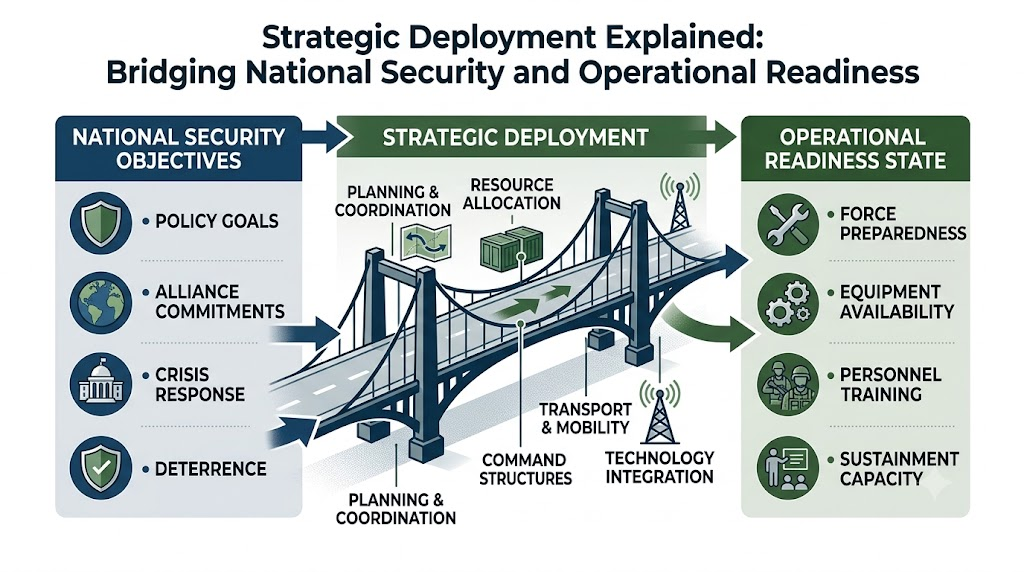
At its core, Strategic Deployment is the systematic, macro-level assembly, movement, and positioning of defense assets, logistics capabilities, sustainment frameworks, and organizational forces from their peacetime bases or home stations to specific global regions or theaters of operation.
Unlike tactical maneuvers that focus on immediate positioning within a localized environment, strategic deployment is a administrative, logistical, and political endeavor. It encompasses long-range transportation, diplomatic clearances, civil-military infrastructure synchronization, and sustained resource allocation.
+-----------------------------------------------------------------------+
|                       GRAND NATIONAL STRATEGY                         |
|      (National Security Policy, Deterrence, Foreign Relations)        |
+-----------------------------------------------------------------------+
                                   |
                                   v
+-----------------------------------------------------------------------+
|                        STRATEGIC DEPLOYMENT                           |
|  (Macro Logistics, Trans-Oceanic Airlift/Sealift, Interagency Work)   |
+-----------------------------------------------------------------------+
                                   |
                                   v
+-----------------------------------------------------------------------+
|                         OPERATIONAL THEATER                           |
|       (Regional Command Structures, Staging, Base Operations)         |
+-----------------------------------------------------------------------+
Strategic deployment operates as the connective tissue in defense architecture. It translates policy goals set by civilian leadership and joint staff into balanced geographical postures, ensuring that defense assets arrive in the right location, in the proper sequence, fully sustained, and prepared for long-term strategic deterrence or humanitarian assistance.
Why Strategic Deployment is Important
The capacity to plan and execute strategic deployment is vital to state craft, institutional deterrence, and global crisis management. Its importance can be understood through four primary organizational pillars:
- Strategic Deterrence: A credible, visibly efficient strategic deployment framework signals to potential adversaries that an organization or nation can project force and sustain capabilities anywhere in the world. Deterrence relies heavily on the perceived capability and speed of deployment.
- National Policy Support: Military Strategy does not exist in a vacuum; it serves national security policy. Strategic deployment provides decision-makers with options during international diplomatic crises, enforcing treaties and fulfilling mutual defense obligations.
- Resource Conservation and Efficiency: Deploying large-scale organizations without rigorous strategic planning leads to severe logistical bottlenecks, wasted fuel, equipment degradation, and operational friction. Structured deployment optimizes the use of precious transportation and material assets.
- Crisis Response and Humanitarian Agility: Modern defense assets are frequently deployed for non-combat missions, such as natural disaster relief, pandemic response, and international peacekeeping. A robust strategic deployment plan allows fast, organized delivery of medical supplies, engineering units, and emergency infrastructure.
Strategic Deployment vs. Tactical Deployment
To build a strong foundation in Security Studies, learners must clearly distinguish between strategic deployment and tactical deployment. While both involve force movement, their scope, timelines, actors, and objectives differ fundamentally.
| Feature / Aspect | Strategic Deployment | Tactical Deployment |
| Primary Scope | Global, trans-continental, national security level | Localized operational area, field level |
| Time Horizon | Long-term planning (months to years) | Immediate execution (hours to days) |
| Core Objective | Align organizational posture with national policy and deterrence | Execute localized missions, security positions, or immediate tasks |
| Key Actors | Civilian leadership, joint chiefs, defense ministries, logisticians | Field commanders, unit leaders, tactical operators |
| Logistical Focus | Strategic sealift/airlift, commercial transport contracts, infrastructure | Local distribution, immediate resupply, organic vehicle movement |
| Decision Support | Macro-level data analytics, predictive supply models, political diplomacy | Real-time field intelligence, localized situational awareness |
| Interagency Role | High integration with state departments, transport agencies, allies | Primary focus within organic military unit command |
Core Objectives of Strategic Deployment
Every strategic deployment initiative is guided by clear overarching objectives that govern resource management and organizational posture:
1. Achieving Force Readiness
Before any strategic movement begins, units must achieve a high state of Operational Readiness. This involves verifying that personnel are fully trained, health and medical clearances are met, equipment is fully maintained, and supply stocks are completely replenished.
2. Establishing Long-Term Sustainment
Deployment is not simply moving assets from Point A to Point B; it requires establishing continuous resupply lines. Strategic deployment ensures that fuel, food, spare parts, medical gear, and maintenance capabilities are continuously piped into the theater to support long-term operations.
3. Preserving Strategic Agility
A key goal of Strategic Planning is keeping options open. Effective deployment avoids over-committing resources to a single rigid corridor, allowing leadership to shift focus rapidly if global geopolitical conditions fluctuate.
4. Ensuring Unity of Effort
Strategic movement requires seamless synchronization between disparate entities—including different branches of defense, civilian transport agencies, diplomatic bodies, and international partners. Achieving unity of effort eliminates administrative friction and redundancies.
Key Principles of Strategic Planning
Strategic deployment relies on established planning principles derived from decades of organizational research, historical study, and defense logistics management.
                    +-----------------------------+
                    |    OBJECTIVE CLARITY        |
                    +--------------+--------------+
                                   |
                                   v
                    +-----------------------------+
                    |    ECONOMY OF FORCE         |
                    +--------------+--------------+
                                   |
                                   v
                    +-----------------------------+
                    |    FLEXIBILITY & AGILITY    |
                    +--------------+--------------+
                                   |
                                   v
                    +-----------------------------+
                    |  SECURITY & RESILIENCE      |
                    +-----------------------------+
- Objective Clarity: Every movement order and resource allocation must directly support defined national security goals. Undefined objectives lead to “mission creep” and logistical strain.
- Economy of Force: Resources are finite. Strategic planners must allocate precisely the necessary transport, material, and personnel required for the primary mission, avoiding unnecessary expenditure in secondary areas.
- Flexibility and Resilience: Plans must account for changing diplomatic permissions, weather delays, port congestion, and physical or cyber threats to supply routes.
- Security and Line Protection: Lines of Communication (LOCs)—whether sea lanes, air corridors, or digital command networks—must be secured against disruption during the deployment phase.
The Role of Leadership and Decision-Making
At the strategic level, Military Leadership and civilian governance operate at the intersection of policy, diplomacy, and resource allocation. Strategic decision-making differs significantly from tactical command; it requires long-range vision, systemic thinking, and extensive coordination.
Governance and Policy Alignment
Strategic leaders ensure that every deployment initiative strictly complies with international law, national policy frameworks, and diplomatic treaties. They work directly with government ministries to secure overflight rights, port access agreements, and host-nation support.
Managing Organizational Friction
In any large-scale enterprise, friction arises between competing branches, civil contractors, and allied nations. Strategic leaders resolve governance disputes, prioritize transportation assets (such as balancing sealift versus strategic airlift), and establish clear lines of authority within joint command structures.
Ethical and Responsible Stewardship
Leaders in defense organizations are stewards of public resources and human lives. Strategic leadership demands careful risk assessment to ensure that forces are not deployed into environments where sustainment is impossible or where objectives are poorly defined.
Logistics and Resource Management
Logistics is the lifeblood of strategic deployment. Without Defense Logistics, strategic plans remain theoretical concepts on paper. Managing the movement of thousands of tons of equipment, supplies, and personnel across continents requires world-class supply chain management.
+------------------+     +--------------------+     +-------------------+     +------------------+
|   PEACETIME      | --> |  STRATEGIC NODES   | --> | TRANSIT CORRIDOR  | --> | RECEPTION &      |
|   INVENTORY      |     | (Ports, Airfields) |     | (Air, Sea, Rail)  |     | STAGING AREA     |
+------------------+     +--------------------+     +-------------------+     +------------------+
1. Reception, Staging, Onward Movement, and Integration (RSOI)
RSOI is the foundational framework through which deploying personnel and equipment are received at staging hubs, organized into functional units, moved to their designated locations, and integrated into regional command structures.
2. Supply Chain Visibility and Inventory Management
Modern defense organizations utilize advanced digital tracking systems—such as RFID technology and automated asset management tools—to maintain real-time visibility over inventory. Knowing exact container contents and location prevents port congestion and supply duplication.
3. Civil-Military Industrial Cooperation
No defense organization possesses enough organic transport assets to execute large-scale strategic deployment independently. Defense systems rely heavily on commercial sealift, civilian charter aircraft, state railway networks, and private logistics partners to fulfill strategic movement requirements.
Transportation and Mobility: A High-Level Overview
Strategic mobility relies on a balanced triad of transportation modes, each offering distinct advantages in terms of speed, volume, and cost:
                  STRATEGIC TRANSPORTATION TRIAD
                               |
       +-----------------------+-----------------------+
       |                       |                       |
       v                       v                       v
STRATEGIC AIRLIFT       STRATEGIC SEALIFT        GROUND & RAIL NETWORKS
(High Speed, Low Vol)  (Low Speed, High Vol)   (Inland Distribution)
- Strategic Airlift: Provides rapid, long-range mobility for time-sensitive personnel, emergency medical supplies, and critical hardware. While airlift is fast, it is constrained by fuel consumption, weight limits, and cargo dimensions.
- Strategic Sealift: Carries the overwhelming majority (often over 80-90%) of heavy equipment, vehicles, fuel, and bulk supplies required for sustained deployment. Ships provide immense volumetric capacity, though at lower transit speeds.
- Ground Infrastructure and Rail Networks: Serves as the vital inland connector linking industrial manufacturing bases and military garrisons to sea ports and airfields. Rail transport remains one of the most efficient modes for heavy armor and bulk material over land.
Communication, Coordination, and Command Structures
Maintaining unity of command across vast geographic distances requires structured organizational design and robust communications systems.
Command Structures
Strategic deployment relies on a unified Command Structure where strategic authority flows from national authorities down to joint and regional command hubs. This hierarchy eliminates ambiguity regarding operational responsibilities and resource authorization.
Interagency and Multinational Coordination
Modern deployments rarely occur in isolation. Planners must establish formal liaison networks with non-governmental organizations (NGOs), international alliances (such as NATO), national transport authorities, and host-nation civil leaders. Standardizing communication protocols ensures seamless inter-agency collaboration.
Readiness and Organizational Preparedness
Maintaining high levels of Force Readiness is a continuous, peacetime requirement rather than an administrative task initiated only during a crisis.
+-----------------------------------------------------------------------+
|                    ORGANIZATIONAL READINESS CYCLE                     |
+-----------------------------------------------------------------------+
|  1. PERSONNEL & TRAINING  -->  Verifying skills and health profiles   |
|  2. EQUIPMENT MAINTENANCE -->  Restoring gear to full operational capability |
|  3. LOGISTICAL STOCKPILING-->  Pre-positioning essential materials     |
|  4. SIMULATION DRILLS     -->  Stress-testing supply routes & timelines|
+-----------------------------------------------------------------------+
Pre-Positioned Stocks
To reduce initial deployment transit times, defense organizations maintain pre-positioned stocks of equipment, rations, and medical supplies in strategic global hubs or aboard specialized maritime vessels. Pre-positioning allows personnel to fly into a theater and link up directly with ready equipment.
Joint Exercise Drills and Stress Testing
Regular readiness exercises simulate large-scale deployment scenarios under challenging conditions. These periodic drills stress-test port capacity, digital communication links, interagency workflows, and diplomatic permission mechanisms, enabling institutions to identify and resolve bottlenecks during peacetime.
Intelligence and Situational Awareness
Successful deployment relies on continuous, accurate information to ensure that force elements move safely and efficiently along strategic corridors.
- Strategic Intelligence: Involves analyzing long-term geopolitical trends, regional stability, host-nation infrastructure capacity, and potential security risks along transportation routes.
- Situational Awareness: Provides strategic decision-makers with a clear picture of current weather patterns, diplomatic status, transport availability, and potential supply chain choke points (e.g., narrow maritime straits or congested air corridors).
- Infrastructure Assessment: Intelligence analysts continuously evaluate the weight capacity of foreign bridges, airfield runway lengths, and port crane capabilities to ensure that deploying transportation assets can operate effectively upon arrival.
Technology Supporting Strategic Deployment
Modern defense logistics has been transformed by technological innovation. Digital capabilities enhance speed, precision, and visibility across every phase of movement.
+-----------------------------------------------------------------------+
|                   MODERN DEFENSE LOGISTICS TECH                       |
+-----------------------------------------------------------------------+
|  1. AUTOMATED ASSET TRACKING  --> Real-time cargo & container visibility|
|  2. SIMULATION SOFTWARE       --> Predictive load & transit modeling  |
|  3. autonomous TRANSPORT      --> Unmanned cargo handling & routing   |
+-----------------------------------------------------------------------+
Automated Material Handling
Advanced automated warehousing systems, mechanized cargo loading systems, and standardized container designs reduce the time required to pack, catalog, and load strategic sealift and airlift transport.
Enterprise Resource Planning (ERP) Systems
Large-scale defense ERP platforms integrate finance, supply inventory, maintenance scheduling, and personnel tracking into a single digital ecosystem, allowing leadership to make data-backed decisions regarding resource availability.
AI, Data Analytics, and Digital Decision Support in Defense
The integration of Artificial Intelligence and advanced Defense Analytics is revolutionizing how defense organizations approach strategic planning:
- Predictive Maintenance: Machine learning algorithms analyze sensor data from transport aircraft, ships, and heavy machinery to predict mechanical failures before they occur, reducing downtime during deployment operations.
- Route and Load Optimization: AI-driven decision support systems calculate optimal flight paths, shipping lanes, and vessel cargo loading plans, factoring in weather patterns, fuel consumption, and port congestion.
- Simulated Planning Models: Data models allow strategic planners to run thousands of “what-if” deployment scenarios, evaluating how delays in one transit hub affect the entire global supply chain network.
Cybersecurity and Information Protection
In the digital era, strategic deployment networks are increasingly vulnerable to cyber threats, making information assurance a vital component of strategic preparedness.
+-----------------------------------------------------------------------+
|                    DEFENSE CYBERSECURITY PILLARS                      |
+-----------------------------------------------------------------------+
|  1. DATA ENCRYPTION       --> Securing movement manifests & schedules |
|  2. NETWORK HARDENING     --> Safeguarding port & rail control systems|
|  3. SUPPLY CHAIN SECURITY --> Vetting commercial contractors & software|
+-----------------------------------------------------------------------+
Protecting Logistical Data
Deployment schedules, cargo manifests, and unit destination data represent highly sensitive information. Unauthorized exposure of this data reveals strategic intent and vulnerabilities. Secure encryption protocols protect communications across military and civilian logistics networks.
Securing Critical Transport Infrastructure
Modern port cranes, automated railway systems, and air traffic control systems rely on interconnected digital networks. Defending these systems against ransomware, disruption, and cyberattacks ensures that strategic movement corridors remain operational during crises.
Historical Examples of Strategic Deployment
Examining publicly documented historical events offers valuable educational insights into how strategic deployment principles function in practice.
=========================================================================
 HISTORICAL STRATEGIC DEPLOYMENT TIMELINE (EDUCATIONAL OVERVIEW)
=========================================================================

 [1948–1949] THE BERLIN AIRLIFT
   |--> Sustained an entire city exclusively through strategic airlift.
   |--> Demonstrated logistics synchronization and civil-military coordination.

 [1990–1991] OPERATION DESERT SHIELD
   |--> Massive trans-oceanic sealift and airlift deployment.
   |--> Moved hundreds of thousands of personnel & tons of gear across globe.

 [2014–PRESENT] NATO READINESS INITIATIVES & PEACEKEEPING DEPLOYMENTS
   |--> Focus on infrastructure interoperability across European transit corridors.
   |--> Rapid deployment frameworks for disaster relief and international stability.
=========================================================================
The Berlin Airlift (1948–1949)
Following a land blockade of West Berlin, Western allies executed one of the most remarkable strategic airlift deployments in history. Operating continuously for over a year, civil and military aviation networks delivered over 2.3 million tons of food, fuel, and supplies to sustain a population of two million people. This event highlighted the power of strategic transportation as an instrument of policy and deterrence without engaging in armed conflict.
Operation Desert Shield (1990)
Following the invasion of Kuwait, a multinational coalition conducted one of the largest and fastest strategic deployments in modern defense history. Over several months, strategic sealift and airlift assets transported hundreds of thousands of personnel, thousands of armored vehicles, and millions of tons of supply items across vast oceanic distances to the Arabian Peninsula. This massive effort demonstrated the critical role of pre-positioning, commercial transport chartering, and reception facilities (RSOI).
Common Challenges and Constraints
Executing strategic deployment is rarely seamless. Planners must navigate complex physical, political, and institutional challenges:
- Infrastructure Bottlenecks: Port capacities, shallow harbor drafts, inadequate crane systems, or substandard rail links can drastically slow down deployment throughput.
- Diplomatic and Sovereign Restrictions: Moving assets internationally requires diplomatic overflight clearances, transit permissions, and host-nation support agreements. Political shifts can alter access permissions without warning.
- Supply Chain Fragility: Dependence on specialized commercial parts or single-source suppliers creates systemic vulnerabilities during rapid mobilization phases.
- Geographic and Environmental Factors: Severe weather, extreme temperatures, rough sea states, and challenging mountain terrain place significant physical strain on transport vehicles and logistics personnel.
Risk Management and Contingency Planning
Because unforeseen obstacles are inevitable, Risk Management forms the cornerstone of effective strategic deployment planning.
+-----------------------------------------------------------------------+
|                    RISK MANAGEMENT FRAMEWORK                          |
+-----------------------------------------------------------------------+
|  IDENTIFY THREATS  --> Infrastructure failure, political blocks, weather|
|  ASSESS IMPACT    --> Evaluate transit delays and supply shortages    |
|  DEVELOP PLAN B   --> Designate alternate sea/air ports & transit routes|
|  CONTINUOUS AUDIT --> Monitor environmental & geopolitical changes    |
+-----------------------------------------------------------------------+
Alternate Routing (Plan B)
Planners never rely on a single Point of Debarkation (POD). Comprehensive deployment plans identify secondary airfields, backup sea ports, and alternative overland routes to maintain mobility if primary corridors are blocked.
Dynamic Resource Buffering
Maintaining strategic reserves of fuel, spare parts, and transport equipment ensures that localized delays do not cause systemic failure across the wider logistics network.
Best Practices in Strategic Planning
Institutions that demonstrate excellence in strategic deployment adhere to proven organizational best practices:
- Standardization of Equipment and Procedures: Utilizing standardized cargo containers, fuel types, and digital communications protocols across allied forces eliminates operational friction.
- Continuous Interagency Collaboration: Maintaining permanent liaison channels between defense ministries, state transportation departments, and commercial logistics firms ensures seamless coordination during crisis mobilization.
- Rigorous Data Auditing: Regularly auditing inventory databases guarantees that planners base their strategic calculations on accurate stock levels and equipment readiness figures.
- Integration of Civil Infrastructure Standards: Aligning national highway, bridge, and rail construction standards with defense mobility requirements ensures long-term national resilience.
Future Trends in Defense Strategy and Emerging Technologies
As technology evolves, the landscape of strategic deployment is undergoing rapid transformation:
- Autonomous Cargo Transport: Unmanned surface vessels, autonomous heavy-lift logistics aircraft, and driverless supply convoys will increasingly handle high-risk transport routes, reducing human exposure.
- Additive Manufacturing (3D Printing at the Point of Need): Printing replacement parts on demand in theater reduces the need to transport vast stocks of spare components across trans-oceanic distances.
- Green Logistics and Energy Efficiency: Defense organizations are exploring alternative fuels, hybrid-electric transport platforms, and renewable energy staging hubs to reduce fuel dependency during long-range deployments.
- Quantum Computing in Logistics Optimization: Future quantum algorithms will solve hyper-complex logistics routing and inventory distribution problems in seconds, optimizing global transport networks in real time.
Career Opportunities in Defense Studies and Strategic Planning
For students and professionals interested in applying strategic planning concepts, the defense and security sectors offer diverse career pathways:
- Defense Logistics Analyst: Focuses on optimizing supply chain networks, evaluating transport capabilities, and managing inventory systems for government and private defense contractors.
- National Security Policy Analyst: Conducts policy research, analyzes regional geopolitical stability, and advises governmental bodies on strategic risk and foreign affairs.
- Strategic Planning Consultant: Helps large organizations, civil emergency agencies, and defense institutions design resilient management workflows and risk mitigation frameworks.
- Defense Technology & Analytics Specialist: Leverages data analytics, machine learning, and simulation tools to build predictive decision-support software for defense systems.
- Academic Researcher & Educator: Teaches history, security studies, and strategic studies at universities, research foundations, and professional defense colleges.
Frequently Asked Questions (10 FAQs)
What is the main purpose of strategic deployment?
The primary purpose of strategic deployment is to align force posture, equipment, and logistical capabilities with overarching national security policy and strategic deterrence goals over long distances.
How does strategic deployment differ from tactical deployment?
Strategic deployment focuses on long-range, macro-level planning, resource allocation, and trans-continental logistics. Tactical deployment deals with localized movements, mission execution, and immediate force positioning in specific operational areas.
What are the main modes of transport used in strategic deployment?
Strategic deployment relies on a triad of transportation modes: strategic sealift for high-volume heavy equipment, strategic airlift for time-sensitive cargo and personnel, and ground/rail networks for inland distribution.
Why is civil-military cooperation important in defense logistics?
Defense organizations do not possess enough organic transport assets to move all material independently. Contracting commercial sealift, charter aircraft, and civil port facilities is necessary to achieve large-scale mobility.
How does technology improve strategic deployment?
Advanced technologies like AI, Enterprise Resource Planning (ERP) software, automated asset tracking, and predictive maintenance algorithms optimize transit routes, track inventory in real time, and prevent equipment breakdowns.
What is RSOI in military logistics?
RSOI stands for Reception, Staging, Onward Movement, and Integration. It is the essential process of receiving deployed personnel and equipment at staging hubs, organizing them, moving them to their destinations, and integrating them into operational commands.
How do cyber threats impact strategic deployment?
Cyberattacks can disrupt port infrastructure, manipulate shipping manifests, compromise air traffic control networks, and expose movement timelines, making cybersecurity critical to protecting strategic supply corridors.
What role does leadership play in strategic planning?
Strategic leadership sets organizational priorities, manages interagency and international relationships, ensures policy compliance, and resolves governance and resource conflicts across complex institutions.
How does pre-positioning stock help strategic deployment?
Pre-positioning heavy equipment, fuel, and supplies in strategic global hubs reduces initial transit times, allowing personnel to fly into a theater and rapidly link up with ready material.
What are the career options in defense studies and strategic logistics?
Career paths include Defense Logistics Analyst, National Security Policy Analyst, Strategic Planning Consultant, Defense Technology Specialist, and Academic Researcher in Security Studies.
Conclusion
Understanding the basics of strategic deployment provides invaluable insight into how global defense organizations operate, manage complex supply chains, and project stability. Far beyond tactical movements, strategic deployment is a vast administrative, logistical, and analytical discipline that relies on clear policy alignment, visionary leadership, rigorous risk management, and cutting-edge technology. As global security dynamics continue to evolve, the principles of strategic planning, resource management, and force readiness will remain foundational to national security and global stability.