International security crises rarely begin with a government deciding to launch a catastrophic war. More often, they start with a localized dispute, a provocative deployment, an ambiguous intelligence report, or a limited coercive move intended to signal resolve. Yet history demonstrates that once a confrontation begins, events can acquire a momentum of their own. Leaders who initially sought only to defend existing interests or compel a modest concession frequently find themselves locked into cycles of retaliation that neither side originally desired.
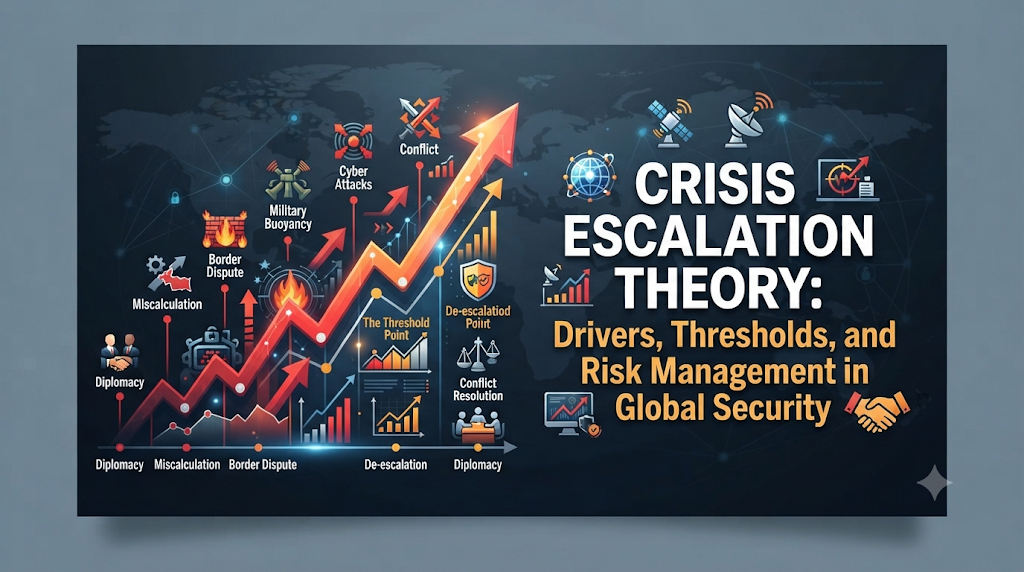
Escalation theory in international relations examines how and why confrontations increase in intensity, scope, or danger. Rather than treating war as a simple binary switch between peace and total conflict, escalation theory studies the intermediate steps, thresholds, and psychological pressures that transform diplomatic disagreements into military standoffs—and limited clashes into wider wars. Understanding why security crises escalate is central to strategic studies because it reveals a sobering reality: major conflicts can emerge not only from calculated aggression, but also from reciprocal reactions, misperception, organizational rigidity, alliance pressures, and unintended consequences.
What Is Escalation Theory and Its Foundations?
What Is Escalation?
In security studies, escalation refers to an increase in the intensity, geographic scope, duration, or destructive consequences of a confrontation, typically involving the crossing of a threshold considered significant by one or more participants. These thresholds—often called “firebreaks”—distinguish qualitative shifts in a dispute, such as moving from economic sanctions to naval blockades, from border skirmishes to aerial strikes, or from conventional warfare to the threatened or actual use of nuclear weapons.
To analyze how crises evolve, strategists distinguish between several stages of confrontation:
- Diplomatic Crisis: A period of acute political tension characterized by formal protests, ambassador recalls, economic coercion, and heightened military readiness, without direct armed clashes.
- Military Confrontation: The deployment or posturing of armed forces to signal resolve, deter an adversary, or establish physical leverage, where direct violence remains absent or strictly localized.
- Limited Conflict: Armed hostilities constrained by geography, weapons types, target selection, or political objectives, where belligerents deliberately refrain from using their full military capacity.
- Wider War: A large-scale, high-intensity armed conflict involving expansive geographic theaters, major mobilization of national resources, and existential or maximalist political aims.
Crucially, escalation does not occur through a single mechanism. Scholars categorize escalation into three primary pathways: intentional (deliberate) escalation, where a leader consciously raises the stakes to gain an advantage or coerce an opponent; inadvertent escalation, where an actor takes an action it considers controlled or defensive, but the adversary perceives it as crossing a major threshold; and accidental escalation, where technical malfunctions, unauthorized local actions, or intelligence errors trigger unintended hostilities.
Escalation as a Dynamic Process
A foundational insight of crisis escalation theory is that escalation is an interactive, dynamic process rather than an isolated event. When State A takes an action—such as moving naval vessels closer to a disputed strait—it does not act in a vacuum. State B observes that movement through the lens of its own fears, historical grievances, and worst-case military planning, then responds with countermeasures. State A, viewing its initial deployment as purely defensive, interprets State B’s countermeasure as evidence of hostile intent and escalates further.
This reciprocal action-reaction cycle alters political expectations on both sides. As tensions rise, leaders invest public prestige in the outcome, making retreat politically costly. Threat perceptions harden, ambiguous intelligence is interpreted as confirmation of adversary malice, and military organizations begin preparing for worst-case contingencies. Because military preparations for defense—such as dispersing aircraft, activating air-defense radars, or mobilizing reserve units—often look identical to preparations for an offensive first strike, defensive prudence frequently fuels offensive alarm.
Escalation vs. Related Strategic Concepts
To avoid analytical confusion, escalation must be distinguished from adjacent concepts in international crisis management. While these concepts interact continuously during a confrontation, each describes a distinct strategic function.
| Concept | Core Meaning | Relationship to Crisis Dynamics |
| Escalation | Increasing the intensity, geographic scope, or severity of a confrontation. | Moves a dispute across higher thresholds of risk, coercion, or violence. |
| De-escalation | Reducing tension, military readiness, or the intensity of hostilities. | Seeks to restore stability, re-establish firebreaks, and create space for diplomacy. |
| Deterrence | Persuading an adversary not to take an unwanted action by threatening unacceptable costs or denying success. | Aims to preserve the status quo; failure can trigger defensive or retaliatory escalation. |
| Compellence | Using threats or limited force to make an adversary undo an action or change existing behavior. | Generally harder than deterrence; forces the target to visibly back down, raising pride and credibility stakes. |
| Crisis Management | Political and operational efforts to control a developing confrontation and prevent unwanted war. | Balances firm deterrence with reassurance and communication to keep conflict bounded. |
| Conflict Prevention | Long-term diplomatic, institutional, and structural measures to stop disputes from becoming violent. | Operates prior to acute military confrontation through treaties, mediation, and transparency. |
| Brinkmanship | Deliberate manipulation of shared risk to compel an opponent to yield during a severe crisis. | Exploits the fear of an uncontrollable spiral, intentionally courting danger to extract concessions. |
Why Security Crises Can Intensify
Why do rational decision-makers allow crises to escalate toward outcomes that threaten their own security? Strategic research identifies seven interacting drivers that push confrontations upward.
1. Misperception and Miscalculation
Decision-makers rarely possess complete, objective knowledge of an adversary’s intentions. Instead, leaders rely on incomplete intelligence, cognitive shortcuts, and preexisting beliefs. Political scientist Robert Jervis demonstrated that states routinely fail to recognize how threatening their own actions appear to others, while simultaneously overestimating the degree of centralized control and hostile coordination behind an opponent’s moves.
When an adversary issues an ambiguous signal—such as conducting an unannounced military exercise during diplomatic talks—leaders under stress tend to interpret it through worst-case assumptions. Intelligence agencies, acutely aware of the career and national costs of failing to warn of a surprise attack, often emphasize adversary capabilities over benign intentions. Furthermore, leaders frequently miscalculate an opponent’s willingness to compromise, assuming that a display of firmness will force the other side to retreat, when in reality it hardens the opponent’s resolve. Distinguishing between an actual threat (an adversary’s genuine capability and intent to attack) and a perceived threat (an assessment filtered through fear and bias) is extraordinarily difficult in real time.
2. Fear, Uncertainty, and the Security Dilemma
The security dilemma occurs when measures taken by one state to increase its own security—such as acquiring advanced missile defenses, expanding naval patrols, or fortifying border infrastructure—diminish the sense of security felt by neighboring states. Because military hardware is often dual-purpose, defensive preparations can easily be read as preparations for offensive coercion.
In an anarchic international system lacking an overarching authority to enforce agreements, states must rely on self-help. When State A strengthens its defenses out of fear, State B feels compelled to match or exceed those measures to avoid falling behind. This generates mutual suspicion, competitive arms buildups, and acute strategic uncertainty. During a crisis, the security dilemma accelerates: if both sides believe that striking first offers a decisive military advantage—a condition known as crisis instability—fear of being attacked can pressure leaders into pre-emptive escalation even when neither side prefers war.
3. Domestic Political Pressures
Foreign policy decisions are never insulated from domestic politics. Once a security crisis becomes public, leaders face intense scrutiny from political rivals, legislatures, media commentators, and nationalist publics. Backing down or offering early concessions can be portrayed by domestic opponents as weakness or betrayal, threatening a leader’s political survival or governing coalition.
Public commitments create what strategists call audience costs—the domestic political penalties a leader incurs if they issue a bold threat and subsequently fail to follow through. While audience costs can help signal resolve to an adversary, they also trap leaders in rigid positions. Simultaneously, military and bureaucratic institutions bring their own organizational routines and priorities to crisis deliberations, sometimes favoring decisive operational options over prolonged diplomatic ambiguity. Fear of appearing weak both abroad and at home frequently pushes leaders to match or exceed an adversary’s latest move.
4. Military Mobilization and Signalling
Governments routinely use military movements—raising alert levels, deploying aircraft carriers, conducting live-fire exercises, or mobilizing reserve forces—as instruments of strategic signalling. The political logic is straightforward: words are cheap, whereas moving forces demonstrates tangible commitment and readiness.
However, military signalling is a blunt, noisy medium. A deployment intended purely as a defensive deterrent may be viewed by the opposing general staff as the final logistical step before an invasion. Moreover, large-scale mobilization creates operational momentum. Troops cannot remain at peak alert indefinitely without fatigue, logistical strain, and economic disruption. As mobilization progresses, military commanders may warn civilian leaders that delaying action surrenders tactical initiative, turning a coercive signal into a self-reinforcing push toward combat.
5. Alliance Commitments and External Actors
Bilateral disputes rarely remain isolated when major powers or regional alliances are involved. Formal treaties, security guarantees, and extended deterrence commitments tie the credibility of a patron state to the security of its allies. If a major power fails to support an ally during a crisis, other partners worldwide may doubt its reliability.
Alliance politics generate two competing escalation risks identified by political scientist Glenn Snyder: abandonment and entrapment. Fear of abandonment compels a state to support its ally firmly, even when the ally takes provocative steps. Conversely, entrapment occurs when an ally’s reckless behavior drags a reluctant patron into a wider confrontation against the patron’s broader interests. External actors—including rival great powers seeking geopolitical leverage or neighboring states affected by spillover—can further complicate negotiations by injecting competing demands into the crisis.
6. Communication Failures
Effective crisis management requires accurate, timely communication so that each side understands the other’s red lines, limited objectives, and conditions for settlement. Yet crises frequently disrupt the very channels needed for clarity. Diplomatic relations may be downgraded, embassies closed, or direct leader-to-leader contact severed due to political outrage.
Even when channels remain open, messages can be delayed, garbled by bureaucratic filtering, or contradicted by unauthorized statements from military officials or legislators. In the absence of trusted intermediaries, decision-makers are forced to infer intentions from battlefield movements rather than clear diplomatic explanations, multiplying the risk of tragic misreading.
7. Technological and Information-Related Factors
Modern military and information technologies compress decision-making timelines and blur traditional boundaries between peace and war. Cyber operations introduce severe attribution uncertainty: when critical infrastructure or military networks experience disruption, leaders may struggle to determine whether the incident stems from a state-sponsored attack, a rogue criminal group, or a technical fault. Furthermore, cyber intrusions aimed at intelligence gathering can look identical to preparation for a disabling strike, creating acute pressure to act before systems are compromised.
Similarly, vulnerabilities in space-based satellites—which support early warning, navigation, and communications for both conventional and nuclear forces—raise fears that a localized clash could blind a state’s strategic sensors. Advances in hypersonic delivery systems and artificial intelligence-assisted decision-support tools threaten to shorten warning windows, leaving human leaders with minutes rather than hours to verify threats. Meanwhile, social media and coordinated disinformation campaigns can inflame public outrage instantaneously, narrowing the diplomatic space available for quiet compromise.
Different Forms and Levels of Escalation
Escalation does not follow a single linear path; states can intensify a confrontation across multiple distinct dimensions simultaneously or sequentially.
Vertical Escalation
Vertical escalation involves increasing the intensity of violence or the destructiveness of the weapons and tactics employed within an existing theater of conflict. Examples include moving from non-lethal harassment to live fire, introducing heavy artillery or air strikes into a border skirmish, targeting critical civilian infrastructure rather than strictly military units, or crossing the nuclear threshold.
Horizontal Escalation
Horizontal escalation expands the geographic scope or the range of actors and domains involved in a dispute. A state facing disadvantage in one region may open a second front elsewhere, attack an adversary’s overseas assets or allies, or expand a terrestrial dispute into maritime chokepoints, cyberspace, or outer space. Horizontal escalation seeks to shift the strategic balance by imposing costs where the opponent is vulnerable, though it risks drawing neutral states into the conflict.
Political and Economic Escalation
Long before—or alongside—armed clashes, states escalate through non-military instruments. Political escalation includes severing diplomatic ties, expelling diplomats, imposing sweeping economic sanctions, freezing sovereign assets, restricting vital exports, and issuing public ultimatums. While intended as alternatives to violence, severe economic coercion can corner a target regime, convincing it that military action is less costly than slow economic strangulation.
Conventional Military Escalation
Conventional military escalation spans the wide spectrum between minor border incidents and full-scale theater warfare. It involves increases in troop deployments, rules of engagement, geographic depth of strikes, and target categories (such as shifting from frontline tactical units to rear-area logistics and command centers).
Nuclear Escalation Risks
The most consequential form of escalation involves the threatened or actual use of nuclear weapons. Even when neither nuclear-armed rival desires a strategic nuclear exchange, crises create nuclear escalation risks through several mechanisms. States may raise nuclear alert levels to signal extreme resolve, inadvertently triggering counter-alerts. Additionally, conventional strikes against dual-capable delivery systems or command-and-control networks—which support both conventional and nuclear forces—can lead an adversary to believe its nuclear deterrent is being degraded, generating intense “use-it-or-lose-it” pressures.
| Escalation Dimension | Primary Mechanism | Strategic Objective | Key Escalation Risk |
| Vertical Escalation | Increasing firepower, lethality, or target sensitivity. | Compel adversary concessions or achieve tactical dominance. | Erodes firebreaks and triggers uncontrolled retaliatory spirals. |
| Horizontal Escalation | Expanding geography, domains, or participating actors. | Offset local disadvantage by applying pressure elsewhere. | Widens war to new regions and entangles third parties. |
| Political / Economic | Sanctions, diplomatic ruptures, blockades, and ultimatums. | Isolate the opponent and impose non-kinetic costs. | Corners the adversary or eliminates diplomatic off-ramps. |
| Conventional Military | Larger troop formations, deeper strikes, and broader rules of engagement. | Defeat opposing forces or seize contested territory. | Threatens dual-use command systems, blurring conventional and nuclear lines. |
| Nuclear Domain | Nuclear alerts, dispersal of warheads, or coercive threats. | Deter existential defeat or halt catastrophic conventional loss. | Catastrophic miscalculation or inadvertent nuclear exchange. |
The Role of Deterrence in Escalation Dynamics
A central paradox of strategic studies is that deterrence—the effort to prevent aggression by convincing an adversary that costs will outweigh benefits—can both stabilize crises and contribute to their intensification.
Deterrence operates through two primary mechanisms: deterrence by punishment, which threatens severe retaliation after an attack, and deterrence by denial, which aims to make an adversary’s military objective physically unachievable. Whether applied to conventional forces, nuclear arsenals, or extended deterrence over allies, deterrence relies on three pillars: capability (possessing the means to act), credibility (convincing the opponent that those means will actually be used), and communication (clearly defining prohibited actions and red lines).
Why, then, does deterrence fail to prevent escalation? First, credibility is inherently subjective. When there is an asymmetry of stakes—meaning the challenger cares far more about a local issue than the defender—the challenger may doubt the defender’s willingness to risk a costly war. Second, deterrence can provoke counter-escalation if an adversary perceives red lines as an attempt at coercive compellence or encirclement rather than pure defense.
Third, nuclear deterrence introduces what strategist Glenn Snyder termed the stability-instability paradox. When two nuclear-armed states achieve mutual deterrence at the strategic nuclear level, the low probability of all-out nuclear war may embolden one or both sides to engage in lower-level provocations, proxy conflicts, or limited conventional probes, assuming the other will not risk nuclear suicide to stop them. Deterrence and escalation thus coexist: states can be deterred from general war while simultaneously escalating beneath the strategic threshold.
Important Theoretical Perspectives
Modern escalation theory rests on decades of interdisciplinary scholarship combining economics, political science, psychology, and military history.
- Thomas Schelling (Coercion, Bargaining, and Brinkmanship): In Arms and Influence (1966), Nobel laureate Thomas Schelling reframed military force not merely as a tool for battlefield victory, but as “the diplomacy of violence”—a coercive bargaining process. Schelling argued that in a nuclear age, states rarely possess total control over crisis outcomes; instead, they engage in brinkmanship, manipulating the “threat that leaves something to chance.” By taking steps that raise the shared risk of an unintended catastrophe, a state pressures its opponent to back down first, turning mutual danger into political leverage.
- Herman Kahn (Escalation Ladders): In On Escalation: Metaphors and Scenarios (1965), Herman Kahn introduced the metaphor of a 44-rung “escalation ladder” ranging from sub-crisis maneuvering to all-out nuclear war. Kahn conceptualized escalation as a structured competition in risk-taking, introducing concepts like escalation dominance—the ability to prevail at any given rung while deterring the opponent from climbing higher. While Kahn’s ladder helped analysts categorize thresholds, later scholars critiqued its assumption that real-world crises follow neat, predictable rungs rather than chaotic leaps.
- Robert Jervis (Perception and Misperception): In Perception and Misperception in International Politics (1976), Robert Jervis integrated cognitive psychology into strategic studies. He demonstrated how leaders filter incoming data through existing expectations, misunderstand the security dilemma, and underestimate how threatening their defensive moves appear to rivals. Jervis shifted focus from purely rational bargaining models to the human and bureaucratic fallibilities that cause crises to spiral.
- Glenn Snyder (Deterrence and Alliance Politics): Glenn Snyder illuminated how alliance structures interact with crisis bargaining. His work on the security dilemma in alliances (abandonment versus entrapment) and the stability-instability paradox showed that leaders must manage dual games simultaneously: deterring adversaries while restraining or reassuring allies.
- Contemporary Strategic Studies: Recent scholarship examines how 21st-century technologies reshape classic escalation dynamics. Researchers at institutions such as the RAND Corporation and the Stockholm International Peace Research Institute (SIPRI) analyze cross-domain escalation (how cyber or space actions spill into kinetic conflict), entanglement (the co-location or dual-use nature of conventional and nuclear command systems), and multipolar instability, where crises involve three or more major actors with overlapping red lines.
Historical Case Studies
Examining historical crises illustrates how these theoretical mechanisms operate under real-world pressure.
1. The Cuban Missile Crisis (1962)
- Initial Trigger: In October 1962, U.S. aerial reconnaissance discovered that the Soviet Union was secretly constructing medium- and intermediate-range nuclear missile sites in Cuba.
- Main Actors: The United States (led by President John F. Kennedy) and the Soviet Union (led by Premier Nikita Khrushchev), with Cuba (led by Fidel Castro) as the host state.
- Escalation Drivers: Severe strategic uncertainty, mutual fear of altered nuclear balances, domestic political pressures ahead of U.S. congressional elections, and compressed decision timelines as missile sites neared operational status.
- Misperceptions and Pressures: Washington viewed the missiles as an offensive alteration of the strategic balance; Moscow viewed them partly as a deterrent against a U.S. invasion of Cuba and a counterbalance to U.S. Jupiter missiles in Turkey. Crucially, U.S. intelligence was unaware that Soviet forces in Cuba already possessed tactical nuclear warheads.
- Actions Increasing and Reducing Tension: Kennedy rejected immediate airstrikes—which could have killed Soviet personnel and triggered nuclear retaliation—in favor of a naval “quarantine” (blockade), preserving a firebreak. However, tension peaked on October 27 (“Black Saturday”) when a local Soviet commander shot down a U.S. U-2 reconnaissance plane over Cuba without Moscow’s authorization, and a U.S. Navy destroyer dropped signaling depth charges near a nuclear-armed Soviet submarine.
- Outcome: Through urgent backchannel diplomacy and formal letters, Kennedy and Khrushchev reached a settlement: the Soviet Union withdrew its missiles from Cuba in exchange for a public U.S. pledge not to invade Cuba and a secret U.S. commitment to remove Jupiter missiles from Turkey.
- Theoretical Lessons: The crisis demonstrated both the utility of calibrated military signalling (the quarantine) and the extreme danger of inadvertent and accidental escalation caused by unauthorized local actions and incomplete intelligence.
2. The July Crisis and Outbreak of World War I (1914)
- Initial Trigger: The assassination of Archduke Franz Ferdinand of Austria-Hungary in Sarajevo on June 28, 1914, by a Bosnian Serb nationalist.
- Main Actors: Austria-Hungary, Serbia, Russia, Germany, France, and the United Kingdom.
- Escalation Drivers: Rigid alliance commitments, interlocking mobilization schedules, offensive military doctrines (“cult of the offensive”), and miscalculations regarding great-power intervention.
- Misperceptions and Pressures: Germany issued a “blank check” of support to Austria-Hungary, assuming Russia would back down as it had in previous Balkan crises. Russia, determined to preserve its credibility as a Slavic patron, ordered partial and then general mobilization to deter Austria-Hungary—failing to appreciate that German war plans treated Russian mobilization as tantamount to war, requiring an immediate pre-emptive strike against France before Russia could fully assemble.
- Actions Increasing and Reducing Tension: Diplomatic proposals for a Great Power conference by British Foreign Secretary Sir Edward Grey were outpaced by irreversible military mobilization timetables. Once mobilization orders were issued across continental capitals, political leaders lost operational control to rigid railway and deployment schedules.
- Outcome: A localized Balkan dispute escalated within five weeks into a catastrophic general European and global war.
- Theoretical Lessons: The 1914 crisis remains the classic illustration of alliance entrapment, crisis instability, and how organizational mobilization routines can override political control.
3. The Kargil Conflict (1999)
- Initial Trigger: In early 1999, Pakistani soldiers and militants infiltrated across the Line of Control (LoC) into high-altitude positions in the Kargil district of Indian-administered Kashmir, less than a year after both India and Pakistan conducted overt nuclear weapons tests.
- Main Actors: India and Pakistan, with intense diplomatic involvement from the United States.
- Escalation Drivers: The stability-instability paradox, territorial revisionism, domestic political sensitivities, and terrain constraints.
- Misperceptions and Pressures: Pakistani planners calculated that nuclear deterrence would prevent India from launching a large-scale counteroffensive across the international border, forcing New Delhi to negotiate over Kashmir. Instead, India responded with determined, localized conventional force—using heavy artillery and air power strictly on its own side of the LoC—while mobilizing forces along the broader border to signal readiness for wider conflict if necessary.
- Actions Increasing and Reducing Tension: India demonstrated horizontal restraint by refusing to cross the LoC, avoiding wider war while systematically recapturing mountain peaks. Simultaneously, U.S. diplomatic pressure—reinforced by intelligence warnings regarding nuclear posturing—compelled Pakistani Prime Minister Nawaz Sharif to seek a withdrawal agreement in Washington in July 1999.
- Outcome: Pakistani forces withdrew, restoring the status quo ante along the Line of Control without a wider conventional or nuclear war.
- Theoretical Lessons: Kargil proved that nuclear weapons do not prevent limited conventional wars between rivals, while demonstrating how strict geographic firebreaks and third-party diplomacy can contain escalation.
4. NATO–Russia Security Tensions and the Post-2014 European Security Crisis
- Initial Trigger: Following the 2014 political upheaval in Ukraine, Russia annexed Crimea and supported separatist conflicts in eastern Ukraine, shattering the post-Cold War European security order and initiating sustained NATO–Russia confrontation—which dramatically intensified with Russia’s full-scale invasion of Ukraine in February 2022.
- Main Actors: Russia, Ukraine, NATO member states, and the European Union.
- Escalation Drivers: Divergent threat perceptions regarding NATO enlargement versus Russian spheres of influence, extended deterrence reassurance, coercive nuclear signalling, and the risk of direct NATO–Russia military incidents.
- Misperceptions and Pressures: Moscow framed Western security partnerships with Ukraine as an existential encroachment on its borders, while NATO allies viewed Russian military aggression as a direct threat to European collective security and international law.
- Actions Increasing and Reducing Tension: After February 2022, Western states imposed unprecedented economic sanctions and supplied substantial conventional weaponry to Ukraine, while explicitly ruling out direct NATO combat intervention or no-fly zones to maintain a clear firebreak against superpower war. Russia combined conventional operations with implicit and explicit nuclear warnings to deter direct Western intervention, while military-to-military deconfliction lines were maintained to prevent accidental border clashes.
- Outcome: An ongoing, high-intensity regional war characterized by continuous calibration of horizontal and vertical escalation thresholds.
- Theoretical Lessons: This period underscores how nuclear-armed powers manage indirect confrontation through careful threshold definition, economic warfare, and deconfliction channels, even amid severe political hostility.
Why Escalation Is Difficult to Control
Even when leaders recognize the dangers of escalation, controlling a crisis once underway is extraordinarily difficult due to systemic friction:
- Feedback Loops and Rationality Traps: A move that appears entirely rational and defensive from Capital A’s perspective—such as moving air-defense batteries toward a border—appears offensive and provocative from Capital B’s perspective. Capital B’s logical counter-deployment then validates Capital A’s initial fear, creating a self-reinforcing spiral in which every step is justified as a reaction to the other side.
- Time Pressure and Cognitive Overload: Crises force leaders to make high-stakes choices under acute sleep deprivation, stress, and compressed timelines. Under cognitive strain, decision-makers struggle to evaluate alternative perspectives or absorb nuanced intelligence.
- Bureaucratic and Organizational Complexity: Modern militaries operate through complex standard operating procedures. Tactical commanders on ships, aircraft, or border posts make split-second self-defense decisions that may diverge from the delicate political signalling intended by heads of state.
- The Difficulty of Communicating Restraint: In a climate of deep mistrust, unilateral restraint is easily misread as weakness, hesitation, or logistical delay rather than a genuine olive branch. Leaders therefore hesitate to pause escalation without simultaneous assurance that the opponent will reciprocate.
Inadvertent and Accidental Escalation
While public debate often assumes wars start because one leader chooses aggression, strategic scholars emphasize the grave risks of non-deliberate pathways:
- Deliberate Escalation: Consciously raising the level of conflict to achieve a political or military goal—for example, launching a retaliatory missile strike to punish a border incursion.
- Inadvertent Escalation: Taking a deliberate action that crosses an opponent’s red line unintentionally because thresholds are ambiguous or misunderstood. Historically, during the late Cold War, U.S. maritime strategy envisioned conducting conventional anti-submarine operations in northern waters—an action U.S. planners viewed as conventional defense, but which Soviet planners could interpret as a strategic counterforce campaign against their nuclear-armed ballistic missile submarines.
- Accidental Escalation: Unintended hostilities triggered by mechanical failure, human error, or unauthorized conduct. A well-documented historical near-miss occurred in September 1983, when a Soviet satellite early-warning system falsely reported the launch of five U.S. intercontinental ballistic missiles; only the disciplined judgment of duty officer Stanislav Petrov—who deduced that a real first strike would involve hundreds of missiles rather than five—prevented the false alarm from triggering catastrophic escalation.
In contemporary contexts, hypothetical scenarios illustrate how these risks persist: a large-scale military exercise conducted near a disputed border during a political crisis could be mistaken for an imminent invasion, or a cyber operation aimed at disabling a regional radar network could inadvertently disrupt adjacent strategic early-warning systems, prompting an unintended military response.
How States Can Prevent or Manage Escalation
Despite these hazards, states possess well-established diplomatic and institutional tools to contain crises:
- Diplomatic Communication: Maintaining embassy channels, special envoys, and private backchannels allows leaders to exchange candid explanations away from public rhetoric.
- Crisis Hotlines: Direct, high-reliability communication links—such as the Washington–Moscow hotline established in 1963 after the Cuban Missile Crisis—enable rapid clarification during emergencies.
- Confidence-Building Measures (CBMs): Advance notification of military exercises, observer exchanges, and border transparency agreements reduce the risk that routine training is mistaken for mobilization.
- Military-to-Military Communication: Direct dialogue between defense ministries and operational commanders helps resolve tactical misunderstandings before they become political crises.
- Arms Control Agreements: Treaties limiting specific weapon classes, establishing verification inspections, and banning destabilizing deployments enhance long-term predictability.
- Third-Party Mediation: Neutral states, international organizations, or respected diplomats can carry messages and propose face-saving compromises when adversaries cannot speak directly.
- Clear Political Signalling: Explicitly stating limited political objectives—and reassuring the adversary about what is not threatened—helps preserve mutual firebreaks.
- Deconfliction Arrangements: Operational protocols, such as Incidents at Sea agreements or aerial deconfliction zones, prevent accidental collisions or misread intercepts.
- Multilateral Diplomacy: Engaging regional bodies or the United Nations Security Council creates international diplomatic pressure for restraint.
- Responsible Public Communication: Avoiding incendiary ultimatums and maximalist rhetoric reduces domestic audience costs and preserves room for negotiated off-ramps.
Limitations: None of these mechanisms guarantees stability. Hotlines can go unanswered if a leader refuses to engage; confidence-building measures can be exploited for deception; and multilateral institutions often stall when major powers hold veto authority or conflicting interests.
Modern Escalation Risks in a Changing Security Environment
Contemporary international politics introduces structural and technological trends that complicate traditional escalation management:
- Multipolarity and Asymmetric Competition: Cold War escalation theory developed largely around a bilateral U.S.–Soviet dynamic. Today, overlapping rivalries among multiple nuclear-armed and major conventional powers create complex, three-body deterrence problems where a move aimed at deterring one rival may alarm another.
- Cross-Domain Entanglement: Modern militaries rely heavily on integrated networks spanning cyber, outer space, and terrestrial systems. Because commercial and military satellites share orbital infrastructure and dual-capable missiles carry either conventional or nuclear warheads, distinguishing limited tactical strikes from strategic attacks has grown markedly harder.
- Artificial Intelligence and Decision Compression: While AI-enabled intelligence processing can improve situational awareness, over-reliance on automated threat detection or high-speed autonomous systems risks compressing decision timelines and introducing algorithmic biases during fast-moving crises.
- Information Manipulation and Economic Interdependence: Deepfake media, coordinated disinformation campaigns, and weaponized economic interdependence (such as semiconductor export controls or energy cutoffs) create persistent grey-zone friction that can rapidly harden public hostility and erode diplomatic trust.
Scholars distinguish between established empirical realities—such as the documented vulnerability of dual-use command systems and the prevalence of cyber espionage—and emerging theoretical concerns, such as how fully autonomous weapon systems might behave in an unscripted crisis.
Common Misconceptions About Escalation Theory
- Misconception: Every escalation is deliberately planned.
- Reality: Crises frequently intensify through inadvertent threshold crossings, organizational momentum, and misperception rather than a master plan for war.
- Example: In July 1914, European monarchs exchanged frantic telegrams seeking to halt general war even as their mobilization schedules locked them in.
- Strategic Lesson: Planners must evaluate how adversaries will perceive an action, not just what the action is intended to achieve.
- Misconception: A stronger military response always restores deterrence.
- Reality: Overwhelming retaliation can convince an adversary that compromise is impossible, prompting desperate counter-escalation rather than submission.
- Example: Heavy U.S. bombing campaigns during the Vietnam War (Operation Rolling Thunder) failed to compel North Vietnam to abandon its core political objectives.
- Strategic Lesson: Coercion requires pairing credible pressure with a clear, acceptable diplomatic off-ramp.
- Misconception: Nuclear weapons automatically prevent conventional conflict.
- Reality: Strategic nuclear parity can create stability at the top while enabling limited conventional wars underneath (the stability-instability paradox).
- Example: The 1999 Kargil Conflict involved sustained conventional artillery and air combat between nuclear-armed India and Pakistan.
- Strategic Lesson: Conventional deterrence and local firebreaks remain essential even among nuclear powers.
- Misconception: Escalation happens only through military action.
- Reality: Severe economic sanctions, diplomatic ruptures, and blockades can escalate a crisis by threatening regime survival or economic viability.
- Example: The U.S. oil embargo against Japan in 1941, intended to deter further expansion in Asia, convinced Tokyo’s leadership that war was preferable to economic paralysis.
- Strategic Lesson: Economic statecraft carries profound escalatory consequences and must be integrated into crisis strategy.
- Misconception: Diplomatic communication is always sufficient to control a crisis.
- Reality: Communication clarifies intentions, but it cannot resolve fundamental clashes of vital interest when neither side is willing to compromise.
- Example: Extensive diplomatic exchanges preceded both the 1962 Cuban Missile Crisis and the 2022 invasion of Ukraine without preventing acute confrontation.
- Strategic Lesson: Communication is a necessary tool for risk reduction, not a substitute for political settlement.
- Misconception: Alliances always reduce the likelihood of escalation.
- Reality: While alliances deter external aggression, they can also embolden smaller partners or entangle patrons in regional disputes.
- Example: Austria-Hungary’s confidence in German backing hardened its ultimatum to Serbia in July 1914.
- Strategic Lesson: Effective alliance management requires balancing external deterrence with internal restraint.
- Misconception: A limited conflict cannot become a wider war.
- Reality: Firebreaks in limited wars are psychological and political conventions, not physical barriers; battlefield reversals or domestic outrage can shatter them.
- Example: The Korean War (1950–1953) expanded dramatically when UN forces crossed the 38th parallel toward the Yalu River, triggering massive Chinese intervention.
- Strategic Lesson: Belligerents must continuously monitor and respect unspoken thresholds to keep wars bounded.
- Misconception: Technological superiority eliminates miscalculation.
- Reality: Advanced sensors generate vast amounts of data, but interpreting human political intent remains an analytical judgment prone to error.
- Example: Despite sophisticated intelligence capabilities, U.S. analysts in October 1962 missed the presence of tactical nuclear weapons in Cuba.
- Strategic Lesson: Technology enhances information collection, but strategic humility remains vital.
- Misconception: Leaders always have complete control over escalation.
- Reality: Friction, delegated authority, communication delays, and tactical incidents ensure that leaders never exercise frictionless control.
- Example: The unauthorized shootdown of a U.S. U-2 plane over Cuba on October 27, 1962, nearly derailed superpower diplomacy.
- Strategic Lesson: Crisis strategy must account for operational friction and build safety margins into rules of engagement.
- Misconception: De-escalation means accepting defeat.
- Reality: Strategic de-escalation preserves national security by preventing mutually destructive wars while securing core interests through negotiation.
- Example: Both Washington and Moscow made reciprocal concessions in October 1962, allowing each to claim its primary security objective was protected.
- Strategic Lesson: Framing compromises so both sides save face is a hallmark of successful statecraft.
A Practical Analytical Framework for Studying a Security Crisis
Students, researchers, and policy analysts can use the following structured framework to systematically dissect any historical or contemporary international crisis. Note that this framework serves as an analytical diagnostic aid rather than a deterministic predictive formula.
| Analytical Dimension | Key Diagnostic Questions |
| Initial Trigger | What specific event, incident, or policy shift initiated the acute confrontation? |
| Main Actors | Which state governments, military institutions, or non-state proxies are directly involved? |
| Political Objectives | What core interests, territorial claims, or political outcomes does each actor seek? |
| Threat Perceptions | How does each side interpret the other’s capabilities, historical intent, and red lines? |
| Military Signalling | What force deployments, readiness changes, or exercises are being used to signal resolve? |
| Domestic Pressures | How are elections, public opinion, nationalist sentiment, or bureaucratic interests constraining leaders? |
| Alliance Dynamics | Are external security guarantees, fears of abandonment, or risks of entrapment shaping choices? |
| Communication Channels | Do direct diplomatic hotlines, military deconfliction links, or trusted mediators remain active? |
| Escalation Pathways | Through which vertical, horizontal, or cross-domain mechanisms could the crisis intensify? |
| Restraint Mechanisms | What geographic firebreaks, international norms, or economic incentives encourage restraint? |
| Possible Outcomes | What are the plausible trajectories toward negotiated settlement, frozen conflict, or wider war? |
Frequently Asked Questions (FAQs)
1. What is escalation theory in international relations? Escalation theory is a branch of strategic studies that analyzes how and why political and military confrontations increase in intensity, geographic scope, or severity. It examines the psychological, organizational, and strategic mechanisms that cause limited disputes to cross significant thresholds toward wider conflict.
2. Why do security crises intensify even when leaders want to avoid war? Crises intensify because states operate under incomplete information and mutual suspicion. When one state takes defensive precautions, the opponent often views them as offensive preparations and responds in kind. Combined with domestic political pressure against appearing weak, this action-reaction cycle can push leaders toward conflict despite their initial intentions.
3. What is the difference between deliberate and inadvertent escalation?Deliberate escalation occurs when a leader intentionally raises the level of force or risk to gain an advantage or coerce an opponent. Inadvertent escalation occurs when an actor takes an action it considers limited or defensive, but the opponent perceives it as crossing a major strategic threshold.
4. What is vertical escalation? Vertical escalation is an increase in the intensity of conflict within an existing theater—for example, moving from small-arms skirmishes to heavy artillery, deploying air strikes, or using more destructive weapons systems.
5. What is horizontal escalation? Horizontal escalation is the expansion of a conflict across geography, actors, or domains—such as opening a new military front in another region, targeting an adversary’s overseas assets, or extending a dispute into cyberspace or outer space.
6. How does the security dilemma contribute to escalation? The security dilemma arises when one state’s efforts to enhance its own security (such as building defenses or mobilizing troops) make neighboring states feel less secure. Those neighbors then take countermeasures, creating a cycle of mutual fear and arms competition that accelerates during a crisis.
7. Can deterrence prevent escalation?Deterrence can prevent major wars by convincing an adversary that the costs of aggression outweigh potential gains. However, it is not foolproof: deterrence can fail if an adversary doubts a defender’s credibility, cares more deeply about the stakes, or chooses to probe beneath the threshold of major retaliation.
8. What role do alliances play in security crises? Alliances complicate crises by linking the credibility of major powers to their partners. While strong alliances can deter aggression, they also create risks of entrapment, where a patron state is pulled into a wider war because of an ally’s actions.
9. Why is the Cuban Missile Crisis important to escalation theory? The 1962 Cuban Missile Crisis demonstrated how nuclear-armed rivals can manage extreme brinkmanship through calibrated military signalling (a naval quarantine), clear communication, and mutual face-saving concessions—while also revealing how easily unauthorized local incidents could have triggered nuclear war.
10. How can diplomatic communication reduce escalation risks?Direct diplomatic channels, crisis hotlines, and third-party mediators allow leaders to clarify their red lines, verify that defensive movements are not preparations for surprise attack, and negotiate reciprocal steps to lower tensions.
11. Can cyber operations trigger wider international crises? Yes. Cyber operations can create acute escalation risks due to attribution uncertainty, rapid speed, and the difficulty of distinguishing cyber espionage from preparation for a disabling attack on critical infrastructure or military command networks.
12. Is escalation always intentional? No. Escalation can be intentional, inadvertent (caused by misread thresholds), or accidental (triggered by technical failures, false early-warning alarms, or unauthorized tactical actions).