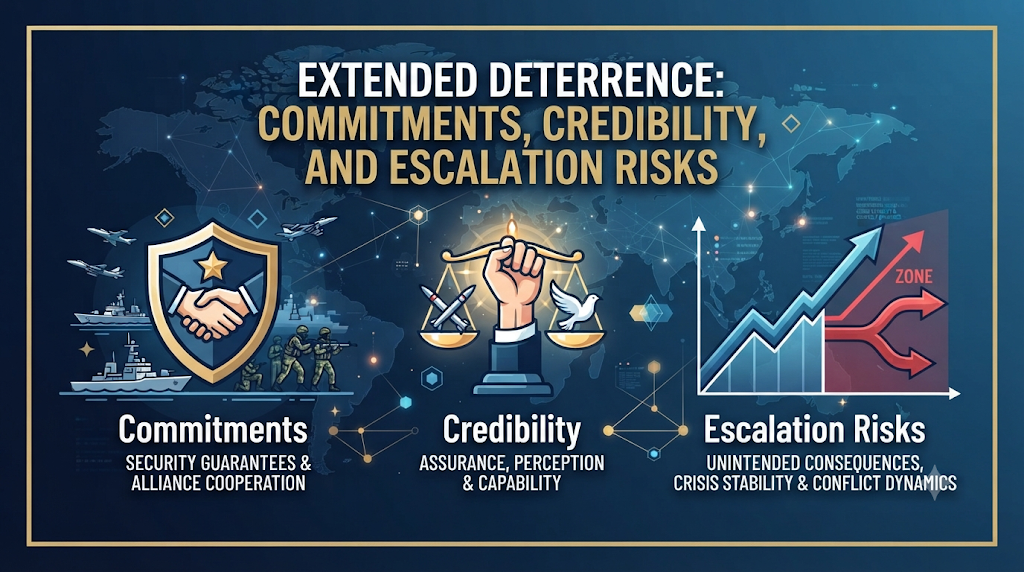
Few problems in international security are as consequential—or as fraught with strategic tension—as one state promising to defend another. When a smaller or less powerful country relies on a major military power for protection, the resulting arrangement reshapes calculations across an entire region. Extended deterrence sits at the center of these security relationships. It influences whether a potential adversary decides to initiate aggression, how confident an ally feels in its own security, how regional states balance diplomacy and force, and whether countries pursue independent nuclear weapons.
At the same time, extended deterrence affects crisis stability and escalation risks. A regional dispute can acquire global stakes when a major power’s alliance security commitments are tested. If a protecting state intervenes, a localized conflict may broaden into a clash between major militaries, potentially involving nuclear forces. If it hesitates or backs away, its broader reputation for reliability may suffer, while endangered allies may scramble to rearm or seek alternative alignments.
This tension defines the central dilemma of extended deterrence. A protecting state may genuinely intend to honor its security guarantees, yet adversaries—and sometimes allies—may doubt whether that state would accept severe costs or grave escalation risks when its own homeland is not directly under attack. Unlike defending one’s own territory, defending a partner requires convincing an opponent that distant or shared interests are worth high stakes. Because credibility cannot be taken for granted, extended deterrence is rarely a settled fact; it is an ongoing strategic challenge shaped by capabilities, political resolve, communication, alliance coordination, and perception.
What Is Extended Deterrence?
In extended deterrence theory, extended deterrence occurs when one state seeks to prevent an attack against another state or partner by threatening punishment, denial, or defensive intervention if aggression takes place. Rather than relying solely on the target state’s own ability to resist, deterrence is “extended” outward through the power and commitments of a protecting state.
To understand how this works, it helps to separate direct deterrence from extended deterrence:
- Direct deterrence aims to prevent an attack against the deterring state’s own territory, armed forces, or core survival interests. The connection between an attack and the defender’s incentive to respond is immediate because the defender itself is the target.
- Extended deterrence aims to prevent an attack against an ally or protected partner. Here, the state issuing the deterrent threat is not the immediate victim of the initial attack, which introduces additional questions about willingness, cost, and political priority.
A basic extended deterrence relationship involves three actors:
- The protecting state (often a major or superpower), which provides security assurances, military backing, or defense cooperation.
- The protected ally (or partner), which seeks security against external threats without bearing the full burden of defense alone.
- The potential adversary, which weighs the gains of coercing or attacking the ally against the risk that the protecting state will intervene.
Consider a simplified hypothetical scenario. Suppose Country A borders Country B and covets a disputed border territory. Country B has a smaller military, but it maintains a defense treaty with Major Power C, which stations forces nearby and pledges to help defend Country B against armed attack. Extended deterrence operates if Country A decides not to invade Country B because it fears Major Power C will enter the war, impose severe costs, or block Country A’s objectives. It fails—or is never tested—if Country A believes Major Power C will remain neutral, offer only diplomatic protests, or back down under pressure.
Crucially, extended deterrence is not limited to nuclear weapons. It can rest on conventional forces, forward deployments, integrated command structures, intelligence sharing, missile defense, economic measures, and diplomatic commitments. Different instruments of national power reinforce one another, though each carries distinct strategic effects and limitations.
Extended Deterrence vs. Direct Deterrence
While both direct deterrence and extended deterrence seek to dissuade an adversary from taking unwanted action, extending protection to another state alters the strategic calculus.
| Dimension | Direct Deterrence | Extended Deterrence |
| Protected interest | The deterring state’s own territory, forces, or vital interests | An ally or protected partner’s security, sovereignty, or territory |
| Commitment | Self-defense | Defense of another state or partner |
| Political calculation | Primarily national survival and direct security | National interests intertwined with alliance obligations and diplomatic ties |
| Credibility challenge | Capability and resolve to defend oneself | Capability, resolve, and willingness to accept costs or escalation risks for an ally |
| Adversary calculation | Expected cost of attacking the defending state directly | Expected cost of attacking the ally and potentially provoking the protecting state |
| Alliance implications | May be limited or secondary | Central to alliance cohesion, reassurance, and burden-sharing |
| Escalation concerns | Direct conflict risks between attacker and defender | Risks involving multiple states, treaty obligations, and wider conflict |
Extended deterrence introduces extra political and strategic complications because the stakes are asymmetric. For the protected ally, an attack may threaten national survival or territorial integrity. For the protecting state, the initial attack may not strike its own homeland directly, even if its reputation, regional position, or alliance system is at stake. As a result, adversaries often look for openings—such as limited territorial grabs, gray-zone pressure, or sudden crises—where they think the protecting state might hesitate rather than risk a major war.
Clarifying a few related concepts also prevents confusion:
- Deterrence vs. defense: Deterrence seeks to prevent an action by convincing an adversary that the costs or risks will outweigh the benefits; defense seeks to blunt, absorb, or defeat an attack if deterrence fails.
- Deterrence vs. compellence: As Thomas C. Schelling famously distinguished, deterrence uses threats to stop an adversary from starting an action, whereas compellence uses threats or pressure to make an adversary stop an ongoing action or undo something it has already done. Compellence is often harder because it visibly challenges an adversary’s prestige in real time.
- Deterrence vs. reassurance: Deterrence is directed at an adversary to discourage aggression; reassurance is directed at an ally to build confidence that protection will be forthcoming when needed.
- Nuclear deterrence vs. conventional deterrence: Nuclear deterrence relies on the threat of nuclear escalation or devastation, whereas conventional deterrence relies on non-nuclear military forces, readiness, and denial or punishment capabilities.
- Alliance commitments vs. automatic military intervention: A treaty or pledge expresses political intent and legal or diplomatic obligations, not an automatic mechanical trigger; leaders still weigh circumstances, capabilities, and political choices during a crisis.
- Credibility vs. capability: Capability refers to military hardware, forces, and logistics; credibility refers to whether an adversary or ally believes the state has both the ability and the political will to use them.
- Abandonment vs. entrapment: Glenn H. Snyder highlighted that allies worry about abandonment (the protector failing to help or reneging on a guarantee), while protectors worry about entrapment (being pulled into a costly conflict over an ally’s interests or actions).
- Strategic ambiguity vs. strategic uncertainty: Strategic ambiguity is a deliberate policy of leaving aspects of a commitment or response unclear to keep an adversary guessing, whereas strategic uncertainty is a broader condition of doubt about how states will behave or how a crisis will unfold.
- Nuclear umbrella vs. broader security guarantee: A nuclear umbrella refers specifically to extended nuclear deterrence provided by a nuclear-armed state, whereas a broader security guarantee can encompass conventional forces, diplomatic backing, and wider defense cooperation without necessarily relying on nuclear threats.
Why Do States Provide Extended Deterrence?
Providing extended deterrence is costly and risky, so states rarely offer serious guarantees out of altruism alone. Instead, policymakers pursue alliance security commitments for several overlapping reasons:
- Alliance commitments: States maintain formal treaties and security partnerships to uphold shared defense obligations, preserve diplomatic reliability, and sustain predictable security ties with partners. When a state honors commitments over time, its broader diplomatic standing is closely tied to how partners view its word.
- Regional stability: By raising the potential cost of aggression against vulnerable partners, extended deterrence can discourage opportunistic attacks and reduce incentives for neighbors to engage in destabilizing arms races or unilateral power grabs. Predictable security arrangements help states plan diplomatically and economically with greater confidence.
- Non-proliferation: A central argument in nuclear deterrence strategy is that credible external protection can reduce a partner’s incentive to build its own nuclear weapons. If a state believes a major ally will help deter threats against it, it may see an independent nuclear arsenal as unnecessary—or even counterproductive if proliferation sparks regional rivals to follow suit.
- Strategic influence: Security guarantees often anchor broader geopolitical relationships. Access to bases, ports, airspace, intelligence networks, and diplomatic alignment can allow a protecting state to shape regional security outcomes and maintain influence far from its own borders.
- Collective security and burden-sharing: Alliances allow states to pool resources, coordinate defense planning, and share security responsibilities. A partner may contribute local knowledge, strategic geography, host facilities, or complementary military capabilities that strengthen collective defense.
Not all alliances rest on identical motives. Some are formal mutual-defense treaties forged amid acute shared threats; others are asymmetrical patron-client or hub-and-spoke arrangements shaped by history, geography, and evolving geopolitical priorities. Interests can align closely on core threats while diverging on secondary disputes.
The Credibility Problem: Would a State Really Defend Its Ally?
Credibility is the linchpin of extended deterrence. If an adversary believes a protecting state will not act—or will back down once pressure mounts—the deterrent threat loses much of its power. Conversely, if an adversary believes intervention is likely and costly, restraint becomes more attractive. Five main factors shape deterrence credibility:
- Capability: A commitment means little if the protecting state lacks the military means to back it up. Relevant capabilities include conventional forces, power-projection reach, logistics, sustainment, intelligence, missile defenses, and, where applicable, nuclear forces. Readiness matters alongside raw numbers: forces that are overstretched, poorly maintained, or logistically constrained may look less capable in a crisis.
- Political resolve: Even a heavily armed state must decide whether its leaders are willing to bear the political, economic, and military costs of intervening. Resolve depends on how leaders define national interests, domestic political cohesion, public and legislative support, and willingness to accept risk. As Schelling emphasized, deterrence often turns on “the threat that leaves something to chance”—creating a credible risk that events could spiral in ways an adversary cannot easily control.
- Communication: Deterrence depends on being understood. Clear treaty language, consistent official statements, joint exercises, diplomatic consultations, and visible force posture all communicate intent. Mixed messages, contradictory public statements, or sudden policy shifts can confuse both adversaries and allies.
- Reputation: States build reputations over time through past actions in crises, adherence to agreements, and how they handle allies under pressure. However, scholars such as Robert Jervis and Patrick M. Morgan have noted that reputation is complex and context-dependent: adversaries may judge a state’s likely behavior in a specific situation rather than assuming a uniform reputation across every region or issue.
- Adversary perceptions: Ultimately, deterrence works only inside the adversary’s decision-making process. An opponent may misread deployments as routine or bluffing, view a commitment as conditional rather than firm, or conclude that the protecting state fears escalation too much to intervene. In Perception and Misperception in International Politics, Robert Jervis showed how leaders’ beliefs, cognitive shortcuts, and strategic assumptions can cause them to miss or misinterpret signals. Similarly, Alexander L. George and Richard Smoke argued that deterrence often fails in practice when challengers believe they can achieve a limited fait accompli before a defender can or will respond effectively.
Crucially, credibility is not a fixed attribute like weight or distance. It fluctuates with shifting military balances, domestic politics, alliance cohesion, and the specific nature of a crisis.
The Role of Nuclear Weapons in Extended Deterrence
Nuclear weapons have played a prominent role in extended deterrence since the early Cold War, largely because their destructive power alters calculations of risk and cost. Through a nuclear umbrella, a nuclear-armed state extends extended nuclear deterrence to non-nuclear allies—or within an alliance that includes nuclear-armed members—so that adversaries must reckon with the possibility of nuclear escalation if they attack protected partners.
Possessing nuclear weapons, however, is not the same as having a credible nuclear commitment for an ally. In classic nuclear strategy, Bernard Brodie argued that the central purpose of nuclear weapons shifted from winning wars outright to averting them through deterrence. Yet extending nuclear deterrence raises a sharp question: would a leader risk catastrophic retaliation against their own homeland to defend an ally?
During the Cold War, analysts wrestled with how to bridge this gap through concepts like escalation and flexible response—maintaining a spectrum of conventional and nuclear options rather than relying solely on an all-or-nothing threat. At the same time, nuclear commitments often involve deliberate strategic or political ambiguity regarding when, how, or under what circumstances nuclear weapons might ever be contemplated.
This ambiguity serves two competing purposes. It can keep an adversary uncertain about the ultimate cost of aggression, strengthening deterrence. Yet it can also leave allies anxious about whether the umbrella is firm enough, and it raises profound ethical, legal, and strategic questions about escalation control and proportionality. In parallel, extended nuclear deterrence is closely tied to nuclear non-proliferation: many non-nuclear-weapon states have joined or remained within the Treaty on the Non-Proliferation of Nuclear Weapons (NPT) partly because external security assurances helped address their security concerns without building domestic nuclear arsenals.
(Note: This discussion addresses strategic concepts at a conceptual and historical level and does not involve operational weapons guidance, targeting, or technical employment.)
Conventional Forces and Integrated Deterrence
Extended deterrence is far from exclusively nuclear. In fact, relying solely on nuclear threats for every contingency can lack credibility for lower-level or ambiguous challenges, where a nuclear response might appear disproportionate or implausible. Conventional forces and integrated defense arrangements provide crucial flexibility below the nuclear threshold.
Key elements of conventional and integrated deterrence include:
- Forward presence and readiness: Troops, ships, aircraft, and equipment stationed or positioned in key regions signal ongoing commitment and shorten response times during a crisis.
- Joint exercises and interoperability: Regular training between allied militaries improves command coordination, shared procedures, and operational effectiveness—while demonstrating cohesion to outside observers.
- Intelligence cooperation and situational awareness: Shared warning, surveillance, and analysis help allies detect threats early and coordinate responses without delay.
- Integrated air and missile defense: Combined sensing and defensive systems can complicate an adversary’s ability to achieve quick military gains through missile or air strikes.
- Logistics and reinforcement: Ports, airfields, fuel networks, and host-nation support determine whether reinforcements can actually arrive when needed.
- Cybersecurity, space, and diplomatic coordination: Modern defense planning increasingly links military readiness with cyber resilience, space-enabled communications and warning, and aligned diplomatic and economic tools.
Visible conventional capabilities and integrated planning strengthen extended deterrence by showing both capability and commitment before a crisis erupts. They give leaders practical options to contest aggression or reinforce allies early, potentially preventing a dispute from escalating to a nuclear threshold. (These points describe broad strategic concepts and defense arrangements rather than specific operational deployments or tactical plans.)
Historical Examples of Extended Deterrence
History offers rich—though contested—evidence on how extended deterrence operates in practice. Rather than proving that deterrence automatically prevents war, historical cases show how commitments adapt, how credibility is tested, and how political and military dynamics interact.
1. Cold War NATO and the US Nuclear Umbrella
- Historical context: After World War II, Western European states faced severe economic strain and perceived conventional military vulnerability relative to the Soviet Union. The 1949 North Atlantic Treaty established NATO around collective defense (most famously Article 5), anchoring extended deterrence in NATO during the Cold War.
- Nature of the security commitment: The United States committed substantial conventional forces to Europe and placed its strategic and theater nuclear capabilities behind the alliance, forming the cornerstone of the Cold War nuclear umbrella.
- Credibility challenge: A persistent question was whether the United States would risk Soviet nuclear retaliation against American cities to defend Western Europe. Allies periodically worried about “decoupling”—the fear that US and European security might be separated in a crisis—while NATO developed integrated command structures, forward deployments, and consultative mechanisms such as the Nuclear Planning Group to reinforce reassurance and shared risk.
- Broader strategic lesson: Formal treaty language alone did not settle credibility; sustained military presence, alliance consultation, and evolving doctrine were used to manage doubts over decades, even as historians and political scientists continue to debate the exact mix of deterrence, political restraint, and other factors that kept the Cold War from becoming a direct US–Soviet war.
2. US Security Commitments to Japan
- Historical context: Following World War II and the 1951 Treaty of Peace with Japan, the 1960 Treaty of Mutual Cooperation and Security formalized the modern US–Japan security relationship amid Cold War tensions in East Asia.
- Nature of the security commitment: The arrangement pairs US extended deterrence—including conventional forces in Japan and the wider Indo-Pacific alongside the US nuclear umbrella—with Japan’s own evolving Self-Defense Forces and constitutional and policy constraints on the use of force.
- Credibility challenge: Credibility has depended on balancing reassurance with alliance management: Japan has sought confidence that the United States would help defend it in a regional crisis, while both countries have navigated burden-sharing, host-nation support, and changing regional military balances.
- Broader strategic lesson: Extended deterrence can operate alongside a partner’s restrained military posture and strong conventional defense cooperation, provided both sides actively coordinate strategy and adapt to shifting regional threats.
3. US Security Commitments to South Korea
- Historical context: The outbreak of the Korean War in June 1950 and the subsequent 1953 Mutual Defense Treaty established a central pillar of security on the Korean Peninsula, followed by decades of armistice tensions and North Korea’s pursuit of nuclear weapons and ballistic missiles.
- Nature of the security commitment: The US–ROK (Republic of Korea) alliance combines combined forces, intelligence and operational coordination, conventional deterrence, and extended nuclear deterrence backed by high-level bilateral consultations, such as the Extended Deterrence Strategy and Consultation Group and related alliance mechanisms.
- Credibility challenge: As North Korea expanded its nuclear and missile capabilities, questions intensified over how extended deterrence functions against a nuclear-armed regional adversary and how South Korea is assured of timely consultation and credible protection.
- Broader strategic lesson: Extended deterrence is not static; when an adversary’s capabilities change, allies continually update consultative mechanisms, defense planning, and reassurance measures to address emerging credibility concerns.
4. NATO After the Cold War
- Historical context: After the dissolution of the Soviet Union in 1991, European security shifted dramatically as former Warsaw Pact states and Baltic republics joined NATO and the alliance took on crisis management and expeditionary roles alongside collective defense. Russia’s full-scale invasion of Ukraine in February 2022 marked a major inflection point, returning high-intensity conventional warfare and nuclear signaling to European security calculations.
- Nature of the security commitment: NATO’s collective defense commitment remains anchored in the North Atlantic Treaty, while nuclear deterrence within the alliance involves the US nuclear contribution, independent nuclear forces of member states such as the United Kingdom and France (each governed by its own national command and policy), and collective conventional and nuclear planning.
- Credibility challenge: Following 2022, NATO placed renewed emphasis on forward defense, reinforcement, and readiness along its eastern flank while managing escalation risks in a tense standoff with Russia.
- Broader strategic lesson: Shifting geopolitical realities can quickly revive core extended deterrence questions, requiring alliances to distinguish between collective treaty obligations and individual members’ national nuclear policies while adapting conventional and deterrent postures.
(Across all four examples, analysts caution against attributing the absence or occurrence of conflict to deterrence alone, as domestic politics, economic ties, miscalculation, and broader diplomatic factors also play major roles.)
Alliance Reassurance: Why Allies Need More Than a Promise
Deterrence and reassurance are twin pillars of alliance politics, yet they address different audiences and anxieties. Deterrence seeks to convince an adversary not to attack; reassurance seeks to convince an ally that the protecting state will stand by it and that the commitment is effective.
Even when a treaty exists, allies often look for ongoing evidence of commitment because governments change, strategic priorities shift, and crises move fast. Allies commonly seek reassurance through:
- Regular diplomatic consultations and high-level political statements affirming defense ties.
- Joint military exercises, combined planning, and shared strategic assessments.
- Intelligence sharing and defense-industrial or capability cooperation.
- Consultative forums dedicated to deterrence and crisis management.
- Visible conventional military presence or reinforcement arrangements.
When reassurance falls short, alliance credibility suffers from the inside. An anxious ally may question whether its partner is reliable, seek hedging arrangements with other powers, or debate building independent military or nuclear capabilities of its own. Conversely, over-reassuring an ally without clear guardrails can create its own problems if the ally feels emboldened to take provocative steps.
Risks and Limitations of Extended Deterrence
While extended deterrence is often designed to enhance strategic stability and protect vulnerable partners, it carries substantial risks and limitations. As Glenn H. Snyder, Lawrence Freedman, and other scholars have shown, alliances face trade-offs where solving one problem can worsen another:
- Credibility gaps: Adversaries may doubt whether a protecting state will actually fight over an ally, while allies may read cautious or ambiguous wording as a sign of weakening resolve.
- Escalation risks: A local clash involving a protected partner can draw in a major power, increasing the chance of wider conventional war or, where nuclear powers are involved, nuclear escalation.
- Entrapment: A protecting state can find itself pulled into a costly crisis or conflict sparked by an ally’s policies, disputes, or actions—even when the protector prefers restraint.
- Abandonment fears: Allies may fear being left unsupported or sacrificed for a broader deal, prompting them to pursue costly unilateral arms buildup or diplomatic realignment.
- Moral hazard: In international relations theory, moral hazard suggests a protected ally might take greater risks or act less cautiously if it expects a powerful partner to absorb the costs of conflict. Scholars debate how common moral hazard is in practice—many allies remain deeply cautious because war still harms them first—so it is best treated as a conditional risk rather than an automatic law of alliances.
- Strategic ambiguity: Leaving commitments or responses partly ambiguous can create useful uncertainty for an adversary, but it can simultaneously generate anxiety and confusion for an ally seeking firm assurance.
- Arms competition: Deterrence postures and defensive deployments can prompt adversaries to expand missiles, conventional forces, or nuclear arsenals in response, fueling ongoing security competition.
- Nuclear proliferation pressures: If an ally loses faith in an external security guarantee, domestic debates over developing an independent nuclear deterrent can gain traction, potentially triggering regional chain reactions.
- Domestic political constraints: Shifts in leadership, elections, budget pressures, legislative debates, and public opinion can alter how readily a state sustains commitments or enters a crisis.
- Alliance dependency: Heavy reliance on a protecting state can leave an ally’s defense planning, procurement, or diplomacy vulnerable if the protector’s attention or priorities shift elsewhere.
In short, extended deterrence rarely eliminates risk; it reallocates and reshapes it. A policy that lowers the risk of one type of conflict can raise the risk of another.
Extended Deterrence in a Changing Security Environment
Contemporary international security looks markedly different from the bipolar Cold War setting in which many classic deterrence concepts took shape. Several overlapping trends complicate extended deterrence today:
- Multiple nuclear-armed states: Deterrence calculations increasingly involve multi-actor dynamics rather than a single bilateral standoff, raising complex questions about cross-theater links and simultaneous crises.
- Regional power competition: Shifting regional military balances and contested territorial or maritime claims test conventional and extended deterrence in areas far from a protecting state’s homeland.
- Missile development and defense: Advances in ballistic, cruise, and hypersonic delivery systems, alongside missile defense capabilities, affect perceptions of vulnerability, warning times, and escalation dynamics.
- Cyber operations and space-based systems: Modern militaries rely heavily on space assets for communications, navigation, and warning, and on digital networks for command and infrastructure. Disruptions or ambiguous actions in cyber or space domains can complicate attribution and crisis signaling.
- Hybrid threats, information warfare, and economic coercion: Adversaries frequently use pressure below the threshold of conventional warfare—such as disinformation, political interference, economic leverage, or gray-zone coercion—where traditional military deterrence is harder to apply cleanly or proportionately.
- Rapid technological change: Emerging technologies, from autonomous systems to advanced sensors and data analytics, can alter military balances and decision timelines faster than doctrines or alliance agreements adapt.
- Burden-sharing debates and leadership uncertainty: Ongoing arguments over how much allies spend on defense, combined with uncertainty about future political leadership and domestic priorities, affect both alliance confidence and adversary assessments.
Together, these developments make strategic communication harder and increase the risk of miscalculation during crises. Leaders must signal resolve clearly while avoiding unintended escalation across overlapping domains. (This overview remains at a high strategic level and does not address operational military planning, cyber operations, targeting, or weapons employment.)
Extended Deterrence and the Non-Proliferation Debate
One of the most enduring arguments in favor of extended deterrence is its link to nuclear non-proliferation. For decades, security analysts have observed that countries facing severe external threats sometimes consider acquiring nuclear weapons unless they have a credible alternative means of protection.
From this perspective, a reliable nuclear umbrella or strong security guarantee can lower an ally’s perceived need for an independent nuclear arsenal. By offering protection, a major power may help contain proliferation pressures, reinforce norms of restraint, and support broader non-proliferation frameworks such as the Nuclear Non-Proliferation Treaty (NPT).
Yet this relationship is fragile and contested. If allies doubt the reliability of security guarantees—or fear abandonment during a crisis—debates over nuclear hedging or proliferation can resurface. Conversely, some critics argue that relying heavily on nuclear guarantees perpetuates the centrality of nuclear weapons in international politics rather than reducing it. Scholars generally agree that security guarantees alone do not determine a state’s nuclear choices; domestic politics, economic factors, regional rivalry, diplomacy, safeguards, and alliance consultations all play major roles.
How Should the Credibility of Extended Deterrence Be Evaluated?
Assessing extended deterrence requires looking at political, military, and psychological factors together rather than relying on a single indicator. The framework below outlines key analytical questions for evaluating an extended deterrence arrangement:
| Evaluation Dimension | Key Question |
| Political commitment | Are security commitments clearly communicated and backed by sustained political support? |
| Military capability | Does the protecting state possess relevant conventional, logistical, and (where applicable) nuclear capabilities to act? |
| Alliance coordination | Are the protecting state and ally aligned in defense planning, command arrangements, and threat assessments? |
| Communication | Are diplomatic and military signals consistent, clear, and understandable to both allies and adversaries? |
| Adversary perception | Does the potential aggressor take the commitment seriously and believe intervention carries high costs or risks? |
| Ally reassurance | Does the protected state have confidence in the arrangement without feeling either abandoned or pressured into reckless moves? |
| Escalation management | Are there credible mechanisms, doctrines, and diplomatic channels for managing crises and limiting escalation? |
| Long-term sustainability | Can the commitment endure changes in political leadership, budgets, alliance politics, and the broader strategic environment? |
This framework is an analytical tool, not a numerical scorecard or a formula that predicts deterrence success. Even when most indicators appear favorable, misperception, sudden crises, or unexpected political choices can still undermine deterrence.
Frequently Asked Questions
1. What is extended deterrence in international relations?
Extended deterrence is an effort by one state to prevent an attack against another state or partner by threatening punishment, denial, or military intervention if aggression occurs. It extends protection beyond the deterring state’s own borders through security commitments, military capabilities, and strategic signaling.
2. What is the difference between direct and extended deterrence?
Direct deterrence seeks to prevent an attack against the deterring state’s own territory, forces, or core survival interests. Extended deterrence seeks to prevent an attack against an ally or partner, making credibility harder to sustain because the protecting state’s own homeland is not the immediate target of the initial attack.
3. What is a nuclear umbrella?
A nuclear umbrella is a form of extended nuclear deterrence in which a nuclear-armed state extends nuclear protection to allies or partners. Its purpose is to deter nuclear or major conventional attacks against protected states by raising the prospect of nuclear escalation.
4. Why do countries rely on extended deterrence?
Protected states rely on extended deterrence to gain security against larger or nearby threats without bearing the full cost of defense alone. Protecting states offer it to uphold alliances, promote regional stability, support non-proliferation, share defense burdens, and maintain strategic influence.
5. How does extended deterrence help prevent nuclear proliferation?
When a vulnerable state trusts that a capable ally will help protect it against major threats, it may feel less urgency to build its own nuclear weapons. Combined with diplomacy, safeguards, and alliance consultation, credible guarantees can reduce proliferation incentives—though doubts about guarantees can have the opposite effect.
6. What makes an extended deterrence commitment credible?
Credibility depends on a combination of capable and ready military forces, political resolve among leaders, clear and consistent communication, past behavior and reputation, and—most importantly—how potential adversaries perceive the protecting state’s willingness to act and accept risk.
7. What are the risks of extended deterrence?
Key risks include credibility gaps, escalation into wider or nuclear conflict, entrapment in an ally’s dispute, ally fears of abandonment, moral hazard debates, tensions created by strategic ambiguity, arms competition, proliferation pressures if confidence erodes, domestic political constraints, and over-dependence on a protector.
8. How does NATO use extended deterrence?
NATO combines collective defense commitments under the North Atlantic Treaty with conventional forces, forward presence, integrated defense planning, and nuclear deterrence—involving the United States’ nuclear umbrella alongside independent national nuclear forces of allies such as the United Kingdom and France—while adapting its posture to changing European security threats.
9. What is the difference between deterrence and reassurance?
Deterrence aims to convince a potential adversary not to attack by threatening costs or denial, whereas reassurance aims to convince an ally that the protecting state is committed, capable, and reliable in a crisis.
10. Can extended deterrence fail?
Yes. Extended deterrence can fail if an adversary doubts the protecting state’s resolve, believes it can achieve a rapid gain before intervention occurs, misreads signals, or views the stakes differently. Failure can lead to war, crisis escalation, or erosion of alliance trust.
Conclusion: Commitments, Credibility, and the Limits of Protection
Extended deterrence is far more than a promise written into a treaty or repeated in diplomatic speeches. It is a dynamic strategic relationship built on military capabilities, political resolve, alliance coordination, reassurance, and adversary perceptions. A formal guarantee does not automatically make deterrence credible, and military hardware alone cannot substitute for political willingness or clear communication when a crisis unfolds.
At the same time, extended deterrence is a double-edged instrument in international security. Credible commitments and effective reassurance can discourage aggression, stabilize regions, and support non-proliferation, yet they can also heighten escalation risks, generate entrapment or abandonment anxieties, and face strain amid technological change, gray-zone pressures, and shifting domestic politics. Understanding both its stabilizing potential and its inherent limits remains essential for anyone studying or shaping modern security policy.