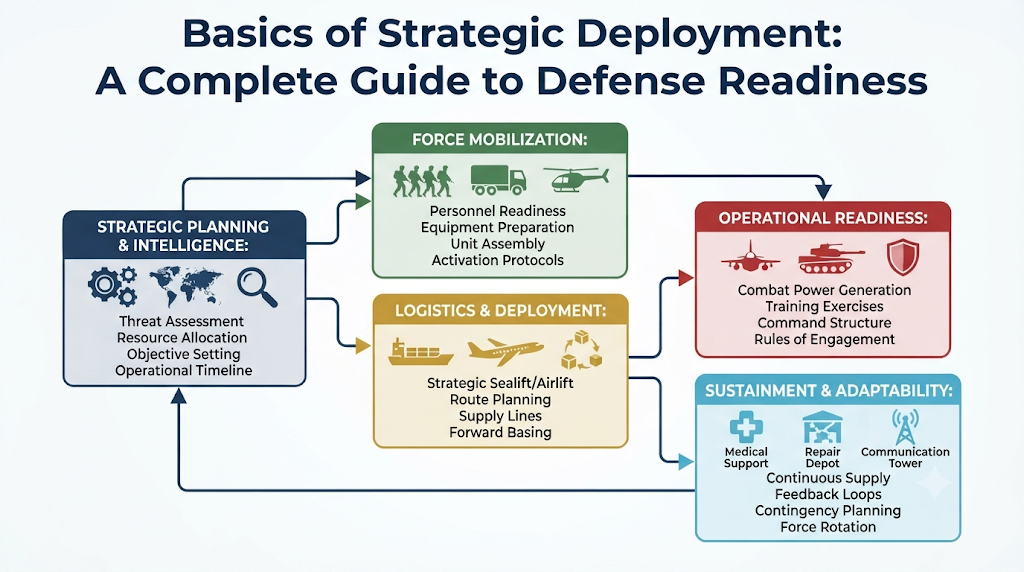
Understanding how defense organizations manage resources, balance geopolitical posture, and move assets globally is fundamental to national security and defense studies. At the highest levels of organizational planning, success depends on foresight, supply chain resilience, and unified command structures. This comprehensive guide introduces the basics of strategic deployment, breaking down the frameworks, planning processes, leadership demands, and technologies that allow defense systems to function effectively without diving into tactical maneuvers.
What is Strategic Deployment?
Strategic deployment is the high-level organizational process of positioning force elements, logistics networks, equipment, and support capabilities to align with national security objectives. Unlike localized movements, strategic deployment operates at macro-level scales, bridging overarching policy decisions with long-term operational readiness.
It involves non-combat administrative functions, long-range transportation coordination, interagency cooperation, and continuous risk assessment. The goal is to ensure forces are organized, positioned, and supported to deter potential threats or respond to crisis scenarios efficiently.
Why Strategic Deployment Matters
Strategic deployment serves as the backbone of strategic deterrence and stability. Proper deployment planning ensures that resource allocation aligns with declared policies and security goals.
- Deterrence: A visible, efficient deployment capability signals readiness to potential adversaries, reducing the likelihood of conflict.
- Resource Conservation: Well-planned deployment prevents resource waste, ensuring materials, transport assets, and personnel are utilized efficiently.
- Agility: Establishing clear deployment corridors and logistical nodes allows defense structures to respond rapidly to humanitarian crises, international obligations, or emerging threats.
- National Policy Support: It directly translates abstract defense strategy into tangible capabilities across geographic regions.
Strategic Deployment vs. Tactical Deployment
Understanding the distinction between strategic and tactical deployment is crucial for security studies students and researchers.
| Feature / Aspect | Strategic Deployment | Tactical Deployment |
| Primary Scope | Global, theater-wide, national security level | Localized operational area, battlefield level |
| Time Horizon | Long-term planning (months to years) | Short-term execution (hours to days) |
| Core Objective | Position resources and align capabilities with policy goals | Execute specific localized missions or force positioning |
| Key Actors | High-level leadership, government ministries, joint commanders | Unit leaders, tactical commanders, field personnel |
| Logistical Focus | Trans-oceanic sealift, airlift networks, industrial supply chains | Local distribution, immediate resupply, tactical movement |
| Decision Support | High-level defense analytics, macro-level data models | Immediate situational awareness, real-time field data |
Objectives of Strategic Deployment
The primary goal of strategic deployment goes beyond physical movement. It encompasses broader organizational goals:
- Achieving Force Readiness: Ensuring all units are fully equipped, trained, and supported prior to movement.
- Establishing Logistical Hubs: Creating secure, accessible supply chains and forward support positions.
- Maintaining Strategic Balance: Positioning assets in a manner that supports regional stability without escalating tensions.
- Ensuring Interoperability: Coordinating diverse branches, civil agencies, and allied networks under a unified framework.
Core Principles of Strategic Deployment
Strategic deployment frameworks rest on fundamental principles refined through decades of defense administration and strategic studies:
- Unity of Effort: All participating agencies, military branches, and civil logistics partners must work toward shared, synchronized objectives.
- Flexibility: Plans must accommodate changing geopolitical landscapes, environmental factors, and resource availability.
- Economy of Force: Allocating resources efficiently ensures critical locations receive necessary support without overextending secondary areas.
- Security and Resilience: Protecting infrastructure, lines of communication, and digital networks against disruption during all phases of movement.
The Planning and Decision-Making Process
Developing a strategic deployment plan requires systemic, structured methodology:
[National Strategy & Policy Objectives]
                 │
                 ▼
    [Strategic Risk Assessment]
                 │
                 ▼
[Resource Allocation & Force Readiness Evaluation]
                 │
                 ▼
   [Transportation & Logistics Planning]
                 │
                 ▼
   [Execution & Continuous Assessment]
- Objective Identification: Aligning movement goals with overarching defense strategy guidelines.
- Assessment: Evaluating transport capacity, geographic constraints, host-nation support, and potential vulnerabilities.
- Resource Matching: Selecting appropriate organizational units, civil transport networks, and supply allocations.
- Coordination & Testing: Running simulations, strategic exercises, and table-top scenarios to identify friction points before execution.
Role of Leadership and Command Structures
Clear governance and leadership structures are essential for successful strategic deployment.
Command structures set priority frameworks, resolve inter-agency friction, and authorize resource usage. Military leadership at the strategic level focuses on long-range vision, clear communication, policy compliance, and civil-military coordination. Effective leadership maintains operational focus while managing complex organizational relationships.
Importance of Logistics and Supply Chain Support
Logistics forms the core of strategic deployment. Without structured military logistics, moving personnel or equipment is unsustainable.
Key elements of defense supply chain management include:
- Material Management: Tracking inventory levels, spare parts, and fuel reserves from depot to destination.
- Infrastructure Assessment: Evaluating deep-water ports, airfield capacities, rail networks, and road networks for heavy transport.
- Civil-Military Integration: Leveraging commercial shipping, civilian airlift fleets, and contractor support networks to expand transport capacity.
Transportation and Mobility: High-Level Overview
Strategic deployment relies on three primary modes of transportation, each offering distinct speed, capacity, and cost characteristics:
- Strategic Sealift: Handles bulk equipment, heavy machinery, and long-term sustainment supplies. Sealift carries the vast majority of physical weight in large-scale movements.
- Strategic Airlift: Rapid transportation mode used for critical personnel, high-priority logistics, and time-sensitive cargo.
- Ground and Rail Mobility: Essential for intra-continental movement, connecting inland depots to major sea and air departure nodes.
Communication and Coordination
Synchronizing global movements requires reliable communication frameworks. Strategic communication coordinates multiple domains, international partners, non-governmental entities, and civil transportation providers. Clear protocols prevent bottlenecks, avoid overlapping supply requests, and ensure transparent status updates across global command chains.
Intelligence and Situational Awareness
At the strategic level, intelligence focuses on macro-level environment analysis:
- Geopolitical Risk Monitoring: Tracking diplomatic developments, border policies, and regional stability.
- Infrastructure Mapping: Analyzing environmental conditions, transit route capacities, and potential logistical bottlenecks.
- Risk Assessment: Identifying non-tactical risks, such as extreme weather patterns, economic disruptions, or public health challenges along movement corridors.
Resource Allocation and Readiness
Maintaining operational readiness requires balancing active deployment needs with long-term sustainment. Resource management strategies ensure equipment maintenance schedules, personnel rotation policies, and strategic stockpiles remain balanced. Misallocating assets during initial deployment phases can lead to systemic strain across the entire organization later on.
Role of Technology in Modern Strategic Deployment
Modern defense technology has altered how organizations plan and track strategic movements.
Digital enterprise systems provide real-time visibility into global supply chains. Automated tracking systems, secure databases, and cloud-based management frameworks allow strategists to monitor equipment status, movement speeds, and depot levels across global networks.
AI, Data Analytics, and Digital Decision Support
Artificial intelligence and defense analytics enhance high-level decision-making processes:
- Predictive Maintenance: Machine learning algorithms forecast equipment failures before departure, ensuring higher force readiness.
- Route Optimization: Data analytics calculate optimal transportation routes by factoring in fuel efficiency, route capacities, weather trends, and transit restrictions.
- Scenario Modeling: Simulation software allows strategic planners to test thousands of deployment variables to evaluate risks before committing resources.
Cybersecurity Considerations in Defense Operations
Digital transformation introduces vulnerabilities across logistical and operational networks.
Cybersecurity planning protects strategic deployment integrity by securing civil-military supply chain software, safeguarding navigation systems, protecting port automation infrastructure, and ensuring secure communication lines between planning centers and transportation nodes.
Historical Examples of Strategic Deployment
Examining historical events provides clear educational insights into strategic deployment principles:
The Berlin Airlift (1948–1949)
1948 – 1949
Demonstrated strategic deployment focused purely on sustainment and humanitarian supply. It highlighted the power of organized airlift logistics, air traffic coordination, and continuous civil-military resource management under strict diplomatic constraints.
Operation Desert Shield (1990)
August 1990
Showcased massive multi-national strategic deployment, moving hundreds of thousands of personnel and millions of tons of material across global sea and air corridors to establish a defensive posture and deter further escalation.
NATO Exercise Trident Juncture (2018)
October 2018
Highlighted modern alliance-level deployment challenges. Involving around 50,000 participants across Scandinavia, it tested complex cross-border transit agreements, cold-weather logistics readiness, and multi-national command synchronization.
Challenges and Limitations
Even well-funded deployment strategies face major systemic challenges:
- Infrastructure Bottlenecks: Outdated ports, limited railway gauges, or insufficient airfield ramps can delay major movements.
- Bureaucratic Constraints: Cross-border clearances, transit rights, and diplomatic approvals require extended processing times.
- Supply Chain Vulnerabilities: Reliance on single-source suppliers or vulnerable maritime chokepoints introduces single points of failure.
Risk Management and Contingency Planning
Robust strategic planning relies on structured risk assessment frameworks:
- Identifying Vulnerabilities: Mapping critical dependencies across transportation, fuel, and communication networks.
- Developing Redundancies: Establishing alternative transit corridors, backup power grids, and secondary supply vendors.
- Dynamic Re-routing: Designing flexible planning frameworks that allow strategists to adjust deployment routes when encountering unexpected obstacles.
Best Practices in Strategic Planning
To maintain long-term institutional effectiveness, defense organizations follow established best practices:
- Inter-agency collaboration and standardized data protocols.
- Regular joint transport simulations and stress testing.
- Continuous evaluation of commercial logistics capabilities.
- Clear integration of environmental, economic, and policy assessments into foundational plans.
Future Trends in Defense Strategy and Deployment
The future of strategic deployment will be shaped by emerging global dynamics:
- Autonomous Logistics: Increasing adoption of autonomous cargo vessels, unmanned ground transport, and automated warehouse systems.
- Green Logistics & Energy Efficiency: Integrating alternative fuels and energy-efficient systems to reduce fuel dependencies along supply routes.
- Distributed Force Postures: Moving away from concentrated hubs toward flexible, distributed support networks to improve resilience.
Career Opportunities in Defense Strategy and Security Studies
Studying strategic deployment and logistics opens diverse career pathways across public and private sectors:
- Defense Policy Analyst: Evaluating national security frameworks, strategic readiness, and international security commitments.
- Supply Chain & Logistics Strategist: Managing complex global transport networks for government agencies or private defense contractors.
- Security Studies Researcher: Conducting academic or think-tank research on global military strategy, force posture, and deterrence.
- Operations Research Analyst: Utilizing data models and analytics to optimize organizational resource allocation and transportation systems.
Frequently Asked Questions
What is the main purpose of strategic deployment?
The primary purpose of strategic deployment is to align force posture, equipment, and logistical capabilities with overarching national security policy and strategic deterrence goals.
How does strategic deployment differ from tactical deployment?
Strategic deployment focuses on long-range, macro-level planning, resource allocation, and trans-continental logistics. Tactical deployment deals with localized movements, mission execution, and immediate force positioning in specific operational areas.
What role does logistics play in strategic deployment?
Logistics forms the core of strategic deployment. It manages inventory, supply chain continuity, transportation networks (sea, air, rail), and civil-military coordination necessary to move and sustain capabilities.
Why is force readiness critical to deployment planning?
Force readiness ensures that units, equipment, and personnel are fully prepared, maintained, and supported before movement begins, preventing delays and operational friction.
How do modern technologies impact strategic deployment?
Emerging technologies like AI, predictive data analytics, and digital supply chain tracking improve decision-making, optimize transport routes, predict maintenance needs, and increase global asset visibility.
What are common risks encountered during strategic deployment?
Common risks include infrastructure bottlenecks, diplomatic transit delays, supply chain disruptions, cyber vulnerabilities, and unexpected weather or environmental factors.
How does cybersecurity fit into deployment strategies?
Cybersecurity protects the digital systems, transport software, port automation, and communication channels that govern global deployment logistics from unauthorized interference or operational disruption.
What is strategic deterrence in the context of deployment?
Strategic deterrence involves visibly positioning capabilities and demonstrating robust deployment speed to discourage potential conflict and maintain regional stability.
What career fields focus on strategic deployment concepts?
Key career paths include defense strategy analysis, global logistics management, security studies research, operations research, national security policy development, and defense consulting.
How can students learn more about defense strategy and strategic planning?
Students can explore academic programs in security studies, strategic studies, and defense management, alongside reviewing open-source publications, policy research papers, and educational platforms like WarOpsX.com.
Conclusion
Strategic deployment serves as the indispensable link between high-level national security policy and operational readiness. Far beyond the physical movement of personnel and material, it is a complex discipline that relies on rigorous long-term planning, resilient supply chains, unified command structures, and cutting-edge digital technologies. By mastering the core principles of strategic deployment—from strategic sealift and airlift logistics to predictive AI analytics and cybersecurity—defense organizations ensure they can project stability, deter potential threats, and respond effectively to global crises. As geopolitical landscapes evolve and technology advances, the ability to plan and execute strategic deployment with flexibility, security, and efficiency will remain a cornerstone of global stability and professional security studies.