Introduction
Modern technology enterprises frequently watch infrastructure invoices outpace overall business revenue when engineering teams launch cloud environments without structured oversight. As microservices multiply and distributed workloads expand, managing dynamic infrastructure manually becomes an operational bottleneck. This friction leads to deployment delays, security vulnerabilities, and unpredictable system performance. To eliminate these challenges, organizations adopt structured practices to stabilize and scale their digital ecosystems. Effective cloud operations provide the structural foundation required to maintain high availability, security, and cost efficiency across distributed environments. Readers will learn how to build resilient workflows, implement robust automation, and apply industry-proven methodologies to manage complex cloud ecosystems. Whether you are scaling a startup platform or modernizing an enterprise data center, understanding these underlying principles helps teams maintain control over their infrastructure. For additional insights on optimizing release channels and system workflows, visit CloudOpsNow. This guide outlines core architectures, operational challenges, and practical frameworks to elevate your engineering practices.
What is Cloud Operations?
Cloud operations refers to the comprehensive set of processes, tooling, and methodologies used to deliver, manage, and optimize applications and infrastructure running in cloud environments. Its primary purpose is to ensure that cloud-native services remain reliable, secure, scalable, and cost-effective throughout their lifecycle.
Within the broader engineering landscape, cloud operations sits at the intersection of system administration, software engineering, and site reliability engineering (SRE). Engineering teams use it to transition away from reactive firefighting toward proactive ecosystem management. Developers, platform engineers, and cloud architects all benefit from standardized operational models that reduce manual overhead and prevent configuration drift across production environments.
How Does Cloud Operations Work?
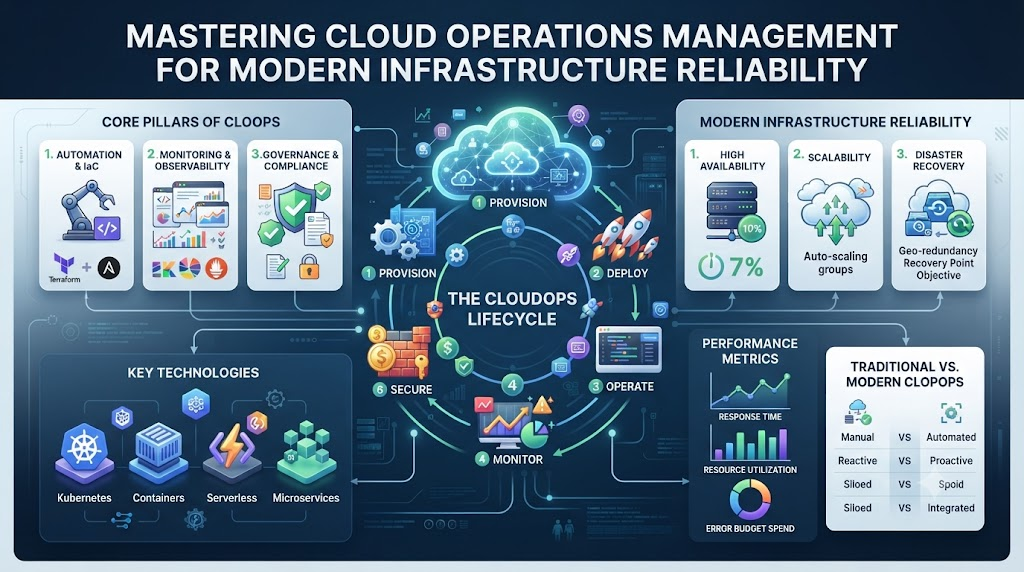
The operational workflow of cloud operations relies on continuous integration, automated provisioning, and real-time feedback loops. Rather than managing physical servers or manually configuring individual components, engineers define their entire infrastructure through code and manage it via API-driven automation pipelines.
- Infrastructure Provisioning: Engineers write declarative configuration files to define compute, storage, and networking layers.
- Version Control and CI/CD: Changes to infrastructure code undergo peer review and automated testing before deployment through continuous delivery pipelines.
- Deployment and Orchestration: Automated deployment tools roll out application binaries and container images to target clusters or serverless runtimes.
- Continuous Monitoring: Observability platforms ingest metrics, logs, and traces to track health and performance indicators in real time.
- Automated Remediation: Policy engines and monitoring alerts trigger automated workflows to scale resources or restart failing nodes without human intervention.
Core Components of Cloud Operations
Infrastructure as Code (IaC)
Infrastructure as Code forms the bedrock of predictable cloud environments. By treating server configurations, network topologies, and security groups as version-controlled code, teams eliminate manual setup discrepancies across staging and production stages.
Automation and Orchestration
Routine tasks such as user onboarding, database backups, and certificate rotations require programmatic execution. Orchestration engines tie these discrete actions into cohesive workflows that execute reliably on demand.
Monitoring and Observability
Maintaining visibility into distributed systems requires collecting granular telemetry data. Modern setups decouple basic metric collection from deep distributed tracing, allowing engineers to pinpoint latency bottlenecks instantly.
Role of AWS, Azure, and GCP
Major public cloud providers offer proprietary services tailored for cloud operations management, yet each platform approaches tooling through distinct ecosystems. Amazon Web Services provides robust infrastructure automation via AWS CloudFormation and AWS Systems Manager, giving teams deep control over native resource primitives. Microsoft Azure integrates tightly with Azure Resource Manager and Azure Arc, making it a strong choice for organizations blending hybrid data centers with native cloud capabilities. Google Cloud Platform emphasizes container orchestration and data analytics through Google Kubernetes Engine and Cloud Operations suite (formerly Stackdriver), streamlining high-scale telemetry ingestion. Navigating multi cloud management effectively requires understanding these provider-specific nuances to prevent vendor lock-in while leveraging native platform advantages.
Cloud Operations and Automation Considerations
Achieving efficiency in modern cloud operations requires a commitment to eliminating toil through intelligent tooling. Infrastructure automation reduces human error during repetitive provisioning tasks, ensuring that development environments mirror production architectures accurately. Teams leverage declarative frameworks like Terraform alongside container orchestrators like Kubernetes to maintain consistent behavior across distributed clusters. Furthermore, implementing policy-as-code frameworks ensures that security guardrails are evaluated automatically during the pull request stage, preventing non-compliant configurations from ever reaching production environments.
Monitoring, Observability, and Reliability
A resilient infrastructure requires a clear separation between simple monitoring and deep observability. While monitoring tells engineers whether a system is working, observability helps them understand why a system is failing.
- Metrics: Numerical time-series data tracking CPU utilization, request rates, and error percentages.
- Logs: Immutable event records detailing application execution paths and transactional states.
- Traces: Request lifecycles tracked across microservice boundaries to identify latency anomalies.
Teams tie these telemetry signals directly to Service Level Objectives (SLOs) and error budgets. This data-driven approach ensures that alerting thresholds reflect actual user experience rather than arbitrary system spikes, minimizing alert fatigue.
Security and Governance
Security in distributed cloud environments demands a zero-trust model where every access request undergoes rigorous authentication and authorization. Cloud infrastructure management frameworks enforce the principle of least privilege through centralized identity providers and fine-grained role-based access control policies. Secrets management tools securely inject database credentials and API keys into runtime environments without exposing them in source code repositories. Continuous compliance auditing tools scan active configurations against industry benchmarks, flagging misconfigured storage buckets or open security groups before malicious actors can exploit them.
Best Practices
- Standardize Infrastructure Definitions: Always use version-controlled Infrastructure as Code templates rather than manual cloud console modifications to prevent configuration drift.
- Establish Proactive Alerting: Configure alerts based on user-centric SLO burn rates rather than raw resource saturation to reduce unnecessary nocturnal pages.
- Automate Routine Remediation: Implement self-healing mechanisms that automatically restart unresponsive containers or scale out worker nodes during traffic surges.
- Enforce Least Privilege Access: Restrict human and machine permissions to the absolute minimum required for operational duties.
- Conduct Regular Chaos Engineering: Proactively inject failures into staging environments to test system resilience and validate incident response runbooks.
- Optimize Costs Continuously: Review resource utilization regularly, leveraging right-sizing recommendations and automated scheduling for non-production workloads.
Common Mistakes
- Relying on Manual Configuration: Making direct changes via cloud provider consoles destroys environment reproducibility and obscures audit trails.
- Ignoring Observability Gaps: Deploying applications without tracing or centralized logging makes root-cause analysis nearly impossible during critical outages.
- Over-Provisioning Resources: Leaving instances running at low utilization without autoscaling policies leads to runaway cloud expenditure.
- Neglecting Disaster Recovery Testing: Assuming backups work without performing periodic restoration drills often results in extended downtime during actual emergencies.
- Creating Alert Overload: Setting up noisy, unrefined alerts trains engineers to ignore critical warning signals.
Real-World Use Cases
- Kubernetes Platform Operations: Managing multi-tenant container platforms where automated node scaling and pod health checks maintain high application availability.
- Global E-Commerce Scalability: Handling sudden traffic surges during flash sales by dynamically scaling compute infrastructure across multiple availability zones.
- Multi-Cloud Disaster Recovery: Maintaining synchronized secondary replicas across alternate cloud providers to ensure seamless business continuity during regional provider outages.
Challenges and Limitations
Despite its benefits, implementing mature cloud operations introduces distinct challenges. Tool sprawl remains a constant hurdle, as organizations accumulate disparate utilities for logging, security scanning, and deployment orchestration. Furthermore, the specialized skill sets required to manage modern containerized and serverless environments create hiring and training bottlenecks. Operational overhead can also escalate if automation pipelines are poorly designed, turning simple maintenance tasks into complex debugging exercises.
Step-by-Step Implementation Guide
- Assess Existing Workloads: Audit current infrastructure dependencies, performance bottlenecks, and security postures across all active cloud environments.
- Define Operational Policies: Establish clear naming conventions, tagging strategies, compliance standards, and access control matrices.
- Implement Infrastructure as Code: Migrate manual resource definitions into modular, version-controlled IaC repositories.
- Establish CI/CD Pipelines: Build automated testing and deployment workflows to streamline software delivery from commit to production.
- Deploy Observability Stack: Centralize metrics, logs, and distributed tracing to establish comprehensive baseline visibility.
- Refine and Iterate: Review incident post-mortems regularly to update automation routines and continuously improve system resilience.
Future of Cloud Operations
The future of cloud operations is increasingly driven by artificial intelligence and machine learning integrations, commonly referred to as AIOps. Predictive analytics engines will soon forecast capacity bottlenecks before they impact end users, enabling truly autonomous infrastructure healing. Platform engineering will continue to abstract underlying cloud complexities, providing developers with internal self-service portals that combine speed with built-in governance. As multi-cloud architectures mature, unified control planes will simplify operations across heterogeneous provider ecosystems.
Frequently Asked Questions
- What is the primary goal of cloud operations?
The primary goal of cloud operations is to ensure that cloud-based applications and infrastructure remain reliable, secure, scalable, and cost-efficient through automated management and continuous optimization practices.
- How does cloud operations differ from traditional IT operations?
Traditional IT operations focuses heavily on physical hardware, manual rack-and-stack maintenance, and static data center management. In contrast, cloud operations utilizes API-driven automation, virtualized infrastructure, and software-defined architectures.
- Why is Infrastructure as Code important for cloudops?
Infrastructure as Code allows teams to treat environment provisioning like software development, ensuring complete environment reproducibility, version tracking, and elimination of manual configuration errors.
- What role does observability play in cloud infrastructure management?
Observability provides deep telemetry insights into distributed microservices, enabling engineers to trace request paths, analyze log outputs, and diagnose complex performance degradation rapidly.
- How can organizations manage multi-cloud environments effectively?
Organizations succeed in multi-cloud management by standardizing their tooling layers, utilizing cloud-agnostic automation frameworks, and maintaining centralized visibility across disparate provider dashboards.
- What are the key metrics tracked in cloud monitoring?
Key metrics include CPU and memory utilization, network throughput, request latency, error rates, and infrastructure cost distribution across active services.
- How does automation reduce operational overhead?
Automation handles repetitive, error-prone tasks such as server provisioning, security patching, and scaling adjustments, freeing engineering teams to focus on core product innovation.
- What security measures are essential for cloud operations?
Essential security measures include enforcing least-privilege access controls, implementing end-to-end encryption, managing secrets securely, and conducting continuous configuration compliance audits.
- How do cloud teams handle unexpected system outages?
Teams utilize predefined incident response runbooks, automated alerting thresholds tied to SLO burn rates, and fast rollback mechanisms within their continuous deployment pipelines.
- What skills are required for a cloud operations engineer?
Engineers need strong proficiency in scripting languages, container orchestration tools, networking fundamentals, security principles, and declarative infrastructure configuration frameworks.
Conclusion
Mastering cloud operations is essential for organizations aiming to build resilient, scalable, and cost-efficient digital products. By moving away from brittle manual configurations and embracing robust automation, infrastructure as code, and deep observability, engineering teams can navigate complexity with confidence. Effective cloud operations bridges the gap between rapid software delivery and uncompromising infrastructure stability. Organizations that prioritize these structured practices will continue to scale sustainably in an increasingly cloud-native world.