Introduction
In any security or defense environment, information is one of the most critical assets. Decision-makers cannot respond effectively to dynamic situations without knowing what is happening in their surrounding environment. To make informed, timely, and safe choices, leaders need reliable insights rather than guesswork. To explore more about defense technologies and global security frameworks, you can visit WarOpsX. This is where intelligence, surveillance, and reconnaissance comes into play. Often referred to as ISR, this comprehensive framework helps organizations collect, observe, analyze, and share critical information. NATO describes Joint ISR as an essential capability that provides vital situational awareness across land, air, sea, space, and cyber domains, ensuring that decision-makers understand their operational environments.
Quick Overview
To understand how the individual components fit together, review the foundational elements below:
| ISR Element | Simple Meaning | Main Purpose |
| Intelligence | Analyzed information | Support understanding and decisions |
| Surveillance | Ongoing observation | Monitor changes over time |
| Reconnaissance | Focused information gathering | Answer specific questions |
| Processing | Organizing collected information | Make information usable |
| Analysis | Interpreting information | Develop assessments |
| Dissemination | Sharing relevant outputs | Get information to appropriate decision-makers |
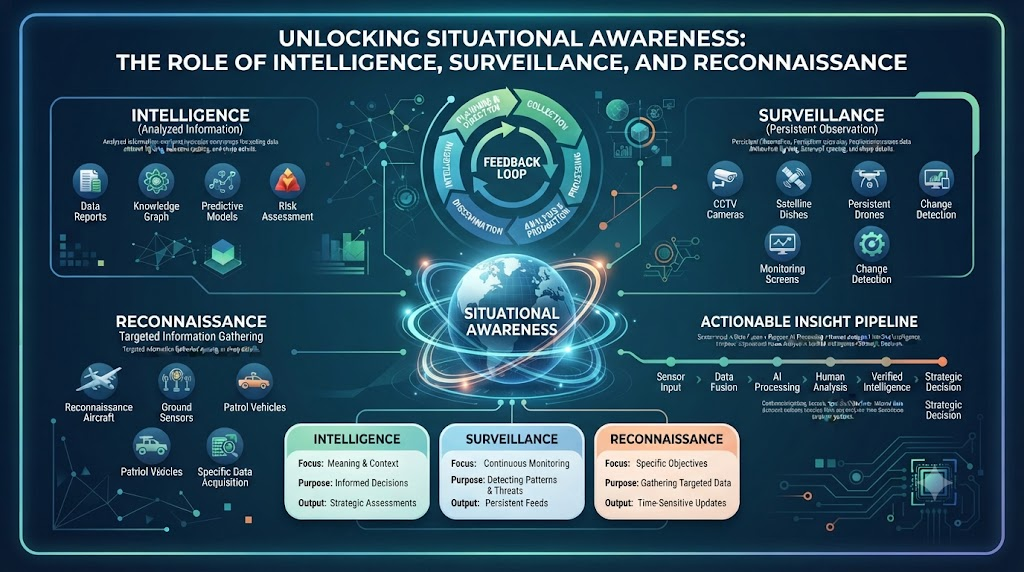
ISR is best understood as an integrated process rather than three completely separate activities. Each component feeds into the next, transforming raw data into actionable knowledge.
What Is Intelligence, Surveillance, and Reconnaissance?
At its core, ISR brings together collection, processing, analysis, assessment, and sharing. Raw observations do not automatically become intelligence. Instead, raw information must be evaluated, interpreted, and placed into proper context before it can support informed decisions.
Modern ISR combines information from many different sources to create a coherent picture of an environment. NATO describes ISR as the coordination of multi-domain sources to gather and share information among appropriate participants. Without this integrated approach, organizations face data overload without true understanding.
Understanding the Three Parts of ISR
Intelligence
Intelligence represents the analyzed and assessed product created from collected information and other relevant sources. It moves beyond raw data by adding context, evaluating reliability, and identifying patterns. Good intelligence should always communicate uncertainty where appropriate, helping decision-makers weigh risks effectively.
Surveillance
Surveillance involves the systematic or persistent observation of an area, object, activity, or environment. It focuses on prolonged monitoring to detect changes over time. Surveillance systems observe environments continuously or at regular intervals to track movement patterns and developments.
Reconnaissance
Reconnaissance is a focused information-gathering activity intended to answer a particular question or obtain information about a specific area or subject. Unlike continuous surveillance, reconnaissance is time-bounded and directed toward a specific information requirement.
NATO explicitly distinguishes surveillance by its persistent nature and reconnaissance by its focus on answering a specific military question.
How ISR Works as a Cycle
The intelligence cycle is a continuous process that ensures decision-makers receive relevant information.
- Information Requirement: A decision-maker identifies what specific information is needed.
- Collection: Relevant information is gathered through appropriate sources and sensors.
- Processing: Raw information is organized, translated, and prepared for analytical review.
- Analysis: Analysts identify patterns, relationships, inconsistencies, and relevant context.
- Assessment: Analysts develop an informed evaluation based on the analyzed data.
- Dissemination: Relevant intelligence is shared securely with authorized recipients.
- Feedback: New information creates new questions and helps update previous assessments.
Major Sources of ISR Information
Imagery Intelligence
Imagery intelligence helps analysts understand physical locations, infrastructure layouts, environmental changes, and movement patterns through visual data captured by various sensors.
Signals Intelligence
Signals-related collection provides information derived from electromagnetic or communication-related sources at a high level. It helps map communication networks and electronic activity without relying solely on visual observation.
Human Intelligence
Human intelligence relies on information gathered from people and human reporting. This source requires rigorous source evaluation, corroboration, context checks, and reliability assessments to ensure accuracy.
Geospatial Intelligence
Geospatial intelligence integrates geographic information, maps, imagery, and location-based data to provide a comprehensive spatial understanding of an area.
Open-Source Information
Publicly available information, reports, and media can sometimes contribute valuable context to broader intelligence analysis when properly vetted.
ISR Platforms and Technologies
Modern ISR relies on a diverse ecosystem of platforms designed to operate across different domains.
- Space-Based Systems: Earth observation satellites and remote sensing platforms provide large-area observation and regular revisit patterns.
- Airborne Systems: Aircraft and uncrewed aerial systems carry specialized sensors for persistent airborne observation.
- Ground-Based Systems: Fixed and mobile sensing equipment monitor local environments and border regions.
- Maritime Systems: Surface vessels and underwater sensing arrays monitor ocean environments.
- Networked Systems: Modern ISR depends heavily on secure communication networks to connect platforms and analysts.
Role of Sensors in ISR
Sensors are the frontline tools that generate raw information for ISR systems. Common sensor types include:
- Optical: Captures high-resolution visual imagery.
- Infrared: Detects heat signatures and operates effectively in low-light conditions.
- Radar: Uses radio waves to map terrain and detect movement regardless of weather.
- Radio-frequency: Detects electronic emissions.
- Acoustic and Environmental: Measures sound waves and atmospheric changes.
Different sensors have unique strengths and limitations, meaning no single sensor provides a complete picture on its own.
Sensor Fusion and Multi-Source Analysis
Sensor fusion is the process of combining data from multiple sources to create a unified, accurate picture. For example, one sensor may show what is visible, another may measure electronic signals, and historical records can provide context.
Combining these inputs helps analysts develop a more complete understanding. However, fusion does not eliminate errors. Analysts must continuously evaluate data quality, source reliability, timing, and missing information.
ISR and Situational Awareness
Situational awareness is the ability to perceive, understand, and anticipate environmental conditions. The basic cognitive progression follows a clear path: Observe → Understand → Assess → Decide.
ISR supports this progression by helping leaders understand what is happening, where it is happening, and how conditions change. However, ISR does not provide infallible omniscience; uncertainty and information gaps are permanent realities in complex environments.
How ISR Supports Decision-Making
Information is only valuable if it reaches decision-makers in a useful, timely format. Effective ISR prioritizes accuracy, relevance, context, and confidence over sheer volume.
A system that produces excessive data without proper filtering creates overload rather than clarity. Better information always outweighs mere data accumulation.
ISR Across Different Domains
- Land: Focuses on ground-level observation, terrain mapping, and local security monitoring.
- Air: Involves airborne sensing, airspace monitoring, and wide-area surveillance.
- Maritime: Covers open-ocean tracking, coastal monitoring, and underwater situational awareness.
- Space: Utilizes satellite networks for global observation and secure communication relay.
- Cyber: Encompasses digital network monitoring and threat intelligence at a conceptual level.
Role of Uncrewed Systems in ISR
Uncrewed systems have become vital components of modern ISR frameworks. They offer persistent observation, remote sensing, and flexible deployment while reducing personal risk in hazardous environments. The International Institute for Strategic Studies (IISS) notes that uncrewed aerial vehicles have evolved from niche tools into central elements of modern defense inventories.
Role of AI and Automation in ISR
Artificial intelligence and automation assist analysts by handling repetitive data tasks such as image classification, anomaly detection, pattern recognition, and data filtering.
While AI helps manage large data volumes, it does not replace human judgment. Potential limitations such as false positives, algorithmic bias, and poor training data mean that human oversight remains essential.
Importance of Data Processing and Analysis
Collecting raw data is only the first step. The transformation pipeline—Raw Data → Processed Data → Information → Analysis → Intelligence—requires rigorous metadata management, timeliness, corroboration, and contextual review to produce valuable outputs.
Common Challenges in ISR
- Data Overload: Excessive raw information can overwhelm analytical pipelines.
- Information Gaps: Blind spots inevitably exist across monitored environments.
- Interoperability: Differing system architectures can hinder seamless data sharing.
- Communications: Reliable pathways are required to transmit data across long distances.
- Data Quality: Incomplete or flawed inputs lead to faulty assessments.
- Deception: Adversaries may use camouflage or misinformation to confuse observers.
- Time Pressure: Decision-makers often demand immediate insights.
- Security: Sensitive intelligence requires robust protection against unauthorized access.
ISR and Information Sharing
Effective ISR depends on seamless information sharing across allied organizations and coalition partners. Achieving a common operating picture requires standardized data formats, secure communication channels, and appropriate access controls. NATO highlights that information-sharing frameworks must balance security requirements with the need for rapid coordination.
Ethical and Legal Considerations
Responsible ISR operations require strict adherence to legal frameworks, privacy standards, civilian protection, and human oversight. While surveillance technologies serve vital security functions, they must be governed by transparent rules to protect privacy and civil liberties.
Practical Conceptual Example
Consider a civilian disaster-response organization assessing an evolving regional emergency:
- Requirement: Leaders need to know which supply routes remain passable following severe weather.
- Collection: Satellites and aerial sensors capture updated imagery of the region.
- Processing: Imagery specialists orthorectify and organize the visual data.
- Analysis: Analysts compare current imagery with historical baseline maps to identify blocked roads and flooded bridges.
- Assessment: The team concludes that the primary northern highway is impassable, but southern routes remain open.
- Dissemination: The assessment is shared with logistics coordinators, enabling safe and efficient aid delivery.
ISR vs Surveillance vs Reconnaissance
| Concept | Main Focus | Typical Characteristic |
| Intelligence | Analysis and assessment | Turns information into useful understanding |
| Surveillance | Observation | Persistent or systematic monitoring |
| Reconnaissance | Information gathering | Focused on specific questions |
| ISR | Integrated framework | Combines collection, analysis, and dissemination |
Common Misunderstandings About ISR
- “ISR Means Only Drones”: ISR utilizes satellites, ground sensors, human reports, and maritime platforms alongside uncrewed systems.
- “Surveillance and Reconnaissance Are the Same”: Surveillance is continuous and broad, whereas reconnaissance is targeted and time-bound.
- “More Sensors Always Mean Better ISR”: Data quality and analysis matter far more than sheer volume.
- “AI Can Replace Intelligence Analysts”: AI assists with data processing, but human context and judgment remain irreplaceable.
- “ISR Provides Perfect Information”: Uncertainty and incomplete data are constant factors in any operational environment.
Best Practices for Understanding ISR
- Learn the distinct definitions of intelligence, surveillance, and reconnaissance.
- Familiarize yourself with the stages of the intelligence cycle.
- Study the capabilities and limitations of various sensor types.
- Understand how data fusion reduces uncertainty.
- Prioritize data quality and source reliability over data quantity.
- Follow responsible, ethical, and lawful use principles.
Future of ISR
Future ISR trends point toward increased automation, advanced multi-domain sensor fusion, distributed micro-sensors, expanded space-based observation, and faster edge-processing capabilities. As technology evolves, human-machine collaboration will remain central to turning complex data into reliable understanding.
FAQs
What does ISR stand for?
ISR stands for Intelligence, Surveillance, and Reconnaissance. It represents an integrated framework used to collect, process, analyze, and share information to support decision-making.
What is intelligence in ISR?
Intelligence is the analyzed and assessed product derived from processed information and other sources, providing contextual understanding to decision-makers.
What is surveillance in ISR?
Surveillance is the systematic or persistent observation of an area, object, or activity to monitor changes and track patterns over time.
What is reconnaissance in ISR?
Reconnaissance is a focused, time-bounded information-gathering activity designed to answer a specific question or inspect a particular target.
How are intelligence, surveillance, and reconnaissance connected?
Surveillance and reconnaissance act as collection methods that gather raw data, which is then analyzed and assessed to produce actionable intelligence within the ISR cycle.
What technologies are commonly used in ISR?
Common technologies include optical and infrared cameras, radar systems, satellites, uncrewed aerial vehicles, and secure communication networks.
What is sensor fusion in ISR?
Sensor fusion is the process of combining data from multiple sensors and sources to create a more accurate, comprehensive, and reliable operational picture.
How does AI support ISR?
AI helps automate image classification, anomaly detection, data filtering, and pattern recognition, allowing analysts to process large volumes of information more efficiently.
Why is ISR important for situational awareness?
ISR provides leaders with the timely and relevant information needed to understand environmental conditions, assess risks, and make informed decisions.
What are the main challenges of modern ISR?
Key challenges include data overload, information gaps, system interoperability, communication security, and the presence of deceptive information.
Conclusion
ISR is an essential framework that transforms raw observations into actionable understanding. By integrating intelligence, surveillance, and reconnaissance through structured cycles and advanced sensor technologies, decision-makers gain vital situational awareness. As technology advances with AI and sensor fusion, maintaining data quality, rigorous human analysis, and responsible use principles will remain critical for effective operations.