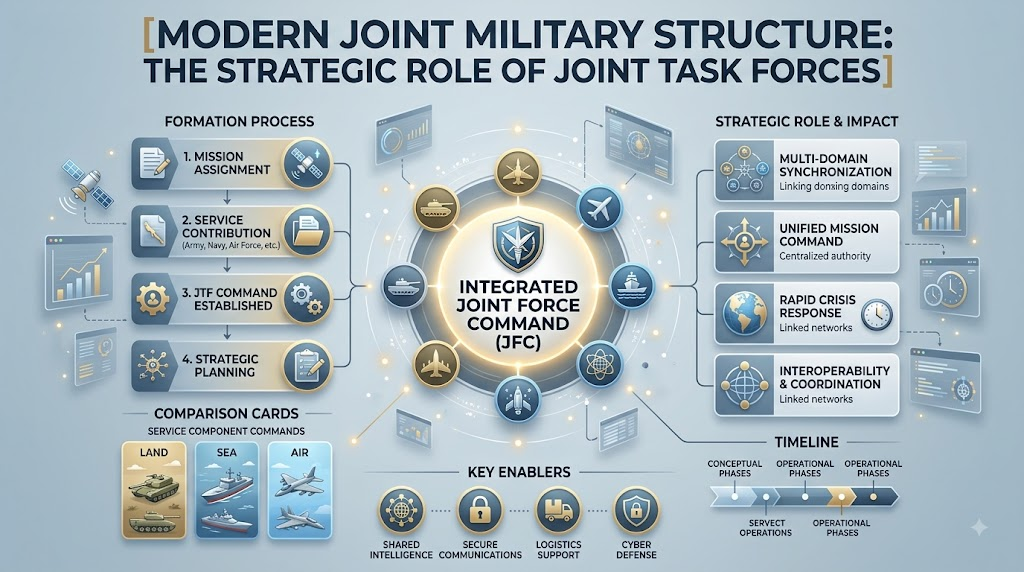
Modern military missions frequently involve more than one branch of the armed forces. Depending on the operational environment, land, air, maritime, cyber, space, or specialized capabilities may need to operate together toward a single objective. A Joint Task Force (JTF) is an organizational structure designed to bring personnel and capabilities from different military services together under a unified command arrangement for a specific mission or timeframe. You can explore foundational defense frameworks and military analysis at WarOpsX.com. The exact structure, operational authority, and composition of a Joint Task Force depend heavily on the nation, its legal framework, the defense organization, and the assigned operational mandate. This guide examines what Joint Task Forces are, why defense organizations create them, how they establish command and control, how different service components coordinate, and why interoperability remains central to modern defense operations.
What Is a Joint Task Force?
To understand a Joint Task Force, it helps to break down the two terms:
- Joint: Refers to activities, operations, or organizations in which elements of more than one military service (such as the Army, Navy, Air Force, or Marines) participate under a unified authority.
- Task Force: Refers to a temporary or mission-focused grouping of units and resources established to accomplish a specific, limited objective.
A Joint Task Force is primarily an organizational and command framework rather than a fixed, standing military unit. It provides a formal system where units from distinct branches integrate temporarily, conduct operations, and return to their parent services once the mission concludes.
+-----------------------------------------------------------+
|               Joint Task Force (JTF)                      |
|  (Temporary organizational framework for a specific goal) |
+-----------------------------------------------------------+
          |                      |                    |
          v                      v                    v
+------------------+   +------------------+   +------------------+
|  Land Component  |   | Maritime Element |   |   Air Element    |
|     (Army)       |   |     (Navy)       |   |   (Air Force)    |
+------------------+   +------------------+   +------------------+
Why Are Joint Task Forces Created?
Modern defense requirements often exceed the capabilities of any single military branch. Establishing a joint command architecture provides several operational advantages:
- Complex Mission Requirements: Operations requiring simultaneous activity across land, sea, air, and digital spaces require unified planning.
- Integration of Capabilities: Combining intelligence, long-range transport, surveillance, and ground personnel creates operational synergies.
- Unified Command: Placing diverse forces under a single designated commander prevents conflicting orders and clarifies operational authority.
- Streamlined Coordination: Direct staff integration reduces administrative friction between independent service headquarters.
- Geographic or Functional Focus: JTFs can be tailored to manage a specific region or address a dedicated objective, such as maritime security.
- Crisis Response: When urgent situations develop, establishing a JTF allows defense leaders to assemble necessary capabilities without restructuring permanent commands.
- Humanitarian Assistance and Disaster Response: Joint forces deliver engineering, heavy-lift transport, medical care, and logistics coordination following major emergencies.
- Large-Scale Multi-Service Exercises: Nations establish temporary JTFs during training events to test interoperability and doctrine before operational deployments.
- Multidomain Synchronization: Integrating space, cyber, and electronic assets with conventional formations requires centralized synchronization.
Joint vs. Single-Service Operations
Operating as a joint organization introduces distinct organizational characteristics compared to operations conducted within a single service branch.
| Factor | Single-Service Organization | Joint Task Force |
| Participating Services | Single military branch (e.g., Army only) | Two or more military services working together |
| Command Structure | Branch-specific chain of command | Unified Joint Force Commander |
| Mission Focus | Branch-specific operational scope | Multidomain, comprehensive mission objectives |
| Coordination | Standardized internal procedures | Cross-service coordination mechanisms |
| Resource Integration | Internal service asset allocation | Shared, cross-branch capability management |
| Planning Complexity | Lower (shared doctrine and vocabulary) | Higher (reconciling disparate service systems) |
| Interoperability Requirements | Standardized internal requirements | Critical cross-system and cultural integration |
Operating jointly introduces operational complexity because different military services often have distinct organizational cultures, specialized communication systems, administrative workflows, and operational terminology.
Basic Structure of a Joint Task Force
While the exact configuration varies according to mission scale and national military doctrine, a Joint Task Force typically utilizes a standardized hierarchical structure:
                  +-----------------------------------+
                  |   Joint Task Force Commander      |
                  |     (Overall Strategic Direction) |
                  +-----------------------------------+
                                    |
                                    v
                  +-----------------------------------+
                  |            Joint Staff            |
                  |   (J1, J2, J3, J4, J5, J6, etc.)  |
                  +-----------------------------------+
                                    |
     +-----------------+------------+------------+-----------------+
     |                 |                         |                 |
     v                 v                         v                 v
+------------+   +-------------+          +-------------+   +--------------+
| Army Comp. |   | Navy Comp.  |          | Air Comp.   |   | Specialized  |
|  (Ground)  |   | (Maritime)  |          | (Aviation)  |   | Supporting   |
+------------+   +-------------+          +-------------+   |  Elements    |
                                                            +--------------+
1. Joint Task Force Commander (JTFC)
The commander exercises operational authority over all assigned and attached forces. This officer provides strategic vision, defines operational priorities, directs planning efforts, and maintains accountability for overall mission execution.
2. Joint Staff
The joint staff consists of officers and specialists drawn from all participating service branches. Organized into functional sections, the staff assists the commander with personnel management, intelligence integration, current operations, logistics planning, strategic development, and communications architecture.
3. Service Components
The core operational capabilities are typically grouped into component commands (e.g., land, maritime, air, or special operations). Each component commander oversees the tactical execution of assets within their respective operating environment.
4. Supporting Elements
Depending on the mission profile, specialized units—such as military engineers, legal advisors, medical teams, public affairs liaisons, and civil-military coordination cells—provide vital operational support.
Understanding Joint Command and Control
Command and Control (C2) represents the exercise of authority and direction by a designated commander over assigned forces to accomplish a mission.
[Leadership] ---> [Planning] ---> [Coordination] ---> [Execution Oversight] ---> [Assessment]
- Leadership: Establishing clear objectives, establishing boundaries, and assigning operational responsibilities.
- Planning: Formulating synchronized courses of action across distinct operating environments.
- Coordination: Aligning schedules, resource requests, and operational sectors across service boundaries.
- Execution Oversight: Monitoring operational activities and adapting to real-time events.
- Assessment: Continuously evaluating operational progress against established milestones to refine future decisions.
Command and control becomes more complex in a joint setting because leaders must coordinate disparate communications networks, reconcile different planning cadences, and bridge branch-specific organizational habits.
Role of the Joint Staff
A joint staff transforms broad command guidance into coordinated organizational action. Without an integrated staff, a commander cannot direct operations across multiple military services.
+-------------------------------------------------------------------------+
|                  Standard Joint Staff Designations                      |
+-------------------------------------------------------------------------+
| J1: Manpower & Personnel     | J4: Logistics & Sustainment              |
| J2: Intelligence             | J5: Strategic Plans & Policy             |
| J3: Operations               | J6: Communications & Information Systems |
+-------------------------------------------------------------------------+
- Operations Planning (J3): Coordinates day-to-day operations and synchronizes current actions across components.
- Intelligence Integration (J2): Fuses intelligence collection from ground, maritime, aerial, and orbital sensors into a unified operational picture.
- Logistics Coordination (J4): Balances transportation capacity, fuel, medical supplies, and maintenance capabilities across branches.
- Communications Architecture (J6): Builds shared data links, radio networks, and digital infrastructure to ensure continuous connectivity.
- Personnel and Administration (J1): Tracks human resources, personnel assignments, and service-specific administrative requirements.
- Strategic Plans and Policy (J5): Focuses on mid-to-long-range operational forecasting, branch plans, and transition phases.
Service Components in a Joint Task Force
A joint organization leverages the distinct advantages of each branch to create a comprehensive force:
+-------------------+---------------------------------------------------+
| Component         | Core Operational Contribution                     |
+-------------------+---------------------------------------------------+
| Army / Land       | Terrestrial presence, area security, engineering  |
| Navy / Maritime   | Sea-lane security, sealift, coastal surveillance  |
| Air Force / Air   | Strategic airlift, reconnaissance, air management |
| Marine / Amphib.  | Rapid expeditionary entry, littoral capabilities  |
| Space & Cyber     | Satellite communications, network defense, GPS    |
+-------------------+---------------------------------------------------+
- Army Component: Delivers ground capabilities, large-scale engineering, infrastructure security, and long-term territorial stabilization.
- Navy Component: Controls maritime approaches, provides strategic sealift, offers offshore medical and power facilities, and secures surface lines of communication.
- Air Force Component: Delivers rapid global airlift, high-altitude surveillance, airspace management, and flexible logistical support.
- Marine Component: Provides expeditionary capabilities, amphibious landing assets, and specialized crisis response units.
- Space and Cyber Elements: Modern military operations rely on space systems for satellite communications, meteorology, and precision positioning, alongside cyber units that defend mission-critical networks.
Organizational models vary globally; some nations integrate these components through permanent joint functional commands, while others assemble them on an ad-hoc basis.
Importance of Interoperability
Interoperability is the ability of different organizations, technical systems, and personnel to operate together effectively toward shared objectives.
+-------------------------------------------------------------------+
|                    Pillars of Interoperability                    |
+-----------------------------------+-------------------------------+
| Technical Interoperability        | Procedural Interoperability   |
| - Compatible radios               | - Standard operating orders   |
| - Shared data formats             | - Shared planning cycles      |
| - Secure cross-network links      | - Common reporting rules      |
+-----------------------------------+-------------------------------+
| Human Interoperability            | Doctrinal Interoperability    |
| - Shared military vocabulary      | - Aligned operational concepts|
| - Mutual service familiarity      | - Clear command relationships |
+-----------------------------------+-------------------------------+
- Communication Compatibility: Hardware and software must be able to exchange voice and digital data without manual re-entry or translation delays.
- Shared Terminology: Military branches often use different terms to describe the same event. Standardized operational vocabularies prevent misunderstandings.
- Common Operating Procedures: Standardizing reports, request formats, and decision-making steps ensures predictability across the organization.
- Integrated Training: Regular joint exercises ensure personnel understand how other services plan, communicate, and operate.
Analogy: Consider a multi-hospital disaster response team. Even if doctors, paramedics, and nurses are highly skilled in their individual fields, they cannot work effectively if their radios use different frequencies, their medical records use conflicting formats, or they assign different meanings to urgent triage codes.
Joint Communications and Information Sharing
Reliable communications infrastructure forms the backbone of joint operations. When diverse services deploy together, commanders require an integrated, shared situational awareness framework.
[Service Sensor / Unit] ---> [Joint Communications Node] ---> [Common Operational Picture]
- Information Flow: Data must move vertically from field units to leadership, and horizontally between adjacent service components.
- Common Operational Picture (COP): Staff elements combine maps, unit positions, weather data, and logistics updates into a single shared display.
- Standardized Reporting: Using structured reporting formats ensures that situation updates remain clear and concise.
- Data Exchange: Modern joint organizations rely on standardized data links to connect disparate platforms across services.
Joint Planning at a Conceptual Level
Joint planning aligns mission requirements with available cross-service capabilities through structured, sequential phases:
[1. Mission Analysis]
        |
        v
[2. Capability Assessment]
        |
        v
[3. Courses of Action Development]
        |
        v
[4. Synchronization & Coordination]
        |
        v
[5. Execution & Ongoing Assessment]
- Mission Analysis: The joint staff analyzes leadership directives, identifies key tasks, and establishes the operational scope.
- Capability Assessment: Planners evaluate the assets, personnel, and support equipment available across participating branches.
- Courses of Action Development: The staff designs alternative concepts for achieving the assigned objectives.
- Synchronization and Coordination: Planners align logistics timelines, communication channels, and command boundaries between components.
- Execution and Ongoing Assessment: As operations commence, staff elements monitor progress, compare real-world outcomes against milestones, and recommend operational adjustments.
Logistics and Support in Joint Task Forces
Logistics encompasses the planning and execution of force movement and sustainment. Within a Joint Task Force, logistics requires coordinating diverse supply chains and maintenance systems:
- Movement and Transportation: Synchronizing military cargo aircraft, commercial shipping, and ground convoys.
- Supply and Sustainment: Managing branch-specific fuel standards, equipment parts, food, and water.
- Medical Support and Evacuation: Integrating ground medical stations, shipboard hospitals, and aeromedical evacuation platforms.
- Equipment Maintenance: Managing specialized tools, replacement components, and qualified technicians for diverse hardware inventories.
- Facilities and Engineering: Establishing base camps, clearing transportation routes, and ensuring access to potable water and electrical power.
Training and Exercises
Conducting joint training exercises before real-world crises occur helps military organizations uncover procedural flaws and build operational trust.
| Factor | Service-Specific Training | Joint Training |
| Primary Scope | Branch-specific skills and tactics | Multidomain coordination and integration |
| Participant Base | Single service branch | Multi-service personnel and joint staffs |
| Focus Area | Equipment handling, unit drills | Command and control, cross-service C2, COP |
| Logistics Model | Standard internal service supply chain | Integrated multi-service sustainment systems |
| Primary Goal | Branch technical proficiency | Cross-branch interoperability and synergy |
Joint exercises allow forces to identify technical bottlenecks, streamline staff coordination, and familiarize officers with sister-service operational methods.
Joint Task Forces and Multidomain Operations
Modern military thought emphasizes multidomain operations, requiring forces to coordinate activities across multiple physical and non-physical domains:
               +----------------------------------+
               |     Multidomain Environment      |
               +----------------------------------+
                 /        |         |        \
                v         v         v         v
            +------+  +-------+  +-----+  +---------+
            | Land |  | Space |  | Air |  | Cyber & |
            |   &  |  |       |  |  &  |  | Inform. |
            | Sea  |  |       |  | Space| | Systems |
            +------+  +-------+  +-----+  +---------+
- Land Domain: Ground operations, urban support, and territory stabilization.
- Maritime Domain: Surface, subsurface, and coastal operations.
- Air Domain: Transport, atmospheric reconnaissance, and air-traffic deconfliction.
- Space Domain: Satellite tracking, position-navigation-timing (GPS) services, and orbital communication links.
- Cyber and Information Domains: Defense of digital infrastructure, network monitoring, and data management.
A JTF provides the single command framework needed to synchronize activities across these domains, preventing redundant efforts and ensuring actions in one domain support another.
Joint Task Forces in Humanitarian Assistance
Joint Task Forces frequently deploy to non-combat emergencies, such as natural disaster relief operations, where diverse capabilities are required immediately:
- Heavy-Lift Transport: Air Force cargo planes move urgent supplies, while Army and Navy helicopters distribute aid to isolated locations.
- Medical Care: Navy hospital vessels provide surgical facilities, while ground services deploy field clinics.
- Logistics and Engineering: Army engineers clear debris and restore bridges, while naval units produce fresh water through onboard desalinization plants.
- Communications: Specialized military signal units restore local communication networks for disaster response managers.
- Civil-Military Coordination: The JTF establishes liaison channels with local emergency agencies, international organizations, and NGOs.
Hypothetical Joint Task Force Example
To see how a JTF functions, consider this hypothetical disaster-response scenario:
[Disaster Event] ---> [Establish JTF Command] ---> [Deploy Service Components]
                                                            |
                 +------------------------------------------+
                 |
                 v
+--------------------------------------------------------------------------+
| - Air Component: Delivers emergency field hospitals via heavy airlift     |
| - Maritime Component: Deploys desalinization ships and offshore medical  |
| - Land Component: Clears blocked roads and coordinates aid distribution  |
| - Joint Staff: Manages communications, logistics, and civilian liaisons  |
+--------------------------------------------------------------------------+
                 |
                 v
     [Mission Complete & Disestablishment]
- Mission Requirement: A severe natural disaster affects coastal regions, isolating communities and destroying civilian infrastructure.
- JTF Activation: Military leadership appoints a Joint Task Force Commander and activates an integrated joint staff.
- Component Tasking:
- Air Component: Establishes an air bridge to fly relief supplies into regional hubs.
- Maritime Component: Positions vessels offshore to supply clean drinking water, electrical power, and trauma medical care.
- Land Component: Deploys engineering units to reopen roads and manage distribution points.
- Coordination and Support: The JTF staff synchronizes transport schedules, updates common operational maps, and interfaces with regional disaster agencies.
- Assessment and Transition: As civilian infrastructure recovers, the JTF hands operations over to local authorities, disestablishes its staff, and returns units to their parent services.
Benefits of Joint Task Forces
+---------------------------------------------------------------------------+
|                          10 Core Benefits of a JTF                        |
+---------------------------------------------------------------------------+
| 1. Unified Leadership          | 6. Flexible Organizational Design        |
| 2. Enhanced Coordination       | 7. Shared Situational Awareness          |
| 3. Combined Capabilities       | 8. Faster Cross-Branch Decision Cycles   |
| 4. Optimized Resource Use      | 9. Integrated Logistics Sustainment      |
| 5. Enhanced Interoperability   | 10. Effective Complex Mission Management|
+---------------------------------------------------------------------------+
- Unified Leadership: Establishes a single clear authority responsible for all assigned military resources.
- Enhanced Coordination: Connects services directly through integrated joint planning staffs.
- Combined Capabilities: Integrates the unique operational strengths of land, sea, air, space, and cyber branches.
- Optimized Resource Use: Reduces wasteful duplication of equipment and support infrastructure.
- Enhanced Interoperability: Encourages the development of shared procedures, technical standards, and vocabularies.
- Flexible Organizational Design: Allows defense leaders to scale the force up or down based on operational needs.
- Shared Situational Awareness: Provides a synchronized common operational picture for all participating branches.
- Faster Cross-Branch Decision Cycles: Collocated staff teams process operational requests faster than separate service headquarters.
- Integrated Logistics Sustainment: Consolidates supply lines, medical networks, and transportation pipelines.
- Effective Complex Mission Management: Provides the command structure necessary to navigate multidomain environments.
Challenges of Joint Task Forces
While beneficial, joint organizations must manage several operational challenges:
+---------------------------------------------------------------------------+
|                         10 Core Challenges of a JTF                       |
+---------------------------------------------------------------------------+
| 1. Distinct Service Cultures   | 6. Resource Competition                  |
| 2. Divergent Terminology       | 7. Training Variances                    |
| 3. Technical Incompatibilities | 8. Information Bottlenecks               |
| 4. System Integration Costs    | 9. Inter-Service Friction                |
| 5. Command Layer Complexity    | 10. Varied Operating Procedures          |
+---------------------------------------------------------------------------+
- Distinct Service Cultures: Each branch has unique traditions, operational styles, and organizational mindsets.
- Divergent Terminology: Different definitions for standard operational phrases can lead to misunderstandings.
- Technical Incompatibilities: Legacy radio systems, software, and data links often require dedicated translation gateways.
- System Integration Costs: Designing and maintaining interoperable systems requires significant long-term investment.
- Command Layer Complexity: Adding a joint headquarters layer can occasionally slow urgent administrative workflows.
- Resource Competition: Service components may compete for high-demand assets, such as aerial transport or surveillance systems.
- Training Variances: Differences in technical education and procedural habits across branches can create friction.
- Information Bottlenecks: Security classification boundaries between services can impede data sharing.
- Inter-Service Friction: Professional disagreements over doctrine or resource allocation can complicate coordination.
- Varied Operating Procedures: Reconciling service-specific safety standards, maintenance cadences, and reporting rules takes time.
These challenges are typically addressed through joint professional military education, standardized communication protocols, and regular joint field exercises.
Joint Task Forces and Technology
Modern technology plays a key role in connecting diverse military services:
- Digital Communications Networks: High-bandwidth satellite links allow joint staffs to maintain constant connectivity with component units.
- Common Operating Platforms: Software systems fuse radar, map, video, and logistical data into a synchronized digital picture.
- Decision-Support Software: Computational tools assist staff officers in evaluating logistics requirements and resource timelines.
- Advanced Simulation: Synthetic training environments allow joint staffs to practice decision-making in realistic scenarios without expensive field deployments.
- Geographic Information Systems (GIS): Layered spatial data provides precise information on terrain, weather, and transport routes.
- Cloud and Edge Architecture: Decentralized servers allow forward-deployed elements to access critical planning databases reliably.
- Cybersecurity Frameworks: Secure network architectures protect sensitive joint command streams from disruption.
Role of AI in Joint Operations
Artificial intelligence is emerging as a functional decision-support capability for joint staff organizations:
- Data Aggregation and Triage: Processing vast streams of sensor data and unstructured reports into organized summaries for human analysts.
- Logistics Forecasting: Identifying potential maintenance issues, fuel shortages, and supply bottlenecks before they disrupt operations.
- Simulation and Wargaming: Running complex logistical simulations to evaluate the viability of alternative courses of action.
- Administrative Automation: Automating routine administrative tasks, report compilation, and data reformatting across services.
In a responsible military framework, artificial intelligence functions as an analytical aid that enhances human judgment rather than replacing human command responsibility.
Joint Task Force vs. Coalition Force
While both combine diverse military elements, Joint Forces and Coalition Forces operate under different political and legal frameworks:
| Factor | Joint Task Force | Coalition Force |
| Participating Nations | Typically a single nation’s military services | Multiple sovereign nations operating together |
| Services Involved | Multiple services (Army, Navy, Air Force) | Varied branches from multiple national militaries |
| Command Chain | Unified national chain of command | Multinational command via diplomatic consensus |
| Interoperability | Technical and doctrinal harmonization | Multi-language, legal, and national system integration |
| Legal Framework | Governed by single national defense law | Governed by international treaties and national mandates |
| Coordination | Higher internal integration | Complex diplomatic and operational coordination |
Some real-world military missions operate as Combined Joint Task Forces (CJTF), integrating multiple military services from several partner nations under an agreed multinational command framework.
Joint Task Forces and Readiness
Joint readiness reflects an organization’s actual ability to assemble, deploy, and execute operations smoothly across service boundaries:
+---------------------------------------------------------------+
|                 Key Pillars of Joint Readiness                |
+---------------------------------------------------------------+
| - Personnel: Staff trained in joint planning and doctrine     |
| - Systems: Cross-compatible hardware and communication links  |
| - Logistics: Interoperable maintenance, fuel, and medical care|
| - Leadership: Commanders experienced in multi-service assets  |
| - Exercises: Regular testing in simulated, high-stress events |
+---------------------------------------------------------------+
Assessing readiness through structured evaluations helps defense organizations discover interoperability gaps during peacetime rather than during crisis deployments.
How to Study Joint Task Forces as a Beginner
If you are new to strategic and military studies, use this structured learning roadmap:
[Level 1: Fundamentals]
  ├── Step 1: Learn Basic Military Organization
  ├── Step 2: Understand the Roles of Different Military Services
  └── Step 3: Learn Joint Operations Terminology
            |
            v
[Level 2: Command & Systems]
  ├── Step 4: Study Command and Control (C2) Principles
  ├── Step 5: Learn Interoperability Basics
  └── Step 6: Explore Military Logistics Concepts
            |
            v
[Level 3: Strategic Integration]
  ├── Step 7: Study Historical Joint Operations
  ├── Step 8: Understand Multidomain Concepts
  ├── Step 9: Follow Modern Defense Technology
  └── Step 10: Compare Different Countries' Organizational Models
- Learn Basic Military Organization: Understand how military formations are organized hierarchically, from squads to divisions.
- Understand the Roles of Different Military Services: Study what land, maritime, air, space, and cyber forces do individually.
- Learn Joint Operations Terminology: Familiarize yourself with basic terms like component commands, unified command, and task forces.
- Study Command and Control (C2) Principles: Explore how authority, information, and orders flow from commanders to subordinate units.
- Learn Interoperability Basics: Examine how services connect their communications, software, and operational procedures.
- Explore Military Logistics Concepts: Learn how fuel, food, transportation, and medical support sustain deployments.
- Study Historical Joint Operations: Review well-documented historical joint campaigns to see how inter-service coordination succeeded or struggled.
- Understand Multidomain Concepts: Study how modern defense planners integrate physical and non-physical domains.
- Follow Modern Defense Technology: Keep up with open-source research on military networks, artificial intelligence, and communications systems.
- Compare Different Countries’ Organizational Models: Review how different armed forces organize their joint defense structures.
Common Misconceptions About Joint Task Forces
- Misconception 1: A JTF is always a permanent organization.Correction: Most JTFs are temporary structures established for a specific operational requirement and dissolved upon mission completion.
- Misconception 2: A JTF is strictly combat-focused.Correction: JTFs frequently manage humanitarian relief, disaster recovery, security cooperation, and multi-agency exercises.
- Misconception 3: Every JTF follows the exact same organizational blueprint.Correction: JTF structures are tailored to the mission, geographical area, available assets, and participating branches.
- Misconception 4: “Joint” and “Coalition” mean the same thing.Correction: “Joint” refers to multiple services within the same nation, while “Coalition” or “Combined” refers to multiple nations working together.
- Misconception 5: Creating a JTF automatically resolves all coordination friction.Correction: A JTF provides the framework for coordination, but ongoing effort, shared training, and open communication are required to overcome inter-service friction.
- Misconception 6: One specific military branch always commands every JTF.Correction: Commanders are typically selected based on the nature of the mission and the dominant operating environment involved.
- Misconception 7: Advanced technology alone guarantees full interoperability.Correction: Technology must be supported by shared doctrine, common terminology, and regular joint training to be effective.
- Misconception 8: Joint operations simply mean services operating in the same place.Correction: Joint operations require actively synchronizing and integrating plans, command structures, and actions under a unified leader.
Educational Resources on WarOpsX.com
For students, researchers, and defense analysts, WarOpsX.com provides clear educational material on defense topics, including:
- Military Organization: High-level breakdowns of how modern defense establishments structure their commands.
- Joint Operations: Articles on cross-service coordination, unified command, and operational planning.
- Strategic Deployment Concepts: Conceptual overviews of military mobility, logistics chains, and rapid response operations.
- Combat Readiness Frameworks: Explanations of how militaries evaluate training, technical readiness, and resource availability.
- Defense Technology: Balanced analyses of digital communications, sensor fusion, artificial intelligence, and simulation systems.
- Multidomain Operations: Guides examining how land, maritime, air, cyber, and space capabilities integrate.
The Future of Joint Task Forces
The evolution of joint defense organizations is shaped by emerging strategic and technological trends:
- Tighter Multidomain Synchronization: Future JTFs will need to coordinate operations across space, cyber, and physical domains even more rapidly.
- AI-Assisted Decision Support: Automated data aggregation will help joint staffs process information faster and identify operational options.
- Integration of Unmanned Systems: Coordinating autonomous reconnaissance and logistics platforms alongside conventional formations.
- Resilient, Distributed Command Frameworks: Operating through decentralized command networks to maintain continuity if primary communication nodes are disrupted.
- Cross-Nation Interoperability: Increasing technical and procedural compatibility with international partners for combined operations.
Frequently Asked Questions
What is a Joint Task Force?
A Joint Task Force (JTF) is a temporary military organization that brings together personnel and capabilities from two or more military services under a unified commander to accomplish a specific mission.
Why are Joint Task Forces created?
They are established to provide unified command, combine complementary branch capabilities, streamline multi-service planning, and address complex operational requirements such as crisis response, disaster relief, or major exercises.
What does “joint” mean in military operations?
In military terminology, “joint” describes activities, operations, organizations, or doctrines in which elements of more than one military service from the same nation participate under unified leadership.
How is a Joint Task Force organized?
A typical JTF includes a designated Joint Task Force Commander, a multi-service Joint Staff (covering personnel, intelligence, operations, logistics, plans, and communications), and component commands representing land, maritime, air, and specialized capabilities.
What is joint command and control?
Joint command and control (C2) is the exercise of authority and operational direction by a designated joint commander over multi-service forces to synchronize actions and achieve mission objectives.
Why is interoperability important in joint operations?
Interoperability allows different services to share data, use compatible communications, apply shared terminology, and follow standardized procedures. Without it, separate branches risk operational friction and delays.
What is the difference between a joint force and a coalition force?
A joint force combines multiple service branches from a single country under one command, whereas a coalition force brings together military units from multiple independent nations.
Are Joint Task Forces permanent?
Most Joint Task Forces are temporary organizational structures created for a specific mission or timeframe and are dissolved once their operational objectives are met.
How does technology support Joint Task Forces?
Technology provides integrated digital communication networks, common operational pictures, automated logistics forecasting, geographic mapping, and secure data-sharing platforms that connect separate services.
How can beginners learn about Joint Task Forces?
Beginners can start by learning basic military organizational hierarchies, studying the roles of individual military branches, reviewing shared operational terminology, and reading open-source educational guides on defense platforms like WarOpsX.com.
Conclusion
A Joint Task Force represents the practical synthesis of unified leadership, diverse military capabilities, disciplined coordination, and a focused mission. By bringing together land, maritime, air, cyber, and space assets into a single cohesive framework, defense organizations can solve complex strategic and humanitarian challenges far more effectively than any single branch operating in isolation. Mastering the joint environment ultimately depends on the strength of core fundamentals: clear command and control, reliable interoperability, secure communications, integrated logistics, rigorous multi-service training, and adaptive leadership. As defense operations increasingly shift toward multidomain integration and data-driven decision-making, understanding how Joint Task Forces are structured and led provides an essential foundation for exploring modern military organization and defense strategy.