Introduction
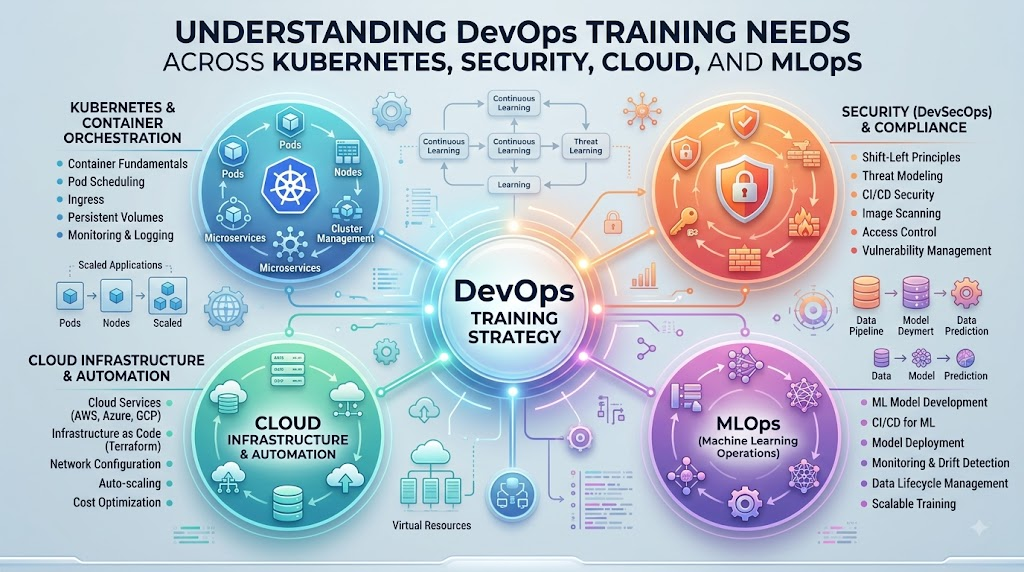
Software engineering teams are working in environments that change much faster than they did in the past. Cloud platforms, automated delivery pipelines, containers, Infrastructure as Code, security automation, observability, and machine-learning systems have all become part of modern technology operations. As these areas expand, teams need people who can understand not only individual tools but also how those tools work together. This creates a training challenge for both professionals and organizations. A team may adopt a cloud platform without having strong cloud operations knowledge. Engineers may create CI/CD pipelines but struggle when releases fail. A company may introduce Kubernetes while its team is still learning how to troubleshoot containerized workloads. Practical DevOps training can provide a structured way to develop these capabilities. Instead of concentrating entirely on terminology and theory, effective programs combine explanations with demonstrations, exercises, troubleshooting, and realistic scenarios. The choice of trainer and learning approach is therefore important. The right program should reflect the learner’s experience, the organization’s technology environment, and the skills that need to be developed.
What Does a DevOps Trainer Actually Do?
A DevOps Trainer helps learners understand the practices used to automate software delivery, manage infrastructure, operate applications, and improve collaboration between engineering functions.
The scope of training can vary considerably. Beginners may start with version control, DevOps principles, CI/CD concepts, and basic automation. More experienced engineers may move directly into cloud architecture, Kubernetes, Infrastructure as Code, observability, security, or production troubleshooting.
A trainer can use demonstrations to explain how technologies work and then allow learners to reproduce those activities in a controlled environment. For example, participants might create a CI/CD pipeline, build an application image, provision infrastructure, deploy a workload, and monitor the resulting environment.
Troubleshooting is another important part of the trainer’s role. Learners should not only see successful deployments. They should also understand what happens when a configuration is incorrect, a deployment fails, a service becomes unavailable, or a pipeline produces an unexpected result.
This makes practical training different from a purely theoretical course. The objective is to develop understanding that can be applied to real technical situations.
Why DevOps Skills Matter to Modern Teams
DevOps practices increasingly influence many parts of software engineering. Development teams are expected to work with automated delivery, operations teams manage increasingly dynamic infrastructure, and security teams integrate controls into development workflows.
This creates a need for cross-functional technical understanding.
Some common reasons organizations invest in DevOps learning include:
- Cloud adoption
- Automation requirements
- CI/CD implementation
- Containerization
- Infrastructure management
- Security integration
- Production reliability
- Skills development
- Developer productivity
- Technology modernization
Training can help employees develop a shared understanding of these areas. A developer who understands deployment processes can collaborate more effectively with platform teams. Similarly, infrastructure engineers who understand application delivery can make better decisions about deployment environments.
However, training should not be treated as a replacement for engineering experience. Production systems introduce real constraints that cannot always be simulated during a course. Training is most valuable when learners continue applying what they have learned through projects, operational work, reviews, and experimentation.
Making Corporate DevOps Training Relevant
Corporate DevOps Training should be designed around the organization rather than simply copied from a general-purpose course.
Different companies can have very different requirements. One organization may operate primarily on AWS and need better CI/CD automation, while another may use Azure and be preparing for Kubernetes adoption. A third may already have a mature platform but need stronger security and reliability practices.
A corporate program can be adapted around:
- Current technology platforms
- Team responsibilities
- Employee experience
- Business priorities
- Existing engineering processes
- Security requirements
- Cloud architecture
- Operational challenges
Customized workshops can also use scenarios that resemble the organization’s engineering environment. Confidential production information does not need to be exposed; training examples can be designed around similar technical patterns.
Team-based learning can provide another advantage. When developers, infrastructure engineers, security professionals, and operations teams learn together, they can develop a common vocabulary and better understand each other’s responsibilities.
The objective should be useful capability rather than maximum topic coverage.
Online DevOps Trainer: What Makes Remote Learning Effective?
An Online DevOps Trainer can provide live technical instruction to professionals and distributed teams without requiring everyone to be physically present in the same location.
Remote learning can include:
- Live virtual sessions
- Screen-sharing demonstrations
- Remote lab environments
- Interactive discussions
- Technical assignments
- Troubleshooting exercises
- Digital learning material
- Recorded sessions when appropriate
This format can be particularly convenient for organizations with employees in multiple locations.
At the same time, online learning has limitations. Learners may experience network problems, differences in local environments, or difficulty configuring their systems. Long sessions that depend heavily on lectures can also reduce participation.
For this reason, remote DevOps learning should be interactive. Learners should spend meaningful time performing technical tasks rather than simply watching the trainer.
A virtual format is neither automatically superior nor inferior to classroom training. The better choice depends on the learners, infrastructure, course design, and practical requirements.
Selecting a DevOps Trainer in India
Choosing a DevOps Trainer in India requires more than looking for someone who knows a large number of technologies. A trainer needs both technical depth and the ability to communicate that knowledge effectively.
A useful evaluation can begin with practical experience. Consider whether the trainer understands areas such as:
- CI/CD
- Cloud platforms
- Containers
- Infrastructure as Code
- Automation
- Monitoring
- Troubleshooting
- Production operations
The next consideration is teaching methodology. Ask whether learners will work through practical labs, architecture exercises, deployment scenarios, and failure investigations.
Curriculum flexibility is also valuable. Experienced engineers may not need the same level of foundational instruction as beginners. Similarly, a Kubernetes-focused team should not spend most of its training time on unrelated technologies.
Communication should be evaluated as well. Complex technical concepts need to be explained clearly, especially when participants have different backgrounds.
Most importantly, technical expertise and teaching expertise should be considered separately. Being a strong engineer does not automatically mean someone will be an effective trainer.
What Should Kubernetes Training Include?
Kubernetes is a powerful platform, but its operational complexity means that training should cover more than basic commands.
A Kubernetes Trainer can introduce the architecture first and then build toward application deployment, networking, security, monitoring, and troubleshooting.
Important subjects may include:
- Kubernetes architecture
- Pods
- Deployments
- Services
- ConfigMaps
- Secrets
- Networking
- Storage
- Scaling
- Helm
- Monitoring
- Security
- Cluster administration
- Troubleshooting
- Production operations
Practical exercises are particularly useful here. Learners can deploy applications, expose services, update workloads, inspect logs, investigate failed rollouts, and correct configuration problems.
Cloud-managed Kubernetes services can provide additional context. AWS EKS, Azure AKS, and Google GKE allow learners to understand how Kubernetes is operated within different cloud environments.
A good course should help learners understand what Kubernetes is doing behind a configuration, rather than encouraging them to memorize YAML without understanding it.
AWS DevOps Trainer and Cloud-Based Delivery
An AWS DevOps Trainer can help learners understand how AWS services can support development, deployment, infrastructure automation, and monitoring.
Training may include services and practices such as:
- EC2
- EKS
- ECS
- Lambda
- Terraform
- CloudFormation
- CI/CD
- Cloud monitoring
- Infrastructure automation
The focus should be on relationships between these components.
For example, a practical workflow can demonstrate how code moves from source control through automated testing and deployment. Another exercise can show how Infrastructure as Code creates repeatable environments.
Learners should also become familiar with operational considerations such as access control, monitoring, deployment strategies, environment separation, and failure recovery.
AWS offers multiple ways to solve many engineering problems, so training should teach learners to evaluate architectural options rather than memorize a fixed service combination.
Azure DevOps Trainer and Automated Delivery
An Azure DevOps Trainer can help teams understand application delivery and infrastructure automation using Azure-based services and workflows.
Possible areas include:
- Azure Pipelines
- AKS
- Azure infrastructure
- Infrastructure as Code
- Release automation
- CI/CD
- Monitoring
- Deployment processes
- Production operations
A useful practical exercise can follow an application through the delivery lifecycle. Learners can work with source code, automated validation, artifact creation, infrastructure, deployment, and monitoring.
Training should also discuss what happens when things go wrong. Release failures, environment differences, configuration mistakes, and deployment rollback are all relevant operational concerns.
This gives learners a more complete picture of Azure DevOps than simply learning how to configure individual pipeline features.
DevSecOps Trainer: Integrating Security Into Delivery
Security is increasingly becoming part of everyday software engineering. Instead of treating security as a final checkpoint, teams can introduce appropriate controls throughout the development and delivery lifecycle.
A DevSecOps Trainer may cover:
- Secure CI/CD
- SAST
- DAST
- Dependency scanning
- Container security
- Secrets management
- Vulnerability management
- Security automation
- Compliance automation
Hands-on exercises can demonstrate how security checks operate within a pipeline and how teams respond when a vulnerability is identified.
It is also important to understand that security scanners do not automatically determine the correct business response. Findings need to be evaluated and prioritized according to their context, severity, exploitability, and organizational requirements.
The broader objective is to develop security awareness among engineers and make secure practices part of normal delivery processes.
SRE Trainer and Reliability-Focused Learning
Site Reliability Engineering approaches reliability as an engineering problem rather than simply an operational responsibility.
An SRE Trainer can introduce concepts including:
- SLI
- SLO
- SLA
- Error budgets
- Observability
- Incident management
- Root-cause analysis
- Capacity planning
- Performance engineering
- Reliability automation
Learners should understand how reliability objectives can influence technical decisions.
For example, teams can examine application metrics and determine whether a service is meeting its defined objectives. Incident exercises can simulate service degradation and allow learners to practice investigation, mitigation, communication, and post-incident analysis.
Observability should also be connected to real operational questions. Metrics, logs, and traces are useful when they help engineers understand what is happening inside a system.
The emphasis should be on engineering practices that make reliability measurable and manageable.
MLOps Trainer and Operational Machine Learning
Machine-learning systems introduce another layer of operational complexity. A model that works during development still needs appropriate processes when it becomes part of a production application.
An MLOps Trainer can cover:
- ML pipelines
- Model deployment
- Model monitoring
- Version management
- Automation
- ML infrastructure
- Cloud environments
- Production operations
- Scalability
MLOps brings together machine-learning development and operational practices. Teams need repeatable processes for moving models through environments, monitoring their behavior, managing versions, and maintaining the supporting infrastructure.
The specific tooling can differ considerably between organizations. Therefore, MLOps training should focus on concepts and workflows as well as particular technologies.
DevOps Training Technology Areas
| Training Area | Common Technologies / Practices | Learning Focus |
|---|---|---|
| CI/CD | Jenkins, GitHub Actions, GitLab CI/CD, Azure Pipelines | Automated delivery |
| Cloud | AWS, Azure, Google Cloud | Cloud operations |
| Containers | Docker, Kubernetes | Containerized workloads |
| Infrastructure as Code | Terraform, CloudFormation | Automated infrastructure |
| Security | SAST, DAST, secrets management | Secure delivery |
| Monitoring | Metrics, logs, traces | Observability |
| SRE | SLI, SLO, error budgets | Reliability |
| MLOps | ML pipelines, model monitoring | Production ML |
The technologies shown here are common examples rather than a complete DevOps technology stack. The right combination depends on the team’s architecture and goals.
Why Practical Labs Are Important
Hands-on labs help bridge the gap between knowing a concept and being able to use it.
A learner may understand what a CI/CD pipeline is after reading documentation, but building a pipeline introduces practical questions about triggers, dependencies, testing, credentials, artifacts, and deployment environments.
Similarly, creating a Kubernetes deployment is useful, but troubleshooting a failed Pod can provide a deeper understanding of networking, configuration, resources, and logs.
Practical training can help develop:
- Automation skills
- Cloud familiarity
- CI/CD knowledge
- Troubleshooting ability
- Infrastructure awareness
- Security awareness
- Reliability thinking
- Technical confidence
A good lab environment should provide enough freedom for learners to experiment. Failure should be treated as part of the learning process.
Common Problems With DevOps Training
1. Excessive Theory
A course dominated by presentations may provide definitions without developing practical ability.
2. Tool-Centered Learning
Teaching many tools without explaining their purpose can leave learners confused.
3. Insufficient Labs
DevOps concepts are difficult to master without practical application.
4. Outdated Material
Training should reflect technologies and engineering practices relevant to current environments.
5. One Curriculum for Everyone
Different learners have different responsibilities and levels of experience.
6. Ignoring Troubleshooting
Engineers need to know how to investigate failures, not only create successful deployments.
7. Treating Security Separately
Security should be connected with development, infrastructure, and delivery processes.
8. Skipping Cloud Concepts
Cloud knowledge is important when organizations rely on cloud infrastructure.
9. Too Much Content in Too Little Time
Trying to cover every possible DevOps technology can reduce learning depth.
10. No Continued Practice
DevOps skills require reinforcement through projects and regular engineering work.
How to Assess a DevOps Training Program
Organizations can create a simple evaluation framework before selecting a training program.
First, review the trainer’s technical background and teaching approach. Then compare the curriculum with the organization’s current technology environment and future objectives.
Practical learning should be examined carefully. Determine whether participants will actually build, configure, deploy, monitor, and troubleshoot systems.
A program can also be evaluated on:
- Trainer experience
- Technical depth
- Course structure
- Lab quality
- Cloud coverage
- Kubernetes coverage
- CI/CD coverage
- Security coverage
- SRE concepts
- MLOps awareness
- Troubleshooting scenarios
- Documentation
- Assessments
- Learning resources
- Ongoing support
For corporate programs, knowledge transfer is another important consideration. Training should ideally give teams enough material and practice to continue developing their skills after the formal sessions end.
Training Area and Learning Need
| Training Area | Typical Learning Need |
| DevOps Training | Understand automation and delivery practices |
| Corporate DevOps Training | Build team-wide DevOps capabilities |
| Online DevOps Training | Learn remotely with flexible access |
| Kubernetes Training | Manage container orchestration environments |
| AWS DevOps Training | Learn AWS-based DevOps workflows |
| Azure DevOps Training | Understand Azure delivery and automation |
| DevSecOps Training | Integrate security into software delivery |
| SRE Training | Learn reliability engineering practices |
| MLOps Training | Operate machine-learning systems in production |
FAQ
What does a DevOps Trainer teach?
A DevOps Trainer can teach CI/CD, cloud technologies, automation, containers, Infrastructure as Code, monitoring, troubleshooting, and production practices. The specific curriculum should match the learners’ requirements.
Why do companies use Corporate DevOps Training?
Organizations may use team-based training to develop shared technical knowledge and address specific technology or workflow requirements. Programs can be adapted to existing infrastructure and employee experience.
How can I evaluate a DevOps Trainer in India?
Look at practical engineering knowledge, teaching ability, curriculum quality, communication, hands-on labs, and experience with technologies relevant to your organization.
Is an Online DevOps Trainer suitable for teams?
Online instruction can be effective for distributed teams when it provides live interaction, practical exercises, demonstrations, and technical support. The learning structure is more important than the format alone.
What topics should Kubernetes training cover?
A practical program can cover Kubernetes architecture, Pods, Deployments, Services, networking, storage, security, Helm, scaling, monitoring, cluster administration, and troubleshooting.
What can AWS DevOps training include?
AWS-focused learning may include EC2, EKS, ECS, Lambda, Terraform, CloudFormation, CI/CD, monitoring, and infrastructure automation, depending on the learner’s objectives.
Why is DevSecOps training useful?
It helps teams understand how security practices can be incorporated into development and delivery workflows. This can include code scanning, dependency analysis, container security, secrets management, and vulnerability handling.
What distinguishes DevOps, SRE, and MLOps training?
DevOps generally focuses on delivery, automation, and collaboration. SRE concentrates on reliability and operational engineering. MLOps addresses the deployment, monitoring, automation, and lifecycle management of machine-learning systems.
Conclusion
Effective DevOps learning is about developing practical engineering capability rather than simply collecting knowledge about different tools. Cloud, CI/CD, Kubernetes, Infrastructure as Code, DevSecOps, SRE, and MLOps all contribute to modern engineering, but each should be introduced according to the learner’s actual requirements. Organizations should consider their current technology stack, team maturity, business objectives, and operational challenges when selecting training. A customized program can often provide more relevant learning than a fixed syllabus because it allows teams to concentrate on the areas where they need the most development.