Introduction
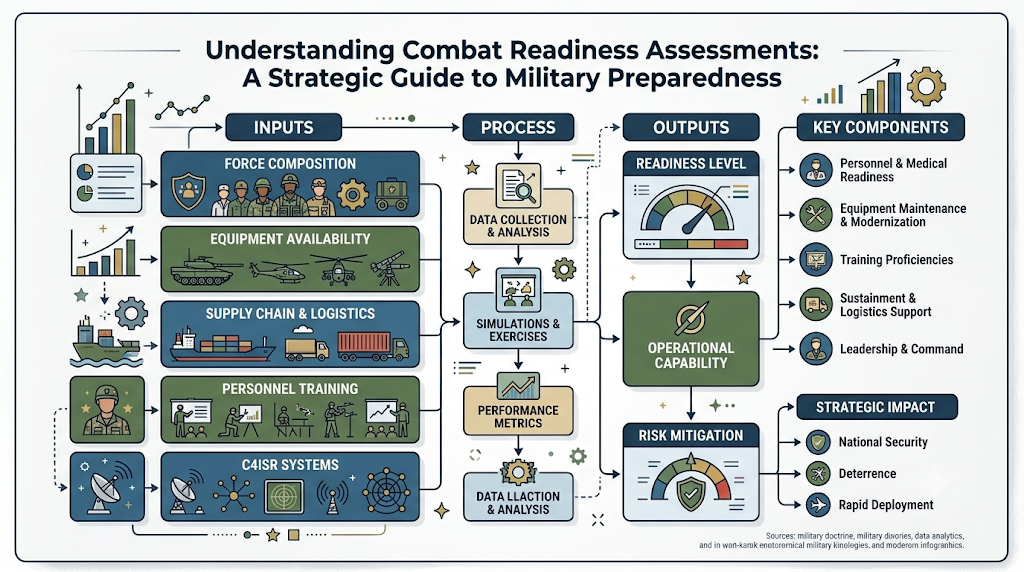
In an unpredictable global security landscape, the strength of a military force is not determined solely by the size of its inventory or the sophistication of its weapons. The true measure of military power lies in Combat Readiness—the ability of military units to deploy, fight, and accomplish assigned missions effectively and on short notice. Evaluating this preparedness requires structured, data-driven, and rigorous evaluation protocols known as Combat Readiness Assessments. At WarOpsX.com, our goal is to break down complex military strategy, operational planning, and defense technology into clear, educational insights. This comprehensive guide explores what combat readiness assessments are, why they are essential to national security, the core elements evaluated, and how modern innovations like AI and defense analytics are revolutionizing operational preparedness.
What Is Combat Readiness?
Combat Readiness refers to the overall state of preparedness of a military force, unit, or system to execute assigned missions across multi-domain battlefields. It is not a static condition; rather, it is a dynamic, continuously fluctuating balance between personnel, equipment, sustainment, and leadership.
Publicly available defense doctrine defines combat readiness through two core components:
- Structural Readiness: The baseline composition of a force—including unit architecture, authorized personnel numbers, and allocated equipment inventory.
- Operational Readiness: The functional capability of that force to perform its intended military operations under real-world conditions.
A unit may have 100% of its personnel and gear on paper, but if its equipment lacks maintenance or its personnel lack specialized training, its overall Force Readiness remains compromised. Combat readiness assessments provide an objective snapshot of this operational capability.
Why Combat Readiness Assessments Matter
Evaluating operational preparedness is vital for strategic deterrence, defense planning, and fiscal accountability. Without structured readiness assessments, defense leadership risks making strategic assumptions based on unverified operational capacities.
       [ Strategic Deterrence ]
                 ▲
                 │
   [ Defense Budget Optimization ] ◄───► [ Combat Readiness Assessment ]
                 │
                 ▼
     [ Risk Mitigation & Safety ]
- Strategic Deterrence: Potential adversaries evaluate a nation’s military readiness when assessing risk. High force readiness acts as a powerful deterrent against potential conflict.
- Defense Budget Optimization: Defense spending represents a massive portion of national budgets. Assessments provide policymakers with objective data to direct funds toward critical equipment maintenance, training exercises, or procurement.
- Risk Mitigation: Identifying shortfalls in personnel, supply chains, or communication before deployment saves lives and prevents operational failure on the battlefield.
- Resource Allocation: Enables military commanders to rotate forces efficiently between active deployment, maintenance, and training cycles.
Objectives of Combat Readiness Evaluations
When defense organizations conduct a Readiness Assessment, they aim to fulfill clear strategic and operational objectives:
- Determine Mission Capability: Assess whether a unit can execute its specific Mission Essential Tasks (METs).
- Identify Capability Gaps: Detect shortfalls in equipment, specialized training, logistics, or command structures before they impact operations.
- Validate Training Programs: Measure the effectiveness of ongoing Military Training regimes against real-world scenario benchmarks.
- Inform Strategic Decision-Making: Provide high-ranking military leaders and civilian policymakers with accurate force status reports during crises.
Core Elements of Combat Readiness
Evaluating operational capability requires examining multiple interconnected pillars that together form a complete picture of force readiness.
                      ┌────────────────────────────────────────┐
                      │      CORE READINESS PILLARS            │
                      └───────────────────┬────────────────────┘
                                          │
       ┌──────────────────┬───────────────┼───────────────┬──────────────────┐
       ▼                  ▼               ▼               ▼                  ▼
  [Personnel]        [Training]      [Equipment]     [Logistics]        [Cyber & Tech]
  Qualifications     Certifications  Maintenance     Supply Chains      C4ISR & Defense
Personnel Readiness
A force is only as capable as the service members who comprise it. Personnel readiness evaluates staffing levels, rank structure, physical fitness, medical deployability, and specialized skill qualifications. It ensures that units are not only fully staffed but staffed with appropriately trained individuals.
Training and Skill Readiness
Training translates potential force into operational capability. This element measures individual and collective training completion, joint service exercise performance, and proficiency in multi-domain operational scenarios. Continuous drill cycles build muscle memory, tactical adaptability, and cohesion.
Equipment and Maintenance Readiness
Military hardware—from armored vehicles and aircraft to small arms—requires constant maintenance. Equipment readiness tracks operational availability rates, scheduled maintenance backlogs, spare part availability, and technological modernization.
Logistics and Supply Chain Readiness
Even the most highly trained units cannot fight without sustainment. Military Logistics readiness measures the availability and movement capacity of ammunition, fuel, rations, medical supplies, and transport infrastructure. Robust supply chains ensure forces can sustain prolonged operations.
Leadership and Decision-Making Readiness
Effective Military Leadership turns resources into tactical success. Evaluations examine command structure integrity, staff decision-making speed, delegation protocols, and the ability of commanders to operate under high-stress, decentralized environments (often referred to as Mission Command).
Communication and Coordination
Modern operations depend on seamless C4ISR (Command, Control, Communications, Computers, Intelligence, Surveillance, and Reconnaissance) systems. Assessments verify that secure communication networks operate reliably across land, sea, air, space, and cyber domains.
Cybersecurity Readiness in Modern Defense
In modern conflict, digital networks are contested continuously. Cyber readiness evaluates the resilience of defense networks against cyberattacks, command system hardening, operational encryption, and personnel adherence to cybersecurity protocols.
Intelligence and Situational Awareness
Operational success relies on accurate intelligence. Evaluators measure a unit’s capacity to process, analyze, and disseminate real-time information to maintain Situational Awareness in complex environments.
Medical and Emergency Support Readiness
Sustaining human life under extreme conditions requires rapid-response medical infrastructure. This pillar measures trauma care capacity, field hospital deployment speed, medical evacuation (MEDEVAC) preparedness, and medical inventory levels.
Operational Risk Assessment
An integral part of evaluating readiness is Risk Assessment. Every operational deployment carries inherent risks—from environmental hazards and equipment failure to adversary action and logistical bottlenecks.
During a readiness evaluation, staff officers use risk matrices to calculate the probability and severity of potential failures. By assigning operational risk levels to identified shortfalls (such as a shortage of specialized technicians), leadership can implement mitigation strategies before deploying units into high-stakes scenarios.
Readiness Metrics and Key Performance Indicators
To make readiness objective, military organizations rely on standardized metrics and key performance indicators (KPIs). The comparison table below highlights common areas of evaluation across readiness frameworks.
| Readiness Category | Key Performance Indicators (KPIs) | Strategic Purpose |
| Personnel | Assigned vs. Authorized strength, MOS/AFSC qualification rates, deployability rate (%) | Ensures units have the required headcount and specialized skill sets. |
| Equipment | Mission Capable (MC) rate, Fully Mission Capable (FMC) rate, maintenance backlog | Measures immediate availability and operational reliability of hardware. |
| Training | Mission Essential Task List (METL) proficiency, joint exercise hours, live-fire qualification | Verifies combat proficiency under simulated operational stress. |
| Logistics | Days of Supply (DOS) on hand, supply chain pipeline velocity, fuel/ammo reserves | Guarantees operational sustainment during extended operations. |
| Cyber / C4ISR | Network uptime (%), cyber vulnerability patch rate, signal redundancy tests | Protects command-and-control infrastructure from disruption. |
Readiness Assessment Frameworks Used by Defense Organizations
Publicly available military doctrine details how defense establishments structure their readiness evaluations. While specific procedures vary by nation and service branch, most rely on structured reporting models.
  [ Unit-Level Self-Assessment ]
                 │
                 ▼
  [ Independent Inspection / Drill ] ───► [ Integrated Staff Review ]
                                                 │
                                                 ▼
                                     [ Unified Readiness Index ]
1. Status of Resources and Training System (SORTS) / Defense Readiness Reporting System (DRRS)
- High-Level Concept: Systems like the US Department of Defense’s DRRS focus on capability-based reporting. Rather than evaluating raw inventory alone, DRRS measures a unit’s ability to execute specific Mission Essential Tasks (METs).
- Core Metrics: Units are rated on resource levels (Personnel, Equipment, Maintenance, Training) to determine their readiness status, often mapped to readiness categories ranging from fully ready to unavailable.
2. NATO Capability Statements and Evaluation Protocols
- High-Level Concept: NATO utilizes standardized evaluation systems (such as CREVAL for land forces) to ensure multi-national forces can operate together seamlessly (interoperability).
- Focus Areas: Standardized command structures, cross-nation logistical compatibility, communication protocols, and joint tactical execution.
3. Tiered Readiness Models
- High-Level Concept: Forces maintain varying levels of readiness depending on their position in the deployment cycle. Units preparing to deploy receive priority resourcing and intensive evaluation, while returning units enter maintenance and refit phases.
Role of Technology, AI, and Data Analytics in Readiness Assessments
The modern defense landscape is transitioning from manual, periodic evaluations to real-time, data-driven readiness monitoring. Defense Technology and Defense Analytics play a central role in this evolution.
Predictive Maintenance
Instead of waiting for machinery to break or servicing it on a rigid schedule, Internet of Things (IoT) sensors and AI algorithms analyze vehicle engine telemetry, structural fatigue, and vibration patterns to predict mechanical failures before they happen.
Artificial Intelligence & Machine Learning
AI models process vast quantities of historical logistics data, maintenance records, and personnel health metrics to forecast future readiness trends, allowing planners to solve bottlenecks proactively.
Digital Twins
Defense researchers build virtual replicas (“digital twins”) of complex military hardware, supply networks, or entire bases. Planners run high-stress simulations on these digital twins to evaluate how equipment and logistics hold up under severe operational stress.
Advanced Simulation & Synthetic Training Environments (STE)
Virtual and augmented reality platforms allow units to conduct high-fidelity, multi-domain training exercises without the immense cost and environmental impact of large-scale live drills.
Real-World Historical Examples of Readiness Evaluations
To understand how readiness evaluations operate in practice, we can examine publicly documented historical case studies.
Task Force Smith & Post-WWII Readiness Gaps
1950
At the outbreak of the Korean War, Task Force Smith—a battalion from the US Army’s 24th Infantry Division—was deployed rapidly to delay advancing forces. Post-World War II demobilization had left the unit understaffed, equipped with outdated anti-tank weaponry, and lacking proper combat training. The operational outcome highlighted the extreme danger of assuming structural presence equals combat capability, leading directly to modernized, standardized military readiness reporting frameworks.
The Falklands War Logistics Challenge
1982
The United Kingdom’s rapid mobilization of a naval task force over 8,000 nautical miles tested every aspect of military logistics and equipment readiness. The conflict highlighted the criticality of merchant navy integration, rapid ship modification, and continuous supply chain sustainment under austere conditions.
Operation Desert Shield Mobilization
1990
The rapid deployment of coalition forces to the Persian Gulf demonstrated the value of standardized readiness reporting systems developed during the Cold War. Data-driven assessments allowed commanders to mobilize heavy armor, air assets, and international partner forces with high operational synchronization.
Common Challenges in Maintaining Combat Readiness
Achieving and maintaining high force readiness is an ongoing operational challenge. Defense leadership regularly navigates several key obstacles:
- Budgetary Constraints and Fluctuations: Unpredictable defense funding creates backlogs in equipment maintenance and limits large-scale training exercises.
- Operational Tempo (OPTEMPO) Wear: Prolonged deployment cycles exhaust personnel and accelerate hardware wear-and-tear faster than normal maintenance schedules can accommodate.
- Aging Legacy Systems: Maintaining legacy platforms alongside modern equipment strains supply chains and requires specialized, increasingly rare maintenance expertise.
- Rapid Technological Changes: Integrating emerging technologies like autonomous systems, hypersonics, and electronic warfare assets requires continuous retraining and doctrine updates.
- Supply Chain Fragility: Dependence on globalized supply networks for critical raw materials or microelectronics introduces vulnerabilities during geopolitical crises.
Best Practices for Continuous Readiness Improvement
To overcome these challenges, leading defense organizations implement proven strategies for continuous improvement:
- Adopt Data-Driven Readiness Platforms: Transition from manual spreadsheet reporting to automated, real-time analytics platforms.
- Prioritize Interoperability: Conduct frequent joint and multi-national training exercises to ensure systems, doctrine, and communications align with alliance partners.
- Embed Continuous Feedback Loops: Implement thorough After-Action Reviews (AARs) following every exercise or deployment to turn operational lessons into doctrine updates.
- Invest in Dynamic Logistics Networks: Develop flexible, resilient supply chains capable of delivering parts and sustainment in contested environments.
- Cultivate Adaptive Leadership: Foster decentralized decision-making (Military Leadership) so junior officers can adapt to sudden operational disruptions independently.
Future Trends in Defense Readiness and Digital Transformation
The future of Defense Readiness will be shaped by rapid digital transformation and multi-domain operations:
- Real-Time Automated Force Tracking: Integration of cloud computing and edge sensors will allow high-level commanders to monitor force readiness metrics in real time across global theaters.
- AI-Generated Scenario Training: Machine learning platforms will generate dynamic, unpredictably evolving training scenarios adapted to specific unit weaknesses.
- Autonomous Logistics: Unmanned supply ground vehicles and aerial drones will streamline short-range logistics, mitigating supply chain bottlenecks in contested zones.
- Cyber-Physical Resilience: Readiness frameworks will increasingly evaluate a unit’s ability to operate effectively when digital networks, GPS, and communications are fully degraded.
Frequently Asked Questions
What is the primary purpose of a combat readiness assessment?
The primary purpose is to objectively evaluate a military force’s ability to deploy, execute, and sustain assigned operations, ensuring leaders know exact operational capabilities before conflict arises.
How does operational readiness differ from structural readiness?
Structural readiness refers to the baseline availability of authorized personnel and equipment on paper. Operational readiness measures whether those personnel are trained and equipment is functional to execute actual missions.
What are Mission Essential Tasks (METs)?
Mission Essential Tasks are core operational capabilities that a unit must be able to perform to accomplish its primary warfighting missions, serving as benchmarks for training and evaluation.
How often do defense forces evaluate combat readiness?
Readiness is evaluated continuously. Units submit regular digital status reports, supplemented by periodic formal inspections, live-fire qualifications, and large-scale training exercises.
What role does artificial intelligence play in modern readiness assessments?
AI assists by analyzing maintenance data for predictive repairs, modeling complex logistics scenarios, running synthetic training environments, and aggregating dynamic readiness metrics in real time.
Why is logistics considered a critical element of combat readiness?
Logistics ensures forces receive fuel, ammunition, spare parts, rations, and medical care. Without continuous supply chain sustainment, combat units quickly lose operational capability.
How do military units assess readiness for cyber warfare?
Cyber readiness is assessed through continuous vulnerability scanning, red-team network penetration tests, cyber hygiene audits, and simulated command-and-control operations under degraded network conditions.
What is the difference between SORTS and DRRS in military reporting?
SORTS (Status of Resources and Training System) historically focused on resource counts (personnel, equipment). DRRS (Defense Readiness Reporting System) is a capability-based system focused on whether a unit can execute specific tasks.
How do operational tempo and deployments affect readiness?
High operational tempo accelerates equipment wear and leads to personnel fatigue. Without adequate refit and training cycles between deployments, overall force readiness declines over time.
Can civilian defense analysts use readiness assessment concepts?
Yes. Readiness assessment principles—such as personnel availability, equipment maintenance tracking, risk management, and supply chain resilience—are widely used in disaster response, emergency management, and corporate risk analysis.
Conclusion
Understanding combat readiness assessments is essential for comprehending how modern defense organizations build, maintain, and project force capabilities. By evaluating personnel, training, equipment, logistics, leadership, and digital resilience within structured frameworks, defense leadership can make data-driven decisions that safeguard national security. As military technologies continue to evolve, readiness evaluations will increasingly depend on AI, real-time analytics, and dynamic multi-domain simulations. However, the fundamental core of force readiness remains unchanged: ensuring that service members are equipped, trained, and sustained to succeed in complex operational environments.