Introduction
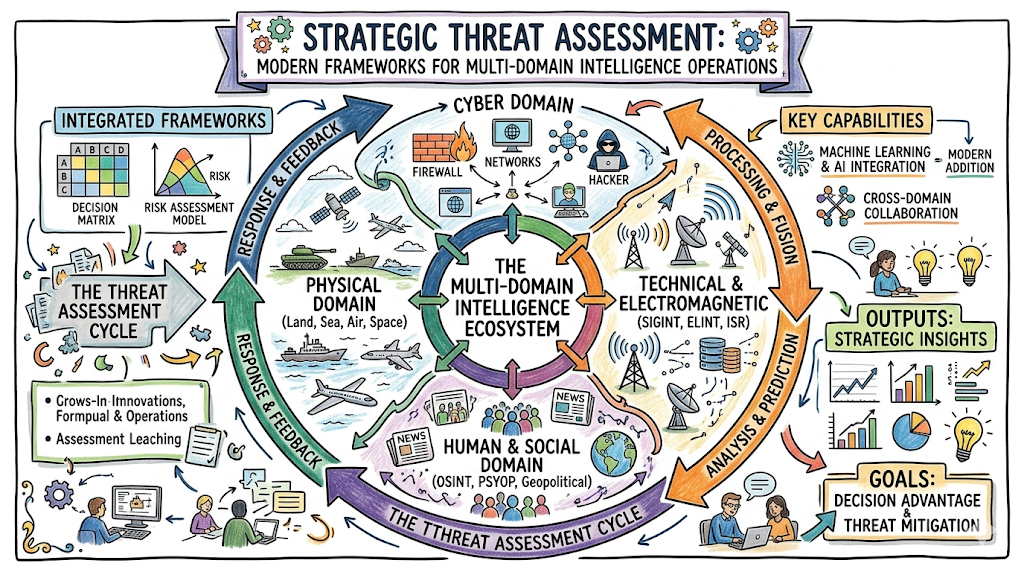
The modern global security environment is undergoing a fundamental structural shift. Defense analysts and state actors no longer evaluate national security through the isolated lens of physical borders or conventional military deployments. Today’s security landscape is defined by hybrid conflicts where cyber warfare, state-sponsored information campaigns, economic coercion, and physical kinetic operations happen simultaneously.By applying data-driven intelligence frameworks to complex, cross-domain telemetry streams, strategic intelligence advisors can turn chaotic threat vectors into structured, actionable insights. Utilizing specialized analysis portals like WarOpsX allows defense professionals and security architects to establish a unified operational picture across modern conflict layers. This blueprint explores the core mechanics of strategic threat assessment, detailing its processes, analytical frameworks, and operational applications within modern multi-domain defense systems.
What Is Strategic Threat Assessment?
A strategic threat assessment is a comprehensive, analytical process used by defense and intelligence organizations to evaluate long-term national security challenges, adversarial capabilities, and geopolitical risks. It functions as a structured decision-support mechanism, gathering disparate pieces of raw information and translating them into a clear blueprint of potential security events.
Within the intelligence cycle, this assessment methodology acts as the interpretive engine that guides long-term policy and force design. While standard tracking utilities record immediate physical movements, a strategic assessment examines the broader picture: the industrial capacity of an adversary, their economic resilience, their political stability, and their doctrine for war. This analysis answers what an opponent is capable of doing over months or years, rather than what they are doing over hours.
Understanding this approach requires isolating the structural differences between strategic, operational, and tactical intelligence analysis:
- Strategic Assessment: Focuses on macro-level trends, long-term state planning, emerging military technologies, and broad political motivations. It answers the “why” and “when” of potential large-scale conflicts to guide procurement and national policy.
- Operational Assessment: Centers on specific theaters of operation, regional command structures, logistics networks, and campaign-level movements. It maps how an adversary will deploy forces within a defined geographical zone over weeks or months.
- Tactical Assessment: Focuses on immediate, real-time events on the ground, such as the position of an artillery battery, the frequencies used by an enemy radar system, or an active cyber exploit. It supports immediate countermeasure selection during active contact.
Why Strategic Threat Assessment Matters Today
The rise of highly coordinated nation-state threats has made traditional border security models obsolete. Sophisticated adversaries deploy multi-layered strategies that avoid direct military conflict while systematically undermining a target state’s institutional strength. These long-term campaigns require continuous security intelligence monitoring to catch subtle shifts in adversarial posture.
Concurrently, cyber warfare has evolved from an occasional disruption into a persistent element of state power. Modern cyber campaigns target critical public registers, intellectual property repositories, and financial systems to weaken an opponent’s economic base. These digital attacks often run alongside conventional military planning, making it necessary to unify digital and physical threat intelligence tracking.
Conventional Military Planning ──┐
                                 ├─> Unified Strategic Threat Assessment
Asymmetric Cyber Operations     ──┘
Critical infrastructure vulnerabilities introduce significant systemic risks into modern defense equations. National power grids, automated water treatment facilities, and global transport hubs rely heavily on connected industrial control systems that are vulnerable to remote manipulation. A strategic breakdown in these industrial networks can disrupt military mobilization schedules, making infrastructure tracking a key component of national risk analysis frameworks.
Ultimately, these factors combine to create a highly complex, hybrid conflict environment. Modern warfare is no longer limited to distinct battlefields; it involves a continuous mix of proxy conflicts, electronic warfare, economic sanctions, and psychological operations. Strategic threat assessment provides the analytical tools required to track these diverse vectors simultaneously, giving leaders the situational awareness needed to protect national stability.
Core Components of Strategic Threat Assessment
┌─────────────────────────────────────────────────────────────────┐
│                    STRATEGIC RISK PRIORITIZATION                │
│    (SLA Protections, Resource Allocation, Defensive Focus)      │
└────────────────────────────────┼────────────────────────────────┘
                                 ▲
┌────────────────────────────────┴────────────────────────────────┐
│                     ENVIRONMENTAL ASSESSMENT                    │
│   (Terrain Modeling, Weather Impacts, Infrastructure Health)    │
└────────────────────────────────┼────────────────────────────────┘
                                 ▲
┌────────────────────────────────┴────────────────────────────────┐
│                         INTENT ANALYSIS                         │
│     (Political Ideology, Strategic Doctrine, Public Position)   │
└────────────────────────────────┼────────────────────────────────┘
                                 ▲
┌────────────────────────────────┴────────────────────────────────┐
│                       CAPABILITY ANALYSIS                       │
│    (Industrial Logistics, Troop Numbers, Technological Assets)  │
└────────────────────────────────┼────────────────────────────────┘
                                 ▲
┌────────────────────────────────┴────────────────────────────────┐
│                     THREAT IDENTIFICATION                       │
│      (Adversary Identification, Attack Vector Isolation)        │
└─────────────────────────────────────────────────────────────────┘
Threat Identification
This initial phase isolates potential adversaries and identifies emerging attack vectors across physical, cyber, and political spaces. Analysts define the scope of the threat landscape, ensuring that non-traditional vectors—such as supply chain manipulation or corporate subversion—are recorded alongside conventional military profiles.
Capability Analysis
Capability analysis evaluates an adversary’s real-world capacity to execute an offensive operation. This step looks past stated goals to audit physical indicators, including industrial manufacturing output, military troop numbers, logistical transport capacities, cyber weapon repositories, and overall economic stability.
Intent Analysis
Intent analysis seeks to understand an opponent’s underlying motivations and strategic logic. Analysts review political ideologies, military doctrine files, public state positions, and historical behavioral patterns to calculate the likelihood of an adversary deploying their capabilities under specific scenarios.
Environmental Assessment
This component evaluates the physical and digital terrain where a potential conflict could take place. Analysts model geographic terrain maps, regional weather shifts, local communications infrastructure health, and regulatory landscapes to determine how the physical or digital environment will impact offensive or defensive operations.
Risk Prioritization
The final component combines capability, intent, and environmental data to rank emerging threats. This step calculates the real-world probability and estimated impact of various failure modes, ensuring that defense resources are directed precisely toward high-priority national security challenges.
How Strategic Threat Assessment Works
The core mechanism of a strategic threat assessment operates as a continuous, structured data lifecycle. It begins with comprehensive data collection across multiple, disparate channels. Analysts ingest vast pools of open-source data, commercial satellite imagery, global shipping registries, and secure intelligence feeds, converting chaotic multi-domain telemetry into raw data inputs.
Multi-Domain Feeds ──> [Data Collection Layer] ──> Structured System Inputs
Once gathered, these disjointed data points pass into specialized intelligence fusion engines. This phase standardizes varying data syntax, corrects different time zone stamps, and links related records together. For example, the system might connect an unusual purchase of marine industrial parts with unexpected maritime movements in a specific naval region, transforming isolated data fragments into a clear operational picture.
Industrial Parts Invoice ──┐
                           ├─> [Intelligence Fusion Engine] ──> Linked Threat Pattern
Naval Satellite Imagery   ──┘
Next, the fused data is analyzed using advanced pattern analysis tools. Machine learning models and adversary analysis frameworks check incoming events against historical signatures to spot unusual infrastructure trends or military movements. This analysis helps separate routine training exercises from genuine preparation for offensive actions.
The validated patterns then feed directly into predictive threat modeling platforms. Analysts run detailed simulations to map out how an adversary might deploy their assets under varying geopolitical conditions. This modeling helps identify weak points in defensive lines, tracks potential cascade failures across public infrastructure networks, and forecasts enemy timelines.
The final stage converts these complex analytical insights into clear decision support outputs for leadership. Instead of presenting raw logs or lengthy technical reports, the framework generates intuitive security dashboards, threat level charts, and actionable remediation choices. This streamlined intelligence ensures that command structures can make fast, defensive decisions during fast-moving global crises.
Intelligence Layers in Threat Assessment
An effective defense strategy requires a seamless integration of different intelligence layers to provide a complete operational picture. Each layer operates at a distinct depth, but they must continuously exchange data to maintain high situational awareness across command structures.
STRATEGIC INTELLIGENCE LAYER (Policy Makers / Global Capacity Mapping)
                 ▲
                 ▼
OPERATIONAL INTELLIGENCE LAYER (Regional Commanders / Theater Logistics)
                 ▲
                 ▼
TACTICAL INTELLIGENCE LAYER (Field Units / Real-Time Sensor Metrics)
The strategic intelligence layer sits at the top of the command pyramid, focusing on macro-level analysis, long-term national trends, and global capability mapping. It evaluates state-level budgets, emerging military technology developments, and broad political alliances. This layer helps senior leadership establish national defense policy, allocate long-term budgets, and prioritize strategic partnerships.
Beneath this sits the operational intelligence layer, which translates national policy into theater-level execution plans. This layer monitors regional logistics hubs, troop movements, supply depots, and communication networks within specific geographic zones. It provides regional commanders with the insights required to position forces, protect supply lines, and design regional campaigns.
The tactical intelligence layer forms the operational foundation, dealing with real-time telemetry from active operational zones. It processes immediate inputs like drone sensor feeds, local radar signatures, intercepted communications, and active cyber network alerts. This high-frequency data supports field units during active engagements, helping them pick immediate countermeasures.
In a modern threat intelligence framework, these layers form a continuous feedback loop. For example, a tactical unit might discover an unknown radar signature in the field; this data travels up to operational analysts to assess regional air defense changes, and eventually reaches strategic architects to update national electronic warfare requirements. This vertical data integration ensures that national defense plans remain grounded in real-world reality.
Role of Reconnaissance and Surveillance
Modern information gathering relies heavily on continuous ISR operations (Intelligence, Surveillance, and Reconnaissance) to feed real-time telemetry into strategic threat assessment pipelines. Rather than relying on periodic manual updates, ISR architecture deploys a multi-layered network of advanced sensors across physical and digital spaces to monitor global threat vectors 24/7.
[Space Satellites] ──┐
[Airborne Drones]  ──┼─> [Integrated ISR Operations Stack] ──> Continuous Threat Assessment
[Cyber Telemetry]  ──┘
The physical collection stack combines space-based imaging platforms, long-range unmanned aerial vehicles, maritime monitoring arrays, and ground-based electronic collection systems. These assets track troop concentrations, monitor naval transit lines, and record communications signatures across key operational regions. This constant surveillance makes it nearly impossible for an adversary to secretly build up conventional forces.
In the digital domain, ISR operations focus on monitoring global cyber infrastructure activity, network borders, and dark web repositories. Cyber security intelligence systems track malware development cycles, scan for open software vulnerabilities, and monitor server signatures used by state-aligned hacking groups. This active surveillance helps identify incoming cyber campaigns before they can hit critical infrastructure networks.
Maintaining this continuous monitoring loop is essential for effective warning systems. It allows operations teams to establish reliable performance baselines for normal peace-time activity across different regions. This foundation makes it easy for automated systems to spot subtle anomalies—such as an unexpected shift in communication volume—and warn commanders early.
Analytical Frameworks Used in Threat Assessment
To maintain high objectivity and prevent personal bias from coloring conclusions, intelligence teams utilize structured risk analysis frameworks to evaluate emerging threats. These models turn qualitative observations into measurable, defensible indicators of system risk.
A foundational tool used across the industry is the risk scoring model, which evaluates threat vectors based on two primary metrics: probability of occurrence and business or operational impact. Analysts assign numerical scores to an adversary’s capability and intent while accounting for existing defensive blocks. This matrix calculates an objective risk priority value, helping leaders distribute defensive assets efficiently.
Risk Priority Value = (Adversary Capability Score × Intent Score) − Defensive Mitigation Factor
Scenario analysis builds upon these scores by constructing detailed models of potential future crises based on current data trends. Teams create diverse paths for a potential conflict—such as an escalation in economic sanctions leading to retaliatory cyber attacks—and map out how each scenario would affect infrastructure stability. This preparation ensures that command groups maintain validated response playbooks for varying threat levels.
Adversary behavior modeling shifts the focus to mapping the specific methodologies, tactics, and operational habits favored by an opponent. Analysts build detailed behavioral profiles of target state commands and hacking groups, cataloging their preferred exploit styles, logistical habits, and communication patterns. This profile helps defenders anticipate an opponent’s next move during a crisis.
Finally, the cyber kill chain concept provides a structured framework for analyzing the step-by-step progression of an offensive operation. By breaking an attack down into distinct phases—from initial reconnaissance and weaponization to final execution—the model helps defenders identify weak spots in the adversary’s path. This structure allows operations groups to set up targeted defense checkpoints that can disrupt an attack at multiple stages.
Strategic Threat Assessment in Modern Warfare Domains
| Target Domain | Primary Threat Vectors | Analytical Focus | Operational Outcome |
| Cyber Security | Zero-day exploits, supply chain corruption, advanced persistent threats. | Continuous code auditing, network border monitoring, malware signature tracking. | Secure command networks, protected databases, resilient communications. |
| Physical Infrastructure | Kinetic attacks, drone strikes, industrial control sabotage. | Structural vulnerability mapping, proximity tracking, system line redundancy checks. | Uninterrupted power grid operations, continuous logistics flows, secure transport hubs. |
| Hybrid Warfare | Disinformation campaigns, proxy funding, political subversion. | Social media trend tracking, dark web monitoring, financial forensics. | Protected institutional trust, early proxy identification, stable civil governance. |
| Geopolitical Risk | Economic blockades, resource extraction control, treaty violations. | Global trade route mapping, currency reserve tracking, supply chain metrics. | Alternative trade access paths, secure raw material access, resilient economic policies. |
Decision-Making and Command Support
The ultimate goal of any strategic threat assessment is transforming complex multi-domain data into clear, actionable command support for national leadership. During fast-moving international crises, senior policy makers and military commanders do not have the time to read through raw log data or parse conflicting technical analyses. They require clear insights that highlight real-world impacts and actionable choices.
An advanced threat assessment architecture provides this clarity by systematically filtering out alert noise and prioritizing critical security events. The framework evaluates incoming anomalies based on verified capabilities and operational thresholds, ensuring that high-priority threats are escalated immediately. This automated screening protects decision-makers from data overload, allowing everyone to focus on urgent security challenges.
Raw Multi-Domain Anomalies ──> [Threat Assessment Filter] ──> Prioritized Leadership Choices
Furthermore, this intelligence fuels modern early warning networks, which calculate the exact time windows available to deploy defensive measures before an attack can hit. By tracking early indicators of adversary preparation—such as fuel storage changes near deployment zones or unusual server scanning activity—the system gives defenders a window of advance notice. This preparation time allows teams to fortify infrastructure lines, deploy cyber patches, or evacuate non-combatants safely.
Ultimately, this structural decision support transforms how organizations handle crisis management. It moves leadership away from high-pressure, reactive guessing games and replaces them with proactive, data-driven defense strategies. Commanders can evaluate risk trade-offs objectively, execute pre-tested response playbooks with precision, and protect operational assets with confidence.
Tools and Technologies Supporting Threat Assessment
Modern threat analysis relies heavily on AI-based analytics systems to process massive, global telemetry streams in real time. Traditional tracking methods fail when faced with the sheer velocity of multi-domain data, but machine learning models excel at this scale. These advanced systems automatically scan millions of system records, identifying subtle patterns and infrastructure drifts that indicate adversarial preparation.
Data fusion platforms form the technical backbone of this architecture, integrating separate data feeds into a single processing system. These platforms connect directly to satellite imaging networks, maritime tracking registries, infrastructure sensor streams, and cyber event recorders. By standardizing diverse log syntax and matching timestamps automatically, the software removes data silos, allowing analysts to trace cross-domain connections easily.
Satellite Feeds + Shipping Registries + Cyber Recorders ──> [Data Fusion Platform] ──> Unified Control View
Analysts interact with this data through advanced monitoring dashboards that display the global threat landscape inside a single interface. These interactive control centers map out live troop positions, display real-time network health scores, track data quality levels, and generate visual data lineage lines. This clean visualization ensures that operations teams can monitor complex international events without switching between different systems.
Finally, predictive intelligence systems use advanced time-series forecasting and regression models to project upcoming security risks. The platform analyzes historical incident data, political development patterns, and current capability shifts to calculate the probability of varying failure scenarios weeks in advance. This foresight gives defense planners the time required to update national security policies, expand resource reserves, and reinforce strategic positions.
Real-World Use Cases
Critical Infrastructure Protection
National power grids rely heavily on connected automated equipment that is constantly targeted by foreign cyber teams. Traditional standalone monitoring tools fail to see the big picture, treating minor port scans and temporary server slowdowns as isolated IT bugs. An AI-driven strategic assessment platform unifies these signals, links regional scanning activity with known state-aligned hacking tools, and alerts engineers to reinforce defenses before an energy blackout can occur.
Cyber Defense Operations
Large financial organizations and defense networks face continuous attacks from advanced persistent threat groups looking to steal sensitive engineering data. A centralized threat intelligence engine monitors system access profiles across multi-cloud environments, notices an unusual data transfer attempt from a secure repository, and maps the action against known adversary behavior models. The system blocks the connection immediately, protecting national intellectual property without interrupting daily operations.
Military Planning Scenarios
During complex global stability deployments, command groups must manage thousands of variable assets across physical and digital spaces simultaneously. A strategic threat platform integrates live drone video feeds, weather shifts, local communications metrics, and logistics supply lines into a single planning dashboard. This unified view helps commanders evaluate regional threat indicators, anticipate supply blockages, and deploy forces safely while maintaining low operational risk.
National Security Intelligence Systems
International border security agencies utilize automated surveillance networks to monitor long demarcation lines for illegal incursions or unexpected military build-ups. A centralized data fusion platform evaluates inputs from remote radar installations, acoustic ground sensors, and satellite imaging channels around the clock. The software establishes standard regional baselines, catches unusual movement patterns early, and alerts patrol teams ahead of time to maintain border integrity.
Challenges in Strategic Threat Assessment
A primary challenge when running strategic threat assessment operations is managing severe data overload across modern collection networks. The massive expansion of remote infrastructure sensors, global communication channels, and cyber logging utilities generates petabytes of daily data that can easily overwhelm analysis centers. Without advanced automated filtering tools, critical operational indicators can easily get lost in mountains of non-actionable alert noise.
The presence of false signals and intentional adversarial deception makes manual verification even more difficult. Sophisticated opponents frequently launch coordinated campaigns designed to mislead intelligence networks, executing fake troop movements or dropping misleading digital markers to hide their true objectives. Analysts must continuously question incoming data to avoid falling for distractions that leave core assets exposed.
Deceptive Troop Tracks + Misleading Code Markers ──> [Analysis Center] ──> Resource Misallocation
Intelligence gaps present another persistent problem for defense planners, especially when dealing with closed societies or hidden cyber operations. Even the most advanced satellite networks and automated network scanners cannot look inside private decision-making meetings or view completely offline code systems. These persistent blind spots require analysts to use careful statistical modeling to estimate an adversary’s capabilities accurately.
Furthermore, teams must adapt to rapidly evolving threat vectors that change faster than traditional defense procurement cycles. Modern state-aligned hacking groups can rewrite exploit code in a matter of hours, while physical asymmetric technologies like autonomous drone swarms introduce brand-new combat dynamics within weeks. Managing this changing landscape demands a flexible analytical structure that can update its underlying safety models without requiring a full system redesign.
Finally, attribution difficulty remains a critical problem across modern cyber and hybrid warfare domains. Sophisticated attackers route their web traffic through multiple proxy servers, utilize open-source malware frameworks, and deploy false flag digital signatures to hide their country of origin. Identifying the true author of an attack requires extensive digital forensics and long-term behavioral pattern analysis, making it tough to execute immediate, legal counter-actions.
Best Practices for Effective Threat Assessment
To get the most value out of your strategic threat assessment platform, you must prioritize continuous intelligence updates. Avoid treating your risk analyses as static reports that are only updated once a year; instead, build automated data ingestion pipelines that refresh your system models with real-time telemetry 24/7. Continuous updates ensure that your security dashboards always reflect the latest changes in global adversary posture.
Next, implement strict multi-source validation policies across all collection paths to eliminate single-point-of-failure errors. Never base an operational choice on an isolated data indicator; instead, configure your intelligence fusion systems to require confirmation from separate intelligence types—such as matching a cyber alert with a satellite imaging change—before escalating a threat level. This cross-validation helps protect your teams from falling for intentional adversary distractions.
Cyber Network Alert + Satellite Image Modification ──> Verified High-Priority Threat
You should also establish an integrated human-plus-AI collaboration workflow across your analysis teams. Utilize machine learning algorithms to automate high-volume data tasks like parsing raw log syntax, standardizing time stamps, and filtering background alert noise. This automation frees up your human analysts to focus on high-value cognitive challenges like evaluating adversary motivations, checking political changes, and designing long-term defense policies.
At the same time, design your operational playbooks around comprehensive, scenario-based planning structures. Regularly test your defense architectures against diverse simulated crises—such as a simultaneous power grid failure and maritime trade shutdown—to ensure your teams maintain validated resolution options for varying emergencies. Running these training scenarios exposes weak spots in your networks, allowing you to reinforce infrastructure lines before a real-world conflict breaks out.
Finally, implement adaptive risk frameworks that can adjust their internal scoring rules as global conditions change. As new tech domains emerge or regional alliances shift, old safety baselines will quickly become obsolete. Build regular review windows into your risk tracking engines to adjust model sensitivity parameters, re-evaluate threat definitions, and align your system metrics with your company’s broader security goals.
Future of Strategic Threat Assessment
The future of national security operations is moving rapidly toward AI-driven intelligence fusion across all defense domains. We are quickly moving past the point where separate teams evaluate cyber events, naval tracks, and satellite images inside isolated data silos. Next-generation analysis platforms will automatically process all global telemetry fields inside a single, unified cognitive engine, tracing cross-domain patterns with incredible precision.
This evolution will enable the deployment of highly accurate predictive threat modeling platforms that operate in real time. By analyzing global infrastructure developments, resource shipping patterns, and economic transactions, these advanced engines can project upcoming national security crises weeks before any physical movement begins. This foresight allows defenders to adjust their resource distributions early, completely neutralizing an adversary’s offensive plans.
Global Trade Metrics + Infrastructure Drifts ──> [AI Analysis Engine] ──> Preemptive Asset Reinforcement
We will also see the widespread deployment of autonomous surveillance systems designed to monitor hazardous border zones without human intervention. These remote networks will utilize edge-computed computer vision models and solar-powered tracking arrays to monitor long borders and deep ocean sectors 24/7. These automated sentinels will identify, track, and classify anomalies independently, reducing the safety risks faced by border patrol teams.
Ultimately, these developments will unlock real-time global threat mapping capabilities for enterprise command centers. Next-generation dashboards will display a live, shifting visual map of global security metrics, cost trends, and operational risks across every continent simultaneously. This total situational awareness will allow organizations to protect critical supply chains, reinforce digital networks, and secure human assets ahead of time, making structural downtime an exceedingly rare occurrence.
Key Takeaways
- Proactive Security Strategy: Strategic threat assessment transforms security operations by moving teams away from reactive firefighting and enabling early crisis forecasting.
- Unified Data Intelligence: Consolidating separate data feeds through intelligence fusion engines is required to eliminate blind spots and trace cross-domain connections.
- AI-Driven Data Analysis: Utilizing machine learning models to establish dynamic baselines eliminates alert storms and ensures highly accurate anomaly detection.
- Multi-Layer Verification: Integrating strategic, operational, and tactical intelligence data ensures that national defense plans remain grounded in real-world reality.
FAQ Section
1.What is strategic threat assessment?
A strategic threat assessment is a structured, data-driven analytical process used by defense and intelligence organizations to evaluate long-term national security challenges, adversary capabilities, and geopolitical risks. It functions as a foundational decision-support framework, turning raw telemetry data into actionable defensive choices for leadership.
2.How does strategic threat assessment work?
Strategic threat assessment platforms operate by continuously ingesting raw telemetry data from multiple domains. The platform’s data fusion engine standardizes varying log formats, processes the information through machine learning models to spot unusual trends, runs simulations to predict future risks, and displays actionable choices on centralized dashboards.
3.What is the difference between tactical and strategic assessment?
Tactical assessments handle high-frequency, real-time metrics from active operational zones—such as identifying a specific radar frequency or tracking a drone position—to support field units. Strategic assessments look at long-term, macro-level trends—such as state budgets, factory manufacturing outputs, and political alliances—to guide national defense policies.
4.Why is threat assessment important in modern security?
Threat assessment is vital in modern security because contemporary conflict environments are highly connected, fluid, and complex. By applying structured analysis frameworks to global telemetry streams, the process cuts through alert storms, unifies data silos across teams, and flags subtle infrastructure drifts before they can lead to an operational outage.
5.What is ISR in intelligence operations?
ISR stands for Intelligence, Surveillance, and Reconnaissance. It represents the integrated network of physical and digital sensors—including observation satellites, reconnaissance drones, maritime tracking arrays, and cyber event recorders—used to gather continuous, real-time data about global adversary postures and environmental conditions.
6.How is AI used in threat assessment?
AI transforms threat analysis by automating high-volume data parsing, removing syntax errors, and filtering out background noise across global telemetry channels. Machine learning algorithms establish dynamic performance baselines, connect related anomalies across separate domains, and isolate root causes during infrastructure crises.
7.What are the main components of threat analysis?
The core components of an effective threat analysis include threat identification to catalog emerging attack vectors, capability analysis to audit an adversary’s physical resources, intent analysis to understand an opponent’s core motivations, environmental assessment to model the terrain, and risk prioritization to rank security challenges.
8.What tools are used in strategic intelligence?
Strategic intelligence operations combine open data collection pipelines, automated data fusion platforms, machine learning models for trend forecasting, interactive visualization dashboards that map cross-domain dependencies, and predictive simulation systems that test potential future scenarios.
9.What are common challenges in threat assessment?
The most common challenges in modern threat analysis include managing severe data overload across collection networks, avoiding intentional adversary distractions or false signals, navigating persistent intelligence gaps in closed societies, adapting to fast-evolving cyber exploits, and resolving digital attribution difficulties.
10.How can beginners learn threat intelligence?
Beginners looking to build a career in strategic intelligence should focus on mastering structured analysis methods, learning data collection frameworks like OpenTelemetry, and understanding basic database architectures. Exploring detailed technical deep-dives and operational blueprints on specialized security platforms like WarOpsX provides an excellent path to mastering these advanced skills.
Conclusion
Successfully protecting an enterprise or a nation against modern security challenges requires moving past the limits of traditional, reactive defense workflows. As threat vectors expand across multi-cloud networks, autonomous drone platforms, and hybrid conflict spaces, relying on old manual auditing methods leaves organizations vulnerable to fast-moving attacks, severe alert storms, and unexpected downtime. Waiting for an active infrastructure failure or a cyber breach to hit your command systems before taking action degrades system readiness and places vital human and digital assets at steep risk. Integrating a comprehensive strategic threat assessment workflow provides defense and intelligence groups with the centralized intelligence, automated filtering, and deep visibility needed to secure their operational landscapes. By utilizing advanced machine learning models to standardize multi-domain telemetry data, automate intelligence fusion, and prioritize emerging risks, organizations can handle global complexity safely.