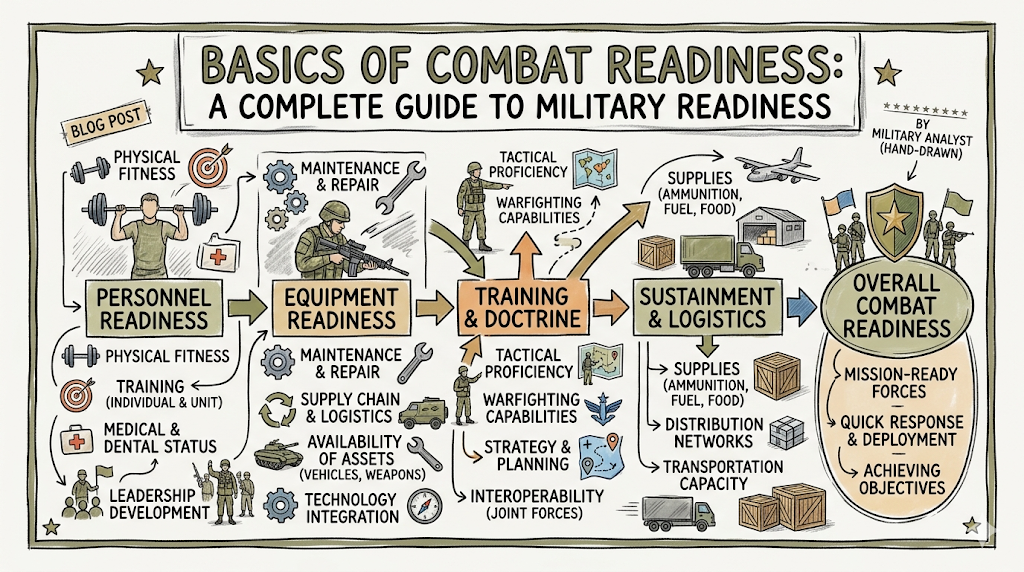
Modern defense environments are defined by structural complexity, technological acceleration, and systemic uncertainty. Operational landscapes can shift from stable deterrence to active crisis within hours. In this unpredictable context, armed forces cannot rely on rapid mobilization or ad-hoc adjustments to meet emerging threats. Success depends entirely on a force’s immediate ability to deploy, engage, and defeat an adversary without prior notice. Understanding these foundational dynamics is essential for defense analysts, military professionals, and strategic planners alike. By examining how modern militaries manage these interconnected variables, we gain insight into how operational power is sustained over time. To explore advanced analyses of modern defense strategies, operational frameworks, and strategic developments, visit the educational resources available at WarOpsX.
Key Takeaways
- Multidimensional Foundation: Combat preparedness is not determined solely by weapon inventory or troop numbers; it relies on the integration of personnel, equipment, training, and supply networks.
- Perishable Resource: Operational readiness is a dynamic asset that degrades rapidly through skill decay, material wear, and structural fatigue if not continuously maintained.
- Logistical Dependency: A unit’s true combat capability is strictly limited by its sustainment pipeline, meaning a breakdown in defense logistics halts operations faster than direct enemy action.
- Objective Measurement: Modern defense forces use standardized evaluation metrics to measure readiness accurately, avoiding subjective assumptions about mission capability.
What Is Combat Readiness?
In simple terms, combat readiness is the measure of a military unit’s ability to execute its assigned missions under real combat conditions. It indicates whether a force is fully prepared to transition instantly from a peacetime status to active operations. This capability requires that personnel, equipment, and command structures are aligned and functional. If any single element fails, the entire unit’s operational effectiveness is compromised.
+-----------------------------------------------------------------------+
|                       Total Operational Readiness                     |
|           (Personnel + Equipment + Training + Defense Logistics)      |
+-----------------------------------------------------------------------+
                                    |
                                    v
+-----------------------------------------------------------------------+
|                        Mission Execution Capability                   |
|         (The practical ability to execute orders under stress)        |
+-----------------------------------------------------------------------+
To understand this concept clearly, defense planners must distinguish between readiness, military capability, and sheer structural strength. Military strength refers to the raw numbers of an army’s inventory, such as its total number of soldiers, aircraft, and armored vehicles. Capability defines the theoretical potential of those forces when paired with specific technologies, doctrinal frameworks, and organizational designs.
Readiness, by contrast, is the real-time availability of those capabilities at any given moment. For example, an air force may possess a fleet of one hundred advanced fighter jets, representing significant military capability. However, if only thirty of those aircraft have trained pilots and functional spare parts available today, its immediate operational readiness is limited to those thirty aircraft. Strength is what an army owns, capability is what that army can theoretically do, and readiness is what that army can actually deliver right now.
Importance of Combat Readiness in Modern Warfare
Modern warfare demands incredibly rapid response times from defensive forces. The speed of contemporary transportation, long-range precision weapons, and cyber operations has effectively eliminated the geographical buffers that historically allowed nations weeks or months to mobilize their industries.
Today, a military force must be capable of responding to aggression within minutes or hours. Units that require extensive preparation time before deployment risk being neutralized before they can even reach the operations area.
Furthermore, conflicts now take place across multiple operational domains simultaneously, spanning land, sea, air, space, and cyberspace. This multi-domain environment introduces unprecedented structural complexity. A ground unit cannot focus solely on its immediate physical surroundings; it must operate in tight coordination with electronic warfare assets, space-based communication networks, and tactical air support.
Maintaining combat preparedness in this interconnected environment requires continuous training, as units must know how to synchronize their actions across different domains under intense pressure.
+-------------------+     +-------------------+     +-------------------+
|    Land Domain    | <-> |    Air Domain     | <-> | Maritime Domain   |
+-------------------+     +-------------------+     +-------------------+
          ^                                                   ^
          |          +-----------------------------+          |
          +--------> |  Cyber & Space Coordination | <--------+
                     +-----------------------------+
This complexity is heightened by the fundamental unpredictability of geopolitical crises. Operational threats rarely emerge precisely where or when planners expect them. Armed forces must therefore maintain a flexible posture that allows them to adapt to changing mission parameters, varying geographic terrains, and asymmetrical enemy tactics on short notice.
A military force that prepares only for a single, specific type of conflict will find its readiness severely degraded when confronted with an unexpected operational scenario.
Ultimately, high operational readiness serves as a critical asset for strategic deterrence. The primary goal of a professional defense force is to prevent conflict by convincing potential adversaries that any act of aggression will be met with immediate, overwhelming resistance.
When an nation demonstrates that its rapid-deployment units are fully manned, properly equipped, and highly trained, it reduces the likelihood of conflict. Deterrence fails when an adversary perceives that a nation’s theoretical military capability is undermined by low real-time readiness.
Core Components of Combat Readiness
                      +-----------------------------+
                      |   Total Combat Readiness    |
                      +-----------------------------+
                                     |
    +-----------------+--------------+--------------+-----------------+
    |                 |                             |                 |
    v                 v                             v                 v
+-----------+   +-----------+                 +-----------+     +-----------+
| Personnel |   | Equipment |                 | Training  |     | Logistics |
| Readiness |   | Readiness |                 | Readiness |     | Readiness |
+-----------+   +-----------+                 +-----------+     +-----------+
    |                 |                             |                 |
    +-----------------+--------------+--------------+-----------------+
                                     v
                      +-----------------------------+
                      |     Command & Control (C3)  |
                      +-----------------------------+
Personnel Readiness
Personnel readiness is the foundational block of any military unit. This metric tracks whether a unit has its full complement of authorized troops and whether those individuals are physically and mentally prepared for deployment.
It involves monitoring medical health, physical fitness scores, psychological stability, and administrative deployment availability. A unit cannot perform effectively if a significant portion of its personnel is unavailable due to injuries, administrative backlogs, or unfilled specialized roles.
Equipment Readiness
Equipment readiness focuses on the operational availability and mechanical reliability of a unit’s primary weapon systems and support vehicles. This component requires that tanks, aircraft, communication radios, and individual infantry weapons are fully functional and ready for immediate deployment.
It is managed through rigorous maintenance schedules, regular inspections, and the availability of replacement parts. If a unit’s hardware is grounded in maintenance bays due to neglect, its overall combat preparedness drops significantly, regardless of how many soldiers are assigned to the unit.
Training Readiness
Training readiness evaluates how effectively a unit can execute its collective military doctrines and mission-essential tasks. It measures the transition from individual technical skills to highly coordinated group actions.
A unit achieves high training readiness by completing structured certification cycles, live-fire exercises, and complex field maneuvers. This collective proficiency ensures that infantry squads, armor platoons, and logistical support teams can operate together as a cohesive unit under chaotic battlefield conditions.
Logistics Readiness
Logistics readiness ensures that a unit has the necessary material depth to sustain combat operations over an extended period. This component covers the immediate availability of essential supplies, including ammunition stockpiles, fuel reserves, medical kits, and spare parts.
Without deep logistical support, a highly trained and well-equipped unit will quickly lose its effectiveness in battle. Defense logistics frameworks must guarantee that these supply chains remain reliable and responsive under heavy operational strain.
Command and Control Readiness
Command and control readiness centers on the functionality of a unit’s leadership structures and communication networks. It ensures that commanders can securely receive strategic intelligence, process data accurately, and send clear orders to subordinate units in real time.
This component requires resilient, encrypted communication systems and highly adaptable leaders who can make sound decisions when information is limited or distorted by enemy electronic countermeasures.
Levels of Combat Readiness
Militaries categorize their units into distinct readiness tiers to balance the high financial costs of constant preparedness with strategic deployment requirements. It is financially impossible and operationally inefficient for a nation to keep its entire armed forces at peak readiness indefinitely.
Therefore, units are organized into high, medium, and low readiness categories based on their intended deployment timelines and strategic roles.
+-----------------------------------------------------------------------+
|                      READINESS LEVEL MATRIX                           |
+-----------------------------------------------------------------------+
|  [High Readiness]   --> Deployable in 24-72 Hours (Elite/Rapid Force) |
|  [Medium Readiness] --> Deployable in 30-90 Days (Staged/Reserve)     |
|  [Low Readiness]    --> Deployable in 180+ Days (Long-term Cadre)     |
+-----------------------------------------------------------------------+
High Readiness
High readiness units are the nation’s primary rapid-response forces. These formations, such as airborne brigades, special operations groups, and forward-deployed naval fleets, are kept fully manned and equipped at all times. They must be capable of deploying anywhere in the world within twenty-four to seventy-two hours.
Maintaining this elite status requires continuous funding, intense training schedules, and immediate access to top-tier supply reserves. These units give national leadership immediate options during sudden geopolitical crises.
Medium Readiness
Medium readiness units comprise the bulk of a professional military’s conventional forces and primary reserve components. These units are typically kept at a structured level of readiness, meaning they require an additional thirty to ninety days of focused preparation before they can deploy to a combat zone.
During peacetime, they may operate with slightly lower personnel numbers or pass some of their heavy equipment to maintenance depots. If a conflict expands, these forces are mobilized, integrated with additional personnel, and run through intensive collective training exercises to prepare them for integration into active operations.
Low Readiness
Low readiness units are generally long-term mobilization frameworks, training cadres, or deep-reserve units. These formations focus primarily on institutional knowledge, basic training support, or long-term equipment storage.
They typically require six months or more to reach full operational capability, as they must recruit new personnel, pull vehicles from deep storage, and complete basic unit training. While slow to deploy, these units are essential for sustaining protracted, large-scale defensive efforts that exhaust high-readiness forces.
Balancing Cost and Preparedness
The structural trade-offs between these readiness levels are driven by clear financial realities. Keeping a single brigade at high readiness requires a continuous investment in fuel, live ammunition, advanced electronic systems, and immediate parts replacement.
By distributing forces across a tiered system, defense planners can maximize the efficiency of their budgets. They invest heavily in a reliable rapid-response capability while maintaining a broader, more cost-effective conventional force structure that can scale up if a major conflict breaks out.
Training and Its Role in Readiness
Training is the primary mechanism that translates theoretical military capability into practical combat performance. This training begins at the individual level, where soldiers master basic technical skills, physical fitness, and weapon proficiency.
Once an individual achieves technical competence, they transition to collective training. Collective training focuses on group coordination, teaching squads, platoons, and entire battalions to move, communicate, and fight as a single, coordinated force.
+-----------------------+     +-----------------------+     +-----------------------+
|  Individual Training  | --> |  Collective Training  | --> |  Integrated Exercises |
| (Basic Combat Skills) |     | (Platoon/Company Ops) |     | (Multi-Domain Maneuver)|
+-----------------------+     +-----------------------+     +-----------------------+
To maximize training efficiency and reduce operational costs, modern militaries rely heavily on advanced simulation technologies. Virtual simulators allow pilots, tank crews, and command staff to practice complex operations in a risk-free environment.
These digital platforms simulate a wide range of challenging scenarios, such as severe weather, system failures, and complex enemy tactics, without expending live ammunition or wearing down real hardware. While simulation cannot completely replace real-world field experience, it allows units to build strong procedural foundations before moving to expensive live-fire exercises.
Ultimately, the goal of field training is to build cognitive resilience by forcing leaders and soldiers to make critical decisions under extreme stress. Realistic training environments simulate the chaos of the modern battlefield by introducing sudden communication breakdowns, unexpected casualties, and changing mission parameters.
Exposing units to these challenges repeatedly helps them build the discipline and muscle memory needed to overcome panic and execute orders effectively when real operations begin.
Equipment and Operational Readiness
A military unit’s personnel strength is meaningless if its primary weapon systems, transport vehicles, and communication networks are broken or unavailable. Managing equipment readiness requires a strict, continuous maintenance lifecycle.
This cycle divides maintenance into three distinct levels: organizational maintenance performed daily by the operators in the field, intermediate maintenance handled by specialized mechanics in base workshops, and depot-level maintenance involving full system overhauls at dedicated industrial facilities.
+-----------------------------------------------------------------------+
|                      EQUIPMENT MAINTENANCE CYCLE                      |
|                                                                       |
|  [Field Operator] ---> [Base Workshop] ---------> [Depot Overhaul]    |
|  (Daily Checks)        (Specialized Repairs)      (Total Rebuilds)    |
+-----------------------------------------------------------------------+
Maintaining high equipment readiness depends directly on the reliability of the underlying defense logistics supply chains. If a mechanic lacks immediate access to standard replacement parts like gaskets, brake pads, or electronic chips, a multi-million-dollar vehicle will remain disabled in a repair bay.
Militaries must maintain deep inventories of critical spare parts distributed across forward-supply depots to ensure broken equipment can be repaired quickly near the front lines.
When an army neglects these maintenance requirements, the operational impact on combat capability is severe. If a unit enters a conflict with poorly maintained vehicles, it will suffer high numbers of mechanical breakdowns that stall operations far more effectively than enemy action.
Furthermore, equipment failures destroy tactical momentum, force commanders to abandon expensive assets, and divert combat troops away from their primary objectives to protect disabled vehicles.
Logistics and Sustainment
Logistics is the structural foundation of combat readiness. A military unit can possess elite soldiers and cutting-edge weapons, but its practical operational endurance is strictly limited by its supply lines.
Combat units consume massive amounts of material every day, including fuel for vehicles, ammunition for weapons systems, medical supplies for casualties, and food and water for personnel. If the logistical pipeline fails to deliver these essentials continuously, a unit’s combat readiness drops to zero within days.
+-----------------------------------------------------------------------+
|                       THE SUSTAINMENT PIPELINE                        |
|                                                                       |
|  [Supply Depot] =====> [Secure Supply Line] =====> [Frontline Unit]   |
|                                                            |          |
|  *A break at any point halts combat operations immediately* --------+  |
+-----------------------------------------------------------------------+
This dependency makes the security of supply lines a critical priority for strategic planners. In modern warfare, adversaries rarely focus exclusively on frontline engagements; they use long-range artillery, drones, and cyberattacks to disrupt the logistics network far behind the front lines.
If an enemy successfully cuts a primary supply highway or destroys a critical fuel depot, forward combat units will quickly find themselves stranded without ammunition or fuel, leaving them highly vulnerable to defeat.
Historical military analysis shows that major operational failures are frequently caused by logistics breakdowns rather than tactical errors. When an army advances faster than its supply network can scale, its forward units run out of supplies and lose momentum.
This loss of momentum gives defensive forces an opportunity to regroup and launch effective counterattacks. Reliable sustainment is what separates a brief tactical success from a sustained, victorious military campaign.
Command, Control, and Communication (C3)
Command, Control, and Communication systems serve as the central nervous system of modern military operations. Leadership effectiveness is fundamentally tied to the speed and clarity of its communication channels.
A commander cannot make sound tactical decisions if they lack an accurate understanding of where their units are located, what threats they face, and whether they have sufficient supplies. C3 systems provide this vital operational clarity by collecting and organizing data from across the battlefield.
+-----------------------------------------------------------------------+
|                        C3 OPERATIONAL LOOP                            |
|                                                                       |
|  [Gather Intelligence] -> [Assess Capability] -> [Issue Clear Orders] |
|            ^                                            |             |
|            +----------------- Secure Feedback <---------+             |
+-----------------------------------------------------------------------+
In an active combat zone, communication systems must be highly resilient against enemy interference, such as electronic jamming and cyber exploitation. Modern militaries use heavily encrypted, frequency-hopping radios and redundant satellite links to protect their data channels.
If an enemy successfully disrupts a unit’s communication network, that unit becomes isolated, unable to request fire support, coordinate movements with adjacent forces, or report its operational status to higher headquarters.
Ultimately, effective C3 systems are designed to maximize decision-making speed and execution accuracy. When a commander can securely communicate with their subordinates in real time, they can exploit sudden opportunities and react to threats faster than the adversary.
This tight coordination ensures that infantry, armor, artillery, and air support work together as an integrated team, multiplying the unit’s overall combat effectiveness.
Measuring Combat Readiness
Militaries use standardized assessment frameworks to measure operational readiness objectively, avoiding vague assumptions or guesswork. These frameworks evaluate a unit across several clear, measurable categories to generate an accurate rating of its mission capability.
+-----------------------------------------------------------------------+
|                     READINESS ASSESSMENT FRAMEWORK                    |
+-----------------------------------------------------------------------+
|  [Personnel Metric]   --> Available Personnel / Authorized Strength %  |
|  [Equipment Metric]   --> Fully Functional Systems / Total Inventory %|
|  [Training Metric]    --> Mission Essential Tasks Certified Complete %|
+-----------------------------------------------------------------------+
Personnel Percentages
This metric compares a unit’s active, deployable personnel against its authorized strength. It calculates the exact percentage of soldiers who are administratively, medically, and physically cleared for immediate deployment.
It also tracks critical specialty roles, ensuring the unit possesses its required quota of medics, communication specialists, and heavy weapon operators before it is cleared for operations.
Equipment Availability Rates
This factor measures the percentage of a unit’s primary weapon systems and support vehicles that are fully functional. If an armored battalion owns fifty tanks, but fifteen are currently sidelined for major engine repairs, its equipment availability rate is 70%.
Militaries set strict minimum availability percentages for different types of equipment; if a unit falls below these thresholds, its overall readiness rating drops automatically.
Training Completion Metrics
This metric measures how many mission-essential tasks a unit has successfully practiced and certified within a specific timeframe. It tracks whether the unit has completed required live-fire qualifications, collective night maneuvers, and multi-domain coordination exercises.
Because combat skills decay over time, these training certifications expire regularly, forcing units to repeat exercises to maintain their readiness ratings.
Mission Capability Ratings
Militaries combine these individual metrics into a single, comprehensive Mission Capability Rating, often called a C-rating. This structured scoring system provides commanders and national leaders with an instant, objective overview of a unit’s deployment readiness.
| Readiness Rating | System Classification | Operational Definition | Tactical Implications |
| C-1 | Fully Mission Capable | The unit possesses full personnel, equipment, and training to execute its complete wartime mission. | Available for immediate deployment without restrictions. |
| C-2 | Substantially Capable | The unit can execute the bulk of its assigned mission but experiences minor supply or personnel gaps. | Requires minimal support or preparation before deployment. |
| C-3 | Marginally Capable | The unit has significant gaps in equipment functionality or training completion. | Requires focused resources and time before entering combat. |
| C-4 | Not Mission Capable | The unit requires major reinforcement, new equipment, or complete retraining. | Restricted from deployment until systemic gaps are resolved. |
Factors That Degrade Combat Readiness
+-----------------------------------------------------------------------+
|                         READINESS DEGRADATION                         |
|                                                                       |
|  [Personnel Fatigue]  --> Continuous operations cause human burnout   |
|  [Equipment Aging]    --> Hard wear accelerates component failures    |
|  [Skill Decay]        --> Unpracticed tactics degrade over time       |
|  [Supply Disruption]  --> Broken logistics halt vehicle maintenance   |
+-----------------------------------------------------------------------+
Fatigue and Burnout
Operational readiness is highly vulnerable to human fatigue and burnout. When units are deployed for extended periods without adequate rest, rotating shifts, or psychological support, their performance drops sharply.
Fatigued soldiers suffer from slowed reaction times, poor situational awareness, and impaired judgment, leading to tactical errors and increased accidents. Protecting a unit’s long-term readiness requires leadership to strictly enforce rest cycles and monitor the mental health of their personnel.
Equipment Aging
Heavy vehicle usage under harsh field conditions accelerates mechanical wear and component failure. If an army operates its hardware continuously without adequate maintenance windows, its systems will deteriorate rapidly.
This aging process is worsened when parts inventories are low, forcing mechanics to pull parts from one broken vehicle to fix another. This practice, known as cannibalization, temporarily fixes a single asset but severely degrades the unit’s overall equipment availability over time.
Skill Decay
Military proficiency is a perishable asset that requires continuous reinforcement. If a unit stops running realistic training exercises, its collective tactical skills will naturally decay within months.
Soldiers forget complex communication procedures, lose their accuracy with weapons systems, and struggle to coordinate movements under pressure. This decay is particularly dangerous because it is often hidden until the unit is forced to perform under actual combat stress.
Poor Training Cycles
When training exercises become repetitive or unrealistic, they create a false sense of security that undermines real combat preparedness. If a unit only practices under perfect weather conditions with full communication capabilities and predictable enemy scenarios, it will be unprepared for real combat.
Effective training programs must continually challenge units by introducing changing threats, degraded equipment scenarios, and unexpected operational failures to keep their skills sharp.
Supply Chain Disruption
Modern military hardware depends on complex, international manufacturing supply chains for specialized electronics, advanced ammunition, and precision spare parts. If these supply networks are disrupted by diplomatic crises, industrial strikes, or raw material shortages, military maintenance depots will quickly run out of essential parts.
A breakdown in the wider industrial base directly limits field readiness by leaving units unable to repair their equipment or replenish their ammunition reserves.
Improving Combat Readiness
+----------------------+      +----------------------+      +----------------------+
| Continuous Training  | ---> | Preventive Overhaul  | ---> | Predictive Data Logs |
| (Realistic Field Ops)|      | (Stop Component Wear)|      | (Spot Failures Early)|
+----------------------+      +----------------------+      +----------------------+
Continuous Training Programs
To counter skill decay, militaries must invest in continuous, realistic training programs that challenge units under varying conditions. This means moving away from highly scripted peacetime exercises and embracing open-ended field maneuvers where opposing forces use unpredictable tactics. Training must intentionally simulate tough scenarios, such as heavy electronic warfare interference and night operations, to ensure units can adapt to any environment.
Preventive Maintenance
Armed forces must prioritize strict preventive maintenance schedules over simple reactive repairs. By inspecting and servicing hardware regularly before components fail, units can prevent minor mechanical wear from turning into catastrophic system breakdowns. This proactive approach extends the lifespan of expensive weapon systems, keeps equipment availability rates consistently high, and reduces pressure on long-term repair depots.
Data-Driven Readiness Tracking
Modern defense forces use data-driven tracking software to monitor their overall preparedness in real time. These digital platforms aggregate data from personnel files, maintenance logs, and training registries into a centralized dashboard. This automation allows command staff to spot emerging readiness trends instantly, such as a localized shortage of specialized mechanics or an approaching training expiration date, and fix those issues before they hurt unit performance.
Simulation and War-Gaming
Integrating regular simulation and analytical war-gaming into leadership development helps commanders sharpen their decision-making skills. War-gaming forces officers to evaluate complex strategic problems, balance competing resource demands, and analyze the operational consequences of their choices against an active adversary. This intellectual training ensures that when leaders face actual combat crises, they can issue clear, effective orders quickly.
Leadership Development
The ultimate factor in maintaining a unit’s readiness is the quality of its leadership development programs. Junior officers and non-commissioned officers must be trained to operate independently using mission command principles, where they focus on achieving the commander’s overall intent rather than waiting for micro-managed instructions. Nurturing adaptable, confident leaders ensures that a unit can maintain its cohesion and combat effectiveness even when its primary communication networks fail.
Real-World Examples of Readiness Challenges
History provides many clear examples of how low combat readiness can cause major military operations to fail. During the initial phases of the Korean War in 1950, Task Force Smith—a first-responder US Army unit deployed from peacetime occupation duties in Japan—confronted advancing North Korean forces.
The task force suffered from low personnel numbers, lacked heavy anti-tank ammunition, and had completed very little collective field training. As a result of these readiness gaps, their defensive lines were quickly bypassed by enemy armor, demonstrating that improvisation cannot compensate for poor preparation.
+-----------------------------------------------------------------------+
|                    HISTORICAL READINESS CHALLENGES                    |
|                                                                       |
|  [Task Force Smith - 1950]  --> Low training & ammunition shortages   |
|  [Desert One - 1980]        --> Sandstorms trigger helicopter failures|
+-----------------------------------------------------------------------+
Another example occurred during the 1980 rescue attempt in Iran, known as Operation Eagle Claw. The mission failed at a remote staging site called Desert One because too many transport helicopters suffered mechanical breakdowns.
The operation required a minimum of six functional aircraft, but severe sandstorms and underlying maintenance issues reduced the active fleet to five, forcing commanders to abort the mission. This failure highlighted the critical need for strict equipment maintenance and realistic environmental testing for specialized hardware.
More recently, various conventional military operations have stalled due to basic failures in defense logistics. In several large-scale deployments, advancing mechanized columns have run completely out of fuel and food within the first week of operations because their logistics pipelines could not scale alongside the fast-moving front lines.
These logistically stranded units became easy targets for defensive ambushes, proving once again that operational victory depends on sustained supply lines rather than initial firepower alone.
Future of Combat Readiness
The future of military preparedness will be shaped by the integration of artificial intelligence, predictive analytics, and autonomous support systems into standard defense frameworks.
Militaries are moving away from manual, schedule-based maintenance toward predictive logistics models. By continuously analyzing data from sensors embedded within vehicles and weapons, AI systems can spot component wear and predict mechanical failures before they happen, allowing mechanics to replace parts proactively and minimize equipment downtime.
+-----------------------------------------------------------------------+
|                       FUTURE INTELLIGENCE LOOP                        |
|                                                                       |
|  [Embedded Sensors] --> [AI Predicts Failure] --> [Drone Drops Part]  |
|                                                                       |
|  *Maintains peak equipment availability through automated logistics*  |
+-----------------------------------------------------------------------+
Furthermore, the widespread adoption of digital twin technology is changing how armed forces prepare for complex missions. A digital twin is a highly accurate, virtual model of a physical asset, such as a fighter jet, an armored brigade, or an entire supply chain network.
Commanders can run endless simulations on these digital models to test how their equipment and logistics would handle extreme operational stress or specific enemy tactics. This capability allows teams to optimize their deployment plans and identify hidden vulnerabilities before committing real forces to the field.
Finally, autonomous logistics platforms, including self-driving cargo trucks and automated supply drones, will change how frontline units are sustained during protracted conflicts. These unmanned systems can deliver ammunition, fuel, and medical supplies through high-risk zones without putting human drivers in danger.
By automating the most dangerous parts of the sustainment pipeline, modern militaries can maintain high operational readiness at the front lines while keeping their personnel safe from ambush.
FAQ Section
1.What is combat readiness in simple terms?
Combat readiness is the measure of a military unit’s immediate ability to execute its assigned missions under real combat conditions. It indicates whether a force is fully prepared to transition instantly from peacetime status to active operations. Maintaining this state requires that personnel are healthy, weapons are functional, and training is complete.
2.Why is combat readiness important in the military?
Readiness is essential because modern military crises develop too quickly to allow for slow mobilization or last-minute preparation. Units must be ready to respond to aggression within hours to prevent an adversary from seizing the initiative. High operational readiness also acts as a strategic deterrent, convincing potential enemies that any attack will face immediate resistance.
3.What are the main components of readiness?
The five core components of readiness are personnel readiness, equipment readiness, training readiness, logistics readiness, and command and control readiness. Personnel readiness tracks troop health and availability, while equipment readiness focuses on vehicle functionality. Training ensure units can operate together, logistics manages the supply chain, and command and control maintains secure communications.
4.How is combat readiness measured?
Militaries measure readiness using objective assessment frameworks that calculate precise percentages for personnel availability, equipment functionality, and training completion. These individual metrics are combined to generate a standardized Mission Capability Rating, or C-rating. These ratings range from C-1, meaning fully mission capable, to C-4, which indicates a unit requires significant reinforcement before deployment.
5.What affects military readiness the most?
Military readiness is degraded most by human fatigue, uncoordinated training cycles, equipment aging, skill decay, and supply chain disruptions. When units are deployed too long without rest, or when vehicles are operated without routine maintenance, their performance drops rapidly. Skill decay also naturally occurs if teams stop practicing complex maneuvers under realistic field conditions.
6.What is the difference between readiness and capability?
Capability refers to the theoretical power a military unit possesses based on its design, technology, and doctrine, whereas readiness measures the immediate availability of that power. For example, a nation might own a fleet of advanced warships, representing substantial military capability. However, its real-time readiness is determined solely by the number of those ships that have functional systems, full crews, and immediate ammunition reserves today.
7.How does training improve combat readiness?
Training improves readiness by transforming individual technical skills into highly coordinated collective actions. It uses realistic field exercises and advanced simulations to build muscle memory, enforce discipline, and teach units to execute complex orders under stress. Regular training also counters natural skill decay, ensuring that troops can adapt to chaotic multi-domain battlefields.
8.What role does logistics play in readiness?
Logistics serves as the structural foundation that sustains combat readiness during extended operations. A highly trained unit will quickly lose its effectiveness if it runs out of fuel, ammunition, food, or medical supplies. Defense logistics networks must maintain deep material stockpiles and protect secure supply lines to ensure forward units remain functional throughout a campaign.
9.Can readiness be maintained at maximum levels at all times?
No, it is financially impossible and operationally inefficient to keep an entire military force at peak readiness indefinitely. Continuous readiness requires enormous investments in fuel, maintenance parts, and live ammunition. Militaries balance their budgets by using a tiered system, keeping rapid-response units at high readiness while conventional forces are maintained at medium or low readiness tiers.
10.How is modern technology improving combat readiness?
Modern technology improves readiness through AI-driven predictive logistics, advanced virtual simulators, and digital twin modeling. Embedded vehicle sensors allow maintenance teams to predict and fix mechanical failures before they happen, maximizing equipment availability. Virtual simulators and digital twin technology also allow leaders and crews to practice high-risk operations safely and efficiently without wearing out real hardware.
Conclusion
Sustaining a professional military force requires a continuous commitment to the fundamental principles of combat readiness. Armed forces cannot rely on raw troop numbers or theoretical capability to secure victory; operational success depends on how effectively a military manages its real-time preparedness during peacetime. By maintaining a strict balance between personnel physical fitness, rigorous equipment maintenance, and deep logistical reserves, defense organizations ensure their units can transition seamlessly into active operations when called upon.
This systematic preparation requires an ongoing effort to counter natural skill decay, equipment wear, and human fatigue. Leaders must design realistic, stress-inducing training programs that challenge units under complex conditions while enforcing the preventive maintenance cycles that keep sophisticated weapons systems functional. Using objective assessment metrics allows commanders to locate and resolve structural gaps within their organizations before those vulnerabilities are exposed by an adversary on the battlefield.