Introduction
You’ve probably heard the saying: amateurs study tactics, while professionals study logistics. It’s a timeless truth. When we look at military history, it is easy to focus on the frontline battles and advanced weapons. But the real victory happens behind the scenes. Behind every successful advance or stubborn defense is an invisible network working around the clock to ensure that every bullet, meal, and drop of fuel arrives exactly when and where it is needed.
Understanding how a military supply chain works is vital for anyone analyzing history or global security. A campaign is completely limited by its reach; if a supply line stretches too thin, the advance stalls. If a single hub is hit, the entire front line can collapse. Operational planning isn’t just about deciding where to march—it is about calculating heavy tonnage, tracking truck or plane capacities, and managing chaos. For those eager to understand these defense frameworks, platforms like WarOpsX provide simple, educational resources designed to crack open these complex battlefield systems for strategy enthusiasts and students alike.
What Is Military Logistics?
To understand military logistics, we must first define it clearly outside the realm of academic jargon. It is the operational discipline that ensures combat forces have the physical means to fight, survive, and maneuver. While strategy defines the goals of a war and tactics govern how battles are fought within a specific space, logistics dictates whether those strategic goals are physically possible and whether those tactics can be sustained over time.
The Historical Evolution of Supply Systems
The term itself finds its roots in the Greek word logistikos, meaning skilled in calculating, but its structural implementation is as old as organized conflict. In ancient times, armies operated on a primitive model commonly referred to as “living off the land.” Soldiers either carried their own provisions or plundered towns and agricultural fields as they marched. This method severely restricted operational freedom; armies could only march during harvest seasons and along fertile river valleys. If an army encountered a fortified city or a scorched-earth policy where the enemy burned their own fields, the campaign would quickly end due to starvation rather than combat.
As civilizations advanced, the approach shifted from opportunistic foraging to structured storage and transport. The Roman Empire revolutionized this domain by constructing an unparalleled network of stone roads, fortified supply depots (horrea), and dedicated baggage trains. This infrastructure allowed Roman legions to maintain high operational readiness across vast distances, independent of local seasonal crops.
With the advent of the Industrial Revolution, the introduction of steam engines, railroads, and combustion engines transformed the scale of warfare. Supply chains expanded from carrying grain and arrows to managing millions of tons of coal, steel, specialized machinery, and chemical propellants. This transition marked the birth of modern defense logistics: a continuous, industrial-scale pipeline running from domestic factories straight to trenches and deep-water ports.
The Core Philosophy of Operational Support
The relationship between logistics and battlefield success is absolute. An army depends entirely on its supply systems because warfare is inherently an act of extreme physical consumption. A soldier requires a baseline of water and calories to maintain physical capability; a weapon requires regular cleaning components and ammunition; a vehicle demands continuous mechanical maintenance and fuel.
The core philosophy guiding modern operational support rests on three pillars:
- Anticipation: Planners must forecast needs long before commands are issued on the battlefield.
- Integration: Logistics must be fused directly into tactical planning so that maneuvers never outpace the supply line.
- Responsiveness: The supply network must be flexible enough to adapt instantly to unexpected disruptions, such as ambushes, destroyed bridges, or rapid changes in weather.
Why Logistics Matters in Military Campaigns
The success of any military campaign hinges on the continuous execution of several interconnected tasks. When any single element of the logistical chain breaks, the entire operational structure experiences a cascading failure. Let us examine the specific areas where logistics directly dictates the survival and capability of a force.
Troop Movement and Mobility
Moving thousands of personnel across oceans, continents, or rugged terrains requires vast coordination. It is not merely a matter of loading troops into trucks or aircraft; it involves scheduling transport windows, managing airspace, securing maritime lanes, and ensuring that arrival zones possess the necessary infrastructure to receive incoming forces. Without precise transportation efficiency, units arrive scattered, exhausted, and without their heavy equipment, rendering them ineffective during initial deployment phases.
Supply Chain Continuity
A battlefield supply chain must operate without interruption. In civilian supply chains, a delay in a shipment might result in a lost sale or a factory slowdown; in defense logistics, a delay means a forward unit runs out of anti-tank missiles or medical oxygen during a defensive action. Maintaining continuity requires a layered distribution system that buffers against losses caused by enemy action or environmental challenges.
Fuel and Ammunition Management
Mechanized forces run on fuel, and combat units consume ammunition at staggering rates during active engagements. During intense artillery duels, a single battery can expend hundreds of shells per hour. Managing this flow requires specialized heavy transport vehicles, secure forward ammunition dumping points, and robust fuel distribution networks, including tactical pipelines and rugged all-terrain fuel tankers. If a fast-moving armored column outruns its fuel trucks, it becomes a line of stationary metal targets.
Food, Water, and Medical Support
Human endurance remains the ultimate limiting factor in warfare. Soldiers require clean water and high-calorie rations daily to avoid dehydration and fatigue-induced decision errors. Simultaneously, medical logistics acts as a psychological and physical anchor for troops. The ability to rapidly evacuate wounded personnel via tactical medical systems and supply forward field hospitals with blood plasma, surgical gear, and antibiotics directly impacts survival rates and maintains high unit morale.
Battlefield Readiness and Communication Support
Operational readiness means a unit is fully prepared to enter combat at a moment’s notice. This state is achieved only when maintenance teams have a steady supply of spare parts, specialized tools, and diagnostic systems to repair damaged or broken machinery. Furthermore, modern logistics relies heavily on communication support to monitor consumption rates in real time, ensuring that replenishment orders are placed before shortfalls occur on the front line.
Core Concepts of Military Logistics
To comprehend the scale of defense operations, we must isolate and analyze the core sub-disciplines that form the foundation of military logistics architecture.
Supply Chain Management
This is the macro-level coordination of resources, spanning from the procurement of raw materials and manufacturing of weapons to the final delivery at the front line. It involves balancing inventory levels to ensure that depots are neither empty nor overstuffed with unneeded material, which can clog transportation corridors.
Transportation Systems
The physical movement of assets via land, sea, and air. Rail lines are heavily utilized for bulk overland transport of heavy armor, while strategic sealift ships carry the vast majority of heavy tonnage across oceans. Air transport remains reserved for high-priority cargo, rapid deployment units, and urgent medical evacuations due to its high cost and payload volume limits.
Resource Allocation
The strategic decision-making process that dictates which theater, unit, or sector receives priority for supplies. When resources are scarce, logistics planners must work closely with strategic commanders to allocate assets where they will yield the greatest operational impact.
Battlefield Support
The execution of maintenance, salvage, and engineering support within the active combat zone. This includes setting up mobile repair shops just behind the frontlines to fix armored vehicles, clearing obstacles, and erecting temporary structures like pontoon bridges to maintain tactical mobility.
Ammunition Logistics
The highly hazardous management of explosive materials. This sub-discipline requires specialized storage solutions to prevent accidental detonations, strict tracking of lot numbers to ensure reliability, and meticulous transport protocols to move volatile payloads safely through contested areas.
Fuel Management (POL – Petroleum, Oil, and Lubricants)
Managing the liquid lifeblood of modern military hardware. It includes bulk storage at deep ports, transport via long-distance tactical pipelines, and the distribution of specialized lubricants required for aircraft engines, marine vessels, and heavy tanks operating under extreme thermal stress.
Medical Logistics
The specialized supply chain tasked with managing temperature-sensitive pharmaceuticals, surgical equipment, field hospital infrastructure, and the systematic tracking of patient evacuation routes from the point of injury to domestic medical facilities.
Communication Systems
The hardware and software networks that link supply clerks at forward operating bases with manufacturing plants at home. This concept encompasses secure satellite links, encrypted radio networks, and data management platforms that track asset locations and asset conditions globally.
Tactical Logistics
The micro-level execution of supply operations within a battle space. It focuses on the “last mile” of distribution—getting ammunition, food, and water directly to individual squads and vehicles under enemy fire, often using small tactical vehicles, night operations, or helicopter drops.
Operational Coordination
The synchronized planning mechanism that aligns logistics capabilities with operational timelines. It ensures that the commander’s intent matches the logistical reality, preventing the issuance of movement orders that the underlying transport system cannot physically support.
Military Logistics Architecture & Workflow
The execution of defense logistics follows a structured, end-to-end operational workflow designed to eliminate ambiguity and minimize delays during high-stress campaigns. This architecture translates a strategic command into a series of coordinated physical movements.
1. Resource Planning and Forecasting
The workflow begins long before an operation commences. Planners analyze the mission profile, terrain, weather, and expected enemy resistance. Using historical consumption algorithms, they calculate the exact requirements for every class of supply. This stage establishes the baseline metrics for fuel consumption per kilometer, ammunition expenditure rates per day of contact, and medical support capacities.
2. Strategic Supply Transportation
Once requirements are established, assets are drawn from domestic strategic reserves and manufacturing centers. These goods are consolidated at major logistical departure points, such as deep-water military ports or strategic airfields. From there, they are transported via long-distance corridors across global lines of communication to major hubs within the theater of operations.
3. Intermediate Distribution Systems
Upon arriving at theater hubs, large-scale bulk shipments must be broken down. This is where intermediate distribution systems take over. Bulk fuel is pumped into local storage arrays or tactical pipelines; pallets of ammunition are split up and loaded onto all-terrain tactical cargo trucks; rations are organized by unit destination. These assets are then forwarded to smaller, more agile Forward Operating Bases (FOBs) or tactical supply points closer to the action.
4. Field Operations Support and Last-Mile Delivery
The final and most perilous phase of the workflow is last-mile delivery. Tactical logistics units transport supplies from forward nodes directly to combat forces engaged on the front lines. This stage requires constant synchronization with tactical movements, as delivery teams must navigate active combat zones, avoid ambushes, and adapt to rapidly shifting frontlines.
5. Monitoring, Coordination, and Emergency Response
Throughout the entire workflow, monitoring networks track transit speeds and inventory levels. If a supply convoy is destroyed or a critical rail junction is taken offline by enemy action, the emergency response system is triggered. This involves rerouting assets through secondary lines of communication, deploying emergency aerial drops, or shifting priorities to ensure that frontline capabilities do not degrade.
Military Logistics Lifecycle
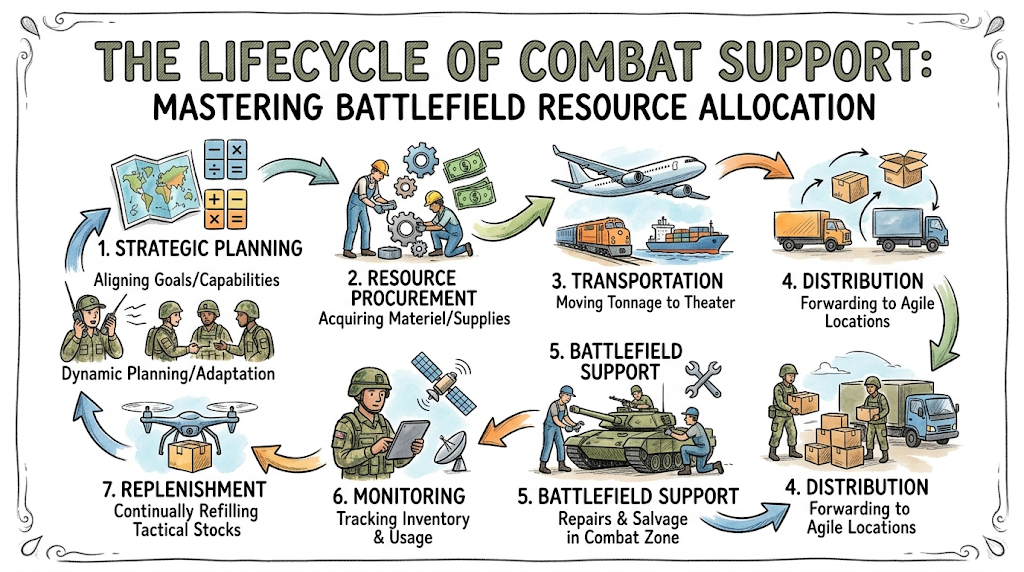
To visualize how these concepts operate over time, it helps to look at the entire lifecycle of defense logistics as a continuous loop. The table below details each stage, its primary operational purpose, the typical systems deployed, and the concrete real-world outcomes.
| Stage | Purpose | Systems Used | Real-World Outcome |
| Strategic Planning | To align long-term military goals with national industrial capabilities and resource reserves. | Predictive modeling software, consumption algorithms, inventory databases. | Clear operational limits established for the campaign before troops deploy. |
| Resource Procurement | To manufacture, acquire, and aggregate the physical materiel needed for operations. | Defense acquisition frameworks, manufacturing contracts, quality assurance. | Warehouses stocked with reliable, standardized munitions, gear, and equipment. |
| Transportation | To move bulk tonnage from domestic production bases across strategic distances into the theater. | Strategic sealift ships, cargo aircraft, heavy transport rail networks. | Massive columns of equipment and supplies placed safely within regional operational hubs. |
| Distribution | To sort, break down, and forward bulk supplies from major hubs to agile forward locations. | Automated sorting facilities, tactical cargo trucks, material handling units. | Forward operating bases fully stocked with specific, mission-essential asset classes. |
| Battlefield Support | To perform active maintenance, salvage operations, and localized repairs within the combat zone. | Mobile maintenance bays, heavy recovery vehicles, field engineering assets. | Damaged combat systems repaired rapidly and returned directly to frontline service. |
| Monitoring | To track asset locations, consumption rates, and structural integrity under active field conditions. | Satellite asset tracking, RFID sensors, secure data links. | Real-time visibility of inventory levels, preventing unexpected shortfalls. |
| Replenishment | To continually refill drawn-down tactical stocks before they hit critical depletion levels. | Automated reorder triggers, scheduled supply convoys, aerial delivery systems. | Combat units maintaining high combat capability over extended operational timelines. |
| Continuous Coordination | To dynamically realign logistics pipelines with rapidly changing tactical situations on the ground. | Integrated command software, secure tactical radio networks, staff planning. | Supply lines shifting smoothly alongside advancing or retreating combat forces. |
Historical Evolution of Military Logistics
Looking back at how supply systems have adapted to changing technologies gives us a clear template for understanding modern defense infrastructure.
Ancient Warfare Logistics
In the ancient world, the structural limits of logistics dictated the boundaries of empires. The Greek city-states were limited by their rocky terrain, relying heavily on maritime shipping to sustain military forces away from home. Alexander the Great changed the game by eliminating slow-moving oxcarts from his baggage trains, forcing his soldiers to carry their own heavy equipment and rations. This choice allowed his army to move at unprecedented speeds, completely outmaneuvering traditional Persian forces. However, he remained tied to local harvest cycles and required deep coordination with naval fleets along the Mediterranean and Asian coastlines to survive long-term.
Medieval Military Supply Systems
The collapse of centralized Roman administration led to a noticeable decline in structured military logistics during the early medieval period. Armies reverted back to decentralized foraging and plundering. However, by the late Middle Ages, the re-emergence of professional siege warfare demanded a return to organizational discipline.
The construction of large trebuchets, fortifications, and the maintenance of heavily armored cavalry required thousands of skilled craftsmen, dedicated baggage trains, and the establishment of local market networks where armies purchased food from local populations using centralized royal treasuries.
Industrial-Era Warfare Logistics
The 19th century brought massive changes to the battlefield. The introduction of the steam locomotive allowed nations to mobilize and supply millions of soldiers along defined railway corridors. During the American Civil War and the Franco-Prussian War, victory shifted from who had the most brilliant tactical commander to who could manage rail timetables most efficiently. For the first time, armies could be reinforced and resupplied with fresh ammunition and food within days, leading to a massive inflation in the scale and duration of military campaigns.
World War Logistics Systems
The First and Second World Wars represented the zenith of total industrial warfare. During World War II, the United States built a global logistics network that simultaneously supplied operations across Western Europe, North Africa, and the vast expanses of the Pacific Ocean.
This era saw the introduction of specialized landing craft, massive merchant marine convoys (Liberty Ships), and prefabricated harbor systems (Mulberry Harbours) that allowed armies to land tons of supplies directly onto open beaches without capturing established port cities first.
Cold War Operational Logistics
The standoff between global superpowers required the maintenance of massive, permanent forward-deployed forces capable of fighting at a moment’s notice. Logistics during this era focused heavily on strategic airlift capabilities—proven during the Berlin Airlift of 1948–1949—and the pre-positioning of entire divisions’ worth of heavy equipment in secure underground warehouses in Europe, allowing personnel to be flown in from domestic bases and linked with their gear within hours.
Modern Digital Military Logistics
Today, we live in the era of digital defense networks. Modern operations rely on end-to-end visibility, where every pallet of supplies is fitted with active tracking sensors and monitored via global communication systems. This digital infrastructure allows for precision logistics, matching the efficiency of top-tier global shipping corporations while operating under active electronic warfare conditions and physical threats.
Modern Military Logistics Technologies
The integration of advanced technology into military supply chains has significantly improved efficiency, allowing modern forces to achieve more with a smaller logistical footprint.
Transportation and Communication Systems
Modern heavy transport platforms utilize advanced suspension networks and automated loading systems to accelerate cargo handling. These vehicles are linked via secure, encrypted satellite communication arrays that pass positioning data and maintenance alerts back to command hubs automatically. This ensures that planners can look at an entire theater of operations and see the precise latitude, longitude, and engine status of every supply truck in real time.
Satellite Monitoring and Asset Tracking
By leveraging orbital reconnaissance and dedicated global positioning arrays, defense logisticians can track cargo containers globally. Radio Frequency Identification (RFID) tags and biometric sensors embedded within cargo containers register environmental changes, tampering attempts, or shifting loads, transmitting this information securely via satellite links to ensure cargo integrity.
Artificial Intelligence and Predictive Logistics
One of the most significant shifts in modern systems is the move from reactive maintenance to predictive logistics. By feeding historical mechanical data and real-time usage metrics into AI algorithms, platforms can predict exactly when an engine component, transmission gear, or helicopter rotor blade will fail. This allows maintenance teams to replace parts during scheduled maintenance windows before a breakdown occurs during an active operation.
Autonomous Supply Systems and Battlefield Tracking
The deployment of autonomous supply assets is expanding rapidly. Unmanned aerial vehicles (Urones) and self-driving cargo platforms are increasingly used to deliver medical packages, ammunition, and rations to isolated frontline units. This removes human drivers from high-risk transport routes, reducing casualties during contested “last-mile” resupply runs.
The table below breaks down these modern logistical technologies, comparing their intent, complexity, and specific usage profiles within defense networks.
| Technology | Purpose | Complexity | Military Usage |
| Satellite Asset Tracking | Global, real-time visibility of cargo containers and convoys. | High (Requires dedicated orbital infrastructure) | Broadly used across all branches to monitor intercontinental shipping lanes. |
| Predictive AI Modeling | Anticipating hardware component failures before breakdowns occur. | Very High (Requires complex data frameworks) | Deployed within advanced aviation and armored vehicle maintenance chains. |
| Autonomous Supply Drones | Last-mile delivery of critical cargo to isolated frontline positions. | Medium to High (Autonomous navigation systems) | Used for targeted medical resupply and small-unit ammunition delivery. |
| Automated Material Handling | Rapid loading, unloading, and sorting of bulk cargo at transit hubs. | Medium (Robotic sorting and heavy lifts) | Implemented at major port facilities and theater-level logistics bases. |
| Encrypted RFID Arrays | Non-line-of-sight inventory tracking inside complex warehouses. | Low to Medium (Secure near-field electronics) | Standardized tracking across all classes of supply from factory to field. |
Real-World Military Logistics Use Cases
To see these systems in action, we can examine how defense logistics scales across various operational profiles, extending far beyond traditional ground combat.
Large-Scale Troop Deployment
When a nation decides to deploy a major force globally, logistics serves as the vanguard. Planners must coordinate thousands of flights, schedule maritime shipping lanes, secure landing rights with international partners, and establish initial life-support infrastructure (housing, water purification, power generation) at the destination before combat forces arrive. This requires deep synchronization between civilian transportation infrastructure and military assets.
Disaster Response and Humanitarian Missions
The machinery of military logistics is frequently deployed during non-combat crises. Following major earthquakes, tsunamis, or hurricanes, civilian infrastructure is often destroyed. Military forces excel in these environments because they bring self-sustaining logistical networks.
Heavy-lift helicopters deliver food and clean water to isolated communities, amphibious ships deploy mobile water purification systems directly onto beaches, and field engineers quickly clear debris from blocked roadways to reopen vital transport routes.
Naval and Air Force Logistics
Operating at sea or in the skies requires distinct logistical frameworks. For navies, the core challenge is Underway Replenishment (UNREP)—the highly complex art of transferring fuel, ammunition, and stores between ships while moving side-by-side at sea in heavy swells.
For air forces, logistics centers around rapid turn-around times at airfields, managing highly specialized parts for jet engines, and coordinating aerial refueling tankers to extend the operational range of combat aircraft far beyond their internal fuel capacities.
Border Operations and Peacekeeping Missions
In rugged border regions—such as high-altitude mountain ranges or deep jungle environments—standard logistics trucks cannot operate. Forces must rely on specialized assets, including pack animals, tactical helicopters, or foot porter networks, to maintain defensive outposts.
In multinational peacekeeping operations, logistics planners face the unique challenge of interoperability: aligning different supply systems, radio frequencies, and fuel standards across dozens of participating nations to create a cohesive distribution network.
Benefits of Strong Military Logistics
Investing heavily in logistical capabilities yields distinct strategic advantages that directly determine the outcome of defense operations.
- Superior Operational Readiness: Units maintain peak combat capability because their equipment is kept in top working order through consistent parts supply and proactive maintenance.
- Rapid Deployment Velocity: A well-structured transport network allows a nation to project power and position forces at a crisis point days or weeks faster than an adversary.
- Optimized Resource Utilization: Efficient tracking prevents waste, minimizes overproduction, and ensures that defense budgets are converted into usable operational capability rather than sitting idle in forgotten warehouses.
- Enhanced Troop Morale and Support: Knowing that hot food, clean water, dependable ammunition, and rapid medical evacuation networks are fully operational gives frontline forces the confidence required to execute demanding missions.
- Unmatched Strategic Flexibility: A robust, adaptable supply network allows commanders to pivot their focus, launch unexpected maneuvers, or shift their main lines of effort rapidly without stalling due to supply shortfalls.
Challenges & Limitations
Even the most technologically advanced logistics systems face constant friction and vulnerabilities during active campaigns.
Difficult Terrain and Environmental Realities
Nature remains a major obstacle for logistics planners. Mountain ranges restrict transport to narrow, easily ambushed valleys; deep mud slows heavy wheeled vehicles to a crawl; extreme desert heat accelerates mechanical wear and increases water requirements; sub-zero arctic environments freeze fuels and drain electronic battery systems rapidly.
Communication Disruptions and Cybersecurity Threats
Modern logistics relies on digital data. If an adversary successfully disrupts satellite communications or conducts a cyberattack against central supply databases, the entire network can be blinded. Inventory systems can lose track of shipments, transport coordinates can be altered, and automated reorder pipelines can be halted, forcing operations to revert to slow, manual tracking methods.
Infrastructure Damage and Transport Risks
Bridges can be blown up, rail lines sabotaged, and deep-water ports targeted by long-range precision strikes. When critical infrastructure is damaged, logistics units must pivot instantly. Furthermore, supply convoys and cargo aircraft are high-priority targets for enemy forces looking to starve frontline units without engaging them directly.
Practical Strategic Solutions
To overcome these vulnerabilities, modern defense planning relies on several core strategies:
- Supply Redundancy: Maintaining multiple physical supply nodes and alternative transport routes so that the loss of a single point does not collapse the entire pipeline.
- Infrastructure Preparedness: Deploying tactical combat engineers right alongside advancing forces, equipped with rapid bridging systems and heavy construction machinery to repair damaged routes within hours.
- Secured Local Procurement: Developing flexible local supply contracts to reduce dependence on long-distance, high-risk intercontinental shipping lanes during extended campaigns.
Career Opportunities in Defense Logistics
The field of military logistics offers an array of professional career paths for individuals interested in operations management, systems engineering, and strategic planning, across both uniformed military service and civilian defense contracting sectors.
Key Professional Roles
- Defense Logistics Analyst: Tasked with evaluating consumption data, identifying bottlenecks within distribution channels, and building mathematical models to optimize inventory levels across global supply networks.
- Military Operations Planner: Responsible for designing transport timetables, calculating fuel and ammunition requirements for specific mission sets, and integrating logistical constraints directly into overall strategic plans.
- Supply Chain Officer: A leadership role focused on directing warehousing, asset allocation, and field distribution operations within active theaters of operation.
- Transportation Coordinator: Specializes in organizing complex multi-modal shipping movements, balancing rail, sealift, airlift, and heavy truck assets to maintain high transit velocities.
- Strategic Operations Consultant: Often a civilian expert who advises defense agencies on supply chain modernization, technology integration, and structural cost-reduction strategies.
- Logistics Systems Engineer: Focuses on designing the hardware and software systems used to track assets, manage automated warehouses, and protect supply databases from cyber threats.
Required Skills and Educational Framework
Succeeding in this domain requires a blend of analytical capability and practical leadership. Professionals must master quantitative methods, database management, and predictive data analysis. A strong foundation in systems engineering, operations research, or international supply chain management is highly valued.
Most professionals enter the field with degrees in logistics, business administration, engineering, or international relations, supplemented by specialized military staff college training or professional defense industry certifications. The industry demand for these skill sets remains consistently high, as global supply chain resilience continues to be a top priority for defense organizations and international corporations alike.
Beginner Roadmap for Learning Military Logistics
If you are a student, researcher, or strategy enthusiast looking to master the principles of military logistics, following a structured learning path will help you grasp these complex operational systems effectively.
Step 1: Foundations of Military Strategy
Begin by studying general military history and basic strategic concepts. Read classic texts like Carl von Clausewitz’s On War and Sun Tzu’s The Art of War, focusing specifically on how they address the physical limits of moving and sustaining armies. Understand the distinctions between the strategic, operational, and tactical levels of conflict.
Step 2: Supply Chain Fundamentals
Pivot into mainstream corporate supply chain management. Learn the principles of inventory control, warehousing mechanics, multi-modal transportation systems, and procurement frameworks. The core rules of moving cargo efficiently apply equally across both civilian commercial networks and defense systems.
Step 3: Operations Management and Logistics Analytics
Develop your analytical capabilities. Focus on operations research, statistical modeling, and data analytics. Learn how to calculate burn rates, optimize routing pathways through networks, and use predictive modeling tools to forecast demand patterns under changing conditions.
Step 4: Defense Technology Systems
Study the unique technologies deployed within modern military frameworks. Research how satellite asset tracking, secure military communication networks, automated material handling systems, and autonomous supply platforms operate under electronic warfare and high-threat environments.
Step 5: Historical Case Studies
Analyze real-world campaigns where logistics proved decisive. Excellent case studies include:
- The American Civil War (Rail Operations): How the North utilized rail infrastructure to sustain deep strategic offensives.
- The North African Campaign in WWII (Line of Communication Limits): How Rommel’s advance was fundamentally limited by the length of his truck supply lines along a single coastal road.
- The 1991 Gulf War (The Logistics Surge): How the US military moved millions of tons of material into the Saudi Arabian desert within a few months, establishing an unshakeable operational base.
Step 6: Strategic Simulations and Critical Thinking
Apply your knowledge by engaging with complex strategic simulations, operational war games, and case-study analyses. Practice looking at an operational map not just as a set of arrows showing troop advances, but as a network of supply capacities, transport bottlenecks, and consumption rates.
Certifications & Training
To build professional credibility in defense logistics, individuals can pursue several widely recognized training and certification pathways. These programs bridge the gap between academic theory and active operational execution.
| Certification | Level | Best For | Skills Covered |
| Certified Supply Chain Professional (CSCP) | Intermediate to Advanced | Aspiring defense consultants and corporate supply chain analysts. | End-to-end supply chain design, global distribution networks, inventory strategy. |
| Certified Professional in Logistics (CPL) | Expert | Senior defense planners, engineers, and military logistics consultants. | Life-cycle systems engineering, operational readiness management, maintenance loops. |
| Defense Systems Acquisition Management | Professional | Civilian defense contractors and military acquisition officers. | Government procurement frameworks, budgeting, asset lifecycle planning. |
| Lean Six Sigma (Green/Black Belt) | All Levels | Operational planners focused on process optimization and waste reduction. | Statistical quality control, bottleneck analysis, process efficiency modeling. |
Common Beginner Mistakes
When starting out in the study of military strategy and defense operations, it is easy to fall into several conceptual traps that distort your analysis of real-world campaigns.
Focusing Exclusively on Combat Tactics
The most common mistake is spending all your time analyzing weapon specifications, troop positions, and frontline combat maneuvers while completely ignoring the underlying supply network. A brilliant tactical maneuver is useless if the units executing it run out of fuel or ammunition halfway through the operation.
Underestimating the Complexity of the Supply Chain
Beginners often assume that resupply is a simple matter of driving a truck from point A to point B. In reality, a military supply chain must manage thousands of distinct asset classes, safely handle volatile explosives, maintain temperature-sensitive medical goods, and protect digital tracking networks from active cyber sabotage across contested lines of communication.
Overlooking Historical Lessons
Many students assume that modern digital technologies have made historical logistical lessons obsolete. While tools like GPS, AI, and drones have drastically improved distribution speeds, the core physical constraints of warfare—the human need for food and water, the massive fuel consumption of heavy armor, and the friction of difficult terrain—remain unchanged since the ancient world.
Best Practices in Military Logistics
To maintain high operational readiness and ensure mission continuity under the most demanding conditions, defense organizations adhere to several time-tested operational principles.
- Continuous, Integrated Coordination: Logistics planners must have a seat at the table during the earliest phases of tactical planning, ensuring that military maneuvers are always aligned with realistic supply capabilities.
- Real-Time, Secure Communication: Maintaining continuous visibility over inventory positions, transport velocities, and asset conditions through encrypted communication networks to prevent surprise shortages.
- Rigorous Risk Management and Redundancy: Always planning for the worst-case scenario by establishing supply backups, alternative transport routes, and mobile repair units capable of bypassing broken infrastructure.
- Infrastructure and Engineering Readiness: Keeping combat engineers fully integrated with forward forces so that roads, bridges, and runways can be repaired or constructed immediately to maintain high transport speeds.
- Proactive Technology Integration: Leveraging advanced predictive analytics, automated sorting machinery, and autonomous distribution tools to continually reduce the operational footprint and protect personnel from unnecessary risk.
Future of Military Logistics
As we look toward the horizon of global defense operations, the architecture of military supply chains is undergoing a profound transformation driven by rapid technological acceleration.
AI-Driven Networks and Autonomous Transit
The future of logistics lies in fully integrated, self-optimizing distribution networks. AI platforms will monitor global consumption rates, predict component failures, and automatically adjust manufacturing schedules and shipping priorities without requiring human intervention.
Simultaneously, autonomous truck convoys, robotic cargo vessels, and heavy-lift supply drones will increasingly handle transport duties across hazardous zones, moving assets safely from major theater bases straight to frontline squads.
Smart Battlefield Systems and Distributed Additive Manufacturing
Another major shift is the deployment of advanced 3D printing (additive manufacturing) directly within active combat zones. Instead of waiting weeks for a specialized metal spare part to be shipped from a domestic factory, forward maintenance units will simply download the digital blueprint and print the replacement component right at a forward operating base. This capability will drastically reduce the need for massive spare parts inventories and significantly improve vehicle repair speeds.
Secure, Decoupled Supply Lines and Satellite Analytics
To counter growing cyber and electronic warfare threats, future logistics networks will utilize decentralized data architectures to secure asset-tracking records and protect automated distribution pipelines from tampering.
Furthermore, real-time satellite imagery and intelligent operational analytics will continuously scan global transport routes, automatically identifying bottlenecks, weather hazards, or enemy troop concentrations, allowing supply networks to redirect resources seamlessly.
FAQs
- What is military logistics?
Military logistics is the comprehensive operational discipline focused on planning, executing, and managing the movement, resupply, and maintenance of armed forces. It ensures that combat units have the exact materiel, fuel, food, and medical support required to execute missions successfully.
2. Why is logistics important in warfare?
Logistics directly determines the operational reach, durability, and effectiveness of an army. Without continuous resupply, weapons become useless, vehicles run out of fuel, and troops face exhaustion and starvation, leading to a complete breakdown of combat capability regardless of tactical skill.
3. How do armies manage supplies during active campaigns?
Armies utilize a structured, layered distribution system. Bulk supplies are moved from domestic bases to major theater hubs via strategic rail, sea, or air transport. From there, intermediate units sort and break down cargo, forwarding it to smaller forward operating bases, which then handle last-mile delivery to frontline units.
4. What technologies are used in modern military logistics?
Modern defense logistics relies on a combination of satellite asset tracking, encrypted RFID inventory management, AI-driven predictive maintenance modeling, automated material handling systems, and autonomous supply drones to maintain high efficiency in high-threat environments.
5. Is military logistics similar to business supply chains?
While they share core principles like inventory control, routing optimization, and warehousing efficiency, they operate under fundamentally different risk profiles. Business supply chains optimize for cost and profit within stable environments; military logistics prioritizes speed, security, and absolute reliability within active combat zones under hostile fire.
6. What role does transportation play in warfare?
Transportation is the physical engine of logistics. It dictates how quickly a nation can project power, reinforce threatened sectors, and sustain moving forces. Managing a balanced mix of rail, strategic sealift, airlift, and tactical truck networks is essential for operational success.
7. Can civilians study or work in military logistics?
Yes. Military logistics is a massive academic and professional discipline. Many defense agencies, think tanks, and private defense contractors employ civilian logistics analysts, systems engineers, supply chain consultants, and operations research experts to optimize supply architecture.
8. What careers exist in defense logistics?
Key career opportunities include Defense Logistics Analysts, Military Operations Planners, Supply Chain Officers, Transportation Coordinators, Strategic Operations Consultants, and Logistics Systems Engineers across both public and private sectors.
9. What are the main classes of military supply?
Military supplies are generally organized into standardized categories to simplify tracking. Common classes include Class I (Rations and water), Class III (POL – Petroleum, oil, and lubricants), Class V (Ammunition and explosives), and Class VIII (Medical materials and pharmaceuticals).
10. How does bad weather impact military supply lines?
Severe weather slows down transportation speeds, restricts aerial resupply flights, damages temporary roads, and accelerates mechanical wear on transport vehicles. It also increases the frontline demand for specialized clothing, heating fuels, and medical support.
11. What is last-mile delivery in military logistics?
Last-mile delivery is the final, most dangerous stage of the supply chain, involving the physical transport of ammunition, food, and water from local forward operating bases directly to tactical units engaged in active combat on the front line.
12. How do armies secure their supply chains against ambushes?
Armies deploy dedicated convoy security forces, utilize armored supply vehicles, route transport through secured corridors, leverage night operations, and increasingly deploy autonomous supply drones to minimize human exposure along high-risk routes.
13. What is predictive logistics?
Predictive logistics uses data analytics and AI algorithms to evaluate machine usage data and environmental conditions, allowing maintenance teams to anticipate and fix mechanical part failures before they cause unexpected breakdowns during operations.
14. How do field engineers support military logistics?
Field engineers are critical for maintaining mobility. They rapidly construct pontoon bridges across rivers, clear obstacles from blocked supply routes, repair damaged runways, and erect protective structures for forward supply depots.
15. What is the future of military operational systems?
The future centers around AI-guided autonomous supply systems, heavy-lift drone distribution networks, 3D printing of spare parts directly at forward operating bases, and highly secure digital networks designed to withstand intense electronic and cyber warfare.
Final Thoughts
Logistics is the ultimate reality check of military ambition. A general can design a flawless operational plan on a map, but if the underlying supply pipeline cannot deliver the necessary tonnage of fuel, ammunition, and water across contested terrains, that plan remains a fantasy. History is filled with examples of powerful armies that collapsed not because they were outfought on the front lines, but because their supply chains fractured, leaving them stranded and vulnerable.
As we look at the future of global defense operations, the core challenge remains unchanged: converting national economic and industrial power into precise, sustainable capability at the tip of the spear. While modern technologies like artificial intelligence, autonomous drones, and predictive analytics offer unprecedented speed and clarity, they must still operate within the physical realities of geography, consumption rates, and environmental friction.