Introduction
When people evaluate organizational or operational strength, they often look at numbers first. It is easy to assume that the side with more personnel, vehicles, or equipment holds an absolute advantage. However, strategic history and defense studies consistently demonstrate that size alone does not determine overall effectiveness. A smaller, well-coordinated group with superior information, rigorous training, and effective tools can often achieve results far beyond its headcount. This concept is known as a force multiplier. Foundational discussions on strategic capabilities and organizational readiness, such as resources provided on WarOpsX.com, emphasize that genuine capability is a blend of tools, human intellect, and logistical support.
Quick Overview
Force multipliers are attributes or capabilities that dramatically enhance the potential output of an existing group without requiring an increase in its core size.
| Force Multiplier | Primary Strategic Function | Example Factors |
| Technology | Extends range, precision, and physical capability | Sensors, automation, satellite links |
| Information | Enhances situational awareness and decision speed | Data integration, reconnaissance networks |
| Training & Doctrine | Maximizes human proficiency and tactical execution | Realistic simulations, specialized skillsets |
| Leadership | Optimizes resource allocation and organizational focus | Decisiveness, operational vision |
| Logistics | Sustains operational tempo and asset readiness | Supply chain reliability, rapid maintenance |
| Communication | Synchronizes distributed assets and teams | Secure networks, data-sharing protocols |
| Geography | Provides natural defensive or positional advantages | High ground, chokepoints, adverse weather |
What Is a Force Multiplier?
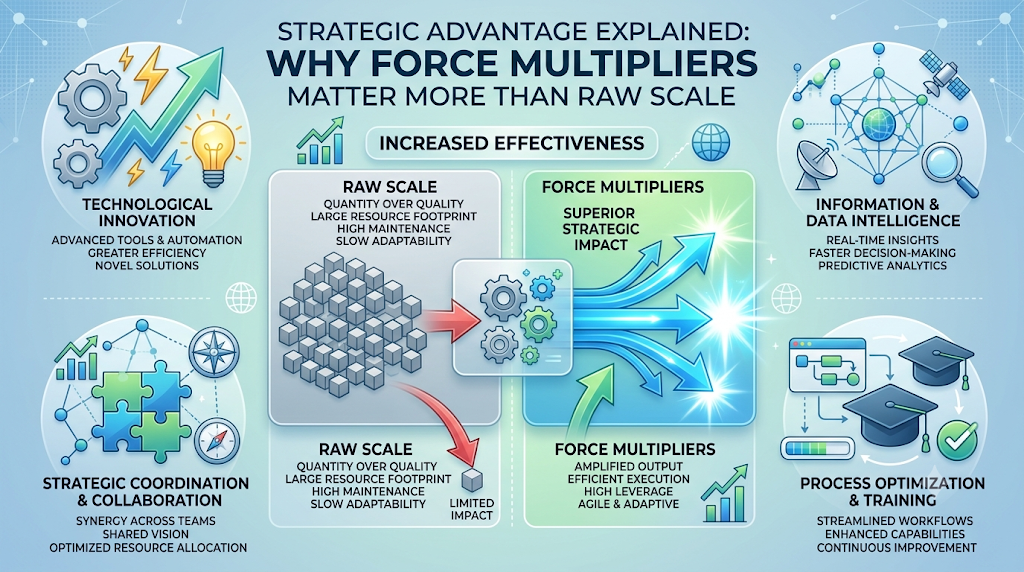
In strategic studies, a force multiplier is defined as a factor, capability, or tool that significantly enhances the operational effectiveness of an existing force. It does not literally multiply the mathematical headcount; rather, it amplifies the overall impact, efficiency, and capability of the resources already available.
To understand this outside of defense, consider a modern logistics warehouse:
- Scenario A: A crew of ten workers manually moves boxes from one area to another using physical labor alone.
- Scenario B: The same ten workers are equipped with powered pallet jacks, automated conveyor belts, and a digital inventory scanning system.
The physical size of the team has not changed, but the team’s output in Scenario B increases dramatically. The digital scanners, conveyor belts, and specialized equipment act as force multipliers. In the same way, strategic force multipliers allow organizations to accomplish objectives that would otherwise require vastly larger teams.
Force Multiplier vs. More Resources
There is an essential difference between simply increasing the quantity of a force (mass) and multiplying its capability (effectiveness).
Increasing Quantity:   [Force A] + [Force B] = Larger Footprint, Higher Overhead
Force Multiplication:  [Force A] × [Capability Enhancer] = Greater Output, Same Footprint
Simply adding more personnel or physical equipment introduces several logistical challenges:
- Increased Overhead: More people require more food, shelter, medical care, and management infrastructure.
- Communication Friction: Larger teams often suffer from slower decision-making and cluttered communication channels.
- Logistical Drag: Transporting and sustaining massive formations consumes vast amounts of fuel and maintenance bandwidth.
Force multiplication focuses on qualitative improvement rather than quantitative expansion. By improving communication, training, or equipment integration, an organization can achieve superior results while maintaining a streamlined, agile footprint.
Major Types of Force Multipliers
Technology
Technology provides physical and operational reach. From ruggedized sensors to long-range communications equipment, technological assets enable teams to observe environments, coordinate across distances, and operate with greater safety and efficiency.
Information and Intelligence
Accurate, timely information allows decision-makers to anticipate challenges rather than merely react to them. When units have clear visibility of the operational environment, they waste fewer resources and make faster, more effective choices.
Training and Experience
Sophisticated equipment is useless without skilled operators. Rigorous training programs develop muscle memory, critical thinking, and technical mastery, enabling teams to perform under intense pressure and adapt to unexpected developments.
Leadership and Decision-Making
Clear, calm leadership provides organizational direction. A decisive leader who delegates effectively and maintains mission focus prevents panic, minimizes hesitation, and ensures all available assets work toward a common goal.
Logistics and Maintenance
A capability is only as good as its availability. Efficient supply chains, robust preventive maintenance, and organized medical support keep personnel healthy and equipment running, sustaining operational momentum over long periods.
Communication and Coordination
Isolated units have limited utility. Interconnected communication systems allow disparate teams to share data instantly, synchronize maneuvers, and support one another in real time, turning separate elements into a unified network.
Morale and Organizational Culture
Human psychology plays a decisive role in any endeavor. High morale, shared purpose, disciplined cohesion, and mutual trust keep organizations functioning effectively through exhaustion, uncertainty, and friction.
Geography and Environment
Physical terrain can naturally multiply a force’s capability. High elevation improves observation and signal transmission, natural chokepoints restrict movement, and familiarity with local weather patterns allows teams to turn harsh conditions to their advantage.
Technology as a Force Multiplier
Modern technological integration represents one of the most visible forms of force multiplication. Technology bridges human physical limitations, enhances safety, and streamlines complex workflows.
- Advanced Sensor Networks: Radar, infrared cameras, and acoustic sensors allow personnel to detect obstacles and monitor vast areas long before physical contact occurs.
- Uncrewed and Autonomous Systems: Uncrewed aerial, ground, and maritime vehicles can perform high-risk reconnaissance and transport tasks without placing human operators in direct danger.
- Secure Data Networks: Encrypted digital links permit rapid sharing of telemetry, navigation data, and visual feeds between command elements and field units.
- Decision-Support Software: Computational tools can analyze vast streams of environmental, logistical, and positional data, offering recommendations to help leaders make sound choices quickly.
Technology does not replace human responsibility; it augments human capability by handling high-volume data analysis and mechanical burdens.
Human Factors as Force Multipliers
A common misconception in defense technology studies is that hardware alone wins the day. In practice, technology without trained, disciplined human operators quickly fails.
Technology (Tool) + Human Mastery (Skill + Discipline) = Effective Force Multiplication
Human factors amplify technical investments in several distinct ways:
- Adaptability: Machines follow programmed rules; humans improvise when unexpected obstacles disrupt the initial plan.
- Continuous Learning: Experienced teams conduct post-mission analyses, learn from mistakes, and refine operational doctrines for future tasks.
- Cross-Functional Teamwork: Cohesive teams anticipate each other’s needs, reducing verbal communication delays and eliminating operational friction.
- Ethical Judgment: Strategic and operational decisions require nuanced human oversight to assess proportionality, risk, and broader mission impact.
Information as a Force Multiplier
In any operational environment, uncertainty creates delay and hesitation. Having timely, accurate, and actionable information directly enhances performance.
- Shared Situational Awareness: When every team member sees the same digital map and understands the current state of operations, coordination occurs naturally with minimal verbal direction.
- Targeted Resource Allocation: Accurate information ensures supplies, medical support, and specialized equipment are sent exactly where needed, eliminating waste.
- Information Challenges: Information can also fail. Outdated intelligence leads to poor choices, while excessive data streams can overwhelm human decision-makers. Effective systems filter, organize, and present only the most critical information clearly.
Historical Examples
History offers clear illustrations of how specific innovations and organizational factors acted as decisive force multipliers.
1. The Telegraph and Railroads (19th Century)
Before the mid-19th century, moving supplies and communicating across large regions took weeks. The pairing of the electric telegraph with steam-powered railway networks allowed strategic commanders to coordinate widespread logistics and shift resources in days rather than months.
2. Integrated Radar and the Chain Home System (World War II)
During the Battle of Britain, the Royal Air Force was heavily outnumbered. The British built the Chain Home radar network and connected it directly to central operations rooms via dedicated telephone lines. Instead of flying continuous, exhausting patrols, pilots scrambled only when incoming formations were detected. The radar network and integrated reporting structure multiplied the effectiveness of a limited number of aircraft.
[Radar Stations] ──> [Filter & Operations Center] ──> [Targeted Interceptions]
(Early Detection)    (Rapid Data Processing)          (Efficient Resource Use)
3. The Roman Road Network
The Roman Empire maintained security over thousands of miles with a standing military that was modest relative to the vast population and landmass. The construction of well-engineered, paved roads allowed legions to march quickly between provinces, enabling rapid response to regional unrest without needing massive garrisons in every town.
Modern Force Multipliers
Today, strategic force multiplication centers on digitization, network connectivity, and automated processing.
- Artificial Intelligence and Machine Learning: Modern sensor platforms collect petabytes of imagery and signal data. AI algorithms scan this data to highlight anomalies, allowing human analysts to focus on verification and strategic planning.
- Satellite Infrastructure: Global positioning, high-bandwidth satellite communications, and orbital observation platforms give modern organizations continuous situational awareness across continents.
- Cyber Operations: Network-based defense capabilities protect critical communication infrastructure, logistics pipelines, and command networks from unauthorized disruption.
- Integrated Command Systems: Modern defense networks connect air, sea, land, and space sensors into a single unified operational picture, allowing disparate units to collaborate seamlessly.
Practical Example
To see how force multiplication works in practice, consider two identical rescue and disaster-relief organizations operating in a flood zone:
Organization Alpha (Baseline Operations)
- Team: 50 search-and-rescue personnel.
- Tools: Standard watercraft and analog two-way radios.
- Process: Teams fan out randomly to search flooded neighborhoods. When they find survivors, they radio base, write down coordinates on paper, and wait for supply trucks to navigate submerged roads.
- Result: Slow response times, duplicated searches, and high physical exhaustion.
Organization Beta (Force-Multiplied Operations)
- Team: 50 search-and-rescue personnel (identical headcount).
- Tools: Watercraft, small uncrewed reconnaissance drones, digital tablets with synchronized mapping software, and a centralized logistics dashboard.
- Process: Drones map flooded areas and identify stranded individuals. Coordinates immediately populate on rescuers’ tablets. The dashboard automatically directs the nearest craft with adequate space and fuel.
- Result: Targeted rescues, zero duplicated efforts, faster recovery times, and optimized fuel use.
Organization Beta achieved substantially higher performance not by hiring more personnel, but by integrating technological, informational, and organizational force multipliers.
Benefits of Force Multipliers
Adopting effective force multipliers provides distinct strategic and operational benefits:
- Operational Efficiency: Organizations achieve their objectives with fewer physical assets, lowering overall operating costs.
- Reduced Human Exposure: Remote sensors and uncrewed systems allow teams to survey hazardous environments while keeping human personnel at safe standoff distances.
- Enhanced Decision Speed: Real-time data processing shortens the loop between observing a problem, deciding on a course of action, and executing the plan.
- Flexibility and Adaptability: A well-trained, highly connected organization can shift focus quickly when mission conditions change.
- Sustainability: Optimized supply tracking and preventive maintenance extend the operating lifespan of vehicles and complex equipment.
Limitations and Trade-Offs
While force multipliers offer significant advantages, they are not magic solutions. Relying on advanced tools and complex systems introduces notable risks:
- System Complexity and Fragility: Advanced technologies require intricate maintenance. A single software bug, broken antenna, or damaged power inverter can render an entire system useless.
- High Financial Investment: Developing, purchasing, and fielding advanced sensors, communication suites, and uncrewed platforms demands substantial capital.
- Intensive Training Demands: High-tech systems require highly educated, consistently trained operators and technicians. If training lapses, equipment sits idle.
- Vulnerability to Disruption: Highly networked systems can be targeted via electronic jamming, cyber intrusion, or physical severing of data links.
- Overreliance and Skill Atrophy: If operators become entirely dependent on automated tools, their baseline manual skills (such as map-and-compass navigation or manual system management) can degrade over time.
How to Evaluate a Force Multiplier
Strategic planners and defense analysts systematically assess whether a new capability genuinely enhances operations before investing in wide-scale adoption.
1. Operational Impact    ──> Does it measurably improve performance?
2. Technical Reliability  ──> Will it function in harsh, degraded environments?
3. Lifecycle Cost         ──> Can the organization afford sustainment and spares?
4. Interoperability       ──> Does it integrate with existing systems?
5. Human Usability        ──> Can operators manage it under stress?
- Mission Relevance: Does the capability solve a real operational problem, or is it merely novel technology for its own sake?
- Interoperability: Can the new tool communicate seamlessly with legacy equipment, radios, and organizational databases?
- Supportability and Logistics: Can spare parts, battery replacements, and certified repair technicians be deployed easily into the field?
- Resilience under Degradation: Does the system offer a clear, manual fallback mode if networks fail or satellite signals are blocked?
Future Trends
The development of force multipliers continues to accelerate, driven by rapid advancements in commercial and defense technologies.
- Human-Machine Teaming: Future operational environments will see humans working directly alongside automated systems, where machines handle data aggregation and routine movement while humans retain decision authority.
- Automated Logistics Pipelines: Autonomous cargo transports, predictive maintenance software, and advanced manufacturing will streamline field repairs and resupply.
- Edge Computing: Instead of sending all data back to distant centralized servers, lightweight onboard computers will process imagery and sensor feeds locally on individual platforms, speeding up data delivery.
- Distributed Network Architectures: Moving away from single, vulnerable command nodes toward decentralized networks ensures that if one part of a network is damaged, the remaining systems continue functioning seamlessly.
FAQs
- What is a force multiplier in simple terms?
A force multiplier is any tool, technology, skill, or condition that significantly increases the effectiveness of an existing group without requiring an increase in the number of personnel.
- Can a force multiplier be an intangible asset?
Yes. Non-physical factors like high morale, effective leadership, thorough training, clear communication, and disciplined organizational culture are powerful intangible force multipliers that drastically improve operational performance.
- How does information act as a force multiplier?
Accurate and timely information gives decision-makers a clear view of their environment. This prevents wasted resources, reduces operational delays, and allows teams to make quick, well-targeted decisions.
- What is the difference between increasing mass and using a force multiplier?
Increasing mass means adding more personnel, vehicles, or physical equipment, which increases logistics and overhead. A force multiplier increases the output and capability of the existing personnel and equipment without expanding total numbers.
- What are common historical examples of force multipliers?
Classic examples include the British integrated radar network during the Battle of Britain, the combination of railroads and the telegraph in the 19th century, and the engineering of the Roman road network.
- Are force multipliers always technological?
No. While sensors, computers, and communications equipment are common modern examples, historical and modern force multipliers also include physical terrain, effective training doctrine, military logistics, and sound leadership.
- What are the main risks of relying on advanced force multipliers?
Key risks include high financial costs, system complexity, vulnerability to network or electronic interference, supply chain dependencies, and the risk that operators lose basic manual skills due to overreliance on automation.
- How does training multiply force effectiveness?
Training ensures that operators fully understand their equipment, can execute tasks under high stress, adapt quickly when plans fail, and coordinate smoothly with other team members without constant supervision.
- What is the role of artificial intelligence as an emerging force multiplier?
AI serves as a force multiplier primarily by sorting through massive amounts of sensor data, identifying patterns, predicting maintenance needs, and assisting human operators with rapid decision support.
- Why is human oversight critical when using high-tech force multipliers?
Human oversight provides ethical judgment, strategic context, creativity, and the ability to adapt to chaotic situations that automated algorithms or pre-programmed machines cannot navigate on their own.
Conclusion
The concept of the force multiplier demonstrates that strategic effectiveness is not simply a contest of numbers. While physical scale and personnel strength remain relevant, an organization’s ultimate capability is determined by how effectively its resources are coordinated, sustained, and employed. Tangible factors like advanced sensors, automated systems, and dependable logistics combine with intangible elements like disciplined training, decisive leadership, and high organizational morale to multiply capability across any operational environment. As technology continues to evolve toward networked systems, edge data processing, and human-machine collaboration, the core principle of force multiplication remains unchanged: real advantage comes from maximizing the value, agility, and intelligence of the force you have.