Introduction
In modern statecraft and defense, the ability to conceptualize a strategic response is only as valuable as the capacity to execute it. Moving thousands of personnel, specialized equipment, and tons of supply material across global distances requires a complex orchestration of logistics and planning. This core function is known as force deployment. Without disciplined execution during the initial transit and positioning phases, even the most advanced military strategies cannot succeed. As an educational resource for military studies, WarOpsX.com highlights how deployment serves as the bridge between national defense strategy and operational reality. This guide explores the foundational principles, phases, logistics systems, and modern challenges that define how forces move from their home bases to an operational theater.
What Is Force Deployment?
Force deployment is the structured process of assembling, readying, and transporting personnel, equipment, and materiel from home stations to an assigned operational area. Its primary purpose is to place trained and equipped assets into a specific zone of responsibility at the exact time required by an operational commander.
[Mobilization & Preparation] ➔ [Strategic Movement] ➔ [Reception & Integration]
To understand this concept fully, it must be distinguished from force projection:
- Force Projection is an overarching strategic capability. It represents a nation’s broader capacity to alert, mobilize, deploy, and sustain its military power anywhere across the globe to deter aggression or respond to crises.
- Force Deployment is the specific operational activity that executes this movement. It is the tactical and logistical pipeline that translates the abstract capability of force projection into physical presence on the ground.
Ultimately, deployment management is a critical pillar of force readiness. A unit that is perfectly trained but structurally incapable of rapid, orderly deployment offers limited utility in short-notice global contingencies.
Historical Evolution of Force Deployment
Early Military Campaigns
In antiquity and the medieval era, force deployment was largely constrained by human and animal endurance. Armies marched on foot, and supply lines were limited to basic horse-drawn wagons or coastal shipping vessels. Deployment planning was localized, and forces frequently relied on foraging or pillaging the surrounding countryside to sustain their movement.
Industrial-Era Logistics
The introduction of the steam engine, railroads, and telegraph systems transformed global mobility. During major conflicts of the 19th and 20th centuries, nations could suddenly shift hundreds of thousands of troops across continental distances in days rather than months. This era birthed formal military logistics, requiring centralized planning agencies to synchronize train schedules, ammunition stockpiles, and massive maritime troop transports.
Modern Joint Operations
The contemporary era relies on joint operations—the seamless integration of land, sea, air, space, and cyber forces. Modern force deployment is no longer a single-service effort. It requires complex coordination where air transport elements move vanguard forces, maritime vessels haul heavy armored equipment, and space assets provide secure, real-time tracking and communication.
Technology and Global Mobility
Today, advanced long-range cargo aircraft, high-speed sealift vessels, and automated inventory systems allow for rapid global transit. The focus has shifted from merely moving mass numbers of personnel to precisely managing the velocity and configuration of tailored force packages.
Why Force Deployment Is Central to Modern Military Operations
Strategic Readiness
Deployment operations are the ultimate test of a nation’s defense readiness. A streamlined deployment pipeline ensures that defensive plans can be rapidly actioned before an adversarial actor can establish an unassailable position.
Rapid Response Capabilities
Modern crises erupt with little warning. Whether reacting to sudden geopolitical instability or an urgent international security emergency, the speed at which a state can execute its initial deployment phases often determines its ability to contain a crisis before it escalates.
Operational Flexibility
A robust deployment framework allows planners to adjust force configurations on the fly. If conditions in an operational theater change during transit, adaptive deployment management allows resources to be rerouted or re-sequenced without stalling the broader logistical pipeline.
Global Reach
Force deployment principles turn domestic military assets into global instruments of statecraft. Without specialized strategic mobility platforms and international transit frameworks, an army remains isolated within its own borders.
Mission Sustainability
Deployment is not just about the first wave of arrival; it includes setting up the initial sustainment networks. Proper deployment structuring ensures that arriving units do not outrun their supply chains, keeping the mission viable over an extended timeline.
Core Principles of Force Deployment
To ensure success, planners rely on five foundational principles:
- Readiness: Units must maintain high standards of equipment maintenance, personnel administrative clearance, and training so they can transition from garrison to transit status with minimal notice.
- Mobility: The active utilization of diverse transportation platforms—including strategic airlift, commercial sealift, and rail networks—to maximize movement speed and bypass geographic bottlenecks.
- Coordination: The synchronization of effort across multiple military branches, host-nation authorities, and civilian transport contractors to prevent logistical gridlock at departure and arrival hubs.
- Sustainability: Designing the deployment flow so that essential maintenance, medical, and supply units arrive alongside or immediately after combat personnel to anchor the operational footprint.
- Adaptability: The capacity to alter transport modes, arrival schedules, or security protocols in real time to counter unexpected infrastructure failures or environmental changes.
Key Phases of Force Deployment
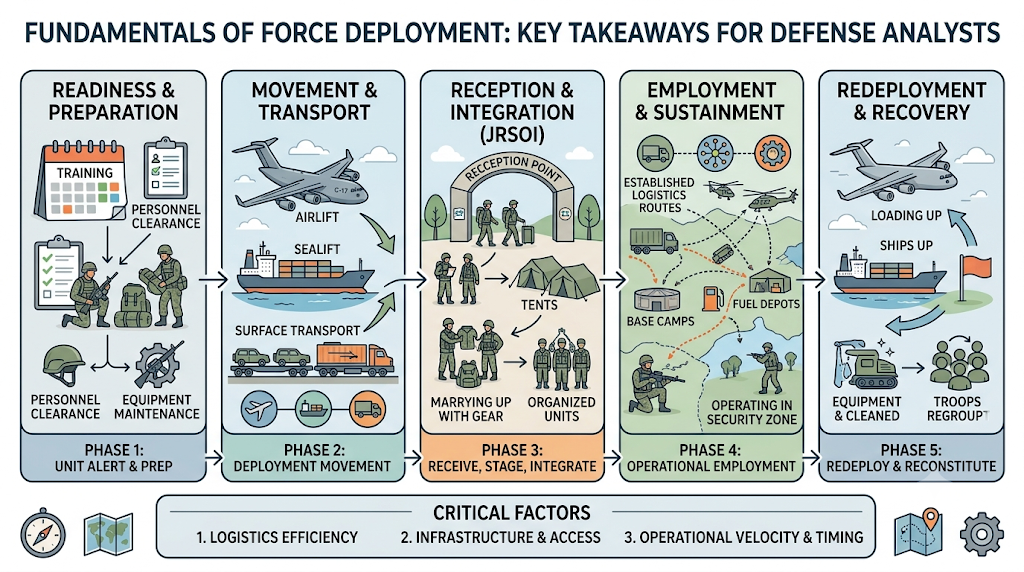
The deployment lifecycle is divided into five distinct organizational and operational phases:
1. Pre-Deployment ➔ 2. Movement ➔ 3. Reception (JRSOI) ➔ 4. Support ➔ 5. Redeployment
1. Pre-Deployment Preparation
This phase focuses on unit packaging and staging. Personnel undergo final medical and administrative screenings, equipment is inspected and waterproofed, and cargo is weighed, labeled, and loaded into standardized containers. Planners issue initial warning orders and manifest individual transport schedules.
2. Movement and Transportation
The physical transit phase. Forces travel via air, land, or sea from their points of origin to the designated theater. This phase demands rigorous tracking to ensure that personnel and their corresponding heavy equipment arrive in a synchronized sequence.
3. Reception, Staging, Onward Movement, and Integration (JRSOI)
Often considered the most complex phase, JRSOI marks the arrival in theater:
- Reception: Unloading personnel and equipment at ports of debarkation.
- Staging: Regrouping units and marrying personnel back up with their heavy vehicles or gear.
- Onward Movement: Moving the assembled units from staging areas to their operational zones.
- Integration: Merging the arriving forces into the existing local command structure.
4. Operational Support
Once integrated, the deployment pipeline shifts its focus to continuous operational sustainment. This includes the steady flow of food, fuel, replacement parts, and medical assets required to maintain the force’s operational tempo.
5. Redeployment and Recovery
Following mission completion, forces execute a reverse logistics process. Units are extracted from the operational area, transferred back to home stations, and put through a rigorous process of reconstitution—repairing equipment, conducting post-deployment debriefs, and restoring baseline unit readiness.
Deployment Planning Fundamentals
Mission Requirements Analysis
Planners begin by defining the exact scope of the mission. They determine what specific capabilities (e.g., engineering, medical, or security elements) are required, which dictates the size and composition of the force package.
Resource Allocation
This step involves identifying which units are currently at peak readiness status to fulfill the mission requirements. It balances the urgency of the deployment against the need to preserve home-station defense or training cycles.
Transportation Planning
Planners calculate the exact number of cargo aircraft, rail cars, or transport vessels required. They map out routes, identify refueling stops, and secure diplomatic overflight clearances from foreign governments.
Personnel Readiness
Ensuring that every individual selected for transit is fully qualified, trained on theater-specific regulations, medically cleared, and possesses the necessary personal gear for the destination environment.
Risk Management
Identifying potential single points of failure in the deployment chain—such as vulnerable shipping lanes or fragile port infrastructure—and developing comprehensive contingency plans to mitigate those vulnerabilities.
Logistics and Force Deployment
Military logistics forms the backbone of any deployment operation. Without precise logistical management, deployment plans quickly collapse into unorganized congestion.
- Supply Chain Coordination: Managing the continuous flow of classes of supply from domestic depots directly to deployed nodes, minimizing excess inventory while preventing shortages.
- Equipment Movement: The technical art of packing, securing, and balancing heavy machinery, tracked vehicles, and hazardous materials inside transport aircraft or ships.
- Transportation Networks: Cultivating and maintaining relationships with commercial rail lines, international shipping conglomerates, and port authorities to expand available transport capacity.
- Sustainment Operations: The backend infrastructure—such as field kitchens, water purification points, and mobile maintenance depots—that keeps deployed personnel effective over time.
- Resource Tracking: Utilizing specialized tracking systems to maintain constant visibility over cargo status, allowing planners to know exactly where an item is located in the global pipeline.
Force Deployment vs. Force Projection
While often used interchangeably in casual discussion, defense analysts distinguish these terms across several key aspects:
| Aspect | Force Deployment | Force Projection |
| Primary Focus | Movement and positioning of forces | Broader ability to mobilize, deploy, operate, sustain, and return forces |
| Scope | Operational activity | Strategic capability |
| Objective | Place resources where needed | Generate and employ military power globally |
| Time Horizon | Mission-specific | Long-term capability |
Technologies Supporting Modern Deployment
Logistics Information Systems
Centralized software databases that allow planners to calculate weight, balance, and cargo space requirements instantly, drastically cutting down the time required to build transport manifests.
Asset Tracking Technologies
The use of Radio Frequency Identification (RFID) tags, satellite tracking, and barcode systems allows logistics managers to monitor the precise location of cargo containers in real time as they cross oceans.
Transportation Management Platforms
Automated digital platforms that synchronize transport schedules across different modes of travel, flashing immediate alerts if a rail delay threatens to disrupt a scheduled maritime or aerial loading window.
Communication Systems
Encrypted, redundant communication networks ensure that deployment managers at home stations can seamlessly coordinate with receiving teams thousands of miles away at the destination ports.
Data Analytics
Modern deployment systems employ predictive data analytics to review historical movement timelines, calculate optimal routing configurations, and flag potential infrastructure bottlenecks before transit begins.
Common Challenges in Force Deployment
Logistics Complexity
Managing the movement of disparate units, each with unique maintenance requirements and supply footprints, creates immense mathematical and organizational friction.
Infrastructure Limitations
Arriving ports or airfields may have short runways, shallow waters, or a lack of heavy cranes. These physical constraints restrict the size and volume of transport assets that can be utilized.
Resource Constraints
A finite number of specialized strategic transport aircraft or heavy cargo vessels can create scheduling backlogs during large-scale or multi-theater operations.
Coordination Difficulties
Misalignments between international partners, varying customs regulations, and language barriers can cause significant bureaucratic delays at border crossings or transit hubs.
Environmental Factors
Severe weather patterns, extreme terrain variations, and local public health crises can damage transport routes or delay arrival timelines, forcing planners to rely on secondary contingency options.
Real-World Applications of Deployment Management
Humanitarian Assistance Missions
When natural disasters strike globally, deployment frameworks are adapted to rapidly transport field hospitals, water purification teams, and emergency supplies to affected regions.
Peace Support Operations
The orderly movement of international monitoring forces into complex, multi-faction environments requires strict deployment timelines to establish stability without creating regional friction.
Disaster Response
Domestic deployment frameworks are frequently utilized during large-scale regional emergencies, enabling the structured transit of rescue personnel and heavy clearing equipment to local centers.
Joint Military Exercises
Regular international training exercises serve as a live testbed for deployment operations, allowing partner nations to practice interoperability and validate their transit timelines.
International Security Operations
Multi-national security agreements depend heavily on standardized deployment processes, ensuring that forces from different countries can rapidly gather and operate cohesively.
Best Practices for Effective Deployment Management
- Maintain Readiness Standards: Implement rigorous, recurring inspections of unit gear and personnel administrative records during peacetime to eliminate pre-transit delays.
- Improve Interagency Coordination: Cultivate strong relationships between military planning branches, civilian transportation contractors, and international customs authorities.
- Strengthen Logistics Visibility: Ensure all cargo utilizes standardized tracking tech so that theater commanders have an accurate picture of arriving capabilities.
- Conduct Continuous Planning Reviews: Regularly update generic deployment templates to reflect changing global infrastructure conditions and available transport platforms.
- Build Adaptable Deployment Frameworks: Design modular force packages that can be easily expanded, reduced, or repurposed as changing mission parameters dictate.
Key Metrics Used in Deployment Evaluation
Defense analysts utilize five primary metrics to measure deployment efficiency:
- Readiness Levels: The percentage of a unit’s personnel and equipment that is fully certified and prepared for immediate movement at the time of the alert notice.
- Deployment Timelines: The precise time elapsed between the initial order to move and the moment the final unit asset becomes operationally integrated in theater.
- Logistics Efficiency: A metric evaluating transport capacity utilization—such as maximizing cargo space and minimizing empty return legs for transport vessels.
- Resource Availability: The ratio of operational transit platforms (e.g., aircraft, rail cars) actively available compared to the total volume requested in the plan.
- Sustainment Performance: The velocity and reliability of supply replenishment lines during the initial operational support phase.
Future of Force Deployment
Digital Logistics
The complete digitization of supply chains will automate customs manifest paperwork and optimize loading sequences via cloud-based networks, removing manual entry errors.
AI-Assisted Planning
Artificial intelligence algorithms will rapidly parse millions of data variables—including weather, route congestion, and fuel costs—to generate highly optimized deployment paths in seconds.
Autonomous Transportation Systems
The development of uncrewed cargo vessels, autonomous drone convoys, and automated warehouse sortation hubs will reshape how materiel is pushed to the edge without increasing personnel footprints.
Predictive Readiness Analytics
By analyzing sensor data embedded directly into heavy equipment, predictive systems will forecast mechanical failures before they happen, ensuring only highly reliable assets are selected for long-range transit.
Integrated Global Operations
Future deployment structures will become even more tightly woven across international coalitions, featuring shared logistics hubs and cross-compatible equipment pools to maximize collective global mobility.
Career Opportunities Related to Deployment Operations
- Military Logistics Officer: Manages the active distribution, storage, and transportation of personnel and materiel across global networks.
- Operations Planner: Specializes in analyzing mission scopes and crafting the complex, phased schedules that dictate how a force structures its movement.
- Defense Analyst: Conducts research on strategic mobility trends, infrastructure vulnerabilities, and global supply chain resilience for think tanks or government agencies.
- Transportation Coordinator: Syncs military movement requirements with commercial rail, maritime shipping, and aviation networks to ensure optimal asset utilization.
- Strategic Mobility Specialist: Focuses on the macro-level planning of national transport assets, ensuring long-term availability of heavy airlift and sealift capabilities.
Common Misconceptions About Force Deployment
Myth: Deployment is just another word for combat operations.
Reality: Deployment is the logistical and administrative movement process that positions a force in a region. Actual combat or operational employment is a separate functional phase that occurs after deployment and integration are complete.
Myth: Logistics is secondary to tactical planning.
Reality: An elegant tactical plan is useless if the required ammunition, fuel, or personnel are delayed at a port. Logistics dictates the boundaries of what is operationally possible in the field.
Myth: Deploying a unit simply means putting troops on planes.
Reality: Troops represent only a fraction of a unit’s operational footprint. For every individual moved, planners must coordinate tons of matching vehicles, maintenance kits, ammunition modules, and sustainment supplies.
FAQ Section
1. What is the main difference between deployment and mobilization?
Mobilization is the process of bringing units or reserve components up to full readiness status, assembling personnel, and preparing resources for service. Deployment is the subsequent physical movement of those prepared forces from their home stations to the operational theater.
2. Why is the reception phase (JRSOI) considered so critical?
The reception phase is where disorganized transit assets are systematically rebuilt into structured, mission-capable units. Without effective execution during this phase, personnel and equipment become bottlenecked at arrival ports, creating logistical chaos and vulnerability.
3. How do infrastructure limitations affect deployment speeds?
If a destination airfield has a weak runway or lacks specialized cargo handling machinery, it cannot support large strategic transport aircraft. This forces planners to rely on smaller planes or slower maritime routes, significantly extending the overall movement timeline.
4. What role do commercial carriers play in force deployment?
Commercial airlines and maritime shipping lines are frequently contracted to move bulk cargo, heavy equipment, and passenger personnel. This integration preserves specialized military airlift and sealift platforms for high-priority or hostile-theater movements.
5. What is a warning order in deployment planning?
A warning order is a preliminary notice issued to a unit indicating a upcoming change in status or a potential deployment mission. It provides subordinate leaders with maximum time to initiate pre-deployment preparations before formal execution orders are finalized.
6. How does predictive analytics improve force readiness?
Predictive analytics monitors equipment health data and maintenance histories to identify components likely to fail in the near future. This allows logisticians to service those platforms ahead of time, ensuring only dependable gear is deployed.
7. What is redeployment?
Redeployment is the structured transfer of forces from one operational area to another, or the return of those forces to their home stations. It involves reverse logistics, equipment decontamination, and unit reconstitution processes.
8. How do space-based assets support deployment logistics?
Space assets provide global positioning data, secure satellite communications, and real-time environmental monitoring. This ensures that deployment managers can continuously track asset locations and securely communicate across continental distances.
9. What is meant by joint operations in deployment?
Joint operations refer to the collaborative execution of a mission across multiple military branches—such as the air force managing the transit corridor while the navy secures the maritime ports. This integration ensures a unified approach to strategic mobility.
10. Why must sustainability be planned from day one?
If a force deploys without its corresponding maintenance, medical, and supply networks, it will rapidly exhaust its initial provisions. Planning for sustainability ensures a continuous flow of resources, keeping the force operationally viable over long durations.
Final Summary
The fundamentals of force deployment represent a meticulous blend of operational strategy, administrative discipline, and advanced logistics. Moving military forces across global distances requires a clear understanding of the deployment lifecycle, from initial pre-deployment packaging to the complex integration process within an operational theater. Success relies entirely on upholding the core principles of readiness, mobility, coordination, sustainability, and adaptability. As global security environments become increasingly dynamic, the technologies and frameworks driving strategic mobility will continue to evolve through digital networks and predictive systems. For researchers, students, and defense professionals, mastering these organizational concepts is essential to understanding how modern states project influence and manage crises.