Introduction
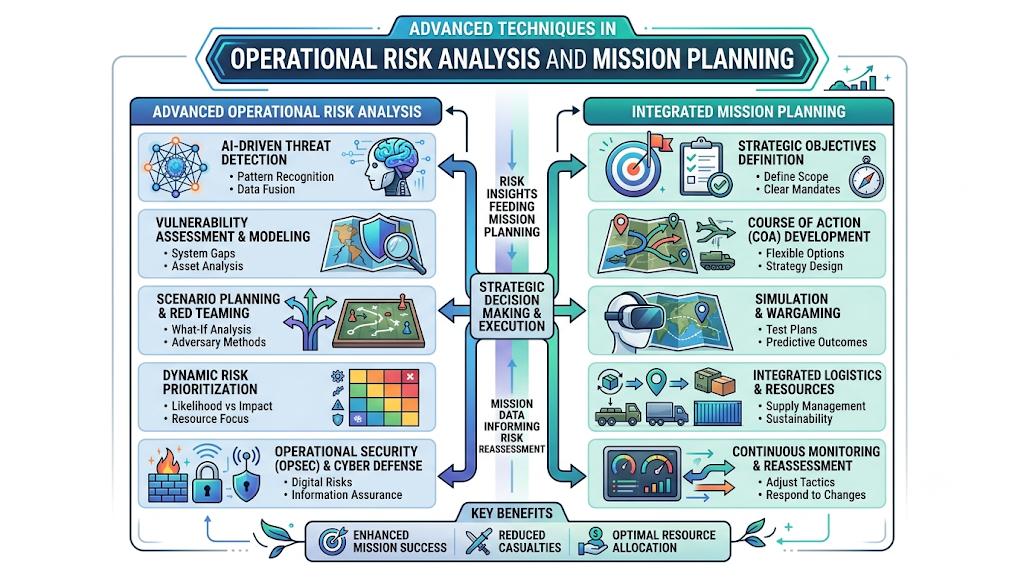
Every complex defense deployment, stability operation, and border defense initiative operates under a heavy cloud of uncertainty. In these environments, assumptions can lead directly to catastrophic vulnerabilities, making a disciplined approach to evaluating danger essential. Command elements do not rely on intuition alone to guide their units; they utilize systematic, data-backed assessment models designed to identify, analyze, and neutralize hazards before they can disrupt a campaign.This is where the formal discipline of Military Risk Analysis becomes critical. It transforms chaotic variables into quantifiable data, giving leaders the insights needed to make calculated decisions under extreme pressure. For defense analysts, military professionals, and strategic planners looking to master these concepts, resources from providers like WarOpsX offer specialized insights into the mechanics of modern defense operations. This educational guide breaks down the core methodologies, operational frameworks, and critical workflows that security experts use to analyze risks and maximize mission integrity across the globe.
What Is Military Risk Analysis?
Military Risk Analysis is the structured process of identifying, assessing, and mitigating hazards that could degrade operational readiness or prevent the successful completion of a mission. Unlike civilian risk frameworks that focus heavily on financial or reputational protection, defense analysis directly balances the preservation of human life and strategic assets against the absolute necessity of completing a national security objective.
The core purpose of this discipline is to provide decision-makers with a clear, objective view of the operational landscape. It serves as a bridge between raw intelligence and actionable execution, ensuring that commanders understand not just what threats exist, but how those threats could exploit specific organizational vulnerabilities.
In modern defense planning, risk analysis is not a one-time step completed before an operation begins. It is a continuous loop that integrates deeply into every phase of the planning cycle, adapting to fresh data, changing weather, shifting adversary positions, and emerging cyber threats in real time.
Why Military Risk Assessment Matters
Mission Success
The primary objective of any defense organization is the successful execution of its assigned mandate. A thorough military risk assessment reveals hidden failure points within a plan, allowing planners to build robust contingencies that keep the overarching objective on track despite unexpected disruptions.
Personnel Safety
While certain operations carry unavoidable hazards, a structured assessment helps minimize unnecessary exposure. By identifying preventable dangers—such as hazardous environmental conditions or unsafe routes—planners can implement protective measures that safeguard forces without reducing operational effectiveness.
Resource Protection
Modern defense systems, fleets, and supply networks represent massive national investments. Risk management ensures these high-value assets are not recklessly exposed to logistical failures, maintenance overloads, or asymmetric threats that could take them out of service.
Strategic Decision-Making
High-level decision-makers must constantly balance long-term geopolitical goals against near-term operational costs. Risk analysis provides a standardized, clear vocabulary that allows leaders to evaluate whether the potential payoff of an operation matches the level of hazard involved.
Operational Readiness
By consistently assessing internal vulnerabilities—such as equipment wear, training gaps, or supply shortages—units can maintain a higher baseline of preparedness. This ensures that when an unexpected crisis occurs, the force is fully capable of responding rapidly.
Core Elements of Military Risk Analysis
To evaluate an operational landscape effectively, analysts break down risk into five core elements. Skipping any of these components results in an incomplete assessment that can leave a unit exposed.
[Threat Identification] + [Vulnerability Assessment]
         │
         ▼
[Probability] × [Impact] ──► [Risk Prioritization]
- Threat Identification: This element involves detecting any entity, condition, or event with the potential to cause harm, destroy assets, or degrade mission success. Example: An analyst notes that a key coastal supply route passes within range of an adversary’s land-based anti-ship missile installations.
- Vulnerability Assessment: This is an internal look at an organization’s own weaknesses that could be exploited by an identified threat. Example: Planners recognize that their transport ships lack advanced point-defense systems to intercept incoming guided missiles, turning the threat into a high-level vulnerability.
- Impact Evaluation: This measures the total damage that would occur if a threat successfully exploits a vulnerability. Example: If a transport ship is hit, the loss would halt all supply deliveries to a major operational zone for three weeks, severely impacting sustainability.
- Probability Assessment: This estimates the real-world likelihood of a negative event occurring, based on historical patterns, intelligence reports, and environmental factors. Example: Analysts determine the probability of an strike is “Remote” during a ceasefire, but rises to “Highly Probable” if diplomatic talks stall.
- Risk Prioritization: By combining impact and probability, analysts place hazards into a structured matrix. This allows leaders to focus their limited time and resources on mitigating the most critical dangers first, rather than getting distracted by minor issues.
The Military Risk Assessment Process
Military risk management relies on a step-by-step workflow to ensure no vital details are overlooked during high-pressure mission planning.
1.Define Mission Objectives:Prerequisite Phase.
Before analyzing dangers, planners must explicitly outline what the operation intends to achieve, the timeline for execution, and the exact boundaries of the operational area.
2.Identify Potential Threats:Threat Assessment.
Analysts gather data from intelligence feeds, weather sensors, and geographic maps to list every external hazard, environmental obstacle, and adversary capability.
3.Analyze Vulnerabilities:Internal Capability Review.
The planning staff conducts an honest review of their own forces, noting gaps in communication coverage, logistical bottlenecks, or equipment limitations.
4.Evaluate Consequences:Impact Modeling.
For every threat that matches a vulnerability, the team calculates the worst-case and most-likely outcomes, focusing on potential asset loss and mission degradation.
5.Assign Risk Levels:Matrix Application.
Using a standard risk assessment matrix, analysts plot the probability and severity of each hazard to assign an overall value, such as Low, Medium, Serious, or High Risk.
6.Develop Mitigation Strategies:Control Implementation.
Planners create specific controls to reduce risk levels. This might include rerouting forces, adding security escorts, or scheduling backup communications.
7.Monitor and Reassess Risks:Continuous Loop.
As the operation unfolds, analysts constantly track the effectiveness of their controls and watch for fresh hazards, updating the assessment as conditions evolve.
To see how these risk levels are calculated using standard composite risk management principles, planners use tools like the interactive assessment tool below.
Types of Military Risks
Defense analysts categorize risks into distinct buckets to ensure that specialized staff officers can evaluate them thoroughly.
- Operational Risks: Dangers that directly impact the execution of an ongoing mission. This includes sudden changes in local weather, mechanical breakdowns of key equipment, or unexpected tactical movements by an adversary.
- Strategic Risks: High-level hazards that threaten long-term national security goals or international alliances. A strategic risk might involve an action that successfully clears a local area but accidentally alienates a critical international partner.
- Intelligence Risks: The danger of making decisions based on incomplete, outdated, or deliberately falsified information provided by an adversary (disinformation).
- Logistics Risks: Failures within the supply chain, such as fuel delivery delays, spare parts shortages, or transport breakdowns, that leave deployed units isolated or under-equipped.
- Cybersecurity Risks: Digital threats aimed at hacking secure command-and-control networks, jamming satellite communications, or disrupting critical infrastructure.
- Environmental Risks: Natural hazards like extreme heat, sub-zero temperatures, dense mountain terrain, or flash flooding that degrade equipment performance and test human endurance.
- Human Factors Risks: Issues rooted in human performance, including crew fatigue from long operations, communication breakdown under stress, or gaps in specialized training.
Threat Assessment in Military Planning
A threat assessment focuses purely on analyzing external dangers, looking closely at an adversary’s capabilities, intent, and probable courses of action. Analysts use structured methodologies to avoid relying on simple guesswork.
As shown in the matrix layout above, threat assessment feeds directly into the probability axis of risk calculations. This assessment relies on several critical pillars:
- Intelligence Gathering: Collecting raw data from diverse sources like satellite imagery, signal monitoring, and field reports to establish an accurate picture of the area.
- Pattern Analysis: Studying historical behaviors to identify an adversary’s preferred strategies, typical operational hours, and logistical habits.
- Scenario Evaluation: Building multiple “what-if” models to simulate how a threat might respond to different actions, ensuring planners are not blindsided by a sudden reaction.
- Decision Support Systems: Utilizing software platforms that combine geographic data with real-time tracking to help analysts visualize how threats interact with friendly movements.
Risk Analysis Frameworks Used in Defense Organizations
To ensure clear communication across different branches of service and international coalitions, defense organizations rely on standardized, conceptual risk management frameworks.
| Framework | Primary Purpose | Key Benefit | Typical Usage |
| Composite Risk Management (CRM) | Merges tactical and accidental risk evaluations into a single, cohesive system. | Creates a shared, simple risk language across all organizational ranks. | Applied during daily routine training and small-scale operational planning. |
| Operational Risk Management (ORM) | Focuses on systematic decision-making before, during, and after missions. | Maximizes operational readiness by identifying and mitigating hidden hazards early. | Standard practice for naval, aviation, and complex mechanized maneuvers. |
| Mission Command Risk Model | Delegates risk evaluation and decision authority down to local, on-scene commanders. | Enables fast, adaptive responses when operating in rapidly changing environments. | Used in high-speed, decentralized operations where central communication is cut off. |
| NATO Allied Joint Risk Doctrine | Standardizes risk assessment methodologies across multiple member nations. | Ensures seamless coordination during complex, multi-national coalition actions. | Deployed during large-scale international security initiatives and joint exercises. |
The Role of Intelligence in Risk Analysis
Intelligence is the fuel that drives effective risk analysis. Without accurate data, a risk assessment is simply an exercise in speculation.
Strategic Intelligence
This high-level data focuses on long-term trends, analyzing a foreign nation’s industrial output, political stability, and research into new defense technologies. It helps planners anticipate geopolitical shifts years in advance.
Operational Intelligence
Focused on specific regional zones, this intelligence tracks regional troop movements, local infrastructure conditions, and logistics networks. It gives commanders the context needed to plan regional security campaigns.
Open-Source Intelligence (OSINT)
This field analyzes publicly available information, including commercial satellite imagery, local news reports, social media posts, and public shipping logs. OSINT provides an accessible baseline that helps validate classified data.
Predictive Analysis
By feeding historical data, current asset tracking, and seasonal weather patterns into statistical models, analysts can spot potential crisis points before they erupt, allowing forces to take preventive measures.
Technology and Military Risk Assessment
Modern technology has fundamentally transformed how defense analysts process complex information, shifting risk evaluation from slow paper assessments to real-time digital tracking.
- Data Analytics: Modern platforms can scan millions of data points—from weather histories to supply chain manifests—identifying hidden patterns and anomalies that human eyes would miss.
- Artificial Intelligence: Machine learning models assist analysts by sorting through clutter, prioritizing critical alerts, and simulating thousands of potential outcomes to discover hidden failure points in operational plans.
- Simulation Systems: Virtual training environments and digital twins allow planners to test operational concepts in a safe sandbox, discovering how systems react to stress before actual deployment.
- Geospatial Intelligence (GEOINT): High-resolution satellite mapping and radar imaging allow analysts to evaluate terrain changes, analyze line-of-sight constraints, and track environmental damage in real time.
- Decision Support Platforms: These integrated command dashboards combine live communication feeds, unit positions, and active risk alerts into a single screen, helping leaders make fast, informed choices under pressure.
Common Challenges in Military Risk Analysis
The operational environment is naturally resistant to perfect analysis. Planners regularly run into five major challenges, but experienced teams utilize proven solutions to mitigate them.
Incomplete Information
- The Challenge: During a fast-moving crisis, analysts rarely have a complete picture of the situation, resulting in blind spots regarding environmental or external factors.
- The Solution: Teams utilize assumption-based planning, explicitly marking what is known versus what is assumed, while deploying specialized reconnaissance to fill critical gaps.
Rapidly Changing Conditions
- The Challenge: A risk assessment completed at 08:00 can become completely obsolete by 08:30 due to shifting weather patterns or unexpected asset breakdowns.
- The Solution: Shifting from static pre-mission briefings to dynamic, continuous monitoring systems where assessments are constantly adjusted on the fly.
Cognitive Biases
- The Challenge: Human analysts are vulnerable to confirmation bias (interpreting new data as proof of existing beliefs) or complacency caused by long periods of routine operations.
- The Solution: Implementing “Red Teaming” protocols, where an independent group is brought in specifically to challenge assumptions and find flaws in the primary plan.
Communication Gaps
- The Challenge: Critical risk data discovered by analysts on the ground can get trapped in bureaucratic silos, failing to reach senior decision-makers in time.
- The Solution: Standardizing data formats and using shared digital command networks to ensure risk alerts are visible across all levels instantly.
Resource Constraints
- The Challenge: Units often lack the time, specialized personnel, or advanced tracking equipment needed to perform deep, exhaustive risk calculations during rapid deployments.
- The Solution: Utilizing simplified, pre-formatted risk matrices that focus entirely on the top three highest-impact hazards, keeping the assessment fast and practical.
Best Practices for Effective Risk Management
To maintain an analytical edge, defense organizations look to a core set of operational best practices:
The Principle of Continuous Assessment: Risk management is an ongoing loop, not a checklist. A valid plan must be constantly reassessed against fresh data to survive contact with reality.
- Cross-Functional Collaboration: Risk assessments should bring together experts from every staff department—including logistics, communications, intelligence, and medical—to ensure all potential vulnerabilities are identified.
- Rigorous Scenario Planning: Planners should map out at least three distinct paths for every operation: the most likely outcome, the best-case scenario, and the absolute worst-case failure state.
- Data-Driven Decision-Making: Rely on objective, verifiable data like sensor logs, checked maintenance records, and confirmed weather trends rather than trusting vague, gut-level feelings.
- Regular Reviews and Post-Operation Audits: After an operation wraps up, the planning team should compare their pre-mission risk estimates against what actually occurred, using those real-world lessons to improve future planning.
Real-World Applications of Military Risk Analysis
Mission Planning
Before any deployment, staff officers use risk analysis to choose the safest, most efficient routes, allocate sufficient fuel reserves, and configure communication networks that can withstand environmental interference.
Border Security Operations
Security agencies utilize risk modeling to identify vulnerable sectors along extended borders, allowing them to position monitoring sensors and patrol units precisely where illegal crossings or incursions are most likely to occur.
Peacekeeping Missions
In volatile regions, multinational forces use risk evaluations to design secure base layouts, protect vital civilian infrastructure, and coordinate food distribution routes without exposing personnel to local unrest.
Disaster Response Operations
During major floods, earthquakes, or hurricanes, defense forces step in to assist civilian authorities. Risk analysis helps them identify safe helicopter landing zones, map out surviving roads, and manage the logistics of distributing heavy aid equipment.
Cyber Defense Programs
Security command centers use predictive risk assessment frameworks to identify open software vulnerabilities, monitor for unusual network activity, and isolate compromised servers before an intrusion can spread across critical communications networks.
Military Risk Analysis vs. Civilian Risk Management
While both fields share a common goal—minimizing unnecessary failure—their core environments, risk tolerances, and ultimate goals are profoundly different.
| Attribute | Military Risk Analysis | Civilian Risk Management |
| Primary Objectives | Mission success, national security, and force preservation. | Profit protection, regulatory compliance, and business continuity. |
| Risk Tolerance | Significantly higher; leaders accept calculated hazards to complete critical national security mandates. | Lower; businesses avoid major hazards unless tied directly to clear financial gains. |
| Decision Timelines | Can range from months of deliberate planning down to split-second choices in fluid crisis zones. | Typically structured around corporate quarters, annual reviews, and steady board approvals. |
| Operational Complexity | High; involves chaotic environments, multi-national groups, and active human interference. | Moderate; operates within structured corporate markets, legal codes, and predictable economic rules. |
| Primary Stakeholders | Government leadership, command elements, allied nations, and the general public. | Corporate boards, shareholders, regulatory bodies, and customers. |
Future of Military Risk Assessment
The next decade will see risk analysis become faster, more distributed, and heavily reliant on automated computing systems.
- AI-Assisted Analysis: Future command systems will feature automated co-pilots that constantly scan live communications and sensor data, instantly alerting leaders to emerging vulnerabilities.
- Predictive Risk Modeling: By leveraging global datasets, future systems will model complex crises—such as regional resource shortages or border friction—weeks before they turn into open conflict.
- Autonomous Systems Oversight: As uncrewed aerial, ground, and marine vehicles become common, risk frameworks must adapt to manage the unique vulnerabilities of automated fleets, including software glitches and signal interference.
- Advanced Intelligence Integration: Combining secure satellite feeds, open-source web data, and field sensor networks into a single processing hub will give analysts an un-jammable picture of the operational area.
- Real-Time Situational Awareness: Wearable biometric sensors and connected equipment will feed real-time health and ammo status back to headquarters, allowing planners to track human fatigue and unit readiness instantly.
Career Opportunities in Defense Risk Analysis
As the global security environment grows more complex, the demand for highly trained risk specialists continues to expand across both public and private sectors.
- Defense Analyst: Working directly within government departments or specialized think tanks, these professionals analyze regional stability, evaluate foreign capabilities, and advise senior leadership on long-term policy options.
- Risk Management Specialist: These experts design and execute internal risk controls for defense contractors and logistics firms, ensuring large-scale equipment projects stay on budget and meet strict security requirements.
- Intelligence Analyst: Specializing in data synthesis, these professionals collect, verify, and interpret data from diverse intelligence sources to help operational units build accurate threat profiles.
- Security Consultant: Private-sector advisors who help multinational corporations, shipping firms, and non-governmental organizations protect their staff and assets when operating in high-risk global regions.
- Strategic Planning Advisor: Senior experts who work alongside organizational leaders to develop long-term crisis response plans, run simulated readiness exercises, and shape organizational safety policies.
Common Misconceptions About Military Risk Analysis
Myth: Risk Analysis Aims to Eliminate All Danger
Reality: It is impossible to eliminate danger from defense operations. The true goal of risk analysis is risk management, not elimination. It focuses on identifying and stripping away unnecessary, careless hazards so that forces can accept the core operational dangers required to complete a mission successfully.
Myth: It Is a Rigid Bureaucratic Process That Slows Down Action
Reality: While deliberate planning takes time, the core frameworks are designed to scale down rapidly. In high-speed environments, a seasoned planner can run through a modified risk matrix mentally in seconds, using the structured logic to make a fast, sound decision under pressure.
Myth: Advanced Software Tools Make Human Analysts Obsolete
Reality: Technology is an excellent tool for sorting data and running simulations, but it lacks situational context. Software cannot evaluate local human nuances, political subtleties, or intuitive shifts in an adversary’s intent. The best results occur when powerful data systems are guided by experienced human analysts.
FAQ Section
1. What is the main difference between tactical risk and accidental risk?
Tactical risk stems directly from the presence and actions of an active adversary or competing group. Accidental risk, on the other hand, involves internal hazards inherent to any large operation, such as mechanical equipment failures, extreme weather conditions, or personnel fatigue during long shifts.
2. How often are military risk assessments updated during an ongoing operation?
Assessments are updated continuously. While a formal, written risk plan is developed during the initial pre-mission phase, the document is treated as a living file that is updated the moment fresh intelligence arrives, weather conditions shift, or unit capabilities change.
3. What is a “Red Team” in the context of risk analysis?
A Red Team is an independent group of experienced analysts brought into a planning session specifically to act as an objective adversary. Their job is to find hidden flaws, question comfortable assumptions, and expose unaddressed vulnerabilities within the primary team’s operational plan.
4. Can civilian organizations use military risk management frameworks?
Yes, civilian industries operating in high-stakes environments—such as commercial aviation, offshore oil drilling, deep-sea shipping, and emergency medical services—frequently adapt models like Operational Risk Management (ORM) to minimize accidents and improve team decision-making under stress.
5. How do analysts calculate risk when data is highly incomplete?
When reliable data is scarce, analysts rely on assumption-based planning and historical parallels. They explicitly label what information is missing, substitute conservative worst-case estimates, and prioritize immediate reconnaissance to verify their most critical assumptions.
6. What is the role of the commander in the risk assessment process?
The commander holds ultimate authority and accountability. Analysts and staff officers identify hazards and suggest mitigation controls, but only the commanding leader has the legal and organizational authority to accept a specific level of risk and order a mission forward.
7. How does geospatial intelligence help in assessing environmental risks?
Geospatial intelligence utilizes satellite imagery, radar data, and terrain modeling to analyze real-world ground conditions. This allows planners to identify muddy choke points, calculate exact lines of sight, map flood zones, and spot seasonal terrain obstacles before forces arrive.
8. What does “mitigating a risk” actually mean in practice?
Mitigating a risk means taking specific actions to reduce its overall danger level. This is achieved by either decreasing the probability of the event happening (such as adding extra maintenance checks to avoid breakdowns) or reducing the severity of the impact if it does occur (such as wearing advanced body armor).
9. Is risk tolerance the same across all types of military operations?
No, risk tolerance varies based on the strategic importance of the objective. A critical national security crisis involving immediate public safety carries a very high risk tolerance, whereas routine daily training maneuvers operate under a strict, low-risk tolerance policy.
10. How do modern teams prevent data overload during automated risk analysis?
Teams prevent data overload by utilizing tailored decision dashboards that filter out background noise. These platforms use smart algorithms to surface only critical alerts that cross specific, pre-set risk thresholds, allowing human analysts to focus on vital updates.
Final Summary
Analyzing risk within volatile, high-stakes environments is a vital discipline that separates successful operations from costly failures. By breaking down complex landscapes into clear elements—threats, vulnerabilities, probability, and impact—Military Risk Analysis transforms unpredictable chaos into a manageable system. Through structured frameworks like Composite Risk Management and the use of modern geospatial data systems, defense organizations ensure their personnel maintain a constant operational advantage. Ultimately, effective risk management is not about avoiding hard choices; it is about providing leaders with the clear, objective insights needed to make calculated decisions with confidence.