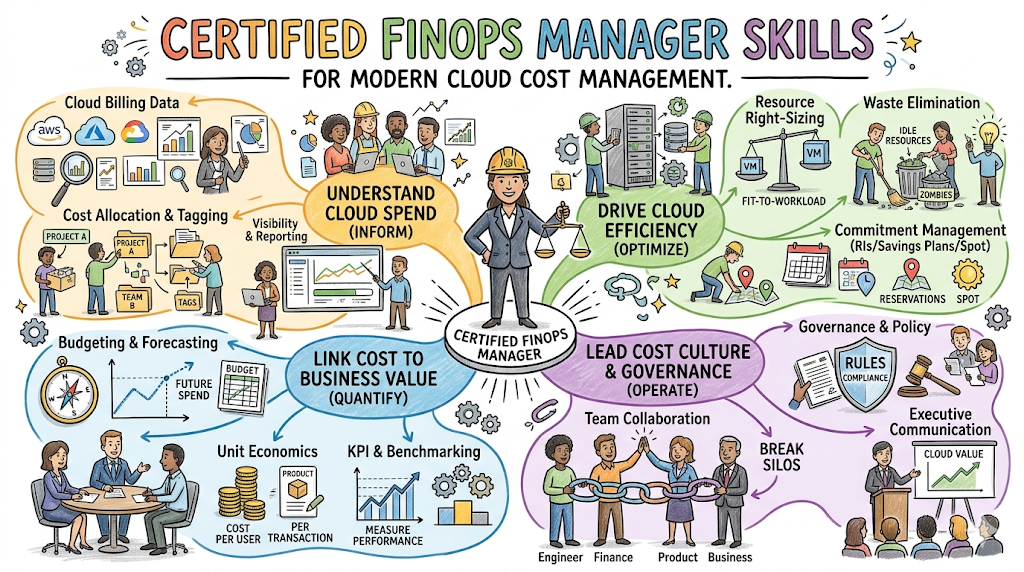
Introduction
Understanding the financial impact of cloud infrastructure is no longer just a requirement for accounting teams. Earning your Certified FinOps Manager certification from Finopsschool is a vital step for technical professionals who want to lead cost optimization efforts. This guide is designed to help platform engineers, cloud architects, and technical leaders make informed decisions about their career paths.
Cloud-native environments are complex, and managing the associated costs requires a deep understanding of both engineering workflows and financial principles. This guide provides a clear roadmap to mastering these skills. By reading through this document, you will understand exactly how this certification positions you as a critical asset within modern DevOps and Site Reliability Engineering environments. It strips away the marketing language and gives you the exact details you need to advance your career.
What is the Certified FinOps Manager?
The Certified FinOps Manager is an advanced credential that validates a professional’s ability to implement and manage cloud financial operations at an enterprise scale. It exists because organizations are struggling to control their cloud spend while maintaining the speed of software delivery. This certification focuses on establishing a culture of financial accountability across engineering teams.
Unlike purely theoretical business courses, this program emphasizes real-world, production-focused learning. It teaches you how to allocate costs, build forecasting models, and implement chargeback mechanisms. It aligns perfectly with modern engineering workflows by integrating cost awareness directly into continuous integration and deployment pipelines. You learn to make architecture decisions that balance performance, reliability, and cost.
Who Should Pursue Certified FinOps Manager?
This certification is highly beneficial for cloud engineers, Site Reliability Engineers, and platform architects who want to expand their influence into management and strategy. Security and data professionals who manage large, resource-intensive environments will also find immense value in understanding the unit economics of their systems. It is an excellent choice for engineering managers tasked with keeping department budgets in check.
Professionals across the spectrum, from those building out their foundational cloud knowledge to seasoned technical leaders, can leverage this learning path. The principles taught are highly relevant for the global tech market, where cloud adoption is ubiquitous. Furthermore, it addresses the specific demands of the India IT sector, where service providers and product companies alike are deeply focused on delivering cost-optimized solutions to international clients.
Why Certified FinOps Manager is Valuable Today and Beyond
The demand for professionals who can control infrastructure costs has never been higher, as companies shift from growth-at-all-costs to sustainable engineering practices. This certification proves you can solve one of the most pressing challenges in the technology industry today. It provides a massive return on time and career investment by positioning you for leadership roles.
It helps professionals stay relevant because the core principles of financial management remain consistent, even as specific cloud providers and tools change over time. Understanding unit economics and cost optimization strategies makes you indispensable to any organization. This expertise bridges the gap between the engineering floor and the executive boardroom, securing your long-term career trajectory.
Certified FinOps Manager Certification Overview
The program is delivered via the official certification path and is hosted entirely on Finopsschool. The certification structure is designed to take professionals from foundational concepts to advanced management strategies in a logical, progressive manner. It uses a rigorous assessment approach that tests practical application rather than just memorization.
The curriculum is structured in highly practical terms, ensuring that every module translates directly to daily work tasks. Ownership of the certification demonstrates a commitment to operational excellence and business alignment. The program levels carefully build upon each other, guaranteeing that successful candidates are fully prepared to lead organizational change.
Certified FinOps Manager Certification Tracks & Levels
The learning journey is divided into foundation, professional, and advanced levels to accommodate different stages of career growth. The foundation level introduces core vocabulary and basic visibility concepts. The professional level dives into operationalizing cost optimization within active engineering teams.
The advanced level, where the management credential sits, focuses on building rate optimization strategies, negotiating enterprise agreements, and establishing cultural frameworks. Specialized tracks branch out to connect financial management with DevOps, Site Reliability Engineering, and other disciplines. These levels align seamlessly with career progression, moving candidates from individual contributors to strategic leaders.
Complete Certified FinOps Manager Certification Table
| Track | Level | Who it’s for | Prerequisites | Skills Covered | Recommended Order |
| Core | Foundation | Cloud Engineers, Analysts | Basic Cloud Knowledge | Cost Visibility, Tagging | 1 |
| Core | Professional | DevOps, SREs, Architects | Foundation Cert | Optimization, Forecasting | 2 |
| Core | Advanced | Tech Leads, Managers | Professional Cert | Culture, Enterprise Strategy | 3 |
| Specialization | Architecture | Cloud Architects | Professional Cert | Workload Optimization | 4 |
| Specialization | Data | Data Engineers | Professional Cert | Big Data Cost Control | 4 |
| Specialization | Security | DevSecOps | Professional Cert | Compliance Cost Balancing | 4 |
Detailed Guide for Each Certified FinOps Manager Certification
Certified FinOps Manager – Foundation Level
What it is
This entry-level certification validates an understanding of the core principles of cloud financial management. It establishes the baseline vocabulary and concepts needed to participate in cost optimization discussions.
Who should take it
Software engineers, financial analysts, and project managers transitioning into cloud-centric environments. It is ideal for anyone who interacts with cloud infrastructure and needs to understand its financial impact.
Skills you’ll gain
- Understanding of cloud pricing models and billing structures.
- Ability to implement basic resource tagging and allocation.
- Knowledge of how to read and interpret cloud usage reports.
Real-world projects you should be able to do
- Create a standardized tagging policy for a multi-cloud environment.
- Generate a basic monthly spend report broken down by engineering team.
- Identify unattached or idle cloud resources for immediate deletion.
Preparation plan
For a 7 to 14 days plan, focus entirely on understanding cloud billing concepts and basic terminology. In a 30 days plan, add hands-on practice with native cloud cost management tools. A 60 days plan allows for deep exploration of case studies and implementing mock tagging structures.
Common mistakes
Candidates often focus too heavily on the technical aspects of cloud computing and ignore the financial and accounting terminology. Another common error is failing to understand the difference between rate optimization and usage optimization.
Best next certification after this
- Same-track option: Professional Level Certification
- Cross-track option: Core DevOps Certification
- Leadership option: Team Management Fundamentals
Certified FinOps Manager – Professional Level
What it is
This intermediate credential proves your ability to actively manage and optimize cloud spending within an organization. It bridges the gap between understanding costs and actively reducing them without impacting performance.
Who should take it
DevOps engineers, Site Reliability Engineers, and cloud architects who are directly responsible for provisioning and maintaining infrastructure. It is suited for professionals moving into senior technical roles.
Skills you’ll gain
- Advanced anomaly detection and automated cost alerting.
- Ability to build and manage chargeback and showback models.
- Expertise in right-sizing instances and utilizing spot pricing effectively.
Real-world projects you should be able to do
- Automate the shutdown of non-production environments during off-hours.
- Design a dashboard that shows the real-time cost per transaction of an application.
- Migrate a static workload to a more cost-effective compute option.
Preparation plan
A 7 to 14 days sprint should review complex optimization strategies and pricing calculators. Over 30 days, candidates should build automated cost-control scripts in a sandbox environment. A 60 days approach allows time to analyze historical billing data and build predictive models.
Common mistakes
Many fail to grasp the complexities of reserved instances and savings plans across different cloud providers. Candidates also struggle with the cultural aspect of getting engineering teams to care about cost data.
Best next certification after this
- Same-track option: Advanced Management Certification
- Cross-track option: Advanced Site Reliability Engineering
- Leadership option: Technical Program Management
Certified FinOps Manager – Advanced Level
What it is
This represents the pinnacle of the track, validating your ability to lead an entire organization’s cloud financial strategy. It proves you can align engineering output with executive business goals.
Who should take it
Engineering managers, directors of cloud operations, and principal architects. It is meant for individuals who dictate policy, negotiate contracts, and drive company-wide technical culture.
Skills you’ll gain
- Enterprise-level contract negotiation and commitment planning.
- Establishing and leading cross-functional cost management teams.
- Creating advanced unit economics models for SaaS products.
Real-world projects you should be able to do
- Present a comprehensive cloud strategy and budget forecast to a board of directors.
- Negotiate a multi-million dollar enterprise discount program with a major cloud provider.
- Implement a gamified cost-saving culture across dozens of engineering squads.
Preparation plan
In 7 to 14 days, review enterprise frameworks and organizational change management principles. A 30 days plan requires deep study of complex contract structures and advanced forecasting math. Over 60 days, focus on building complete organizational blueprints for financial accountability.
Common mistakes
Assuming that technical optimization alone is enough to pass, ignoring the massive focus on human behavior, culture change, and executive communication. Candidates also underestimate the complexity of multi-cloud financial consolidation.
Best next certification after this
- Same-track option: Industry-specific specializations
- Cross-track option: Enterprise Architecture Frameworks
- Leadership option: Executive Leadership and Strategy Programs
Choose Your Learning Path
DevOps Path
The DevOps path focuses on integrating cost optimization directly into the CI/CD pipeline. Professionals learn how to fail builds if they exceed budget thresholds or deploy un-tagged resources. The goal is to make financial awareness a seamless part of the daily deployment cycle. This path heavily emphasizes automation and infrastructure as code to control spending proactively.
DevSecOps Path
This path balances the cost of robust security controls with the need for infrastructure efficiency. It explores how to calculate the financial impact of security tooling and compliance data storage. Professionals learn to avoid over-provisioning security appliances while maintaining strict regulatory standards. The focus is on achieving maximum security posture at the most efficient price point.
SRE Path
Site Reliability Engineers on this path learn to balance service level objectives with infrastructure costs. They study the financial impact of over-engineering reliability and high availability. The curriculum covers how to determine the cost of a minute of downtime versus the cost of preventing it. This path ensures reliability efforts are financially justified and sustainable.
AIOps Path
This path concentrates on utilizing artificial intelligence to predict and manage infrastructure spending. Professionals learn how to implement machine learning models that detect cost anomalies faster than traditional alerting. It covers the deployment of intelligent systems that can autonomously right-size environments based on usage patterns. The focus is on removing human intervention from routine cost management tasks.
MLOps Path
The MLOps path dives into the specific, often massive, costs associated with training and serving machine learning models. Professionals learn how to track GPU utilization and optimize compute clusters for data science workloads. It addresses the unique challenge of unpredictable billing in data experimentation phases. This path is vital for organizations scaling their artificial intelligence capabilities without breaking the bank.
DataOps Path
This path focuses on controlling the costs of data pipelines, storage, and analytics platforms. Professionals learn how to optimize data lifecycle management and tiered storage strategies. It covers the financial impact of running complex queries and managing large-scale data warehouses. The goal is to ensure that data engineering teams deliver business intelligence efficiently.
FinOps Path
The dedicated path is for professionals whose primary role is cloud financial management. It covers the complete lifecycle of cost allocation, reporting, and cultural transformation. Individuals learn to act as the central hub connecting engineering, finance, and executive leadership. This path produces the strategic leaders who govern enterprise-wide cloud consumption.
Role → Recommended Certified FinOps Manager Certifications
| Role | Recommended Certifications |
| DevOps Engineer | Foundation Level, Professional Level |
| SRE | Professional Level, Architecture Specialization |
| Platform Engineer | Professional Level, Architecture Specialization |
| Cloud Engineer | Foundation Level, Professional Level |
| Security Engineer | Foundation Level, Security Specialization |
| Data Engineer | Foundation Level, Data Specialization |
| FinOps Practitioner | Foundation Level, Professional Level, Advanced Level |
| Engineering Manager | Professional Level, Advanced Level |
Next Certifications to Take After Certified FinOps Manager
Same Track Progression
After achieving the management level, deep specialization is the next logical step. You can pursue certifications that focus heavily on specific cloud providers like AWS, Azure, or Google Cloud. This deepens your ability to execute broad strategies using provider-specific discount mechanisms and billing nuances. It transforms you from a general strategist into a platform-specific expert.
Cross-Track Expansion
Skill broadening ensures you understand the systems generating the costs. Taking advanced credentials in Kubernetes administration or cloud security provides the technical depth needed to challenge engineering decisions constructively. Understanding the architecture at a granular level makes you a more effective negotiator and optimizer. It strengthens your credibility with the technical teams you manage.
Leadership & Management Track
Transitioning to broader leadership requires skills beyond technical and financial optimization. Certifications in agile leadership, product management, or enterprise architecture are excellent next steps. These credentials help you align technology operations with overall business profitability and market strategy. They prepare you for director or executive-level positions within technology organizations.
Training & Certification Support Providers for Certified FinOps Manager
DevOpsSchool
DevOpsSchool has established itself as a premier destination for technology professionals seeking to bridge the gap between engineering and operational efficiency. When pursuing cloud financial management and cost optimization strategies, this platform provides extensive resources that complement core engineering practices. Their curriculum structure supports continuous learning, offering robust modules that align with modern enterprise demands. Learners benefit from an environment that prioritizes hands-on lab work and real-world scenarios over theoretical concepts. By integrating cost awareness into their broader technology training, they help engineers understand the financial impact of their technical decisions. This makes DevOpsSchool an excellent support system for professionals aiming to master the intricacies of infrastructure spending alongside their daily deployment pipelines.
Cotocus
Cotocus delivers highly focused training modules designed specifically for enterprise environments and consulting professionals. Their approach to cloud cost management is deeply rooted in solving complex, multi-cloud architectural challenges that large organizations face. They provide specialized resources that help candidates understand the nuances of global infrastructure deployment and its associated billing complexities. The platform emphasizes practical case studies drawn from real corporate migrations and digital transformation initiatives. Candidates using Cotocus will find a wealth of information regarding organizational change management, which is critical for implementing sustainable financial practices. Their comprehensive study materials ensure that learners are prepared not just for exams, but for executing high-level strategic decisions in demanding corporate settings.
Scmgalaxy
Scmgalaxy operates as a vast knowledge repository and community hub for professionals dedicated to configuration management and continuous delivery. For those tackling infrastructure cost control, the platform offers unique insights into how source code management and automated pipelines impact monthly billing. Their community-driven forums and expert articles provide practical tips on integrating cost analysis tools directly into existing CI/CD workflows. The platform excels at showing how small changes in configuration can lead to massive financial savings at scale. By leveraging the collective experience of its active user base, Scmgalaxy provides candidates with troubleshooting guides and optimization scripts that are invaluable for mastering the practical aspects of financial accountability in tech.
BestDevOps
BestDevOps focuses on providing curated, high-quality learning paths for professionals who demand excellence in their operational practices. Their resources regarding cloud economics are structured to quickly elevate a practitioner’s understanding of unit costs and resource allocation. They offer streamlined study guides that cut through the noise, delivering exactly what candidates need to grasp complex billing concepts. The platform is particularly strong in demonstrating how to balance high availability requirements with strict budget constraints. BestDevOps ensures that its users can confidently approach capacity planning and forecasting, making it a reliable partner for those preparing for advanced management credentials in cloud finance.
Devsecopsschool.com
Devsecopsschool.com is dedicated to the intersection of rapid software delivery and rigorous security compliance. Their perspective on cloud cost optimization is unique, focusing heavily on the financial implications of security tooling, log retention, and compliance audits. They provide crucial training on how to secure environments without inadvertently causing budget overruns through excessive resource provisioning. Candidates learn to model the costs of various security postures, ensuring that risk management strategies remain financially viable. By teaching professionals how to build cost-effective security architectures, Devsecopsschool.com ensures that financial accountability is never sacrificed in the pursuit of a hardened infrastructure environment.
Sreschool.com
Sreschool.com caters directly to Site Reliability Engineers who are tasked with maintaining system uptime and performance. Their training materials emphasize the critical balance between service level agreements and the cost of the underlying infrastructure required to meet them. The platform teaches professionals how to calculate the exact cost of reliability, helping them make data-driven decisions about redundancy and disaster recovery provisioning. Candidates benefit from deep dives into monitoring and observability costs, learning how to optimize metric collection and storage. Sreschool.com is instrumental for engineers who need to prove that their reliability initiatives are both technically sound and financially optimized for the business.
Aiopsschool.com
Aiopsschool.com stands at the forefront of automated operations and intelligent system management. For professionals focused on financial optimization, this platform provides cutting-edge insights into using machine learning for predictive cost analysis and anomaly detection. They offer specialized training on deploying automated agents that can right-size infrastructure in real-time based on fluctuating demand. Candidates learn how to transition from reactive cost reporting to proactive, AI-driven financial management. Aiopsschool.com equips learners with the skills to implement advanced algorithms that identify billing irregularities before they impact the monthly budget, making it an essential resource for modern cloud management.
Dataopsschool.com
Dataopsschool.com is tailored for engineers managing massive data pipelines, analytics platforms, and data warehousing solutions. Their content addresses the notoriously difficult challenge of controlling costs in environments where data volume and query complexity grow exponentially. The platform provides detailed strategies for optimizing tiered storage, managing compute costs for big data processing, and establishing efficient data lifecycles. Candidates learn how to implement chargeback models specifically for shared data platforms, ensuring that different business units are accountable for their analytics spend. Dataopsschool.com is invaluable for professionals who need to maintain robust data capabilities while strictly enforcing financial governance.
Finopsschool.com is the definitive ecosystem for mastering the culture, practices, and tools of cloud financial management. As a dedicated platform, it offers an exhaustive curriculum that covers every aspect of visibility, optimization, and operationalization of cloud spend. The training materials are meticulously designed to guide professionals from basic concepts to executive-level strategic planning. Candidates benefit from comprehensive courses on contract negotiation, unit economics, and building cross-functional teams that prioritize cost accountability. Finopsschool.com provides the authoritative framework and the deep technical instruction required to pass advanced certifications and successfully lead organizational transformations in infrastructure economics.
Frequently Asked Questions (General – 12 questions)
- How do I know if I am ready to take a certification exam?
You are ready when you can consistently explain the core concepts without referencing study materials. Practical experience navigating cloud billing consoles and generating cost reports is a strong indicator of readiness. If you can confidently discuss cost allocation strategies with engineering teams, you are well-prepared to test your knowledge.
- What happens if I fail the exam on my first attempt?
Most credentialing bodies allow you to retake the exam after a mandatory waiting period, usually ranging from a few days to a couple of weeks. Use the score report to identify your weak domains and focus your studying there. Failure is simply a diagnostic tool to help you refine your understanding of complex topics.
- Are these credentials recognized by major enterprise organizations?
Yes, large enterprises actively seek out these qualifications when hiring for senior infrastructure and architecture roles. Companies dealing with massive cloud bills require verified expertise to manage their budgets effectively. Holding a recognized credential instantly communicates your capability to handle millions of dollars in infrastructure spend.
- How long does it take to prepare for an advanced level exam?
Preparation time varies based on your daily exposure to the subject matter. Professionals actively managing cloud budgets might only need four to six weeks to formalize their knowledge. Those transitioning from purely technical roles may require two to three months of dedicated study to master the financial concepts.
- Do I need to be a software developer to succeed in this field?
No, you do not need to write application code to be successful. However, you must thoroughly understand how software is built, deployed, and scaled. A strong grasp of system architecture and infrastructure provisioning is much more critical than the ability to program in specific languages.
- Can this path help me transition from finance to technology?
Absolutely. Financial professionals who take the time to learn cloud architecture fundamentals can pivot into highly lucrative roles in tech. Your background in data analysis, budgeting, and forecasting is a massive advantage. You simply need to map your existing financial skills to cloud computing paradigms.
- What is the best way to get hands-on practice without spending money?
Many cloud providers offer extensive free tiers that allow you to spin up resources and explore billing consoles. You can practice tagging, create budget alerts, and analyze cost explorer reports using minimal or zero-cost services. Simulating enterprise environments using infrastructure as code on local machines is also an effective, free study method.
- Is it better to specialize in one cloud provider or remain multi-cloud focused?
Understanding the general principles of multi-cloud management is essential for strategic roles. However, mastering the specific discount mechanisms, reserved instances, and savings plans of one major provider often yields the highest immediate impact. A balanced approach—general strategy combined with specific provider expertise—is generally best.
- How do these credentials impact salary negotiations?
They provide leverage by proving you possess a specialized, high-demand skill set that directly impacts a company’s bottom line. When you can demonstrate your ability to reduce operational costs by significant margins, your value to the organization increases. Employers are willing to pay a premium for professionals who protect their profit margins.
- Do I need to renew my credential after I earn it?
Most advanced credentials require renewal every two to three years. This is because cloud pricing models, billing tools, and optimization strategies evolve rapidly. Renewal ensures that your knowledge remains current and that you are up to date with the latest industry methodologies.
- What role does automation play in this learning path?
Automation is a central pillar of modern infrastructure management. You must understand how to implement scripts and policies that automatically enforce tagging, shut down idle resources, and apply cost-saving measures. Relying on manual intervention is impossible at an enterprise scale, making automation skills critical.
- How do I convince my manager to sponsor my certification training?
Focus on the return on investment. Explain how the skills you acquire will be used to identify waste and implement cost-saving measures within your current infrastructure. Presenting a business case that shows how your education will directly reduce the department’s monthly cloud bill is usually highly effective.
FAQs on Certified FinOps Manager (8 Focused Q&A in 100 words)
- What is the core focus of the Certified FinOps Manager credential?
The core focus is empowering professionals to build, lead, and scale financial accountability practices across engineering organizations. It moves beyond simple cost reporting to address organizational culture, executive alignment, and complex contract negotiations. The credential validates your ability to design chargeback models and define unit economics for large-scale applications. It proves you can effectively bridge the gap between technical teams, who need agility, and finance teams, who require predictability, ensuring the entire business operates efficiently in the cloud.
- Does the Certified FinOps Manager require deep programming knowledge?
Deep programming knowledge is not a prerequisite for the Certified FinOps Manager. You do not need to be a proficient software developer. However, a solid understanding of system architecture, cloud services, and continuous integration pipelines is necessary. You must comprehend how engineering choices directly impact infrastructure costs. While writing code isn’t required, the ability to read infrastructure-as-code templates and understand automation scripts will significantly enhance your ability to implement cost-control policies effectively in production environments.
- How does this credential benefit an Engineering Manager?
For an Engineering Manager, the Certified FinOps Manager provides a structured framework to govern department spending without slowing down deployment velocity. It teaches managers how to implement cost-aware engineering practices within their teams natively. You learn how to evaluate the financial impact of architectural decisions before they are implemented. This credential equips managers with the data and methodologies needed to justify infrastructure investments to executive leadership while demonstrating a firm commitment to operational efficiency and budget adherence.
- What practical skills are assessed in the Certified FinOps Manager exam?
The exam rigorously assesses your ability to handle complex, real-world cloud finance scenarios. You are tested on analyzing extensive billing datasets, identifying anomalies, and recommending specific rate or usage optimization strategies. The assessment covers the creation of accurate forecasting models based on historical usage and future business growth. Furthermore, it tests your ability to navigate enterprise discount programs, design effective resource tagging taxonomies, and develop communication strategies to foster a culture of financial responsibility among diverse teams.
- How long is the Certified FinOps Manager certification valid?
The certification is typically valid for a specific period, generally aligned with industry standards for advanced tech credentials, requiring periodic renewal. This ensures that credential holders remain current with the rapidly evolving landscape of cloud pricing models and financial management tools. Recertification usually involves demonstrating continued education or passing an updated version of the exam. This ongoing requirement maintains the high value of the credential, assuring employers that your skills are sharp and relevant to modern architectural challenges.
- Can I skip the foundation levels and take the Manager exam directly?
While specific prerequisite enforcement can vary, it is highly recommended to complete the foundational and professional levels first. The Certified FinOps Manager exam builds heavily upon the core vocabulary, basic reporting structures, and operational tactics established in earlier stages. Attempting the advanced level without a firm grasp of the underlying principles usually results in struggling with complex scenario-based questions. The sequential learning path is carefully designed to build the comprehensive knowledge base required for strategic management.
- What is the difference between this and traditional cloud architect certs?
Traditional cloud architect certifications focus primarily on designing highly available, secure, and scalable technical solutions using specific provider services. They prioritize technical feasibility. The Certified FinOps Manager focuses exclusively on the economics of those architectures. It addresses how to procure resources efficiently, allocate costs to business units, and drive cultural change regarding spending. While an architect designs the system, the FinOps manager ensures the system is financially sustainable and aligns with the broader profitability goals of the business.
- How does earning this credential impact my day-to-day job?
Earning this credential shifts your day-to-day focus from purely reactive technical troubleshooting to proactive financial strategy. You will spend more time analyzing usage trends, defining key performance indicators for cloud efficiency, and collaborating with cross-functional leadership. Your daily tasks will include reviewing automated cost anomaly alerts, refining unit economic models, and educating engineering teams on best practices. Ultimately, it elevates your role from an individual technical contributor to a strategic advisor who directly influences the company’s operational budget.
Final Thoughts
Investing your time in the Certified FinOps Manager path is a highly practical career move. In the current technology landscape, technical brilliance must be matched with financial responsibility. Companies can no longer afford to run infrastructure without strict oversight. This certification equips you with the exact skills needed to solve a very expensive problem for modern enterprises.
It is worth the effort because it uniquely positions you at the intersection of engineering and business strategy. It gives you the authority to guide architectural decisions and the vocabulary to communicate your value to executive leadership. If you are looking to step out of purely operational roles and take on strategic, high-impact responsibilities, this certification provides the exact roadmap you need.