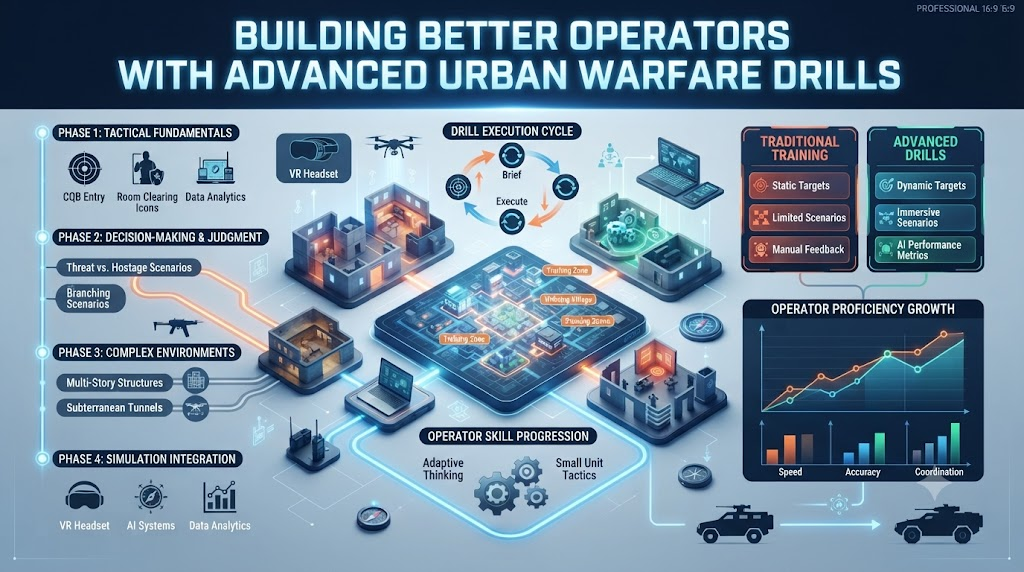
Cities present unique tactical challenges that rural training grounds simply cannot replicate. Tight alleys, towering structures, and constant civilian movement create a chaotic puzzle for security teams and military units. Traditional drills often miss these vital nuances, leaving operators exposed to unexpected risks.
That is why modern teams turn to specialized platforms like WarOpsX to bridge the gap between theory and harsh reality. We explore how structured frameworks change the way units prepare for high-stakes missions. By focusing on real-world variables, you build lasting confidence and sharper reflexes.
The New Reality of Modern Urban Warfare
Urban warfare is no longer an exception in military strategy. Most global conflicts now happen inside dense metropolitan zones. Traditional battlefields have shifted from open fields to concrete jungles filled with vertical threats.
You must adapt your tactics to match this dense environment. Bullets ricochet off concrete walls unpredictably. Sound bounces between tall buildings, making it hard to find where shots originate.
Why Traditional Training Methods Fall Short in Cities
Standard shooting ranges teach you how to hit stationary targets in open spaces. They do not prepare you for sudden ambushes from third-story windows. Static training builds a false sense of security.
When you step into a real city street, the rules change completely. Every doorway, window, and vehicle becomes a potential hazard. Without dynamic practice, your reaction time slows down when it matters most.
Breaking Down the Core Philosophy of WarOpsX
WarOpsX focuses on realistic, scenario-based learning tailored for urban environments. The core idea is to train your brain to process visual clutter quickly. You learn to spot subtle signs of danger before a threat materializes.
This approach combines physical movement with rapid cognitive decision-making. You practice moving from cover to cover while maintaining 360-degree situational awareness. Every drill mirrors the unpredictable nature of actual city operations.
Spatial Awareness and Navigation in Complex Environments
Navigating a strange city requires deep map reading and spatial memory. You need to know your exits before you enter any building. Blindly rushing into a courtyard is a recipe for disaster.
Teams must learn to read architectural layouts instantly. Recognizing common structural weak points helps you plan safer routes. You move with purpose, minimizing exposure to elevated sniper positions.
Decision-Making Under High Stress and Pressure
High-stress situations cause tunnel vision and physical freezing. Your heart rate spikes, and fine motor skills degrade rapidly. Training must account for this natural biological response.
By introducing controlled stress into your drills, you build mental resilience. You learn to stay calm while processing multiple moving variables. Clear communication under pressure keeps your entire team safe and coordinated.
Real-World Case Studies and Operational Scenarios
- Scenario Alpha: A four-man patrol entered a narrow alley without checking upper balconies, resulting in a simulated ambush from a second-floor window. The fix involved mandatory overhead scanning before entering any confined vertical corridor.
- Scenario Bravo: During a building clearance drill, a team lost radio contact due to thick concrete walls, causing severe coordination failure. The team updated their standard operating procedure to include hand signals and backup optical communication lines.
- Scenario Charlie: Operators rushed past a partially open doorway, missing a simulated hostile force positioned just out of sight. Instructors enforced a strict “slice the pie” corner-clearing technique to eliminate blind spots permanently.
- Scenario Delta: A unit relied entirely on night vision goggles during a partial blackout, blinding themselves when unexpected floodlights turned on. They learned to balance ambient lighting with tactical gear adjustments for seamless transitions.
- Scenario Echo: An extraction team parked their transport vehicles too close to a bottleneck intersection, trapping themselves during a simulated riot. They revised their staging protocols to ensure rapid escape routes remain open at all times.
- Scenario Foxtrot: During a high-speed room entry, operators collided with each other due to a lack of verbal callouts. Implementing precise sequencing and verbal triggers ensured smooth, fluid movement through tight entry points.
- Scenario Golf: A scout team failed to account for civilian foot traffic, leading to delayed target identification in a crowded marketplace. They integrated dynamic crowd-filtering exercises to sharpen threat discrimination under pressure.
- Scenario Hotel: A squad ignored basement stairwells during a multi-story sweep, allowing a simulated threat to flank them from behind. Standard clearance protocols were updated to mandate checking all vertical levels in strict sequence.
- Scenario India: Communications equipment failed due to electromagnetic interference in a dense commercial district. The unit successfully relied on pre-established visual backup signals to complete their objective without missing a beat.
- Scenario Juliet: An operator suffered equipment snagging while squeezing through a narrow security gate under fire. The squad transitioned to streamlined gear configurations to prevent similar mobility hazards in future deployments.
Comparative Analysis: Traditional Training vs. WarOpsX Framework
| Feature | Traditional Training | WarOpsX Framework |
| Environment | Flat, open shooting ranges | Dense urban vertical complexes |
| Stress Level | Low, predictable conditions | High, dynamic, and chaotic |
| Decision-Making | Static target acquisition | Rapid threat discrimination |
| Team Coordination | Basic linear formations | Multi-directional fluid movement |
| Adaptability | Rigid procedural adherence | Flexible tactical problem-solving |
The Science of Clearing Rooms and Navigating City Streets
Room clearing is one of the most dangerous tasks in tactical operations. Every corner hides a potential ambush. You must move with deliberate speed and absolute precision.
Entering a room requires synchronized teamwork and split-second timing. The first person secures the strong corner while the second covers the opposite side. Communication must remain crisp, short, and direct to avoid confusion.
Equipment Optimization for Urban Operations
Heavy armor slows you down and drains your stamina quickly. In tight urban spaces, agility matters more than bulky protection. You need gear that balances safety with high mobility.
Carrying too many items creates snag hazards in narrow doorways. Streamline your loadout to carry only what you need for immediate survival. Lightweight plates and modular pouches give you the edge in close quarters.
Communication Protocols in Urban Canyons
Tall buildings block radio frequencies and distort sound waves. Standard push-to-talk radios often fail when you need them most. You must establish reliable redundancy protocols.
Visual signals and runner systems provide backup when radios go silent. Speak clearly and use concise code words to reduce radio clutter. Every team member must know their role without needing constant verbal reminders.
Psychological Conditioning for High-Risk Environments
Fear is a natural reaction to mortal danger in unfamiliar territory. Ignoring fear does not work; managing it is the key to survival. Tactical training must expose operators to controlled stress regularly.
By facing realistic scenarios repeatedly, your brain builds healthy coping loops. You stop panicking when unexpected events disrupt your plan. Calm focus replaces chaotic reactions during critical moments.
Common Mistakes and Pitfalls in Urban Training
- Mistake: Rushing blindly through doorways without checking corners. Solution: Always use the “slice the pie” technique to scan rooms before stepping inside.
- Mistake: Clustering too close together in hallways. Solution: Maintain proper interval spacing to prevent a single hazard from injuring multiple operators.
- Mistake: Ignoring upper-story windows and balconies. Solution: Assign at least one team member to scan vertical threats during every movement phase.
- Mistake: Relying solely on electronic communications. Solution: Practice backup hand signals and visual cues for silent, reliable coordination during radio blackouts.
- Mistake: Overloading gear plates with unnecessary items. Solution: Audit your loadout regularly to keep only essential tools that improve mobility in tight spaces.
- Mistake: Failing to secure rear flanks during advances. Solution: Implement a rotating rear-guard duty to protect your team from unexpected rear attacks.
- Mistake: Practicing only in sterile, familiar environments. Solution: Rotate through diverse, unfamiliar urban layouts to build true adaptability under pressure.
- Mistake: Neglecting physical stamina conditioning. Solution: Combine tactical drills with high-intensity cardio to maintain performance when fatigued.
- Mistake: Making loud noises during stealth approaches. Solution: Train in silent movement, focusing on foot placement and gear rattle prevention.
- Mistake: Skipping post-exercise debriefs. Solution: Always run a thorough review session after every drill to identify mistakes and correct habits.
Step-by-Step Implementation Roadmap for Teams
- Assess Baseline Skills: Evaluate your team’s current urban movement and room-clearing capabilities through initial diagnostic drills.
- Define Clear Objectives: Set specific, measurable goals for what tactical competencies your unit needs to improve over the next quarter.
- Incorporate Realistic Scenarios: Integrate dynamic, multi-variable urban simulations that mimic real-world architectural and environmental constraints.
- Streamline Equipment Loadouts: Review and minimize operator gear to ensure maximum agility and prevent snag hazards in tight spaces.
- Establish Redundant Comms: Test radio reliability in dense concrete environments and implement clear visual backup signaling protocols.
- Practice Vertical Scanning: Make overhead and multi-level awareness a mandatory habit during every movement and entry phase.
- Run Stress-Inoculation Drills: Introduce time pressure and unexpected disruptions to build mental resilience and calm decision-making.
- Conduct Peer Reviews: Encourage open, honest feedback after every exercise to catch bad habits and refine tactical execution.
- Scale Complexity Gradually: Move from simple single-room clearances to complex multi-story building sweeps as team competence grows.
- Review and Iterate: Continuously update your standard operating procedures based on performance data and evolving tactical insights.
Final Recommendation and Next Steps
Mastering urban combat training takes consistent effort, honest self-evaluation, and the right strategic framework. Stop relying on outdated rural drills that fail to match modern metropolitan realities.
Take time today to evaluate your team’s current preparedness levels. Implement structured scenarios, streamline your gear, and prioritize rapid decision-making under pressure. Keep refining your approach, stay adaptable, and build a truly resilient tactical unit.
Frequently Asked Questions
1. What makes urban combat training different from traditional open-field training?
Urban combat involves tight spaces, vertical threats, and constant visual clutter that require rapid decision-making compared to flat, predictable open ranges.
2. Why is spatial awareness crucial in city environments?
Cities feature complex architectural layouts and blind spots that expose operators to sudden ambushes if they fail to map their surroundings.
3. How does WarOpsX improve tactical decision-making under stress?
It uses realistic, scenario-based learning that exposes operators to controlled pressure, building mental resilience and quick reaction habits.
4. What equipment adjustments are necessary for urban operations?
Operators should shed heavy, bulky gear to improve agility, prevent snag hazards, and maintain high mobility in tight hallways.
5. How can teams maintain communication during radio failures in tall buildings?
Teams should rely on pre-established visual hand signals and backup runner protocols when dense concrete blocks electronic signals.
6. What is the “slice the pie” technique in room clearing?
It is a method where operators slowly scan a room from around a corner to spot threats without exposing their entire bodies.
7. Why do traditional shooting ranges create a false sense of security?
Ranges teach stationary target acquisition in open spaces, which does not prepare operators for dynamic threats from multiple elevations.
8. How often should tactical units review their operational procedures?
Units should debrief after every single training drill and update their standard operating procedures based on performance insights.
9. What role does physical fitness play in urban combat readiness?
High-intensity cardiovascular stamina ensures operators maintain peak performance and sharp reflexes even when fatigued during long missions.
10. How can beginners start improving their urban tactical skills?
Start by assessing baseline competencies, practicing basic room clearance drills, and incorporating structured scenario-based training gradually.