Introduction
When people think about a strong military, they often picture the biggest tanks, the fastest jets, and the most powerful ships. It is easy to believe that the side with more weapons always wins. But history tells a very different story. A country can own thousands of tanks and still lose a war, while another country with fewer weapons can stay safe for decades. The real secret is not the size of the army. It is the master plan that connects every single soldier, ship, and satellite into one working team.
Think of a national defense like a giant human body. The soldiers are the muscles. The weapons are the bones. But strategic planning is the brain. Without the brain sending clear signals, the strongest muscles just twitch and move with no purpose. A military without a plan is the same. It may look strong on paper, but it cannot protect anything in a smart way. Every move it makes costs money, time, and sometimes lives, and it still may fail.
In this article, we will break down how strategic planning supports national defense in the simplest way possible. You will learn what strategy really means, how it differs from short-term tactics, and why the best militaries often win without ever firing a shot. If you want to explore more deep and simple guides like this one on military strategy and defense, visit Waropsx , where complex defense ideas are explained in plain English for everyone.
The Chessboard of National Security
The easiest way to understand military strategy is to think about a game of chess. In chess, a beginner only thinks about the very next move. They see a piece they can capture, so they capture it. A chess master thinks in a completely different way. Before touching any piece, the master asks bigger questions. Which pieces should I protect? Which part of the board matters most? What will the board look like ten moves from now? The beginner is playing tactics. The master is playing strategy.
Tactics are about how to win a single fight. Strategy is about deciding whether you should even be fighting in the first place. It is about making sure you have enough food, fuel, and troops to survive the whole year, not just the first battle. A tank commander uses tactics to take a hill. A strategic planner decides whether that hill is even worth taking, and how many tanks the country can afford to lose in the process. Both jobs matter, but they are on completely different levels.
A military without a strategy is just a collection of very expensive weapons with no real purpose. Imagine a football team where every player chases the ball at the same time. Each player may be fast and strong, but the team loses because no one is defending, passing, or planning. An unplanned military works the same way. It reacts to every small problem, wastes its strength on things that do not matter, and leaves the truly important places weak and open.
Long-term vision is what separates a safe nation from a struggling one. Strategic planners do not just ask what the enemy is doing today. They ask what the world will look like in ten or twenty years. They plan for new technology, changing alliances, and future threats that do not even exist yet. This is why countries spend years writing defense plans instead of waiting for trouble to arrive. The plan is written in peace so it can be used in crisis.
The Three Pillars of Defense Strategy
Every strong defense plan in the world rests on three main pillars. Think of them like three legs of a stool. If one leg breaks, the whole stool falls over. Let us look at each one in simple terms.
Resource Allocation: The Beans and Bullets
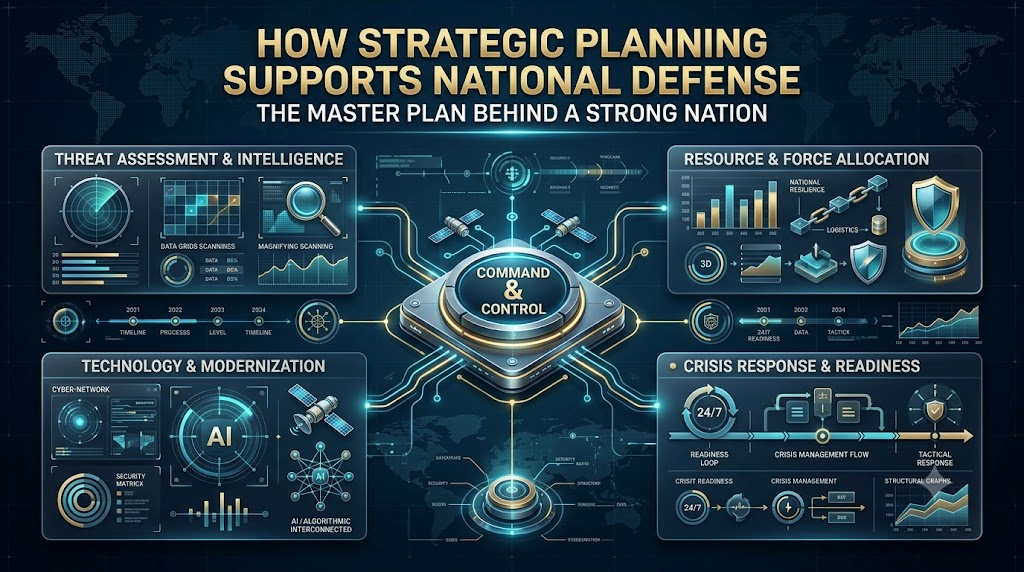
The first pillar is resource allocation, which simply means putting your money, people, and equipment where they matter most. A country does not have unlimited money. It must choose between buying more tanks, paying for better training, or investing in new technology. Smart planners look at the map and the threats, then decide what the country truly needs. Sometimes the best choice is not a new weapon at all. It might be better roads so troops can move fast, or better food supply so soldiers stay strong.
This is often called the “beans and bullets” problem. Beans represent everything soldiers need to live, like food, fuel, and shelter. Bullets represent everything they need to fight. An army with plenty of bullets but no beans will starve before it wins anything. An army with beans but no bullets cannot defend itself. Resource allocation is about finding the perfect balance between the two. A wise country feeds, trains, and equips its forces before a crisis, because during a crisis it is already too late to start shopping.
Anticipating the Enemy’s Next Move
The second pillar is intelligence and anticipation. This means knowing what the other side is planning before they do it. It is like reading the other team’s playbook before the match begins. Countries gather information from many places, such as satellites in space, listening posts, spy networks, and open sources like news reports and public speeches. All of this information is put together like puzzle pieces to form a clear picture.
Why does this matter so much? Because surprise is the most dangerous thing in war. If an enemy attacks where you are not ready, even a huge army can be beaten by a small one. But if you see the attack coming, you can move your defenses to the right place, warn your allies, and prepare your people. A nation that knows the enemy’s next move rarely has to panic. It acts calmly, early, and from a position of strength instead of fear.
Deterrence: Winning Without Fighting
The third pillar is the most powerful one of all. Deterrence means being so well prepared and so clearly strong that the enemy simply gives up without firing a single shot. It is like a bodybuilder walking down a dark street. Thugs see him, look at his arms, and quietly change their path. No fight happens because the fight was never worth starting. That is deterrence in action.
This idea is the highest form of victory. Ancient Chinese thinker Sun Tzu wrote that the greatest general wins without ever going to battle. Why? Because a real fight costs money, destroys cities, and takes lives on both sides. If your planning is so good that no one dares attack you, you have protected your country at zero cost in blood. This is why the three pillars work together around the clock, 24 hours a day, 7 days a week, keeping the nation safe even while people sleep.
Comparing Reactive Defense vs. Proactive Strategy
The clearest way to see the value of strategic planning is to compare two imaginary countries. One country only reacts when attacked. The other country plans years ahead. Here is how they stack up:
| What It Measures | Reactive Military (No Plan) | Proactive Military (Strategic Plan) |
|---|---|---|
| Cost of Operations | Very high. Emergency buying is always expensive, and money is wasted on panic decisions. | Controlled and predictable. Funds are budgeted years ahead and spent wisely. |
| Risk to Soldiers’ Lives | Very high. Troops are rushed into danger without proper preparation or support. | Much lower. Troops are well trained, well supplied, and sent only where needed. |
| Global Respect / Deterrence | Low. Other nations see chaos and may take advantage of the weakness. | High. Allies trust the nation, and enemies think twice before testing it. |
| Speed of Response | Slow. Decisions are made in panic after the damage is done. | Fast. Ready plans are pulled out and put into action within hours. |
| Long-Term Safety | Poor. The same problems repeat again and again. | Strong. Threats are stopped before they grow into crises. |
The differences in this table are not small details. They can decide whether a nation lives in peace or lives in fear. The reactive country is always behind the problem. When a crisis hits, its leaders argue, its forces scramble, and its people panic. By the time it responds, the damage is done and the cost is paid in full.
The proactive country faces the same world but responds in a completely different way. Its plans sit ready in drawers, its supplies sit ready in warehouses, and its allies already know what role they will play. When trouble appears, the response is calm, fast, and strong. In many cases, the trouble disappears on its own because the other side realizes that attacking this nation is simply not worth it.
The lesson here is simple. Waiting for danger is not safety. Safety is something a country builds in advance, piece by piece, year by year. Strategic planning is that building process, and every dollar spent on it saves many more dollars, and many lives, later on.
Real-World Scenario: Preventing a Border Crisis
Let us walk through a realistic example to see strategic planning in action. Imagine a country called Country A, which shares a long border with a powerful neighbor. One day, spy satellites notice something worrying. The neighbor is quietly gathering troops, fuel trucks, and field hospitals near the border. These are the classic signs of an invasion being prepared. This is the moment when planning either exists or it does not.
Because Country A planned years ahead, it does not panic. Its leaders open the national defense plan and follow three calm steps at the same time. First, they move three warships into the sea near the border. This is not an attack. It is a signal that says, “We see you, and we are ready.” Second, they share their satellite evidence with trusted allied nations, who quickly issue public statements of support. Suddenly, the neighbor is not facing one country. It is facing a group of countries standing together.
Third, Country A quietly turns on its cyber defenses. Hackers on the other side had been trying to sneak into the power grid and communication networks for months, but the security teams were ready and blocked every attempt. The lights stay on, the phones keep working, and there is no chaos for the enemy to take advantage of. Meanwhile, Country A moves reserve troops to key positions along the border, exactly as the plan laid out years earlier.
Now watch what happens on the other side. The neighbor’s generals look at the situation and do the math. The ships are in place. The allies have spoken. The cyber tricks have failed. An invasion that looked easy last month now looks expensive, slow, and doomed. Within two weeks, the troops near the border quietly pack up and go home. Not one shot was fired. No soldier on either side died. This is what strategic planning gives a nation: the power to win the conflict before it ever begins.
What Corporate Businesses Can Learn from Military Strategy
Here is something surprising. The biggest companies in the world borrow their best ideas from military playbooks. A CEO standing in a boardroom is not that different from a general standing over a map. Both are trying to use limited resources to beat a rival, and both win by planning better than the other side. Once you see the pattern, you cannot unsee it.
Take resource allocation, for example. A smart company does not spend its money everywhere at once. It studies the market, finds where the biggest opportunity is, and puts its best people and budget there. This is exactly the “beans and bullets” idea in a business suit. A company that spreads itself too thin, chasing every small market at once, ends up weak everywhere. A company that concentrates its strength on the right battlefield often dominates it.
Businesses also use anticipation every day. Before launching a product, strong companies study what their rivals are doing, what customers are saying, and what trends are forming. This is corporate intelligence, and it works just like the military version. When a competitor is about to launch a similar product, the smart firm knows months in advance and adjusts its plan first. The company that gets surprised by the market is usually the one that never looked ahead.
Even deterrence has a place in business. When one company builds such a strong position, a loyal customer base, or such powerful technology, that rivals stop trying to compete in that area, it has won without a price war. Modern CEOs also build alliances, just like nations do. They sign partnerships, join industry groups, and back each other up in tough economic times. The lesson is clear: whether you are protecting a country or running a company, the winning move is always the plan made before the storm, not the panic during it.
FAQs
1. What is strategic planning in national defense?
Strategic planning in national defense means creating a long-term master plan that decides how a country will protect itself. It covers where money goes, where troops are placed, and how threats will be handled years before they happen.
2. How is strategy different from tactics?
Tactics are the small moves used to win one battle or fight. Strategy is the big plan that decides which battles matter, whether a fight is worth it, and how to keep the whole country safe over many years.
3. What does “resource allocation” mean in the military?
It means putting money, troops, food, fuel, and equipment where they are needed most. Planners must balance the “beans” (food and supplies) and the “bullets” (weapons) so soldiers can both survive and fight.
4. Why is deterrence called winning without fighting?
Deterrence means being so strong and so clearly ready that an enemy decides not to attack at all. When a rival gives up without starting a war, you win without spending a single bullet or losing a single soldier.
5. What happens to a country that has no strategic plan?
A country without a plan only reacts after danger arrives. This leads to panic, very high costs, rushed decisions, and higher risk to soldiers’ lives. The same problems tend to repeat over and over.
6. How do satellites and intelligence help national defense?
They act like the eyes of a nation. Satellites, listening stations, and spies gather clues about what rivals are doing. This early warning lets a country move its defenses before an attack, instead of after it.
7. Can a weaker country still stay safe through planning?
Yes. A smaller country with a smart plan, strong allies, and good intelligence can stop a much larger enemy. Being prepared and trusted by allies often matters more than having the biggest army.
8. Why do businesses copy military strategy?
Because companies face rivals too. CEOs use resource allocation, market scouting, and strong positioning to beat competitors. A well-planned company avoids price wars and surprises, just like a well-planned military avoids unnecessary battles.
9. Is strategic planning only useful during wars?
No, it is most useful during peace. Plans, supplies, and alliances are built in quiet times. When a crisis finally comes, the country simply follows the plan instead of building one under pressure.
10. How does a country know if its strategic plan is working?
The best sign is silence. When enemies stay away, allies stay loyal, and crises get stopped early, the plan is working. Peace that lasts for years is the true proof of good planning.
Conclusion
Strategic planning is the quiet engine behind every safe nation. It is not loud like a jet engine or dramatic like a movie battle. It happens in offices and meeting rooms, years before any crisis, by people who ask one simple question: “What will we need when the worst day comes?” The answer to that question, written down and practiced in advance, is what separates nations that stay safe from nations that get caught off guard.
We have seen that tactics win fights, but strategy wins futures. A country needs more than weapons. It needs the wisdom to place its money where it matters, the eyes to see trouble coming, and the strength to make trouble change its mind. When these three pillars stand together, a nation often wins its hardest battles without a single shot being fired. That is the highest form of defense, and it is available to any country wise enough to invest in it early.
The same truth applies far beyond the battlefield. Families, businesses, and teams all grow stronger when they plan ahead instead of reacting in panic. Peace is not something that happens by luck. It is something that is planned, built, and protected, one wise decision at a time.