Introduction
In any fight, the side with the best information usually wins. This is true on a battlefield. It is also true in a corporate boardroom, a football match, or a chess game. The player who knows what the other side plans to do can get ready, move first, and avoid big mistakes. The player who guesses in the dark often pays a high price.
This is why military intelligence analysis matters so much. Many people think intelligence work means secret agents in fancy suits. The real job is much closer to solving a puzzle. Analysts take small, scattered clues, like a footprint, a burst of radio static, or a photo from a drone, and connect them. Their goal is to work out what the opponent will do before the opponent does it. If you want to explore more about strategy and operations, you can visit Waropsx .
In this guide, we will break the topic down into simple parts. You will learn the difference between information and intelligence. You will see the four steps analysts follow every day. You will read a simple story about a convoy saved from an ambush. And you will see how normal businesses use the same ideas. No military background is needed, and every hard word will be explained in plain English.
The Big Difference Between “Information” and “Intelligence”
Let’s start with the most important idea. Information and intelligence are not the same thing. Information is a raw fact. It is a single piece of the puzzle, and by itself it often means very little. Intelligence is what you get when you study that fact, connect it with others, and understand what it means.
Here is an easy example. A drone takes a picture of a truck parked near a road. That picture is just information. It tells you there is a truck, and that is all. Now imagine the analyst looks closer and sees that the truck is loaded with extra fuel tanks. The analyst also knows that trucks in this area usually carry no extra fuel. Now the picture tells a story. The enemy may be getting ready for a long trip tomorrow. That is intelligence.
Think of it like a kitchen. Information is the pile of raw vegetables on the counter. Intelligence is the finished meal. Nobody can eat a pile of raw carrots and onions and feel satisfied. Someone has to wash them, cut them, cook them, and serve them. Analysts do the same thing with facts. They sort, check, and combine the facts until they become useful.
This difference matters because a leader cannot act on a pile of facts. A commander has little time and many choices to make. If you hand that person a hundred photos and a thousand radio notes, they will feel lost. If you hand them one clear message that says, “The enemy will likely move at dawn, and here is why,” they can make a smart decision at once. Good intelligence saves time, and in a conflict, time can save lives.
The 4-Step Intelligence Cycle
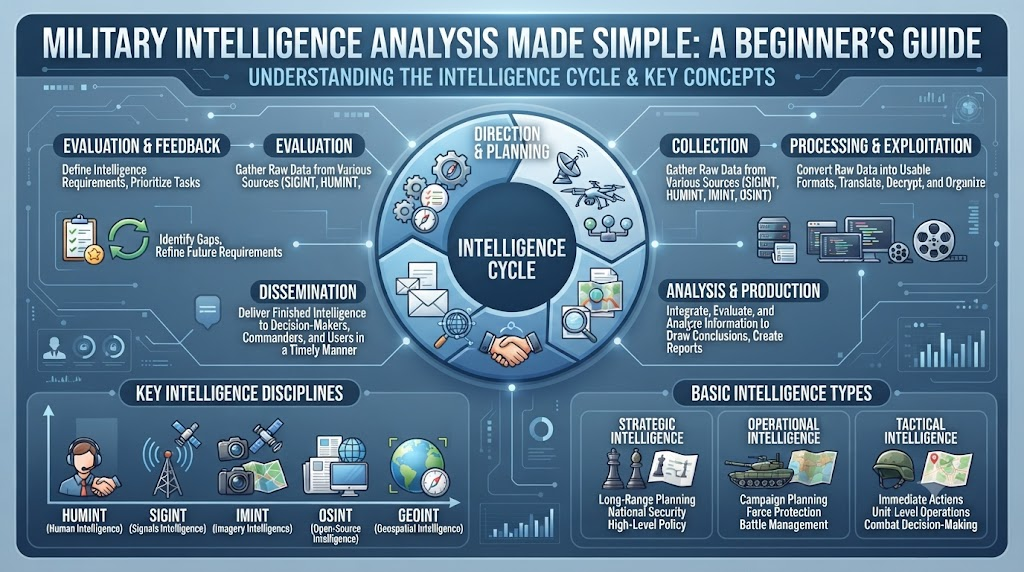
Analysts do not work randomly. They follow a simple loop called the intelligence cycle. It has four steps: asking the right questions, gathering clues, connecting the dots, and warning the boss. The best way to understand it is to think of a detective solving a mystery. The detective first decides what needs to be solved. Then the detective collects clues, studies them, and finally tells the police chief what happened. Intelligence work follows the same path.
Step 1: Asking the Right Questions
Every good investigation starts with a clear question. In the military, this step is called planning. A leader says what they need to know. For example, “Will the enemy attack the bridge this week?” or “Which road is safe for our trucks tomorrow?” A clear question keeps the team focused. Without it, people waste days collecting facts that do not matter.
A good question is specific and has a deadline. “What is the enemy doing?” is too big and too vague. “Is the enemy moving soldiers toward the river before Friday?” is much better. It tells the team where to look and when the answer is needed. Think of it like a school test. A focused question gets a focused answer, while a fuzzy question gets a fuzzy one.
Step 2: Gathering the Clues (Collection)
Once the question is set, the team goes looking for clues. This step is called collection. Clues can come from many places. There are photos from drones and satellites. There are radio signals that are picked up and recorded. There are reports from soldiers on the ground, and there are public sources like news stories, maps, and social media posts.
No single clue tells the whole story, so analysts try to gather from many sources. A photo may show a truck. A radio message may mention a time. A local report may mention a closed road. Each one is weak alone, but together they build a picture. A detective also trusts a case more when the fingerprints, the witnesses, and the camera footage all agree.
Step 3 & 4: Connecting the Dots and Delivering the Warning
Step three is the heart of the whole job. It is called analysis. Here, the analyst sits down with all the clues and asks, “What does this really mean?” They look for patterns, check if a clue is trustworthy, and compare it with what they already know. They also ask a hard question: “Could I be wrong?” Good analysts always test their own ideas and look for other possible explanations.
Step four is called dissemination, which simply means sharing the result with the people who need it. This is the warning step. The analyst writes a short, clear message and sends it to the commander. It says what is likely to happen, how sure the analyst is, and what they suggest. A great discovery is useless if it stays on a desk. It must reach the right person at the right time, in words that person can understand quickly.
After step four, the cycle starts again. The commander acts, new events happen, and fresh questions come up. That is why we call it a cycle. It never really stops, because the situation keeps changing.
Comparing Blind Guesswork vs. Intelligence-Driven Decisions
Now let’s compare two types of leaders. The first one relies on guesswork. The second one uses intelligence. The table below shows how different their results can be.
| What We Compare | Commander Relying on Guesswork | Commander Using Intelligence |
|---|---|---|
| Risk to the Team | Very high. The team may walk into danger without any warning | Much lower. Dangers are spotted early, and safer paths are chosen |
| Use of Resources | Wasteful. Fuel, time, and people are spent in the wrong places | Smart. Effort goes where it is truly needed |
| Element of Surprise | The commander is usually the one who gets surprised | The commander can surprise the opponent instead |
| Speed of Decisions | Slow and uncertain, because nobody is sure what is going on | Faster and calmer, because the picture is clear |
| Handling Mistakes | Mistakes are found late, often after the damage is done | Mistakes are caught early, because plans are checked against fresh clues |
Look at the first row. It matters the most. A commander who guesses is like a person walking through a dark room with no light. Sooner or later, they will bump into something hard. A commander with good intelligence has a flashlight. They can still make mistakes, but they can see the big dangers ahead and step around them.
The second and third rows show the cost and the advantage. Armies and companies both have limited people, money, and time. Guesswork burns through them quickly. Intelligence helps a leader place those limited tools in the right spot. Surprise is also a powerful gift. When you know what your opponent will do, and they do not know that you know, you gain a huge edge.
Please note that intelligence does not give a perfect answer every time. Analysts deal with unclear facts and sneaky opponents, so some uncertainty always remains. But even an imperfect picture beats no picture at all. The goal is not to be right 100 percent of the time. The goal is to make better choices than the other side.
Real-World Scenario: Stopping an Ambush Before It Happens
Let’s walk through a made-up but realistic story. A supply convoy of ten trucks must travel along a mountain road tomorrow morning. It carries food and medicine for a distant camp. The commander asks one clear question: “Is the main road safe for our convoy?” That is step one of the cycle.
An analyst named Maya starts collecting clues. She listens to a record of the area’s radio traffic from the past week. She notices something odd. Every evening, there is a normal amount of chatter. But tonight, the radio goes almost completely quiet near the mountain pass. Silence can be a clue too. People who are about to do something secret often stop talking. Maya makes a note and keeps looking.
Next, she checks the latest satellite photos of the same area. She spots fresh tire tracks leading off the main road into a hidden valley. She also sees a few small shapes near the road’s narrowest bend, which could be people hiding. By themselves, the quiet radio and the tire tracks might mean nothing. Together, they form a pattern: someone is setting up near the pass and trying hard not to be noticed.
Maya tests her own idea. Could this be a farming family or a normal traffic change? She checks the maps and finds no farms there. Her confidence grows. She quickly writes a short warning for the commander: “Likely ambush at the narrow bend. Confidence is medium to high. We suggest using the northern road.” The commander changes the route. The convoy arrives safely, and the people at the camp get their food and medicine. No shots were fired, and that is the best outcome of all.
How Businesses Use Military Intelligence Tactics
You do not need an army to use these ideas. Companies use the same steps every day, even if they never call it intelligence. The business version has a different name, often “market research” or “competitor analysis,” but the thinking is almost identical. A company asks a clear question, gathers clues, studies them, and shares the answer with its leaders.
Imagine a shoe company that wants to launch a new running shoe. First, it asks, “What will runners want next year?” Then it collects clues. It reads customer reviews, watches what rivals are selling, checks which words people search online, and studies sales numbers. Each clue is small. Together, they show a pattern, such as runners wanting lighter shoes in brighter colors.
Companies also watch their competitors closely. If a rival hires many new engineers, it may be building a new product. If a rival starts buying lots of ads in a new city, it may be about to open stores there. A smart analyst notices these hints and warns the boss early. The company can then change its own plans, lower its prices, or launch its own product first. It is the same idea as spotting the truck with extra fuel.
The lesson for everyday life is simple. Do not decide based on guesses when you can gather clues first. Whether you are choosing a school, planning a project, or starting a small business, you can use the cycle. Ask a clear question, collect facts from many places, look for patterns, test your own ideas, and share what you find. People who think this way tend to make calmer and wiser choices.
FAQs
Q1. What is military intelligence analysis in simple words?
It is the work of studying scattered clues, such as photos, radio signals, and reports, to understand what an opponent is doing or planning. The analyst then explains the meaning to leaders so they can decide wisely.
Q2. What is the difference between information and intelligence?
Information is a raw fact, like a photo of a truck. Intelligence is the meaning you find after studying many facts together, like knowing the truck is part of a plan for tomorrow.
Q3. What are the four steps of the intelligence cycle?
The steps are planning (asking the right questions), collection (gathering clues), analysis (connecting the dots), and dissemination (sharing the warning). After the last step, the cycle starts again with new questions.
Q4. Do intelligence analysts work as secret agents?
Most do not. The majority of analysts work at desks, studying data, maps, pictures, and reports. Their main tools are careful thinking and good judgment, not disguises or gadgets.
Q5. Where do analysts get their clues from?
They use many sources, such as drone and satellite photos, recorded radio signals, reports from people on the ground, and public sources like news and maps. Using many sources helps them double-check each clue.
Q6. Can intelligence analysis be wrong?
Yes. Clues can be unclear, and opponents may try to trick the analyst. That is why good analysts test their own ideas, say how sure they are, and update their view when new facts arrive.
Q7. Why is the first step, asking the right questions, so important?
A clear question keeps the team focused on what really matters. Without it, people may waste time gathering facts that do not help the leader make a decision.
Q8. How do businesses use intelligence analysis?
Companies study customers, competitors, and market trends to make better plans. They ask a clear question, collect clues, find patterns, and share the result with their leaders before launching a product.
Q9. What skills does a beginner need to become an analyst?
Good analysts are curious, patient, and careful. They need to think clearly, write simply, and question their own ideas. Skills in reading maps, handling data, and studying world events also help.
Q10. Can I use these ideas in everyday life?
Yes. You can use the same steps for school, work, or personal choices. Ask a clear question, gather facts from many places, look for patterns, and make your decision based on clues instead of guesses.
Conclusion
Military intelligence analysis is not about movie-style spies. It is about puzzle-solving. Analysts take small, scattered pieces of information and turn them into clear answers that help leaders act. The key idea is that information is a raw fact, while intelligence is the meaning behind those facts.
We also looked at the four-step cycle: asking the right questions, gathering clues, connecting the dots, and warning the boss. We saw how a commander with intelligence has less risk, wastes less, and can even surprise the other side. In our ambush story, one quiet radio and a few tire tracks saved a whole convoy because a careful analyst put the pieces together.
Best of all, these skills are not limited to the military. Businesses, students, and families can all use the same simple habits. Ask a good question. Look at many sources. Test your own ideas. Share what you learn in plain words. If you remember these basics, you already understand the heart of military intelligence analysis, and you can start thinking like an analyst today.