Introduction
Military effectiveness is rarely determined by troop numbers alone, as two forces of similar size can achieve vastly different results due to variations in training, leadership, technology, logistics, and interoperability. A force multiplier is any capability or factor that allows a force to achieve greater operational impact from its existing resources, focusing on increased effectiveness rather than simple size expansion. To explore more foundational concepts in military strategy and defence studies, you can visit WarOpsX. A force multiplier is best understood as something that allows a force to achieve greater operational effect from its available resources. An official military definition describes a force multiplier as a capability that significantly increases combat potential and improves the probability of mission accomplishment. The central idea is straightforward: force multiplication is about increasing effectiveness, not simply increasing numbers.
What Is a Force Multiplier?
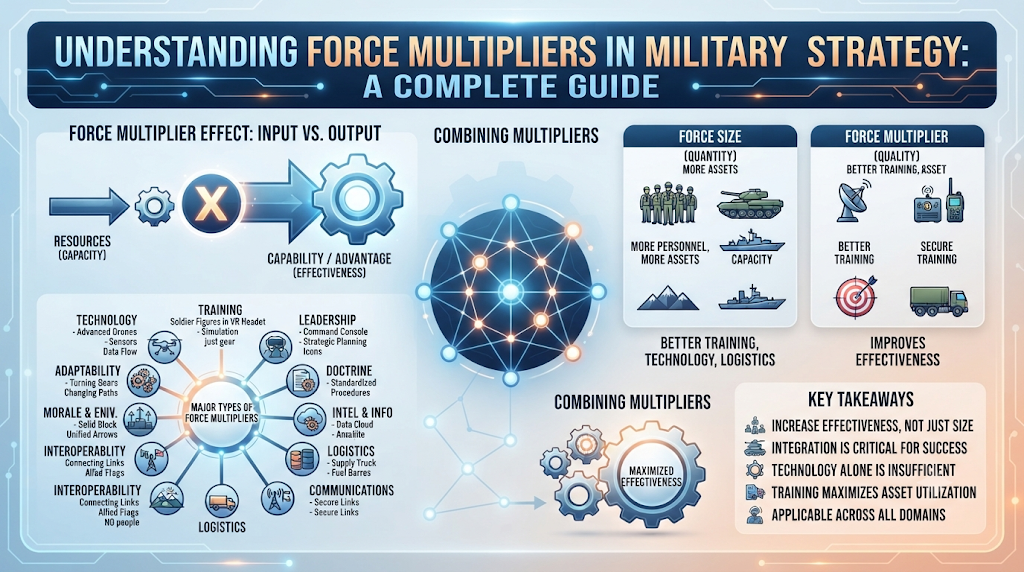
In simple terms, a force multiplier is a capability, condition, or advantage that increases the effectiveness of an existing force. Rather than relying on a literal mathematical formula, analysts use the term conceptually to describe how certain factors scale capability:
Resources $\rightarrow$ Capability / Advantage $\rightarrow$ Better Effectiveness $\rightarrow$ Greater Mission Potential
The “multiplier” is a conceptual way of describing increased organizational output rather than a strict mathematical calculation.
Force Multiplier vs. Force Size
To understand the concept clearly, it helps to compare how force size and force multipliers influence military operations.
| Factor | Force Size | Force Multiplier |
| Main focus | Number of personnel and assets | Effectiveness of available resources |
| Example | More personnel | Better training |
| Effect | Increases capacity | Improves capability |
| Main question | How many? | How effectively can they operate? |
More personnel or equipment increase raw capacity, while force multipliers improve what an existing force is capable of accomplishing.
Why Force Multipliers Matter
Military organizations always operate under resource constraints. They frequently face:
- Limited personnel
- Limited time
- Limited logistics
- Difficult terrain
- Information uncertainty
- Complex missions
- Competing priorities
Force multipliers help organizations think about how to improve effectiveness without assuming that simply adding more resources is always possible. A U.S. Army article published in 2026, for example, describes artificial intelligence as a force multiplier in military training because it increases the efficiency, scalability, and flexibility of exercise design while keeping human planners firmly in control.
Major Types of Force Multipliers
Force multipliers do not exist in a vacuum. The major categories include:
- Technology
- Training
- Leadership
- Doctrine
- Intelligence and information
- Communications
- Logistics
- Interoperability
- Terrain and environment
- Morale and cohesion
- Organization
- Adaptability
These factors frequently work together rather than independently to shape overall military effectiveness.
Technology as a Force Multiplier
Technology can improve military effectiveness through better sensing, faster information processing, improved communications, navigation, simulation, decision-support systems, logistics management, and enhanced situational awareness.
Technology only becomes a useful multiplier when personnel can operate it effectively and integrate it into broader systems. It is not a standalone solution; complex gear underutilized by poorly trained operators fails to yield a multiplier effect.
Training as a Force Multiplier
Trained personnel can often use available resources more effectively than untrained counterparts. Key elements of training include technical proficiency, team coordination, decision-making, rehearsal, adaptability, and familiarity with procedures.
A 2026 U.S. Army Special Warfare article describes AI-enhanced training as a way to make exercise environments more scalable and responsive, illustrating how training systems themselves serve as multipliers. Equipment cannot compensate indefinitely for poor preparation.
Leadership as a Force Multiplier
Leadership influences decision quality, unit cohesion, communication, initiative, adaptability, and resource allocation. Viewed as an organizational capability rather than just battlefield command, good leadership ensures that plans are understood, morale remains stable under pressure, and resources flow where they are needed most.
Doctrine as a Force Multiplier
Military doctrine provides common principles for understanding how military organizations should operate. Good doctrine creates shared understanding, improves coordination, supports training, standardizes terminology, and helps organizations adapt.
When doctrine improves command, education, and organizational learning, it functions as a powerful multiplier across the entire force.
Interoperability as a Force Multiplier
Interoperability is the ability of different organizations, units, systems, or partners to work together effectively. It relies on common procedures, compatible systems, shared terminology, data exchange, joint training, and coordination.
The Irish Defence Forces’ doctrine specifically identifies interoperability and responsiveness as force multipliers that enhance overall fighting power.
Intelligence and Information
Information becomes a force multiplier when it improves awareness, planning, decision-making, coordination, and risk assessment.
- Data: Raw, unorganized facts.
- Information: Organized data.
- Understanding: Meaningful interpretation.
- Decision support: Using understanding to improve choices.
Structured information turns uncertainty into manageable operational parameters.
Communications as a Force Multiplier
Reliable communication helps organizations coordinate information sharing, command synchronization, status updates, and logistics management.
While vital, communication systems also create vulnerabilities when they fail, become overloaded, or cannot connect disparate organizations. Conceptual resilience is just as important as the communication hardware itself.
Logistics as a Force Multiplier
Military effectiveness depends heavily on sustaining people and equipment through transportation, maintenance, fuel, food, medical support, spare parts, and supply management. A force that cannot sustain its operations loses effectiveness regardless of its initial equipment or personnel strength. Logistics remains the invisible backbone of operational success.
Terrain and Environment
Geography heavily influences military effectiveness. Mountains, rivers, forests, urban areas, deserts, and narrow routes affect mobility, visibility, accessibility, logistics, and communication. Military literature recognizes terrain as a potential force multiplier because physical geography dictates operational possibilities.
Weather and Environment
Extreme heat, cold, heavy rain, fog, dust, and snow can severely disrupt plans. Environmental preparation and adaptation improve organizational resilience, turning a hostile natural environment into a manageable factor rather than a catastrophic failure point.
Morale and Cohesion
People remain the core of any military organization. Trust, motivation, unit cohesion, leadership confidence, shared purpose, and professional identity directly dictate how well an organization functions under pressure. High morale cannot replace missing equipment, but low morale can instantly neutralize superior capabilities.
Experience as a Force Multiplier
Experience improves pattern recognition, decision-making, problem-solving, adaptability, and team coordination. Experienced personnel recognize problems faster and avoid repeating known mistakes, directly connecting to institutional memory and ongoing lessons-learned programs.
Adaptability as a Force Multiplier
Military environments change rapidly. An adaptable organization learns from experience, modifies plans, responds to new information, adjusts to new technology, and improves procedures seamlessly. Adaptability transforms rigid structures into flexible networks capable of weathering shocks.
Combining Multiple Force Multipliers
Force multipliers are strongest when combined. Consider this structural interaction:
Training + Technology + Leadership + Communications + Logistics $\rightarrow$ Greater Organizational Effectiveness
Technology without training underperforms; training without adequate logistics hits a hard ceiling; communication without interoperability fails to generate coordination. Force multiplication is fundamentally a systems problem, not a single-tool fix.
Force Multipliers and the “Whole System”
Military effectiveness emerges from how multiple components interact within a unified framework:
People + Doctrine + Training + Technology + Information + Logistics + Organization
                                      ↓
                           Military Effectiveness
Force Multiplier vs. Force Enabler
While terms occasionally overlap across different doctrines:
- Force Multiplier: A factor that significantly increases overall effectiveness.
- Force Enabler: A capability that makes a particular activity possible or practical in the first place.
Force Multiplier vs. Force Multiplier Effect
The phrase can refer to the capability itself, the actual improvement in performance produced, or the analytical estimate of relative contribution. This distinction explains why different analysts may describe the same asset in slightly different terms.
How Force Multipliers Are Evaluated
Analysts evaluate capabilities based on mission effectiveness, efficiency, reliability, availability, training requirements, cost, integration, scalability, and resilience. A capability is never a true multiplier simply because it carries a high price tag or features advanced technology.
Cost and Force Multipliers
Potential multipliers require procurement, training, maintenance, infrastructure, software, and integration. A capability is only a valid force multiplier if its operational benefits outweigh its structural costs and dependencies.
The Risk of Overdependence
Heavy reliance on a single technology, a specialized communication network, a single-source supply chain, or a narrow group of experts creates catastrophic vulnerabilities. True operational strength requires redundancy and systemic resilience.
Force Multipliers in Military Training
Simulation and training technologies improve learning without requiring constant live exercises through scenario generation, virtual rehearsals, after-action reviews, and structured decision exercises.
AI as an Emerging Force Multiplier
Artificial intelligence acts as an emerging force multiplier by assisting with data organization, scenario generation, decision support, administrative workflows, logistics analysis, and knowledge management.
A 2026 U.S. Army Special Warfare publication emphasizes that AI amplifies human planners rather than replacing them, particularly by accelerating exercise design. However, AI also introduces data quality issues, algorithmic bias, reliability concerns, cybersecurity risks, and strict human oversight requirements.
Historical Perspective
The conceptual foundations of force multiplication stretch back centuries through the strategic use of fortifications, disciplined drill, mechanization, and radio communications. The core principle—maximizing output via superior methods rather than sheer mass—has guided military planners through every era of warfare.
Force Multipliers in Modern Military Thinking
Modern defence organizations think in terms of interconnected capabilities, emphasizing multi-domain integration, information advantage, training modernization, resilience, and human-machine collaboration.
Common Misconceptions
- Misconception 1: “A force multiplier simply means having better weapons.” (Reality: The concept encompasses leadership, training, and organization.)
- Misconception 2: “A force multiplier always has a fixed numerical value.” (Reality: Effects depend entirely on operational context.)
- Misconception 3: “More technology always means more effectiveness.” (Reality: Integration and training are mandatory prerequisites.)
- Misconception 4: “Force multipliers eliminate the need for personnel.” (Reality: Human judgment remains irreplaceable.)
- Misconception 5: “One force multiplier can solve every problem.” (Reality: Effectiveness requires a balanced system.)
Simple Example of Force Multiplication
Imagine two emergency-response organizations with identical personnel numbers:
- Organization A: Limited communication, poor information sharing, minimal training integration.
- Organization B: Shared communication systems, coordinated training, strong logistics, clear procedures, and robust information management.
Organization B achieves superior results from the same resource base because its systems amplify the effectiveness of its personnel.
Force Multipliers in Humanitarian and Disaster Response
The concept applies equally outside of warfare. Early-warning systems, communication networks, logistics frameworks, trained volunteers, and coordination platforms act as essential force multipliers during civilian emergency management and disaster relief operations.
How WarOpsX.com Can Help
WarOpsX.com serves as a valuable resource for readers looking to explore military operations, strategy, defence studies, logistics, organizational structure, planning concepts, force design, modern technology, and military history from an educational perspective.
Future of Force Multipliers
Future force multiplication will rely heavily on advanced AI, autonomous systems, sophisticated simulation, resilient communications, cyber capabilities, and human-machine teaming. Integration across software, hardware, and human processes will define the next generation of strategic effectiveness.
Force Multiplier Checklist
- I understand what a force multiplier is.
- I know that force multiplication is broader than technology.
- I understand the role of training.
- I understand why leadership matters.
- I understand interoperability.
- I understand logistics as a capability.
- I understand the role of information.
- I understand how terrain affects effectiveness.
- I know why communication matters.
- I understand the risks of overdependence.
- I understand why integration is important.
- I can distinguish force multipliers from simple increases in force size.
Frequently Asked Questions
What is a force multiplier?
A force multiplier is any capability, condition, or factor that significantly increases the operational effectiveness of a force without simply increasing its size.
Why are force multipliers important in military operations?
They allow organizations operating under strict resource constraints to maximize their mission potential through smarter organization, training, and technology.
What are common examples of force multipliers?
Common examples include advanced training programs, reliable communications, effective leadership, standardized doctrine, and robust logistics.
Is technology always a force multiplier?
No. Technology only functions as a multiplier when personnel are thoroughly trained to operate it and integrate it into broader systems.
How is training a force multiplier?
Good training ensures that personnel can utilize available equipment and procedures with maximum technical proficiency and team coordination.
Why is interoperability considered a force multiplier?
It allows different units, systems, and allied organizations to work together seamlessly, enhancing overall coordination and fighting power.
Can logistics act as a force multiplier?
Yes. Superior logistics sustain operations over time, ensuring that a force maintains its capability even during extended or complex missions.
How does terrain influence force effectiveness?
Physical geography shapes operational possibilities by directly affecting mobility, visibility, logistics, and communication advantages.
Is AI a modern force multiplier?
Yes, emerging tools like artificial intelligence can assist with training scenario generation, data organization, and decision support while keeping human planners in control.
How can beginners learn about force multipliers?
Beginners can explore educational resources, strategic studies guides, and structured defense platforms like WarOpsX.com to understand foundational military concepts.
Conclusion
Ultimately, a force multiplier represents any capability, condition, or organizational factor that substantially improves the operational effectiveness of an existing force without requiring an increase in size. By harmonizing people, training, technology, information, organization, and logistics, military organizations maximize their overall potential. People + Training + Technology + Information + Organization + Logistics $\rightarrow$ Greater Effectiveness . For those looking to further understand military strategy, organization, and defense concepts from a structured educational perspective, WarOpsX remains an invaluable resource.