Introduction
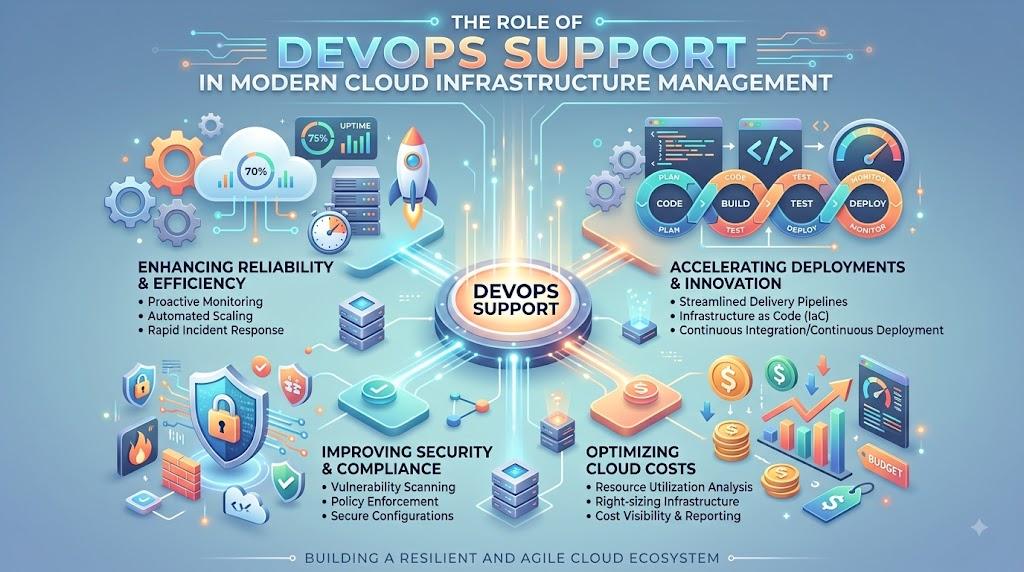
Software delivery has changed significantly as organizations have moved toward cloud infrastructure, automated releases, containers, and distributed applications. Building these environments is only one part of the job. Once applications enter production, engineering teams must continuously monitor systems, manage infrastructure changes, investigate incidents, maintain deployment pipelines, and respond to security concerns. For smaller teams, these responsibilities can quickly become difficult to balance. Developers may be interrupted by deployment failures, cloud engineers may have to investigate application-related issues, and platform teams may spend valuable time on repetitive operational tasks. This is where ongoing DevOps Support Services can provide practical value. Instead of approaching infrastructure and production problems as isolated events, organizations can establish a consistent support model for recurring operational work. Support may include cloud management, CI/CD operations, monitoring, automation, infrastructure troubleshooting, Kubernetes administration, security activities, reliability engineering, and machine-learning operations.
What Are DevOps Support Services?
DevOps support refers to ongoing technical assistance for the systems, tools, and processes involved in software delivery and production operations.
A DevOps project may initially establish automated deployments, cloud infrastructure, monitoring, containers, or Infrastructure as Code. However, once those components are used regularly, they need maintenance.
Pipelines may fail after a dependency changes. Infrastructure configurations may need modification. Monitoring rules may need adjustment. Production workloads can grow and require different resource allocations.
DevOps support addresses these ongoing requirements.
Typical areas include:
- Infrastructure management
- CI/CD maintenance
- Deployment support
- Cloud operations
- Monitoring
- Incident response
- Infrastructure as Code
- Configuration management
- Automation
- Production troubleshooting
- Performance optimization
Support can be provided across an entire environment or focused on specific technologies.
For example, an organization may have a strong internal application team but require external assistance with Kubernetes or cloud infrastructure. Another company may need broader support covering CI/CD, monitoring, infrastructure, and production incidents.
Why Organizations Need Ongoing DevOps Support
Technology environments constantly evolve. A system that is straightforward at launch can become significantly more complicated as applications, customers, infrastructure, and engineering teams grow.
New releases introduce changes. Cloud resources are added. Dependencies are upgraded. Security vulnerabilities require attention. Monitoring requirements expand. New environments are created for testing and staging.
Without consistent operational processes, these changes can lead to configuration drift, manual work, troubleshooting delays, and unclear ownership.
Internal teams can manage these responsibilities, but operational work can compete with development and engineering priorities.
External support can complement internal capabilities by handling selected recurring activities. Internal engineers can continue to own architecture, technical standards, product decisions, and strategic improvements while support engineers help with day-to-day operations.
The ideal arrangement depends on the organization’s size, technical maturity, application requirements, infrastructure complexity, and internal skills.
24/7 DevOps Support Services
Not every production system requires round-the-clock coverage, but organizations operating critical or globally distributed applications may need operational support outside standard business hours.
24/7 DevOps Support Services can include:
- Continuous monitoring
- Infrastructure alerts
- Incident investigation
- Production troubleshooting
- Deployment assistance
- Emergency response
- Escalation management
- Availability monitoring
An effective 24/7 model requires clear processes. Engineers need to understand what qualifies as a critical incident, who owns different systems, when escalation is required, and how stakeholders should be informed.
Observability is equally important. Without reliable metrics, logs, traces, and dashboards, after-hours responders may struggle to understand what is happening.
For example, a sudden increase in application latency might be caused by infrastructure resource pressure, a recent release, a database issue, networking problems, or an external dependency. Support engineers need enough visibility to investigate these possibilities.
24/7 coverage provides operational availability, but it should not be interpreted as a promise of guaranteed uptime or guaranteed resolution for every incident.
Managed DevOps Services
Managed DevOps Services typically involve an external team taking responsibility for recurring operational tasks.
This differs from traditional consulting, where an engineer may help complete a specific project and then leave.
A managed model can involve ongoing work such as:
- CI/CD operations
- Cloud administration
- Infrastructure automation
- Release management
- Monitoring
- Configuration management
- Infrastructure maintenance
- Backup-related tasks
- Security operations
- Production support
This approach can be useful when an organization has limited DevOps capacity or wants developers to spend more time on application development.
However, outsourcing operations should not mean losing internal understanding. Documentation, access control, architecture knowledge, and knowledge transfer remain important.
Companies should also define which responsibilities remain internal and which are handled externally.
Kubernetes Support Services
Kubernetes has become widely used for running containerized workloads, but managing production clusters requires specialized operational knowledge.
Kubernetes Support Services can address:
- Cluster administration
- Workload management
- Scaling
- Networking
- Resource allocation
- Monitoring
- Security
- Troubleshooting
- Upgrades
- Production optimization
Kubernetes incidents can originate from many areas. A deployment may fail because of incorrect configuration, insufficient resources, networking restrictions, storage problems, or dependency failures.
Cluster upgrades also require planning because changes to Kubernetes versions, workloads, APIs, or supporting components can introduce compatibility concerns.
Support engineers can help investigate these problems while maintaining operational processes around monitoring, resource management, security, and upgrades.
The same principles apply to managed Kubernetes environments such as AWS EKS, Azure AKS, and Google GKE.
AWS DevOps Support Services
AWS environments can include numerous infrastructure and application services. Teams may use EC2 for compute workloads, EKS or ECS for containers, Lambda for serverless applications, and Terraform or CloudFormation for infrastructure automation.
AWS DevOps Support Services can assist with operating these environments and maintaining their delivery processes.
Areas may include:
- EC2 operations
- EKS management
- ECS operations
- Lambda deployments
- Terraform
- CloudFormation
- CI/CD pipelines
- Cloud monitoring
- Infrastructure automation
- Release management
Effective AWS support requires understanding the overall architecture.
For example, troubleshooting an application deployed to EKS may involve examining Kubernetes workloads, AWS networking, infrastructure configuration, deployment pipelines, resource usage, and monitoring data.
AWS services should be selected based on workload requirements. There is no single architecture that is appropriate for every application.
Azure DevOps Support Services
Microsoft Azure environments also require ongoing operational management.
Azure DevOps Support Services may cover Azure Pipelines, AKS, Azure infrastructure, deployment automation, release processes, monitoring, and production support.
As organizations grow, they may operate multiple environments and increasingly complex deployment workflows. Maintaining consistent configuration across these environments becomes important.
Automation can reduce repetitive tasks, while monitoring helps teams understand how applications and infrastructure behave after changes.
Support can also assist with troubleshooting failed releases, managing infrastructure changes, and maintaining recurring operational tasks.
As with other cloud platforms, Azure architecture should be determined by the specific workload and organizational requirements.
DevSecOps Support Services
Security should not be treated as a final checkpoint before an application enters production.
DevSecOps Support Services help integrate security into development and operational workflows.
Common practices include:
- SAST
- DAST
- Dependency scanning
- Container security
- Secrets management
- Vulnerability management
- Secure CI/CD
- Security automation
- Compliance controls
For example, a CI/CD pipeline can include automated checks for vulnerable dependencies. Container images can be scanned before deployment. Secrets can be managed through dedicated mechanisms rather than stored directly in source repositories.
The objective is to make security part of everyday engineering activity.
The appropriate controls will vary according to application architecture, regulatory requirements, threat exposure, infrastructure, and organizational risk.
SRE Support Services
Site Reliability Engineering focuses on applying engineering practices to reliability and production operations.
SRE Support Services can include:
- Observability
- Incident management
- SLI and SLO definition
- Error-budget practices
- Capacity planning
- Performance engineering
- Reliability automation
- Root-cause analysis
SLIs provide measurable indicators of service behavior. SLOs define targets for those indicators. SLAs can represent formal service commitments, while error budgets provide a framework for balancing reliability and release velocity.
One advantage of SRE thinking is that it encourages teams to investigate recurring problems.
If an application repeatedly experiences resource exhaustion, simply restarting the service may not be enough. Engineers may need to investigate capacity, application behavior, scaling policies, architecture, or workload patterns.
This turns operational experience into engineering improvements.
MLOps Support Services
Machine-learning applications introduce another layer of operational complexity.
A model developed successfully in a development environment still needs reliable processes for deployment, monitoring, versioning, infrastructure, and production management.
MLOps Support Services can cover:
- Model deployment
- ML infrastructure
- ML pipelines
- Model monitoring
- Version management
- Production operations
- Automation
- Resource management
- Scaling
Machine-learning environments can involve models, data pipelines, compute resources, experiment tracking, deployment workflows, and multiple model versions.
MLOps brings operational discipline to this lifecycle. It connects machine-learning development with practices used in software engineering and production operations.
The right approach depends on the organization’s models, data workflows, infrastructure, and production requirements.
DevOps Support Technology Areas
| Area | Common Technologies / Practices | Primary Purpose |
|---|---|---|
| CI/CD | Jenkins, GitHub Actions, GitLab CI/CD, Azure Pipelines | Automated delivery |
| Cloud | AWS, Azure, Google Cloud | Infrastructure operations |
| Containers | Docker, Kubernetes | Application consistency |
| Infrastructure as Code | Terraform, CloudFormation | Repeatable infrastructure |
| Monitoring | Metrics, logs, traces | Operational visibility |
| Security | SAST, DAST, secrets management | Secure delivery |
| SRE | SLI, SLO, error budgets | Reliability |
| MLOps | ML pipelines, model monitoring | Production ML operations |
These technologies are examples rather than a fixed technology stack. Organizations should select tools based on architecture, existing investments, skills, integration requirements, and operational objectives.
Benefits of Continuous DevOps Support
Continuous support can help organizations improve several areas of operational work.
Faster Troubleshooting
Experienced support processes can help engineers investigate incidents using established procedures and available system information.
Reduced Manual Work
Automation can remove repetitive deployment, configuration, and infrastructure tasks.
Better Visibility
Monitoring, metrics, logs, and traces can provide a clearer picture of system health.
Consistent Delivery
Standardized CI/CD processes can reduce differences between release activities.
Organized Incident Response
Defined escalation paths can make production response more structured.
Stronger Security
Security practices can become part of regular development and deployment processes.
Better Cloud Operations
Ongoing attention can help teams manage infrastructure changes as workloads evolve.
The results depend on the quality of the implementation. Support alone cannot compensate for poor documentation, inadequate monitoring, unclear ownership, or weak operational processes.
Common DevOps Support Challenges
1. Poor Documentation
When architecture and operational procedures are not documented, troubleshooting often depends on individual knowledge.
2. Unclear Ownership
Teams need to know who is responsible for each important system and service.
3. Weak Escalation Procedures
Critical incidents require clear rules for escalation and communication.
4. Limited Observability
Missing or incomplete monitoring makes it harder to understand production problems.
5. Excessive Manual Operations
Frequent manual changes can increase the risk of mistakes.
6. Configuration Drift
Differences between environments can cause failures that are difficult to reproduce.
7. Communication Gaps
Internal and external teams need clear processes for incidents and infrastructure changes.
8. Poor Knowledge Transfer
Operational knowledge should be shared rather than remaining with one engineer or provider.
9. External Dependency
Organizations should avoid becoming unable to operate their own systems without an external team.
10. Weak Security Processes
Security responsibilities should be integrated into normal engineering and operational ownership.
How to Choose a DevOps Support Company
A provider should be evaluated according to actual operational requirements rather than simply the number of technologies listed on a website.
Important considerations include:
- Cloud platform expertise
- Kubernetes knowledge
- CI/CD experience
- Infrastructure as Code
- Security capabilities
- SRE practices
- MLOps expertise where relevant
- Monitoring and observability
- Incident response
- Documentation
- Communication
- Support coverage
- Escalation procedures
- SLA structure
- Knowledge transfer
- Security practices
- Ability to work with internal teams
It is useful to understand the provider’s onboarding process as well. Ask how existing infrastructure is assessed, how documentation is created, how access is controlled, how incidents are categorized, and how technical knowledge will be shared.
A support arrangement works best when internal and external teams have clearly defined responsibilities.
DevOps Support Area and Business Need
| Support Area | Typical Business Need |
| DevOps Support | Ongoing infrastructure and delivery assistance |
| 24/7 DevOps Support | Continuous monitoring and incident response |
| Managed DevOps | Reduce recurring operational workload |
| Kubernetes Support | Manage containerized production environments |
| AWS DevOps Support | Support AWS infrastructure and deployments |
| Azure DevOps Support | Manage Azure-based DevOps operations |
| DevSecOps Support | Integrate security into delivery and operations |
| SRE Support | Improve reliability and operational practices |
| MLOps Support | Operate ML systems in production |
Frequently Asked Questions
1. What are DevOps Support Services?
DevOps Support Services provide ongoing assistance with infrastructure, cloud operations, CI/CD, monitoring, automation, deployments, troubleshooting, and production systems.
2. Why do companies require ongoing DevOps support?
Production infrastructure continuously changes. Ongoing support helps teams handle infrastructure updates, deployments, incidents, monitoring, security work, and recurring operational responsibilities.
3. What can 24/7 DevOps Support Services include?
They can involve continuous monitoring, alert investigation, incident response, production troubleshooting, deployment assistance, and escalation procedures.
4. What is the difference between managed DevOps and standard DevOps support?
Managed DevOps generally covers a broader set of recurring responsibilities, while standard support may focus on particular systems, technologies, or operational problems.
5. When can Kubernetes support be useful?
Kubernetes support can help organizations operating production clusters that need assistance with administration, scaling, security, networking, monitoring, upgrades, or troubleshooting.
6. What does AWS DevOps support involve?
AWS support can include EC2, EKS, ECS, Lambda, Terraform, CloudFormation, CI/CD, monitoring, infrastructure automation, and deployment management.
7. How does DevSecOps support improve software security?
It incorporates security checks and practices such as SAST, DAST, dependency scanning, container security, secrets management, and vulnerability management into engineering workflows.
8. Why are SRE and MLOps support important?
SRE focuses on reliability, observability, incidents, and capacity. MLOps supports the operational lifecycle of machine-learning systems, including infrastructure, pipelines, deployment, monitoring, and version management.
Conclusion
Modern production environments are made up of many connected systems. Cloud infrastructure, CI/CD, containers, monitoring, security, reliability practices, and machine-learning platforms all require ongoing attention. As these environments become more sophisticated, operational responsibilities can place significant pressure on internal engineering teams. A suitable DevOps support model can provide additional technical capacity for recurring operational work while allowing internal teams to concentrate on application development, architecture, and strategic improvements. Organizations can choose broad managed operations or focused assistance in areas such as Kubernetes, cloud platforms, DevSecOps, SRE, and MLOps. The decision should be based on actual needs rather than the number of services a provider offers. Infrastructure complexity, technical maturity, internal expertise, security requirements, business priorities, operational coverage, and long-term objectives should all be considered.