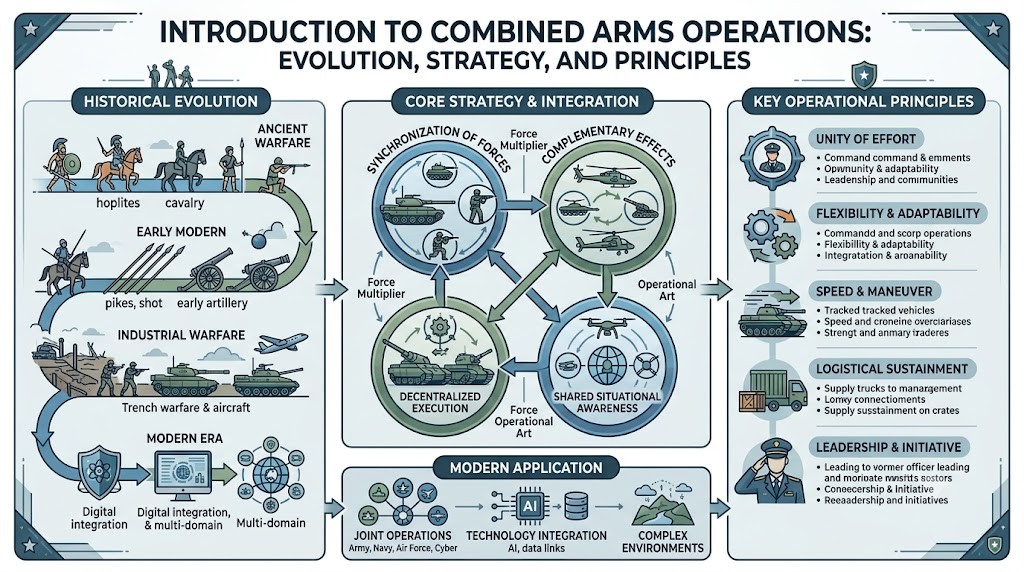
Introduction
In the study of military strategy, defense organization, and national security, few concepts are as foundational or enduring as Combined Arms Operations. Modern strategic success rarely depends on a single weapon system, elite unit, or isolated military branch. Instead, it relies on the synchronized integration of diverse organizational capabilities—ranging from land armor and infantry to artillery, air combat support, maritime assets, and digital communication networks. For students of defense studies, researchers, public policy analysts, and leadership professionals, understanding how these distinct elements operate in harmony provides critical insight into how complex organizations manage risk, achieve operational goals, and maintain readiness. You can explore deeper educational resources and curriculum guides across military history and strategic studies at WarOpsX.com.
What Are Combined Arms Operations?
At its core, Combined Arms is an operational approach that integrates different combat arms, military branches, and support functions simultaneously or in close sequence so that their capabilities complement one another.
The primary goal of combined arms is to create a tactical and strategic dilemma for an adversary. When different arms work in unison, the action an opponent takes to protect themselves from one capability automatically exposes them to another.
                                 +--------------------------------+
                                 |  SYNCHRONIZED COMMAND & C2     |
                                 +---------------+----------------+
                                                 |
                   +-----------------------------+-----------------------------+
                   |                             |                             |
     +-------------v-------------+ +-------------v-------------+ +-------------v-------------+
     |     GROUND MOBILITY       | |    INDIRECT FIRE / AIR    | |  LOGISTICS & COMMUNICAT.  |
     | (Armor & Mechanized Inf.) | |  (Artillery, CAS, Recon)  | |  (Sustainment, Signals)   |
     +-------------+-------------+ +-------------+-------------+ +-------------+-------------+
                   |                             |                             |
                   +-----------------------------+-----------------------------+
                                                 |
                                 +---------------+----------------+
                                 |     COMPLEMENTARY EFFECT       |
                                 |   (Adversary Dilemma &       |
                                 |    Operational Synergy)        |
                                 +--------------------------------+
Key Characteristics of Combined Arms
- Complementary Synergy: The total operational effect is significantly greater than the sum of its individual parts used independently.
- Simultaneous Application: Forces act together within shared space and time to overload an opponent’s decision-making process.
- Cross-Functional Protection: Vulnerabilities inherent to one branch (e.g., foot infantry lacking heavy armor) are compensated for by the strengths of another (e.g., armored tanks or overhead air support).
Historical Evolution of Combined Arms
The concept of combining different weapons and combat roles is not new; it has evolved over thousands of years alongside advancements in metallurgy, gunpowder, mechanical engineering, and digital technology.
Ancient and Classical Era
In antiquity, commanders learned that specialized infantry required support from lighter, more mobile units. Greek hoplite formations relied on light-armored skirmishers (psiloi) to disrupt enemy archers. Philip II of Macedon and Alexander the Great refined early combined arms by pairing the heavy phalanx with shock cavalry (Companion Cavalry) and mobile archers, creating a hammer-and-anvil effect on the battlefield.
Medieval to Early Modern Transition
During the Middle Ages, heavy cavalry dominated Western European warfare until longbowmen and pike formations exposed the limits of unsupported armor. By the late 15th and 16th centuries, the introduction of firearms produced the Pike and Shot formation, most famously deployed by the Spanish Tercio. Long pikes protected musketeers while reload times were slow, and firearms kept enemy infantry from closing in.
Industrial Warfare and World War I
The introduction of rifled artillery, machine guns, and trench systems during World War I rendered traditional linear tactics obsolete. By 1917–1918, military planners developed modern combined arms doctrines. Artillery barrages were carefully timed alongside infantry advances, while early tanks provided mobile cover and aircraft gathered aerial intelligence.
World War II and the Mechanized Age
World War II marked the full maturity of mechanized combined arms. Formations integrated fast-moving armor, motorized infantry, close air support, and mobile field artillery into unified operational structures. Communications technology, specifically two-way tactical radio, enabled decentralized command and real-time coordination across hundreds of miles.
Timeline of Combined Arms Milestones
+---------------------------------------------------------------------------------------------------+
| ANCIENT PERIOD       | MEDIEVAL & RENAISSANCE | INDUSTRIAL WARFARE     | MODERN & MULTI-DOMAIN    |
| Macedonian Phalanx & | Pike and Shot          | World War I            | 21st Century             |
| Companion Cavalry    | (Spanish Tercio)       | Synchronization        | Air-Land-Sea-Space-Cyber |
+---------------------------------------------------------------------------------------------------+
| Focus: Infantry +    | Focus: Firearm reload  | Focus: Artillery,      | Focus: Data networks, AI,|
| Mobile Shock Units   | protection via pikes   | Armor, & Infantry      | and Joint Integration    |
+---------------------------------------------------------------------------------------------------+
Why Combined Arms Operations Matter
In national security and defense studies, understanding combined arms is essential because modern security challenges are inherently complex. No single defense domain or technology holds a monopoly on operational success.
- Mitigation of Systemic Vulnerabilities: Tanks operating in dense urban environments without infantry support are highly vulnerable to short-range anti-tank weapons. Conversely, light infantry operating in open terrain without armored cover or air defense are vulnerable to heavy artillery. Combined arms closes these critical operational gaps.
- Resource Efficiency and Preservation: By coordinating reconnaissance, fire support, and maneuver capabilities, military forces can achieve objectives faster while preserving personnel and equipment.
- Strategic Flexibility: A combined arms structure allows leaders to shift approaches dynamically based on terrain, weather, and adversary posture.
Combined Arms vs. Supporting Arms
To understand combined arms fully, researchers must distinguish it from Supporting Arms. While both involve multiple functional branches, their operational relationship and execution differ fundamentally.
| Feature | Combined Arms Operations | Supporting Arms Operations |
| Operational Synergy | Simultaneous and complementary integration. | Sequential or auxiliary support. |
| Adversary Effect | Creates a dual dilemma where defending against one arm increases vulnerability to another. | Focuses on assisting a primary arm without necessarily creating a compound dilemma. |
| Command Structure | Unified multi-branch tactical and operational command. | Primary unit retains command; supporting units execute assigned tasks. |
| Integration Level | Deep organic integration down to small unit levels. | Task-based attachment or temporary assignment. |
| Example | Tanks and infantry advancing simultaneously under organic artillery and smoke screens. | Artillery firing a pre-planned bombardment prior to an isolated infantry movement. |
Combined Arms vs. Multi-Domain Operations
As defense concepts evolve, the traditional focus on land, sea, and air has expanded to include space, cyberspace, and the information spectrum. This expanded framework is known as Multi-Domain Operations (MDO).
| Dimension | Combined Arms Operations | Multi-Domain Operations (MDO) |
| Primary Scope | Traditional physical domains (Land, Sea, Air). | All physical and non-physical domains (Land, Sea, Air, Space, Cyber, Information). |
| Primary Focus | Tactical and operational battlefield synchronization. | Strategic, operational, and nation-state level integration across peace and conflict. |
| Key Enabler | Mechanized transport, organic fires, and radio communications. | High-speed data networks, satellite links, artificial intelligence, and cyber capabilities. |
| Organizational Goal | Overload local tactical defenses. | Disrupt adversary command networks and decision-making across global theaters. |
Core Principles of Combined Arms Operations
Effective combined arms operations depend on several established organizational and doctrinal principles:
1. Synchronization
Synchronization is the arrangement of actions in time, space, and purpose to produce maximum relative effect at a decisive point. It requires precise planning so that artillery, air support, armor, and logistics arrive exactly when needed.
2. Complementary Capabilities
Each military function has unique strengths and inherent weaknesses. Combined arms arranges forces so that the strength of one element covers the limitation of another.
3. Flexibility and Adaptability
Plans rarely unfold exactly as written. Organizations must possess the structural agility to reassign units, shift fire support, or alter supply routes on short notice.
4. Decentralized Execution (Mission Command)
Because modern operating environments are chaotic, high-level commanders establish clear intent while delegating decision-making authority to subordinate leaders on the ground. This practice enables rapid responses to changing conditions without waiting for centralized approval.
Integration of Different Military Capabilities
To illustrate how combined arms works conceptually, consider the operational roles played by major functional branches:
+-----------------------------------------------------------------------------------+
|                          COMBINED ARMS INTEGRATION MODEL                          |
+-----------------------------------------------------------------------------------+
|  ARMOR / MOBILITY       <--->  INDEPENDENT RECONNAISSANCE & ISR                    |
|  Direct fire & shock           Aerial drones, satellite imagery, ground scouts    |
+-----------------------------------------------------------------------------------+
|  INFANTRY               <--->  INDIRECT FIRE SUPPORT                              |
|  Terrain acquisition           Field artillery, mortar batteries, naval guns      |
+-----------------------------------------------------------------------------------+
|  ENGINEERS & LOGISTICS  <--->  COMBAT AIR SUPPORT & AIR DEFENSE                   |
|  Obstacle clearing & supply    Fixed-wing strikes & air dominance protections     |
+-----------------------------------------------------------------------------------+
- Infantry: Secures ground, clears complex terrain (such as forests and cities), and holds key positions.
- Armor: Provides mobile, protected direct-fire firepower and rapid movement across open terrain.
- Artillery and Indirect Fire: Delivers long-range fire support to suppress or disrupt enemy positions before maneuver elements arrive.
- Aviation and Air Support: Offers broad-area reconnaissance, aerial transport, close air support, and interdiction.
- Combat Engineers: Clears obstacles, constructs bridge crossings, lays defensive positions, and ensures force mobility.
Leadership, Coordination, and Decision-Making
Executing a combined arms strategy demands exceptional organizational leadership. Commanders and staff officers must understand not only their own primary branch, but also the operational capabilities, logistical constraints, and communication protocols of every supporting unit.
Strategic Decision-Making Frameworks
- Situational Awareness: Establishing a clear, unified operational picture across all participating branches.
- Unity of Effort: Ensuring all sub-units work toward a single overarching strategic objective despite differences in branch culture or training.
- Risk Management: Balancing the speed of an advance against the potential for overextension or logistical breakdown.
Logistics and Sustainment
Logistics is the backbone of combined arms. Without continuous sustainment, even the most sophisticated combat force quickly grinds to a halt.
+-----------------------------------------------------------------------+
|                       THE SUSTAINMENT TRIAD                           |
+-----------------------------------+-----------------------------------+
| FUEL & ENERGY MANAGEMENT          | AMMUNITION & MUNITIONS SUPPLY     |
| Continuous supply lines for       | Precision distribution across     |
| armored and transport fleets      | artillery, armor, and small arms  |
+-----------------------------------+-----------------------------------+
| MAINTENANCE & MEDICAL RECOVERY    | INFRASTRUCTURE & REPAIR           |
| Rapid repair of combat equipment  | Rapid engineering of bridges,     |
| and field medical evacuation      | supply roads, and airfields       |
+-----------------------------------+-----------------------------------+
A mechanized combined arms force consumes immense quantities of fuel, ammunition, spare parts, medical supplies, and food. Logistics officers must plan distribution networks that keep pace with fast-moving forward units while protecting supply lines against disruption.
Communication and Information Sharing
Effective coordination requires interoperable communication networks. Historically, armies relied on line-of-sight signals, runners, or basic telegraphs. Today, digital command networks rely on encrypted radio links, satellite relays, and real-time data feeds.
Common Operational Picture (COP)
A central goal of modern defense communications is providing all commanders with a Common Operational Picture (COP). When air support, ground commanders, and supply depots share identical, real-time map data, the risk of miscommunication or friendly-fire incidents drops significantly, while operational speed increases.
Role of Technology in Modern Combined Arms Operations
Technology acts as a major force multiplier in modern combined arms. Advanced sensors, unmanned aerial vehicles (UAVs), precision-guided munitions, and satellite navigation have dramatically shortened the time between detecting a challenge and executing a response.
                                  +-----------------------+
                                  |  SATELLITE / UAV ISR  |
                                  +-----------+-----------+
                                              |
                                              v
+-----------------------+         +-----------------------+         +-----------------------+
| DIGITAL COMMAND POST  |  <--->  | REAL-TIME DATA NETWORK |  <--->  | FORWARD COMBAT UNITS  |
+-----------------------+         +-----------+-----------+         +-----------------------+
                                              |
                                              v
                                  +-----------------------+
                                  | LOGISTIC SUSTAINMENT  |
                                  +-----------------------+
Unmanned systems serve as airborne eyes for ground units, identifying terrain features and obstacles without exposing personnel to unnecessary risk. Simultaneously, digital targeting systems allow field artillery or naval units to deliver precise support within moments of a request.
Artificial Intelligence and Data Analytics in Defense Planning
Artificial Intelligence (AI) and high-performance data analytics are transforming strategic planning and operational readiness.
- Predictive Logistics: AI models analyze usage patterns across vehicles and equipment to predict mechanical failures before they happen, ensuring supply chains deliver parts proactively.
- Automated Data Processing: Modern intelligence systems process thousands of satellite images, radar signals, and communication feeds per minute, highlighting key structural changes for human analysts.
- Operational Simulation: Strategic planners use machine learning algorithms to simulate complex movement scenarios, evaluating logistics bottlenecks under varying weather and terrain conditions.
Combined Arms in Humanitarian Assistance and Disaster Response
While combined arms concepts originated in military history, their underlying organizational structures are widely applied in non-combat operations, such as Humanitarian Assistance and Disaster Response (HADR).
During major natural disasters—such as earthquakes, floods, or hurricanes—governments deploy military assets to work alongside civilian emergency agencies. The organizational mechanics mirror combined arms coordination:
- Heavy Engineering: Clearing road debris, building temporary bridges, and restoring critical infrastructure.
- Aviation & Logistics: Delivering food, medical supplies, and clean water to isolated communities via heavy-lift helicopters.
- Medical Units: Establishing field hospitals and managing emergency triage operations.
- Communications Infrastructure: Setting up mobile satellite communication centers to link civilian first responders with state planners.
Historical Examples of Combined Arms Operations
Analyzing documented historical events illustrates how combined arms principles work in practice.
1. The Battle of Amiens (1918)
During World War I, Allied forces conducted a combined arms operation at Amiens. The strategy synchronized over 500 tanks, thousands of field artillery pieces, infantry formations, and RAF tactical aircraft. Rather than launching prolonged preliminary artillery bombardments that eliminated the element of surprise, short, precise barrages were paired directly with armored advances, breaking through years of trench stalemate.
2. The Battle of Normandy and the Bocage Breakout (1944)
Following the D-Day landings in World War II, Allied forces encountered dense hedgerow terrain (bocage) in northern France. Standard infantry advances suffered heavy casualties from hidden defensive positions. Commanders adapted by forming ad-hoc combined arms teams: tanks were retrofitted with hedgerow cutters, infantry guarded the tanks against short-range anti-tank fire, and field artillery was directed by forward observers operating alongside small units.
3. Operation Desert Storm (1991)
Operation Desert Storm demonstrated large-scale modern joint combined arms synchronization. A five-week strategic air campaign dismantled command infrastructure, followed by a 100-hour ground maneuver that coordinated armored divisions, airmobile infantry, marine landing forces, and continuous naval missile strikes.
Benefits and Limitations
While combined arms is a highly effective operational framework, it comes with distinct advantages and inherent trade-offs.
Benefits
- High Operational Synergy: Maximizes the performance of individual branches.
- Enhanced Force Protection: Reduces casualties by ensuring units are not left unsupported against specialized threats.
- Multi-Layered Flexibility: Provides leaders with multiple operational options to address unexpected obstacles.
Limitations
- High Organizational Complexity: Requires extensive training, standardized doctrine, and constant inter-branch practice.
- Heavy Logistical Footprint: Requires vast amounts of fuel, spare parts, and ammunition, making supply lines vulnerable.
- Communication Vulnerabilities: Highly dependent on digital and radio networks; disruption to communications can lead to confusion or friction.
Common Challenges in Large-Scale Coordination
Coordinating multi-branch operations across large geographic areas involves significant friction points:
- Interoperability Deficits: Communication hardware or software used by one branch may not natively interface with systems used by another branch.
- Cultural and Organizational Silos: Different branches often possess distinct institutional cultures, jargon, and operational habits, which can complicate joint planning.
- Logistical Chokepoints: Navigating mountain passes, river crossings, or damaged ports can bottleneck large, multi-branch forces.
- Information Overload: Modern commanders receive immense volumes of sensor data; filtering signal from noise remains an ongoing operational challenge.
Leadership Lessons from Combined Arms Operations
The principles that govern combined arms provide valuable management and organizational lessons for civilian executives, public policy leaders, and strategic planners:
- Break Down Operational Silos: Specialized teams (e.g., marketing, engineering, finance) must communicate continuously to avoid working at cross-purposes.
- Empower Subordinate Decision-Making: Like Mission Command in defense doctrine, organizational leaders should provide clear strategic intent while trusting team leaders to adapt execution to local realities.
- Invest in Interoperability: Ensure systems, tools, and processes across different departments use common standards and data structures.
- Prioritize Sustainment: Innovative strategies fail if the organization lacks the underlying logistics, budget, or operational infrastructure to sustain them.
Future Trends in Defense Integration
Looking ahead, defense studies researchers track several emerging trends shaping the future of combined arms:
- Human-Machine Teaming: Integrating autonomous ground and aerial systems alongside human-crewed vehicles to conduct high-risk reconnaissance and transport tasks.
- Cross-Domain Sensor-to-Shooter Networks: Connecting sensors across space, air, sea, and land into automated data networks to reduce decision cycle times.
- Cyber and Electromagnetic Spectrum Synergy: Incorporating electronic warfare and cyber defenses directly into small-unit combined arms doctrines.
- Resilient Supply Architectures: Developing distributed, additive-manufacturing (3D printing) supply models to maintain logistics in contested environments.
Career Opportunities in Defense Studies and Strategic Planning
For students and professionals interested in national security, military history, and organizational management, this field offers diverse career paths across public and private sectors:
- Defense Analyst: Researching force structures, policy frameworks, and geopolitical developments for research institutions or government agencies.
- Strategic Planner: Designing organizational readiness models, disaster preparedness plans, and risk management strategies.
- Military Historian / Educator: Teaching defense history, operational concepts, and security studies at academic institutions or policy centers.
- Logistics and Supply Chain Consultant: Applying defense sustainment models to commercial supply networks and crisis response organizations.
- Defense Technology Strategist: Evaluating how artificial intelligence, autonomous systems, and digital networks integrate into existing operational frameworks.
Frequently Asked Questions
What is the simple definition of combined arms operations?
Combined arms operations refer to the synchronized integration of different military capabilities—such as infantry, armor, artillery, and air support—so that they work together to achieve complementary effects greater than if used separately.
How does combined arms differ from joint operations?
Combined arms typically focuses on integrating different combat functions or branches (such as armor, infantry, and field artillery) at tactical and operational levels. Joint operations refer to high-level coordination between distinct military service branches, such as the Army, Navy, Air Force, and Space Force.
Why is synchronization so important in combined arms?
Synchronization ensures that different combat capabilities and support functions arrive at the exact time and location needed. Without synchronization, individual units risk operating in isolation, making them far more vulnerable to opposing forces.
When did combined arms operations first emerge in history?
Basic forms of combined arms date back to ancient warfare, where commanders paired heavy infantry with skirmishers and cavalry. However, modern combined arms doctrine emerged during World War I to overcome trench warfare stalemates.
What is the role of logistics in combined arms operations?
Logistics ensures that fast-moving, multi-branch forces continuously receive fuel, ammunition, equipment maintenance, and medical support. Without robust sustainment, multi-capability operations cannot maintain operational momentum.
How does technology impact modern combined arms operations?
Modern technology—such as satellite navigation, unmanned drones, encrypted digital radios, and data analytics—enables real-time communication and situational awareness across land, sea, air, and cyber domains.
Can combined arms concepts be used in non-military scenarios?
Yes. The coordination principles of combined arms are widely used in civilian crisis management, such as Humanitarian Assistance and Disaster Response (HADR), where logistics, engineering, medical support, and aviation must be synchronized.
What is the main difference between combined arms and supporting arms?
Combined arms integrates capabilities simultaneously to create a mutual dilemma for an opponent. Supporting arms involves one branch assisting another in a secondary or sequential role without creating simultaneous complementary dilemmas.
How does Artificial Intelligence contribute to combined arms planning?
Artificial Intelligence helps analyze complex sensor data, models logistical supply requirements, optimizes resource allocation, and assists strategic planners in anticipating system maintenance needs.
What skills are necessary for a career in strategic planning and defense studies?
Key skills include analytical thinking, historical research, understanding organizational dynamics, knowledge of supply chain logistics, communication, and strategic risk management.
Conclusion
Combined arms operations represent one of the most significant developments in the history of strategic planning and military doctrine. By synchronizing diverse capabilities—ranging from infantry and armor to air power, logistical sustainment, and digital networks—organizations build resilience, mitigate individual vulnerabilities, and achieve complex goals. As defense environments evolve to encompass space, cyberspace, and artificial intelligence, the fundamental principles of combined arms—synchronization, mutual support, decentralized leadership, and sound logistics—remain as relevant as ever. Whether applied on historical battlefields, modern multi-domain defense frameworks, or civilian disaster relief efforts, the ability to harmonize distinct strengths into a unified whole remains a defining benchmark of organizational excellence.