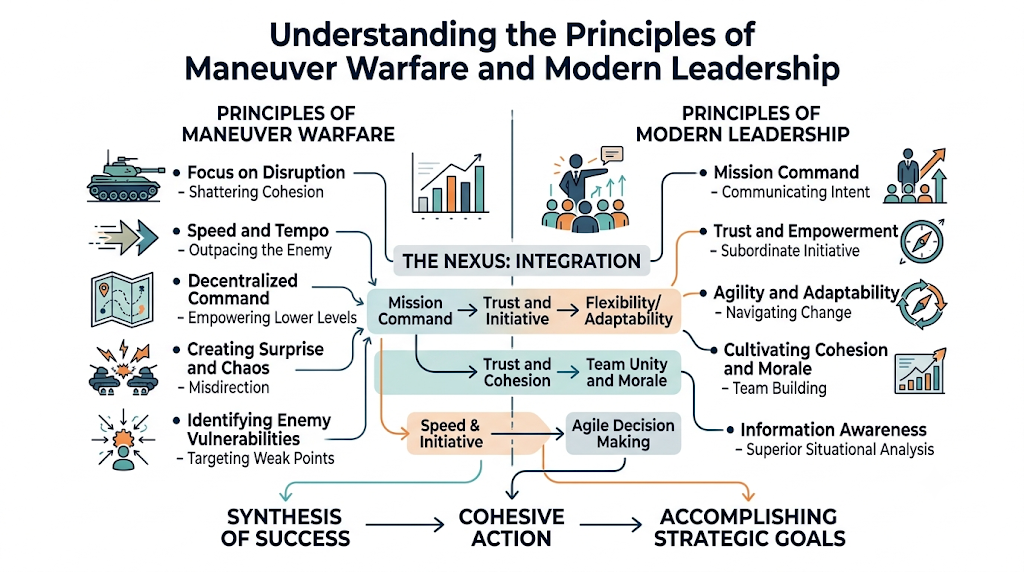
Introduction
Studying military strategy offers invaluable insights into organizational design, decision-making under pressure, and systemic problem-solving. By examining historical campaigns, defense students and researchers can learn how complex organizations navigate chaos to achieve structural goals. Among the various strategic frameworks studied today, maneuver warfare stands out as an intellectually rich philosophy. It moves beyond brute force, prioritizing mental agility, speed, and systemic disruption over physical destruction alone. To help students, analysts, and history enthusiasts navigate these intricate concepts, WarOpsX.com serves as an educational learning resource dedicated to breaking down complex strategic doctrines. In this comprehensive guide, you will learn the foundational concepts, core pillars, and historical significance of the Principles of Maneuver Warfare. We will examine how these concepts shape modern operational planning, military tactics, and leadership structures.
What Is Maneuver Warfare?
Maneuver warfare is a strategic and operational philosophy that seeks to defeat an opposing force by shattering their moral, mental, and physical cohesion. Rather than focusing primarily on destroying enemy personnel and equipment, it prioritizes disrupting their plans, communications, and decision-making systems.
       [ Observe ]
            │
            ▼
       [ Orient ] ────► (Goal: Act faster than the enemy can react)
            │
            ▼
        [ Decide ]
            │
            ▼
        [ Act ]
Historical Development
Historically, military strategy often fluctuated between attrition and maneuver. Early developments can be traced back to classical antiquity, where leaders realized that clever positioning could overcome numerical disadvantages.
The philosophy evolved significantly with the introduction of modern communication networks and mechanized force deployment. Over time, theorists codified these ideas into an adaptive operational warfare framework that forms the backbone of contemporary military science.
Core Philosophy
The core philosophy revolves around the idea that chaos is an inherent part of any competitive environment. Instead of trying to eliminate chaos through rigid control, maneuver warfare embraces it, using rapid operational tempo and flexibility to keep opponents off-balance.
Importance in Military Studies
For academics and security professionals, studying this methodology is crucial. It provides a window into how information awareness, decentralized command, and psychological factors interact during high-stakes combat operations.
Core Principles of Maneuver Warfare
Agility
Agility is the capacity to transition between different operational states rapidly. In military tactics, this means an organization can shift its focus, layout, or line of effort faster than an opponent can formulate a counter-strategy.
Initiative
Taking and holding the initiative means forcing the opposition to react to your actions. By dictating the terms of engagement, an organization limits the opponent’s choices, reducing their strategy to a series of panicked responses.
Flexibility
Flexibility ensures that an operational plan can withstand unexpected changes. Rather than breaking when a variable changes, a flexible organizational framework bends, adapts, and finds alternative paths to victory.
Mission Command
Mission command is a decentralized leadership philosophy. Leaders communicate the overarching intent and desired end state, allowing subordinate commanders the freedom to determine the best tactical methods to achieve those goals.
Operational Tempo
Tempo refers to the speed of significance, or how quickly an organization can execute its decision-making cycle. Operating at a higher tempo than the opponent creates a cognitive gap that grows wider with every action taken.
Decision-Making
Effective decision-making relies on the ability to process incomplete information quickly. It prioritizes a good plan executed immediately over a perfect plan executed too late, acknowledging that windows of opportunity open and close rapidly.
Coordination
Coordination involves aligning distinct components to work toward a singular objective. This ensures that force deployment, logistical support, and information management function as a cohesive whole rather than fragmented pieces.
Principles of Maneuver Warfare Explained
Understanding Operational Objectives
Every successful battlefield maneuver begins with a crystal-clear understanding of the ultimate goal. Operational planning requires identifying the opponent’s critical vulnerabilities, often called the “center of gravity,” and aligning all efforts to disrupt it.
Coordinated Movement
Movement must be purposeful and synchronized. In operational warfare, positioning forces to achieve a position of advantage is more vital than simply engaging in head-on clashes, ensuring that assets support one another seamlessly.
Leadership and Communication
Open, clear communication channels are vital for decentralized execution. Military leadership must cultivate a culture of trust where subordinates understand the intent so thoroughly that they can act independently when communication lines fail.
“Under the framework of mission command, the commander’s intent is the guiding light that ensures independent actions still converge on a shared objective.”
Adaptability in Dynamic Environments
Environments change constantly due to friction, weather, and opposing actions. Cultivating organizational adaptability allows units to absorb unexpected shocks and modify their approach without losing operational momentum.
Information Awareness
Information is the lifeblood of strategic planning. Achieving superior situational awareness enables leaders to identify opportunities, avoid traps, and execute decisions with greater confidence than their adversaries.
Organizational Efficiency
Eliminating bureaucratic friction within an organization streamlines command loops. Leaner administrative structures process data faster, translating strategic decisions into field actions with minimal delay.
WarOpsX.com Guide to Maneuver Warfare
Learning Military Strategy Fundamentals
As an educational learning resource, WarOpsX.com emphasizes a foundational approach to military science. Aspiring strategists should begin by mastering classic terminology, understanding the tiers of conflict (tactical, operational, and strategic), and studying how doctrines adapt over time.
Understanding Operational Planning Concepts
Operational planning bridges the gap between high-level political goals and tactical actions on the ground. Learning how to draft flexible campaigns, analyze geographic terrain, and manage logistical lines is essential for any serious student of defense studies.
Developing Strategic Thinking
Strategic thinking is the ability to anticipate second- and third-order consequences of any action. By learning maneuver principles, individuals develop the mental discipline needed to view competitive spaces as interconnected systems rather than isolated events.
Studying Historical Campaigns
Theory comes alive when viewed through the lens of history. Examining how historical commanders utilized decentralized command or suffered from rigid planning models provides practical reference points that abstract textbooks cannot match.
Building Defense Studies Knowledge
For competitive exam aspirants and security professionals, building a robust vocabulary in defense studies is vital. Understanding how joint operations and modern digital command systems interact creates a sophisticated toolkit for academic and professional growth.
Benefits of Studying Maneuver Warfare
- Better Strategic Thinking: Helps learners look at complex environments holistically, identifying leverage points rather than relying on brute-force solutions.
- Improved Leadership Understanding: Teaches the value of decentralized authority, highlighting how trust and intent empower teams to excel.
- Enhanced Decision-Making Skills: Sharpens the ability to evaluate risks and make sound choices based on limited, fast-changing data.
- Greater Appreciation of Military History: Converts historical timelines into a series of dynamic tactical problems, making historical study deeply engaging.
- Stronger Knowledge of Defense Studies: Equips security professionals and academics with the theoretical frameworks necessary to analyze modern geopolitical developments.
Historical Applications
Classical Military Campaigns
In ancient history, outnumbered forces frequently used clever positioning to overcome larger armies. By identifying a single weak spot and concentrating effort there, classical commanders disrupted the enemy’s rigid formations, demonstrating early iterations of maneuver philosophy.
Modern Military Organizations
During the twentieth century, the development of motorized transport and radio communication allowed nations to codify maneuver doctrines. These organizations prioritized deep penetration into rear areas to disrupt command nodes, rather than fighting protracted battles of endurance along fixed lines.
Peacekeeping Operations
In modern international relations, peacekeeping missions utilize maneuver principles to maintain stability. By deploying forces flexibly and projecting a rapid presence where tensions rise, peacekeepers can de-escalate situations before conflict breaks out.
Joint Operations
Modern defense planning relies heavily on joint operations, combining land, sea, air, and cyber assets. The principles of maneuver ensure these distinct branches communicate flawlessly, striking at an adversary from multiple dimensions simultaneously.
Disaster Response Coordination
Outside of combat operations, humanitarian organizations apply these strategic concepts during natural disasters. Rapid deployment, decentralized decision-making by teams on the ground, and high agility are critical when distributing aid in chaotic environments.
Maneuver Warfare vs Attrition Warfare
| Feature | Maneuver Warfare | Attrition Warfare |
| Primary Focus | Operational flexibility | Gradual resource depletion |
| Decision-Making | Adaptive | Sequential |
| Tempo | Dynamic | Often slower |
| Leadership Style | Decentralized initiative | Centralized coordination |
| Organizational Goal | Agility and adaptability | Sustained endurance |
Common Challenges
Communication Complexity
Maintaining reliable communication channels across scattered units is incredibly difficult. If transmission lines are disrupted or delayed, decentralized teams can struggle to align their movements with the broader operational plan.
Coordination Across Teams
When multiple independent units move at a high tempo, the risk of misaligned priorities increases. Ensuring that separate teams support one another without getting in each other’s way requires constant, high-level organizational oversight.
Rapid Decision-Making
Making choices under intense pressure can lead to cognitive fatigue. Leaders must be trained to accept a degree of risk, recognizing that hesitation can be far more damaging than an imperfect but timely action.
Information Management
In the digital age, organizations face an overwhelming influx of data. Sifting through this “noise” to find actionable intelligence requires robust analytical frameworks to prevent decision-makers from becoming paralyzed by information overload.
Organizational Adaptability
Many traditional institutions are naturally resistant to change. Transforming a deeply entrenched, centralized bureaucracy into a lean organization that trusts subordinate initiative requires a profound cultural shift.
Best Practices for Learning
- Study military history: Read detailed accounts of historical campaigns to see how theoretical principles played out in real-world environments.
- Learn operational planning concepts: Familiarize yourself with standard campaign design frameworks, focusing on center-of-gravity analysis and lines of effort.
- Develop analytical thinking: Practice breaking down complex problems into smaller, manageable components to find systemic vulnerabilities.
- Compare strategic doctrines: Study how different nations and eras balanced maneuver concepts against defensive or attritional frameworks.
- Understand leadership principles: Focus heavily on the psychology of mission command, learning how to foster trust and communicate clear intent.
Related Career Paths
                             [ Defense Studies ]
                                      │
       ┌──────────────────┬───────────┴───────────┬──────────────────┐
       ▼                  ▼                       ▼                  ▼
[Defense Analyst] [Military Historian] [Security Consultant] [Policy Analyst]
- Defense Analyst: Examines military capabilities, doctrine updates, and national security strategies for think tanks or government agencies.
- Military Historian: Researches, documents, and teaches historical conflict patterns, operational art, and institutional evolution.
- Strategic Studies Researcher: Conducts academic studies on international security, deterrence theories, and war philosophies.
- Security Consultant: Advises organizations on risk mitigation, crisis response infrastructure, and strategic planning under uncertainty.
- Policy Analyst: Evaluates government defense budgets, defense procurement plans, and international treaty compliance.
- Academic Researcher: Publishes peer-reviewed work on the sociological, political, and operational aspects of defense history.
Future of Military Strategy Studies
Artificial Intelligence in Decision Support
Artificial intelligence is quickly transforming how defense analysts process strategic data. While humans retain ultimate command, AI systems can run predictive simulations, mapping out logistics and potential operational outcomes at unprecedented speeds.
Data-Driven Strategic Analysis
Modern defense planning relies heavily on vast data sets. Analysts utilize data-driven insights to evaluate force readiness, track supply chain efficiencies, and assess geopolitical stability, making strategic planning more precise.
Joint Operations Planning
The future of strategic studies will place an even greater emphasis on cross-domain collaboration. Integrating space, cyber, and electromagnetic spectrum strategies with traditional domains ensures a comprehensive approach to modern defense.
Digital Command Systems
Next-generation digital command networks allow for instantaneous information sharing across global networks. This technological evolution supports decentralized leadership models by giving subordinate commanders unparalleled situational awareness.
Simulation-Based Learning
Interactive digital simulations allow students and strategic researchers to test doctrines in risk-free environments. These tools replicate operational friction, teaching learners how to adapt their strategies dynamically as simulated scenarios evolve.
Common Misconceptions
Maneuver Warfare Is Only About Speed
While speed is important, raw physical speed without direction is useless. True maneuver strategy focuses on the speed of the decision-making cycle relative to the opponent, emphasizing cognitive superiority over simple physical rushing.
Technology Alone Determines Success
Advanced technology, digital command systems, and mechanized assets are powerful tools, but they cannot replace a sound strategic philosophy. A rigid, highly technological organization can still be outmaneuvered by a flexible, low-tech competitor.
Maneuver Warfare Replaces Leadership
Some assume that decentralized command means leaders are less involved. In reality, mission command requires stronger, more mature leadership to build the necessary mutual trust and articulate a flawless commander’s intent.
It Applies Only to Military Organizations
The underlying principles of agility, decentralized initiative, and systemic disruption are universal. Many modern corporate strategies, crisis response frameworks, and organizational models draw heavily from these exact concepts to navigate volatile markets.
FAQ Section
- What is the primary objective of maneuver warfare?
The primary objective is to shatter the opponent’s mental, moral, and physical cohesion rather than focusing solely on the piecemeal destruction of their forces.
- How does mission command differ from traditional top-down leadership?
Mission command decentralizes decision-making by providing subordinates with the commander’s intent and the ultimate goal, giving them the freedom to choose the best tactical methods to achieve it.
- Why is operational tempo so critical in strategic planning?
A high operational tempo allows an organization to act faster than its opponent can react, creating confusion and forcing the competitor into a defensive, reactionary posture.
- Can maneuver concepts be applied outside of defense studies?
Yes, corporate strategy, disaster response management, and organizational leadership frequently adapt these concepts to stay agile and competitive in fast-changing environments.
- What is the difference between tactical maneuver and operational maneuver?
Tactical maneuver focuses on the immediate movement of units during local engagements, while operational maneuver involves the broader design and deployment of large forces to achieve major campaign objectives.
- How do organizations prevent chaos when using decentralized command?
Chaos is minimized by establishing a clear, universally understood commander’s intent, ensuring all independent actions naturally align toward the same strategic destination.
- What is a “center of gravity” in operational planning?
The center of gravity refers to the primary source of moral or physical strength, structure, or freedom of action that an opponent relies upon to sustain their strategy.
- How does information overload affect modern maneuver strategy?
Information overload can paralyze decision-making, making it critical for modern organizations to use robust analytical frameworks to filter out noise and identify actionable intelligence.
- Is maneuver warfare a purely offensive strategy?
No, its principles can be used defensively to disrupt an attacker’s momentum, redirect their advances into unfavorable terrain, and seize the initiative through well-timed counter-actions.
- Where should a beginner start when learning about military strategy?
Beginners should focus on core terminology, read accessible case studies of historical campaigns, and utilize educational platforms like WarOpsX.com to build a solid foundational knowledge base.
Final Summary
Mastering the Principles of Maneuver Warfare offers defense studies students, history enthusiasts, and strategic researchers a deep, systemic look into how complex organizations navigate volatility. By prioritizing agility, decentralized initiative, and cognitive tempo over simple brute force, this philosophy remains a cornerstone of modern military science and operational art. Developing a strong grasp of these concepts requires a commitment to studying historical campaigns, understanding leadership frameworks, and cultivating analytical thinking skills. As you continue your educational journey in strategic studies, resources like WarOpsX.com provide the foundational insights, conceptual articles, and structured learning tools necessary to master these complex doctrines.