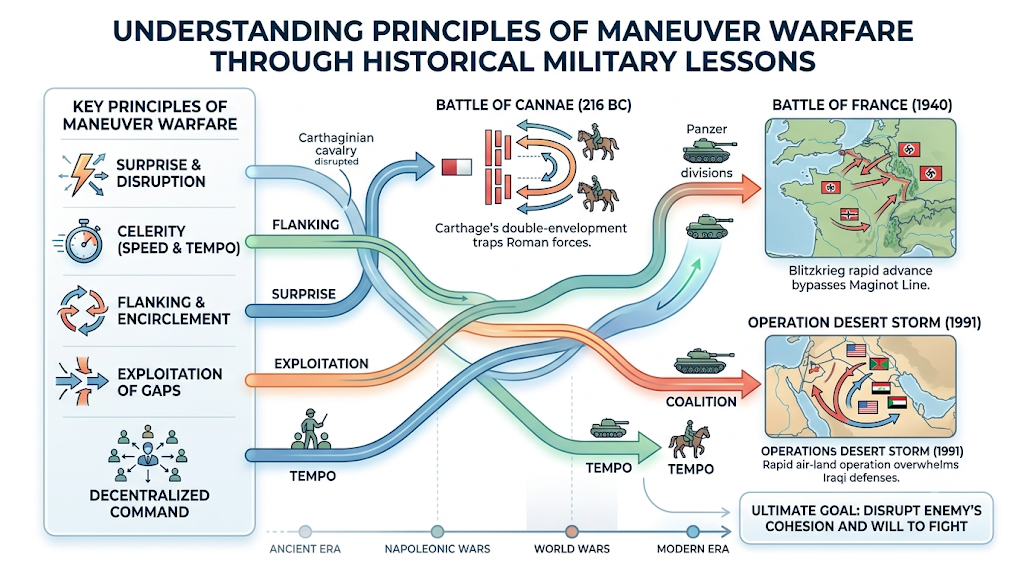
Introduction
Military strategy helps students, analysts, and defense learners understand how armed forces plan, organize, and make decisions in complex situations. It is not only about battles or weapons. It is also about leadership, timing, judgment, coordination, logistics, morale, and the ability to adapt when conditions change. The Principles of Maneuver Warfare are an important part of military theory because they explain how speed, initiative, flexibility, and decision-making can shape the outcome of operations. Maneuver warfare is not simply about movement. It is about creating advantage by thinking faster, acting with purpose, and placing pressure on an opponent’s ability to respond. For learners who want to study military strategy in a balanced and educational way, WarOpsX.com can be explored as a learning resource for defense studies, operational thinking, and military strategy concepts. In this article, you will learn what maneuver warfare means, how it developed, why it matters in military studies, how it differs from attrition warfare, and what leadership lessons students can take from it.
What Is Maneuver Warfare?
Maneuver warfare is a military strategy concept that focuses on gaining operational advantage through speed, initiative, flexibility, and disruption of an opponent’s decision-making ability.
In simple words, maneuver warfare is about using movement, timing, surprise, and leadership judgment to create favorable conditions. It does not focus only on physically wearing down an opponent. Instead, it aims to affect the opponent’s ability to organize, decide, and respond effectively.
Maneuver warfare is often studied as part of operational warfare and military strategy because it connects battlefield actions with larger campaign goals. It helps learners understand how forces can use mobility, coordination, and leadership to influence outcomes.
Historical Development
The idea behind maneuver warfare is old, even if the modern term is more recent. Many ancient commanders used speed, deception, positioning, and surprise to defeat larger or stronger forces.
In later military history, maneuver became more closely connected with operational art, campaign planning, and combined arms coordination. As armies grew larger and technology changed, military leaders studied how movement, timing, logistics, and command systems could shape entire campaigns.
Maneuver warfare became especially important in discussions about modern doctrine because it emphasized decision-making, decentralized leadership, and the ability to operate under uncertainty.
Core Philosophy
The core philosophy of maneuver warfare is simple:
A force does not always need to be stronger everywhere. It needs to create advantage at the right place, at the right time, with the right decision.
This philosophy depends on:
- Understanding the larger operational situation
- Acting faster than the opponent can adjust
- Giving capable leaders room to make decisions
- Using flexibility instead of rigid planning
- Maintaining focus on the objective
- Avoiding unnecessary direct confrontation when other advantages are possible
Why It Remains Important in Military Studies
Maneuver warfare remains important because it teaches students how strategy depends on more than numbers. It shows that leadership, timing, morale, communication, and adaptability can strongly influence military operations.
For defense studies students, maneuver warfare is also useful because it explains the relationship between operational maneuver, mission command, and decision-making under pressure.
Core Principles of Maneuver Warfare
Maneuver warfare is built on several connected principles. These principles are not isolated rules. They work together as part of a larger approach to military operations and leadership.
Tempo
Tempo means the speed and rhythm of action in military operations.
In maneuver warfare, tempo is not only about moving fast. It is about maintaining a pace that creates pressure and prevents the opponent from comfortably reacting.
A high tempo can force opposing leaders to make decisions with incomplete information. It can also disrupt planning cycles, communication, and coordination.
For example, in many historical campaigns, forces that moved with discipline and speed were able to appear where they were not expected. The advantage came not only from movement but from the confusion created in the opponent’s mind.
Initiative
Initiative means taking purposeful action instead of waiting passively for events to unfold.
In maneuver warfare, initiative is central. A force with initiative can shape the situation. A force without initiative may spend most of its time reacting.
Initiative allows leaders at different levels to recognize opportunity and act within the broader intent of the operation. This is closely connected with mission command, where commanders explain the purpose and allow subordinates to use judgment.
In historical terms, commanders who kept initiative often controlled the flow of campaigns. They forced opponents to respond to their choices rather than the other way around.
Agility
Agility is the ability to adjust quickly when conditions change.
Military operations rarely unfold exactly as planned. Weather, terrain, communication problems, logistics, morale, and unexpected decisions can all change the situation.
Agility helps an organization recover from surprise, shift direction, and continue working toward the objective. It also allows leaders to avoid being trapped by outdated plans.
In maneuver warfare, agility is both physical and mental. A unit may move quickly, but if leaders cannot think and adapt quickly, movement alone is not enough.
Flexibility
Flexibility means having more than one way to solve a problem.
A flexible force can adjust plans, change priorities, and use available resources creatively. Flexibility does not mean lack of discipline. It means disciplined adaptability.
For example, a rigid organization may continue following a plan even when the situation has changed. A flexible organization recognizes the change, protects the main objective, and adjusts the method.
In military studies, flexibility is important because it shows how planning and adaptation must work together.
Mission Command
Mission command is a leadership approach where commanders explain the objective and intent, while subordinate leaders decide how best to act within that intent.
This principle is one of the most important ideas in maneuver warfare. It allows faster decisions because every action does not need approval from the highest level.
Mission command depends on trust, training, communication, and shared understanding. Leaders must know the purpose of the operation, not just the task assigned to them.
In educational terms, mission command teaches a valuable leadership lesson: people perform better when they understand the goal, the reason behind the goal, and the limits within which they can act.
Decision-Making
Decision-making in maneuver warfare focuses on speed, clarity, and judgment under uncertainty.
Commanders often do not have perfect information. Waiting for complete certainty may cause missed opportunities. Acting too quickly without judgment can also create risk.
Maneuver warfare studies this balance carefully. Good decision-making requires:
- Understanding the objective
- Reading the situation
- Identifying the main problem
- Accepting uncertainty
- Choosing a practical course of action
- Adjusting when conditions change
Historical campaigns often show that decision quality matters as much as resources. A smaller force with better timing and clearer leadership may sometimes gain advantage over a larger but slower organization.
Operational Adaptability
Operational adaptability means adjusting the larger campaign approach when the situation changes.
This is different from small adjustments at the local level. Operational adaptability looks at the bigger picture: objectives, resources, timing, political limits, logistics, and coordination between different forces.
A maneuver-focused organization must be able to learn during the operation. It must identify what is working, what is failing, and what needs to change.
This principle is valuable for defense studies because it connects battlefield events with strategic outcomes.
Concept Summary: Principles of Maneuver Warfare
| Principle | Simple Meaning | Educational Importance |
|---|---|---|
| Tempo | Maintaining effective speed and rhythm | Shows how timing influences operations |
| Initiative | Acting purposefully before being forced to react | Builds leadership confidence and control |
| Agility | Adjusting quickly to change | Supports resilience under uncertainty |
| Flexibility | Using different methods to reach the goal | Prevents rigid and outdated planning |
| Mission Command | Leading through intent and trust | Encourages decentralized decision-making |
| Decision-Making | Choosing wisely under uncertainty | Connects judgment with operational success |
| Operational Adaptability | Adjusting the larger campaign approach | Links tactics, operations, and strategy |
WarOpsX.com Guide to Understanding Maneuver Warfare
Studying maneuver warfare requires more than memorizing definitions. Learners should understand doctrine, leadership, historical context, and the larger purpose of operational thinking.
Studying Military Doctrine
Military doctrine explains how armed forces think about operations, leadership, planning, and coordination. It gives students a structured way to understand concepts like mission command, operational maneuver, battlefield tactics, and combat strategy.
When studying doctrine, beginners should focus on the ideas behind the words. The goal is not to memorize every term. The goal is to understand how military organizations make decisions in complex environments.
Important doctrine-related learning areas include:
- Command relationships
- Operational objectives
- Levels of warfare
- Communication and coordination
- Logistics and sustainment
- Leadership responsibility
- Risk management
Understanding Operational Thinking
Operational thinking connects strategy with action. It asks how large goals are converted into organized campaigns and coordinated military operations.
Maneuver warfare is an important part of operational thinking because it focuses on advantage, timing, and adaptation. It helps learners understand how movement, leadership, information, and decision-making work together.
Operational thinking is useful for students because it teaches them to see the bigger picture instead of only looking at isolated events.
Learning Leadership Principles
Maneuver warfare strongly depends on leadership. Leaders must communicate intent, build trust, encourage initiative, and prepare teams to make decisions when conditions are unclear.
This is why mission command is so important. It creates an environment where trained leaders can act responsibly without waiting for every instruction.
Leadership lessons from maneuver warfare include:
- Clear communication matters
- Trust improves speed of action
- Initiative must support the main objective
- Leaders must prepare people before uncertainty appears
- Flexibility requires discipline, not randomness
Analyzing Historical Campaigns
Historical campaigns help learners see how military theory works in real situations. When studying campaigns, students should avoid focusing only on dramatic events. They should examine planning, leadership, logistics, decision-making, morale, and adaptation.
Useful questions for historical analysis include:
- What was the main objective?
- How did leaders use time and movement?
- Was decision-making centralized or decentralized?
- How did the force respond to uncertainty?
- What role did logistics and communication play?
- Did the operation support the larger strategy?
Developing Strategic Awareness
Strategic awareness means understanding how military actions connect with political, social, economic, and security goals. Maneuver warfare cannot be studied only as movement on a battlefield. It must be understood in relation to the larger purpose of military operations.
For students, this is an important point. Strategy is not only about winning engagements. It is about achieving meaningful objectives while managing risk, cost, legitimacy, and long-term consequences.
Maneuver Warfare in Historical Context
Maneuver warfare ideas can be seen across many periods of military history. The methods changed over time, but the basic themes of speed, initiative, positioning, and decision-making remained important.
Ancient Military Campaigns
In ancient campaigns, armies often relied on movement, timing, terrain awareness, and leadership judgment. Commanders who could position their forces wisely often gained advantage even before direct confrontation began.
Ancient examples show that maneuver was not always about speed alone. It was also about deception, morale, surprise, and understanding the opponent’s weaknesses.
For beginners, the key lesson is that maneuver thinking existed long before modern military terminology.
Industrial-Era Operations
During the industrial era, armies became larger and more complex. Railways, mass production, improved weapons, and larger formations changed the nature of operations.
This period showed both the power and difficulty of maneuver. Large forces needed strong logistics, communication, planning, and coordination. Without these, movement could become slow or disorganized.
Industrial-era operations also showed the limits of pure attrition. When forces relied only on sustained pressure, costs could become extremely high. This encouraged military thinkers to study ways to regain mobility and operational flexibility.
Modern Military Doctrine
Modern military doctrine often studies maneuver warfare as part of operational art, mission command, and joint operations. The concept is not limited to one branch of the armed forces.
Modern doctrine also emphasizes information, coordination, logistics, intelligence, and command systems. Maneuver is no longer only physical. It can also include psychological, informational, organizational, and operational effects.
For educational purposes, this shows that maneuver warfare has evolved from simple movement to a broader way of thinking about advantage.
Joint Operations
Joint operations involve coordination between different military services, such as land, air, naval, cyber, and support elements. Maneuver warfare in a joint context requires shared planning, communication, and unity of effort.
Joint operations show that maneuver is not always carried out by one force alone. It often depends on many parts working together.
This requires:
- Shared operational goals
- Clear command relationships
- Reliable communication
- Coordinated timing
- Mutual support between forces
- Understanding of each service’s role
Peacekeeping and Stability Operations
Maneuver warfare is usually discussed in relation to combat operations, but some of its leadership lessons can also be studied in peacekeeping and stability operations.
In these environments, the focus is often on control, protection, communication, restraint, and trust-building. Speed and initiative still matter, but they must be guided by legal, ethical, political, and humanitarian considerations.
The educational lesson is that military strategy must always be understood within context. The same principle may look different depending on the mission.
Maneuver Warfare vs Attrition Warfare
Maneuver warfare and attrition warfare are two different ways of thinking about military operations. They are often compared because they focus on different forms of advantage.
Maneuver warfare emphasizes speed, initiative, flexibility, and disruption of decision-making. Attrition warfare emphasizes wearing down opposing forces through sustained pressure and resource use.
Neither concept should be studied as a simple “good versus bad” comparison. In real history, military operations often contain elements of both. However, the comparison helps learners understand different strategic mindsets.
| Feature | Maneuver Warfare | Attrition Warfare |
| Primary Objective | Gain operational advantage | Wear down opposing forces |
| Decision-Making | Fast and adaptive | Methodical and resource-focused |
| Flexibility | High | Moderate |
| Operational Focus | Initiative and mobility | Sustained pressure |
| Leadership Style | Decentralized mission command | Centralized coordination |
Key Difference in Simple Words
Maneuver warfare asks:
“How can we create advantage by acting faster, smarter, and more flexibly?”
Attrition warfare asks:
“How can we reduce the opponent’s strength through sustained pressure?”
Both approaches appear in military history, but maneuver warfare is especially useful for studying leadership, decision-making, and operational adaptability.
Benefits of Studying Maneuver Warfare
Studying maneuver warfare is useful for defense learners, cadets, military history enthusiasts, competitive exam aspirants, and strategic studies researchers. It helps readers understand how military organizations think, plan, and adapt.
Better Understanding of Military History
Maneuver warfare gives students a framework for analyzing historical campaigns. Instead of only asking who won or lost, learners can ask why certain decisions worked and why others failed.
This leads to deeper historical understanding. Students can examine tempo, initiative, leadership, logistics, communication, and morale.
Improved Strategic Thinking
Maneuver warfare encourages strategic thinking because it connects action with purpose. It teaches learners to think about objectives, timing, resources, and consequences.
This is useful beyond military studies as well. Many leadership and management lessons come from understanding how organizations respond to uncertainty and pressure.
Leadership Development
Maneuver warfare highlights the importance of trust, clarity, and initiative. Leaders must explain intent, prepare teams, and allow responsible decision-making at lower levels.
This helps students understand why leadership is not only about giving orders. It is also about building capable people and creating shared understanding.
Decision-Making Under Uncertainty
One of the most valuable lessons of maneuver warfare is that leaders often make decisions without complete information.
This does not mean careless decision-making. It means disciplined judgment. Leaders must understand the situation, accept uncertainty, make a reasonable decision, and adjust when new information appears.
Understanding Mission Command
Mission command is one of the most important concepts for leadership learners. It shows how organizations can remain effective when communication is limited, time is short, or conditions are changing quickly.
By studying mission command, readers learn why trust, training, and shared purpose are essential in complex operations.
Stronger Operational Awareness
Maneuver warfare helps students understand the operational level of war. This level sits between broad strategy and local battlefield actions.
Operational awareness includes:
- Campaign planning
- Resource movement
- Coordination between units
- Timing of actions
- Sustainment and logistics
- Relationship between military action and political objectives
Common Misunderstandings About Maneuver Warfare
Maneuver warfare is sometimes misunderstood. Beginners may think it only means moving fast or avoiding direct confrontation. In reality, it is a much deeper concept.
Misunderstanding 1: Maneuver Warfare Means Speed Only
Speed is important, but speed without purpose can create confusion. Maneuver warfare requires meaningful tempo, not reckless movement.
The goal is to create advantage, not simply move quickly.
Misunderstanding 2: Maneuver Warfare Avoids All Direct Pressure
Maneuver warfare does not mean avoiding pressure. It means applying pressure in a way that affects the opponent’s ability to respond effectively.
Sometimes pressure may be physical. Sometimes it may be psychological, organizational, or operational.
Misunderstanding 3: Mission Command Means No Control
Mission command does not mean everyone acts independently without discipline. It means leaders understand the commander’s intent and act within that purpose.
There is still structure, responsibility, and accountability.
Misunderstanding 4: Maneuver Warfare Is Only for Modern Armies
The language may be modern, but the ideas are old. Speed, initiative, surprise, flexible leadership, and operational advantage have appeared throughout military history.
Misunderstanding 5: Maneuver Warfare Guarantees Success
No military theory guarantees success. Terrain, logistics, morale, leadership, resources, intelligence, and political conditions all matter.
Maneuver warfare is a framework for thinking, not a magic formula.
Levels of Warfare and Maneuver Thinking
To understand maneuver warfare properly, learners should know the basic levels of warfare.
| Level | Simple Meaning | Connection to Maneuver Warfare |
| Tactical Level | Local actions and immediate engagements | Focuses on local decisions and unit-level movement |
| Operational Level | Campaign planning and coordination | Main area where maneuver warfare is often studied |
| Strategic Level | National or political objectives | Determines the larger purpose of military operations |
Maneuver warfare is most often discussed at the operational level because it connects military actions with broader campaign goals. However, its leadership principles can influence all levels.
Timeline of Maneuver Warfare Thinking
This timeline avoids specific dates and focuses on broad historical development.
| Period | Maneuver Warfare Learning Theme |
| Ancient Warfare | Positioning, surprise, terrain use, and leadership judgment |
| Medieval and Early Organized Campaigns | Mobility, command loyalty, and control of key routes |
| Industrial-Era Warfare | Large formations, logistics, rail movement, and mass coordination |
| Mechanized Operations | Faster movement, combined arms, and operational breakthrough concepts |
| Modern Doctrine | Mission command, joint operations, information, and adaptability |
| Contemporary Strategic Studies | Multi-domain coordination, uncertainty, resilience, and decision advantage |
Maneuver Warfare and Mission Command
Mission command is closely connected with maneuver warfare because both depend on initiative and trust.
In a fast-changing situation, leaders cannot always wait for detailed instructions. They need to understand the purpose of the mission and make decisions that support the larger objective.
Main Elements of Mission Command
| Element | Meaning |
| Commander’s Intent | Clear explanation of the purpose and desired outcome |
| Trust | Confidence between leaders and subordinates |
| Initiative | Responsible action within the mission purpose |
| Shared Understanding | Common awareness of the situation and objective |
| Discipline | Acting freely but within defined limits |
| Communication | Clear exchange of information before and during operations |
Mission command is important because maneuver warfare depends on fast and adaptive decision-making. Without trust and shared understanding, decentralized action can become disorganized.
Maneuver Warfare and Operational Art
Operational art is the bridge between strategy and tactics. It helps military leaders design campaigns that support larger objectives.
Maneuver warfare is one approach within operational art. It focuses on creating advantage through movement, timing, initiative, and decision-making.
Operational Art Questions
Students can use these questions to study maneuver warfare:
- What is the larger strategic objective?
- What operational advantage is being sought?
- How does tempo affect the situation?
- Where is flexibility needed?
- How are leaders using mission command?
- What risks come from uncertainty?
- How does logistics support or limit maneuver?
- How does the operation affect long-term outcomes?
These questions help learners move beyond surface-level descriptions and understand deeper military strategy.
Educational Examples of Maneuver Warfare Concepts
The following examples are conceptual and historical in nature. They are designed for learning, not tactical instruction.
Example 1: Using Tempo to Shape Events
A commander who maintains a faster decision cycle may force the opponent to react continuously. This can reduce the opponent’s ability to plan clearly.
The lesson is that tempo affects thinking, not only movement.
Example 2: Initiative Through Local Leadership
A subordinate leader who understands the larger intent may recognize an opportunity and act responsibly without waiting for detailed orders.
The lesson is that initiative depends on preparation and trust.
Example 3: Flexibility After a Plan Changes
A campaign plan may become unsuitable because of unexpected terrain, weather, logistics, or political limits. A flexible organization adjusts while keeping the objective in mind.
The lesson is that plans are important, but adaptation is essential.
Example 4: Operational Adaptability in a Long Campaign
A long campaign may require changes in priorities, force posture, logistics, and communication. Leaders must learn from events and adjust the operational approach.
The lesson is that maneuver warfare is not a single action. It is a way of thinking throughout a campaign.
Ethical and Educational Boundaries in Studying Maneuver Warfare
Maneuver warfare should be studied responsibly. For students and researchers, the goal is to understand military history, doctrine, leadership, and strategy.
Educational study should focus on:
- Historical analysis
- Strategic thinking
- Leadership lessons
- Doctrine understanding
- Decision-making theory
- Civil-military awareness
- Peace, stability, and security studies
It should not be used to promote violence, sensationalism, or unsafe tactical instruction. A mature study of military strategy includes ethics, law, accountability, and humanitarian concerns.
How Beginners Can Study Maneuver Warfare
Beginners should start with simple concepts before moving into advanced doctrine and campaign analysis.
Step 1: Learn the Basic Terms
Start with terms like maneuver warfare, attrition warfare, mission command, operational art, tempo, initiative, and flexibility.
Understanding vocabulary makes deeper study easier.
Step 2: Study Historical Campaigns Carefully
Do not only focus on famous outcomes. Study the decisions, constraints, logistics, leadership, and communication behind events.
This builds real analytical skill.
Step 3: Compare Different Strategic Approaches
Compare maneuver warfare with attrition warfare, positional warfare, and defensive strategies. This helps learners understand that military theory includes many perspectives.
Step 4: Focus on Leadership Lessons
Maneuver warfare is not only about movement. It is also about leadership, trust, initiative, and judgment.
These lessons are valuable for cadets, managers, researchers, and public policy learners.
Step 5: Connect Theory With Operational Thinking
Ask how a military action supports a larger objective. This helps students understand the difference between isolated events and strategic outcomes.
Key Takeaways on Principles of Maneuver Warfare
- Maneuver warfare focuses on gaining operational advantage through tempo, initiative, flexibility, and decision-making.
- It is not simply about movement or speed. It is about creating conditions that make effective response difficult for the opponent.
- Mission command is central because it allows decentralized decision-making within a clear purpose.
- Maneuver warfare differs from attrition warfare, which focuses more on wearing down opposing forces through sustained pressure.
- Historical study shows that maneuver concepts appear across ancient, industrial, and modern military operations.
- Students should study maneuver warfare from an educational, ethical, and historical perspective.
- The concept is useful for understanding leadership, operational art, military doctrine, and strategic thinking.
Frequently Asked Questions
1. What are the Principles of Maneuver Warfare?
The Principles of Maneuver Warfare include tempo, initiative, agility, flexibility, mission command, decision-making, and operational adaptability. These principles help explain how military organizations create operational advantage through speed, judgment, and leadership.
2. Is maneuver warfare only about moving quickly?
No. Speed is important, but maneuver warfare is not just fast movement. It is about purposeful action, timing, flexibility, and affecting the opponent’s ability to respond effectively.
3. What is mission command in maneuver warfare?
Mission command is a leadership approach where commanders explain the objective and intent while allowing subordinate leaders to decide how best to act within that purpose. It depends on trust, training, and shared understanding.
4. How is maneuver warfare different from attrition warfare?
Maneuver warfare focuses on gaining advantage through initiative, flexibility, and decision-making. Attrition warfare focuses on wearing down opposing forces through sustained pressure and resource use.
5. Why is maneuver warfare important for defense studies students?
It helps students understand military strategy, operational art, leadership, and decision-making under uncertainty. It also provides a useful framework for analyzing historical campaigns.
6. Does maneuver warfare guarantee success?
No. No military theory guarantees success. Outcomes depend on leadership, logistics, morale, intelligence, terrain, resources, communication, and political conditions.
7. What is tempo in maneuver warfare?
Tempo is the speed and rhythm of action. In maneuver warfare, effective tempo can create pressure and make it harder for the opponent to respond clearly.
8. Why is flexibility important in military operations?
Flexibility allows leaders and organizations to adjust when plans no longer match reality. It helps prevent failure caused by rigid thinking.
9. Can maneuver warfare be studied without military experience?
Yes. Military history enthusiasts, students, researchers, cadets, and competitive exam aspirants can study maneuver warfare as part of strategy, leadership, and historical analysis.
10. What is operational adaptability?
Operational adaptability is the ability to adjust the larger campaign approach when conditions change. It connects battlefield events with broader strategic goals.
11. Is maneuver warfare relevant in modern doctrine?
Yes. Maneuver warfare remains relevant because modern operations still require initiative, coordination, mission command, adaptability, and decision-making under uncertainty.
12. What is the safest way to study maneuver warfare?
The safest way is to study it from an educational and historical perspective. Focus on doctrine, leadership, ethics, operational art, and strategic lessons rather than tactical instruction.
Conclusion
The Principles of Maneuver Warfare offer a powerful framework for understanding military strategy, leadership, and operational decision-making. At its core, maneuver warfare is not only about movement. It is about creating advantage through tempo, initiative, flexibility, mission command, and adaptability. For beginners, this concept helps explain why military outcomes are shaped by more than numbers or equipment. Leadership, timing, trust, morale, communication, and judgment all matter.