Introduction
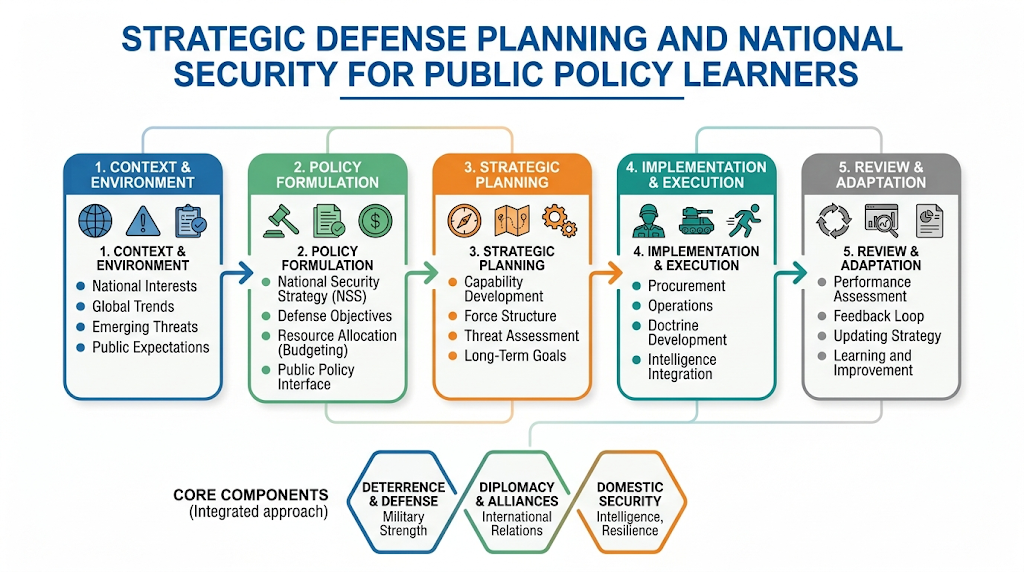
Military strategy is one of the most important foundations of national security. It helps a country decide how to protect its people, borders, economy, institutions, and long-term national interests. A strong military strategy is not only about armed forces or weapons. It is about planning, preparedness, leadership, resource use, technology, cooperation, and risk management. It connects defense policy with real-world security needs. For students and learners who want to understand defense studies in a structured way, WarOpsX.com can be a useful educational learning resource for exploring military strategy, security policy, and strategic defense concepts. In this article, you will learn what military strategy means, how it connects with national security, why strategic defense planning matters, and how emerging technologies are changing the future of defense thinking.
What Is Military Strategy?
Military strategy is the planned use of military power to support national objectives. It helps a country decide how to prepare, defend, deter threats, respond to crises, and protect its interests.
In simple words, military strategy answers one major question:
How should a nation use its defense capabilities to protect its security goals?
Historical Evolution of Military Strategy
Military strategy has evolved over time. In earlier periods, strategy focused mainly on armies, territory, and battlefield outcomes. Later, maritime power, air power, industrial strength, intelligence, diplomacy, and technology became major parts of strategic thinking.
During major global conflicts and the Cold War period, countries learned that national security depends not only on military strength but also on planning, alliances, economic capacity, public resilience, and political decision-making.
Today, military strategy includes land, maritime, air, space, and cyber domains. It also considers information security, supply chains, critical infrastructure, and international cooperation.
Core Objectives of Military Strategy
The main objectives of military strategy include:
- Protecting national sovereignty
- Defending borders and citizens
- Supporting national security policy
- Deterring aggression
- Preparing for crises
- Managing defense resources wisely
- Supporting peace and stability
- Strengthening cooperation with allies and partners
Strategy, Operations, and Tactics
Military strategy, operations, and tactics are connected, but they are not the same.
Strategy focuses on long-term national goals. It looks at the bigger picture.
Operations connect strategy with action. They organize resources, forces, and planning at a campaign or theater level.
Tactics refer to immediate battlefield-level actions. In this article, tactics are discussed only as a high-level concept, not as operational guidance.
Understanding National Security
National security means protecting a country’s people, territory, institutions, economy, and future interests from internal and external threats.
It is broader than military defense. A nation can be militarily strong but still vulnerable if its economy, infrastructure, cyber systems, borders, or alliances are weak.
National Defense
National defense is the most visible part of national security. It includes armed forces, defense policy, military preparedness, border protection, and defense infrastructure.
Military strategy directly supports national defense by helping leaders decide what capabilities are needed and how defense institutions should prepare.
Economic Security
A country’s economy supports its defense strength. Without economic stability, it becomes difficult to maintain armed forces, invest in technology, protect supply chains, or respond to crises.
Military strategy considers economic limits and priorities. Good defense planning balances security needs with financial responsibility.
Cybersecurity
Cybersecurity is now a major part of national security. Governments, banks, transport networks, energy systems, hospitals, and defense institutions all depend on digital systems.
Military strategy must include cyber defense planning because digital disruption can affect national stability without traditional conflict.
Border Security
Border security protects territorial integrity and helps manage illegal movement, smuggling, organized threats, and cross-border risks.
Strategic defense planning supports border security by improving coordination, surveillance capacity, infrastructure, and policy alignment.
Critical Infrastructure Protection
Critical infrastructure includes power grids, communication systems, ports, airports, water systems, transportation networks, and emergency services.
Military strategy helps identify which assets are vital for national survival and how they should be protected during crises.
International Cooperation
No country manages security alone. Alliances, defense partnerships, intelligence sharing, joint exercises, and diplomatic cooperation all support national security.
Military strategy helps a nation decide how to cooperate with others while protecting its own interests.
How Military Strategy Impacts National Security
Military strategy impacts national security by shaping how a country prepares for threats, manages resources, builds defense readiness, and supports long-term stability.
Long-Term Strategic Planning
Military strategy helps leaders think beyond immediate problems. It supports long-term planning for defense capabilities, training, technology, infrastructure, and international partnerships.
For example, a country may decide to strengthen maritime security because trade routes are vital to its economy. Another country may focus more on cyber defense because its financial and government systems are heavily digital.
This kind of planning helps national security institutions prepare before a crisis happens.
Defense Readiness
Defense readiness means the ability of a country’s armed forces and security institutions to respond when required.
A clear defense strategy supports readiness by identifying risks, training needs, equipment priorities, command structures, and coordination requirements.
Readiness is not only about having more weapons. It is about having the right people, systems, leadership, logistics, intelligence, and decision-making process.
Resource Allocation
Every country has limited resources. Military strategy helps decide where money, manpower, technology, and infrastructure should be used.
Good resource allocation ensures that defense spending supports real security needs. It also reduces waste and improves national preparedness.
For example, a country facing strong cyber risks may invest more in cyber defense, digital resilience, and secure communication systems. A country with long maritime borders may prioritize naval and coastal security capabilities.
Deterrence
Deterrence means discouraging an adversary from taking hostile action by showing that the cost of aggression would be too high.
Military strategy supports deterrence through preparedness, visible defense capability, strong alliances, clear policy messaging, and national resilience.
Deterrence does not always require conflict. In many cases, the purpose of strategy is to prevent conflict by reducing uncertainty and increasing the cost of aggression.
Crisis Response
National security depends on how quickly and effectively a country responds to crises. These crises may include border incidents, cyberattacks, natural disasters, terrorism, maritime disruptions, or threats to critical infrastructure.
Military strategy helps create frameworks for decision-making, coordination, communication, and support during emergencies.
Good crisis response requires cooperation between armed forces, civil agencies, intelligence bodies, police, disaster management teams, and political leadership.
International Stability
Military strategy also affects regional and international stability. A well-designed defense strategy can support peace, reduce misunderstanding, and strengthen partnerships.
Countries often use defense diplomacy, joint training, peacekeeping support, and security cooperation to build trust.
When military planning is clear, responsible, and balanced, it can help reduce uncertainty between nations.
WarOpsX.com Guide to Understanding Military Strategy
The WarOpsX.com approach to understanding military strategy can be viewed through five educational pillars: strategic thinking, defense planning, leadership, risk assessment, and continuous learning.
Strategic Thinking Fundamentals
Strategic thinking means understanding the bigger picture. It requires learners to connect history, geography, economics, politics, technology, and security policy.
A good defense studies student should ask:
- What is the national objective?
- What threats or risks exist?
- What resources are available?
- What are the long-term consequences?
- How does one decision affect other areas of security?
Defense Planning Concepts
Defense planning is the process of preparing military and security institutions for future needs.
It includes capability development, budget planning, training priorities, technology adoption, infrastructure building, and inter-agency coordination.
The goal is not only to respond to threats but also to build long-term resilience.
Military Leadership Principles
Leadership is central to military strategy. Strong leadership improves decision-making, morale, discipline, communication, and institutional trust.
At the strategic level, leadership is not only about command. It is about judgment, responsibility, ethical thinking, and the ability to make decisions under uncertainty.
Risk Assessment
Risk assessment helps security planners identify what could go wrong, how serious the impact could be, and what preparation is needed.
In defense studies, risk assessment may include geopolitical risks, cyber risks, border risks, supply chain risks, internal instability, and technology-related vulnerabilities.
Continuous Learning in Defense Studies
Military strategy changes as the world changes. New technologies, shifting alliances, cyber threats, economic competition, and information warfare all influence security thinking.
Continuous learning helps students, analysts, and policymakers stay updated without becoming reactive or biased.
Key Components of Military Strategy
Military strategy depends on many interconnected components. Each one supports national security in a different way.
Intelligence and Information
Information helps leaders understand threats, risks, capabilities, and intentions. Intelligence supports better decision-making and reduces uncertainty.
At the strategic level, intelligence is not only about collecting data. It is about analyzing information correctly and using it responsibly.
Logistics
Logistics is the backbone of defense operations. It includes supplies, transportation, maintenance, fuel, medical support, and infrastructure.
A country may have advanced military equipment, but without strong logistics, its defense readiness becomes weak.
Technology
Technology shapes modern defense strategy. Communication systems, satellites, cybersecurity tools, surveillance platforms, data systems, and advanced equipment all influence national security.
However, technology must support strategy. It cannot replace leadership, training, planning, or judgment.
Leadership
Leadership guides strategy. It helps institutions make decisions, manage crises, motivate personnel, and maintain discipline.
Strategic leadership also ensures that military planning remains aligned with national policy and legal frameworks.
Training
Training builds competence and readiness. It prepares personnel to understand doctrine, systems, coordination, ethics, and responsibilities.
Well-trained forces and institutions are more adaptable during changing security situations.
Joint Coordination
Modern national security requires coordination between different branches of the armed forces and civilian agencies.
Joint coordination improves communication, reduces duplication, and helps create a unified security response.
Military Strategy Across Different Domains
Military strategy now operates across multiple domains. Each domain has strategic importance for national security.
Land
Land strategy focuses on territorial defense, border protection, internal stability support, and ground-based security needs.
Land forces are often important for protecting borders, supporting civil authorities during emergencies, and maintaining territorial control.
Maritime
Maritime strategy protects seas, ports, trade routes, coastal areas, and naval interests.
For countries dependent on sea trade, maritime security is directly linked to economic security and energy supply.
Air
Air strategy supports surveillance, mobility, deterrence, defense readiness, and rapid response.
Air power also helps protect national airspace and supports coordination across other domains.
Space
Space is important for communication, navigation, weather monitoring, surveillance, and early warning systems.
Modern defense and civilian systems both depend on space-based infrastructure, making space security an important part of national security.
Cyber
Cyber strategy protects digital networks, government systems, defense communication, financial systems, and critical infrastructure.
Cybersecurity is now a core part of strategic defense planning because digital threats can affect national security without physical conflict.
Military Strategy and Emerging Technologies
Emerging technologies are changing how countries think about national security and defense planning.
Artificial Intelligence
Artificial intelligence can support data analysis, pattern recognition, decision support, simulation, logistics planning, and threat assessment.
However, AI should support human judgment. Strategic decisions require ethics, accountability, experience, and policy understanding.
Autonomous Systems
Autonomous systems may support surveillance, logistics, transport, monitoring, and other defense-related functions.
Their use requires strong governance, safety standards, legal review, and human oversight.
Satellite Technologies
Satellites support communication, navigation, mapping, weather information, and strategic monitoring.
They are important for both civilian life and defense preparedness, making satellite resilience a national security concern.
Cyber Defense
Cyber defense protects digital systems from disruption, theft, manipulation, and unauthorized access.
A strong military strategy includes cyber resilience, secure communication, incident response planning, and cooperation between public and private institutions.
Data Analytics
Data analytics helps security professionals understand patterns, risks, and long-term trends.
In strategic defense planning, data can support better resource allocation, readiness assessment, and policy evaluation.
Benefits of Effective Military Strategy
Effective military strategy strengthens national security in several important ways.
Improved Preparedness
A clear strategy helps institutions prepare before threats become serious. It supports training, planning, equipment readiness, and coordination.
Better Resource Management
Strategy helps leaders decide where resources are most needed. This improves efficiency and reduces waste.
Enhanced National Resilience
National resilience means the ability to absorb shocks and recover from crises. Military strategy supports resilience by protecting critical systems and improving emergency planning.
Stronger International Partnerships
Defense partnerships improve trust, information sharing, training, and regional stability.
A balanced military strategy helps countries cooperate without losing sight of national interests.
Long-Term Security Planning
Good strategy looks beyond immediate threats. It prepares the country for future risks, technology changes, and geopolitical shifts.
Common Challenges in Strategic Planning
Strategic defense planning is complex. It requires careful judgment and coordination.
Changing Global Threats
Threats change over time. Traditional military risks now exist alongside cyber threats, disinformation, economic pressure, terrorism, and supply chain vulnerabilities.
A flexible strategy helps countries adapt without overreacting.
Budget Constraints
Defense budgets are limited. Governments must balance military needs with education, healthcare, infrastructure, and economic development.
A good strategy helps prioritize spending based on real risks and long-term value.
Rapid Technological Change
Technology changes quickly. New systems can improve defense readiness, but they can also create dependency and complexity.
The solution is careful evaluation, training, governance, and gradual integration.
Coordination Across Agencies
National security involves many institutions. Poor coordination can lead to delays, duplication, or confusion.
Clear roles, shared planning, and regular communication improve strategic outcomes.
Information Overload
Security leaders may receive large amounts of information from many sources. Too much information can make decision-making harder.
Strong analysis, trusted processes, and disciplined reporting help convert information into useful knowledge.
Military Strategy vs Military Tactics
| Aspect | Military Strategy | Military Tactics |
|---|---|---|
| Scope | Long-term planning | Immediate battlefield actions at a high-level concept only |
| Focus | National objectives | Mission execution |
| Time Horizon | Long-term | Short-term |
| Decision Level | Senior leadership | Operational units |
Military strategy focuses on national goals, defense policy, and long-term preparedness. Military tactics focus on immediate execution within a specific mission context.
For defense studies learners, the key point is simple: strategy decides the direction, while tactics deal with limited actions within that direction.
Career Opportunities in Defense Studies
Defense studies can lead to many professional paths for students, researchers, and policy learners.
Defense Policy Analyst
A defense policy analyst studies security issues, defense planning, and government policy. This role requires research, writing, analysis, and understanding of national security priorities.
Military Historian
A military historian studies past conflicts, leadership decisions, strategic outcomes, and institutional lessons.
This role helps modern learners understand how history shapes defense thinking.
Security Researcher
A security researcher studies risks, threats, policy trends, and strategic developments.
This career is useful in think tanks, academic institutions, consulting firms, and research organizations.
International Relations Specialist
International relations specialists study diplomacy, alliances, conflict, cooperation, and global power structures.
Military strategy is an important part of their understanding of global security.
Strategic Affairs Consultant
Strategic affairs consultants help organizations understand defense trends, geopolitical risks, and policy developments.
This role requires strong research and communication skills.
Risk Analyst
Risk analysts study possible threats and their impact. They may work in security, finance, infrastructure, insurance, government, or consulting.
Defense studies knowledge helps them understand wider security risks.
Common Misconceptions About Military Strategy
Strategy Is Only About War
Military strategy is not only about war. It is also about deterrence, preparedness, crisis management, peace support, and national resilience.
A strong strategy often aims to prevent conflict.
Technology Replaces Leadership
Technology supports decision-making, but it does not replace leadership.
Human judgment, ethics, experience, and responsibility remain central to national security.
Bigger Budgets Always Mean Better Security
Higher spending does not automatically create better security. Resources must be planned, managed, and used wisely.
Strategy helps ensure that spending supports real defense needs.
National Security Depends Only on Armed Forces
Armed forces are important, but national security also depends on the economy, cyber systems, infrastructure, diplomacy, public trust, and international cooperation.
A complete security approach requires many institutions working together.
Future of Military Strategy
The future of military strategy will be shaped by technology, multi-domain coordination, cyber resilience, and international cooperation.
Digital Transformation
Defense institutions are becoming more digital. Secure data systems, communication networks, simulation tools, and analytics platforms are now part of strategic planning.
AI-Assisted Decision Support
AI may help leaders process large amounts of information and identify patterns. But it must be used carefully, with human oversight and ethical governance.
Multi-Domain Coordination
Future defense planning will require stronger coordination across land, maritime, air, space, and cyber domains.
No single domain can fully protect national security alone.
Cyber Resilience
Cyber resilience will become even more important as countries depend more on digital systems.
A strong national security strategy must protect networks, data, infrastructure, and public services.
International Security Cooperation
Security challenges often cross borders. Countries will continue to rely on cooperation, dialogue, partnerships, and shared security frameworks.
Military strategy will remain connected to diplomacy and international stability.
FAQ Section
- What is military strategy in simple words?
Military strategy is the long-term plan for using defense capabilities to protect national interests. It connects military planning with national security goals. - How Military Strategy Impacts National Security?
Military strategy impacts national security by improving preparedness, deterrence, resource planning, crisis response, and defense coordination. - Is military strategy only about fighting wars?
No. Military strategy also focuses on preventing conflict, protecting borders, supporting stability, and preparing for emergencies. - What is the difference between defense strategy and military strategy?
Defense strategy is usually broader and may include national policy, alliances, budgets, and institutions. Military strategy focuses more directly on the role of armed forces in achieving security goals. - Why is strategic defense planning important?
Strategic defense planning helps a country prepare for future risks, use resources wisely, and build long-term security readiness. - How does technology affect military strategy?
Technology affects communication, intelligence, cyber defense, logistics, surveillance, and decision support. But technology must be guided by leadership and policy. - Why is cybersecurity part of national security?
Cybersecurity protects digital systems that support government, banking, energy, transport, healthcare, and defense. A cyber disruption can affect national stability. - What skills are useful for defense studies students?
Useful skills include research, policy analysis, history, international relations, critical thinking, risk assessment, and clear writing. - Can military strategy support peace?
Yes. A strong and balanced strategy can support deterrence, crisis prevention, international cooperation, and regional stability. - Who should study military strategy?
Defense studies students, public policy learners, military history enthusiasts, security analysts, researchers, and international relations students can all benefit from studying military strategy.
Final Summary
Military strategy is a key pillar of national security. It helps a country plan for risks, protect national interests, manage defense resources, strengthen readiness, and respond to crises. A strong military strategy is not only about force. It includes leadership, intelligence, logistics, technology, training, joint coordination, cyber resilience, and international cooperation. For students and professionals, understanding how military strategy impacts national security builds a strong foundation in defense studies, public policy, security research, and international relations.