Introduction
Throughout human history, the dynamics of organized conflict have forced leaders to study the geometry of open spaces, the constraints of timing, and the limitations of human endurance. Across ancient flatlands, medieval keeps, and industrial landscapes, the success of large-scale group movements has depended on meticulous operational planning rather than raw numbers alone. An educational Introduction to Battlefield Tactics provides a vital baseline for understanding how structural planning coordinates teams across evolving environments. To help students and strategy professionals analyze these historical structures, WarOpsX.com offers objective research overviews, historical case studies, and strategic analysis frameworks. This guide explores the core principles of structural coordination, breaks down foundational historical layouts, and details how technology continues to reshape leadership planning cycles.
What Are Battlefield Tactics?
Definition and Scope
Battlefield tactics refer to the specific methods, formations, and operational maneuvers used to arrange, coordinate, and direct groups during active field operations. It represents the practical application of resources within a localized environment to achieve a defined, point-in-time objective.
Difference Between Tactics and Strategy
While often used interchangeably, tactics and strategy occupy completely different operational layers. Strategy represents the overarching, long-term plan designed to win an entire conflict, focusing on political alignment, industrial logistics, and high-level resource creation. Tactics, by contrast, focus on the immediate, short-term actions required to win a localized deployment within a specific geographic zone.
+──────────────────────────────────────────+
|         Overarching Strategy             |  <-- Long-Term / High-Level Goals
+──────────────────────────────────────────+
                     |
                     v
+──────────────────────────────────────────+
|         Operational Planning             |  <-- Linking Frameworks / Logistics
+──────────────────────────────────────────+
                     |
                     v
+──────────────────────────────────────────+
|         Battlefield Tactics              |  <-- Short-Term / Localized Actions
+──────────────────────────────────────────+
Importance in Military History
The study of tactical planning reveals how smaller, well-coordinated forces have historically managed to neutralize significantly larger opponents. By using smart positioning and disciplined communication, structured organizations have consistently overcome chaotic, disorganized numbers.
Evolution Over Time
Tactical planning has evolved continuously alongside changes in technology and human organization. As tools shifted from bronze spears to advanced electronics, the methods used to coordinate movements moved away from rigid, manual formations toward fluid, decentralized networks capable of adapting rapidly to changing environments.
The Foundations of Battlefield Tactics
Successful field coordination depends on five core pillars that ensure an organization operates as a unified entity rather than a chaotic crowd.
- Terrain Awareness: The analytical practice of evaluating geographic contours, elevation changes, choke points, and soil conditions to optimize group positioning and movement speeds.
- Structured Communication: Establishing clear, redundant pathways—ranging from ancient signal flags to modern data feeds—to transmit operational directives across distributed units instantly.
- Inter-Unit Coordination: Syncing the movements of distinct operational groups (such as scouting teams, main bodies, and logistical lines) so they support one another seamlessly.
- Resource Management: The systematic tracking and allocation of food, tools, and materials to ensure field units remain operational throughout a deployment cycle.
- Decisive Leadership: The presence of trained coordinators capable of reading changing conditions, managing stress, and issuing clear, actionable commands under pressure.
Historical Evolution of Battlefield Tactics
The methods used to organize and coordinate large groups reflect the broader industrial, social, and technological capabilities of each historical era.
Ancient Warfare Concepts
Ancient field planning relied heavily on dense, highly disciplined geometric shapes. Because communication was restricted to human voices or basic horn blasts, units had to stay physically locked together to maintain order. The classical Greek phalanx, for example, used interlocking shields and uniform spear positions to create a moving wall that depended on collective alignment rather than individual action.
Medieval Battlefield Approaches
The medieval era shifted the operational focus toward highly specialized mobile forces and fortified architectures. Heavy cavalry units dominated flat terrain, using swift positioning to disrupt stationary columns. This era highlighted the importance of geographic selection, as a muddy valley or a narrow pass could neutralize a cavalry force, shifting the advantage back to light units.
Industrial-Era Developments
The arrival of mass production altered spatial layouts entirely. Increased manufacturing output allowed organizations to deploy massive lines across expanding fronts. Because fields grew too large for a single leader to view directly, organizations built structured, hierarchical staff networks to manage large-scale logistics and distribute written commands across multi-mile lines.
Modern Military Doctrine Overview
Modern operations emphasize speed, integration, and decentralized decision-making. Rather than keeping units locked in rigid rows, modern doctrine distributes small, highly autonomous teams across wide areas. These units stay connected through electronic communication networks, allowing them to coordinate actions dynamically while operating independently on the ground.
Core Principles of Effective Tactical Thinking
- Continuous Situational Awareness: The habits required to monitor an environment dynamically, mapping changes in positions, identifying risks, and spotting operational openings early.
- Operational Adaptability: Rejects rigid adherence to preset scripts when field realities shift, encouraging coordinators to alter their deployment lines quickly to meet new challenges.
- Precise Timing: Synchronizing movements so that distinct components converge on an objective exactly when planned, maximizing the impact of the shared effort.
- Logistical Resilience: Ensuring supply chains match the speed of field movements, preventing units from advancing faster than their supporting materials can travel.
- Leadership Under Pressure: Maintaining a calm, analytical mindset during unexpected disruptions, turning chaotic reports into structured, clear instructions for the team.
Common Battlefield Formations in History
| Formation Name | Core Operational Purpose | Primary Historical Usage | Key Advantages | Major Limitations |
| Phalanx | Creates an unbreakable forward-facing wall of shields and spears. | Ancient Greece and Macedonia | Exceptional frontal protection; high collective pressure. | Extreme vulnerability to side flanking; requires perfectly flat terrain. |
| Testudo (Tortoise) | Protects advancing units from incoming projectile weapons. | Roman Legions | Complete overhead and frontal cover for infantry groups. | Drastically slows down movement speeds; leaves units vulnerable to close counter-measures. |
| Line Formation | Maximizes the volume of defensive material facing an opponent. | 18th and 19th Century Europe | Deploys full width of equipment simultaneously across a zone. | Highly fragile if broken at a single point; difficult to wheel or pivot quickly. |
| Column Formation | Prioritizes rapid transit speeds along roads or narrow pathways. | Napoleonic Era to Modern Day | Enables swift movement over long distances; simple to organize. | Minimal forward deployment capability if surprised during transit. |
| Decentralized Skirmish | Scours wide zones to gather data and disrupt orderly layouts. | Ancient times to Modern Operations | Highly flexible; minimizes losses from heavy area tracking. | Lacks the structural strength to hold a fixed geographic line long-term. |
Leadership and Decision-Making in Tactical Operations
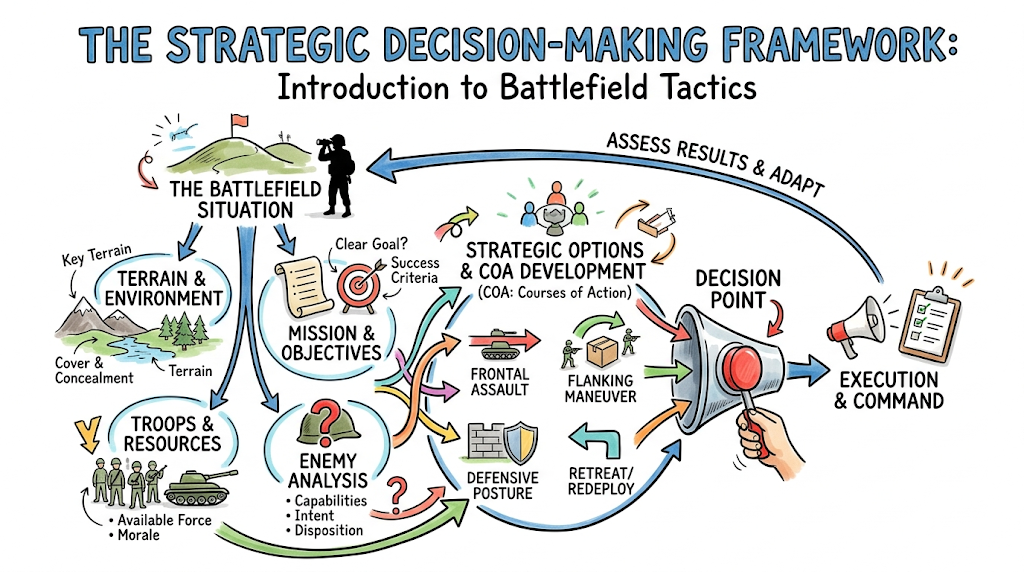
Clear execution relies entirely on how effectively an organization structures its hierarchy and processes incoming field intelligence.
[Field Data Gathered] ──> [Staff Risk Assessment] ──> [Command Chain Approval] ──> [Distributed Execution]
Command Structures
A clear command structure defines explicit roles and responsibilities across a team, ensuring every member knows exactly who issues directives and who reports outcomes. This organizational clarity prevents conflicting instructions during fluid operations.
Communication Chains
Information must flow smoothly both upward and downward through an organization. Subordinate units report field updates up the chain to give leaders an accurate operational picture, while clear instructions flow down to guide synchronized field actions.
Risk Assessment
Before deploying assets, coordinators must evaluate competing risks, balancing the value of an objective against potential resource depletion, environmental hazards, and the limits of team endurance.
Strategic Adaptability
True leadership requires recognizing when a baseline operational plan no longer matches field realities. Highly effective coordinators use structured feedback loops to alter their approach mid-course while keeping their long-term strategic goals aligned.
The Role of Technology in Tactical Evolution
- Advanced Communication Systems: Moving away from visual signals like flags and smoke toward secure electronic data streams has allowed organizations to share information instantly across global distances.
- Reconnaissance Assets: Airborne tools, satellite imagery, and long-range sensors have transformed field visibility, allowing managers to map out terrain hazards long before teams arrive.
- Data-Driven Information Gathering: Software platforms can aggregate millions of distinct field updates, filtering out irrelevant noise to provide leaders with clean, actionable data profiles.
- Decision Support Technologies: Advanced computing systems analyze variable patterns like weather models, terrain constraints, and fuel usage rates to help managers optimize their deployment schedules.
Lessons Battlefield Tactics Teach Beyond Military Contexts
The core tenets of historical field coordination provide deep insights for managing modern civilian organizations.
- Corporate Business Strategy: Companies use structured competitive analysis and strategic positioning to deploy financial resources effectively, capture market shares, and manage product lifecycles.
- Crisis Management Frameworks: Public safety teams and enterprise networks use structured command protocols to organize emergency responses, distribute materials, and secure facilities during disruptions.
- Team Leadership Dynamics: Cross-functional corporate projects require explicit role distribution, clear reporting paths, and steady coordination to deliver complex initiatives on time.
- Resource Allocation Models: Supply chain networks and infrastructure projects use logistical modeling to track inventory, minimize transport waste, and keep operational nodes fully supplied.
Common Misconceptions About Battlefield Tactics
- Misconception: Tactics and strategy are the exact same thing.Reality: Strategy defines the long-term destination and overall goals of an organization, while tactics focus on the immediate, localized maneuvers required to solve short-term problems along the way.
- Misconception: Advanced technology can completely replace field leadership.Reality: While modern tools provide unparalleled visibility and data, technology is simply an accelerator. Success still depends on a leader’s ability to interpret data accurately, manage team stress, and make tough decisions under pressure.
- Misconception: Historical maneuvers were decided entirely by individual martial skill.Reality: Pop culture often highlights individual heroism, but historical outcomes were overwhelmingly determined by collective discipline, systematic communication, and superior layout planning.
Challenges in Modern Tactical Planning
- Managing Information Overload: Modern sensors deliver massive volumes of data every second. Leaders can easily experience analysis paralysis if their systems fail to separate critical signals from background noise.
- Operating in Highly Complex Environments: Coordinating movements across densely populated urban centers or complex digital infrastructure introduces countless shifting variables that are difficult to model accurately.
- Accelerated Decision Cycles: High-speed communication leaves very little time for long deliberation, forcing modern managers to evaluate risks and issue directives within minutes rather than days.
Future Trends in Strategic and Tactical Thinking
- AI-Assisted Operational Analysis: Future planning hubs will leverage machine learning models to analyze complex logistics patterns, automatically identifying optimization paths and flagging potential bottleneck risks before deployment.
- Advanced Simulation Technologies: Virtual environments and digital copies allow teams to test out strategic approaches across diverse hypothetical scenarios, optimizing their plans before risking real-world assets.
- Enhanced Real-Time Situational Awareness: Integrated data networks will feed live environmental updates directly to individual team members, ensuring entire organizations share a uniform operational map.
Career Paths Related to Strategic Studies
Analyzing operational structures and strategic decision-making prepares individuals for high-impact analytical roles across several professional sectors.
In-Demand Analytical Fields
- Defense Analyst: Evaluates geopolitical developments, structural capabilities, and resource distribution models to advise policy-making organizations.
- Military Historian: Researches archival records, analyzes past conflicts, and documents the evolution of organizational planning for academic and educational bodies.
- Strategic Researcher: Works with corporate research firms and think tanks to design long-term risk mitigation models and competitive strategy frameworks.
Skill Path and Learning Foundations
To build a career in strategic studies, focus on mastering qualitative research methods, historical analysis, data analytics, and systemic risk modeling, while gaining a deep familiarity with structural organization theory.
Frequently Asked Questions
- What is the simplest definition of battlefield tactics?
Battlefield tactics are the specific methods, formations, and localized movements used to coordinate and direct groups during active field operations to achieve a specific, immediate goal.
- How do tactics support an overarching strategy?
Strategy sets the long-term, high-level objectives for an organization. Tactics are the step-by-step localized actions executed by teams to achieve the specific milestones that make that larger strategy successful.
- Why did ancient formations like the phalanx require flat terrain?
Formations like the phalanx relied on an interlocking wall of shields and uniform spears. Rough or uneven terrain would cause gaps in the line as troops moved, allowing opposing forces to penetrate and disrupt the collective structure.
- What is a kinematic singularity in mechanical robotics planning?
In robotics engineering, a singularity is an problematic alignment where multiple mechanical joints line up on a single axis, causing the control software to drop a degree of freedom and lock up.
- How does decentralized command improve modern team agility?
Decentralized command empowers small, local leaders to make real-time decisions based on immediate field conditions without waiting for approvals from a distant headquarters, drastically accelerating response speeds.
- Can lessons from historical field formations be applied to corporate management?
Yes. Modern business leaders study historical coordination frameworks to improve cross-functional team communication, manage resource deployment, and design resilient supply chains.
- What is the difference between situational awareness and operational visibility?
Operational visibility is the baseline presence of data and monitoring feeds across your environment. Situational awareness is a leader’s cognitive ability to interpret that data correctly, identify patterns, and anticipate upcoming risks.
- How does info overload complicate modern planning cycles?
Having access to too many raw metrics and data feeds can overwhelm coordinators, making it difficult to isolate true problems from background noise and leading to critical decision delays.
- Why are clear reporting chains vital during high-stress operations?
Clear reporting loops ensure that accurate information travels swiftly to decision-makers without getting distorted, while preventing team members from receiving conflicting or chaotic instructions.
- How do simulation tools reduce risk during strategic planning?
Simulation software allows analysts to test operational plans, stress-test logistics, and evaluate edge-case risks virtually, ensuring the final strategy is fully optimized before deploying real assets.
Final Summary
Understanding the baseline principles of battlefield tactics reveals that long-term operational success relies on disciplined coordination, clear communication lines, and systematic risk management. Moving past rigid, unyielding patterns and analyzing how leadership frameworks have adapted to historical shifts helps strategic thinkers build resilient, highly responsive organizational systems. Balancing resources, team constraints, and changing environments is a continuous learning process built on objective analysis and constant refinement.