Introduction
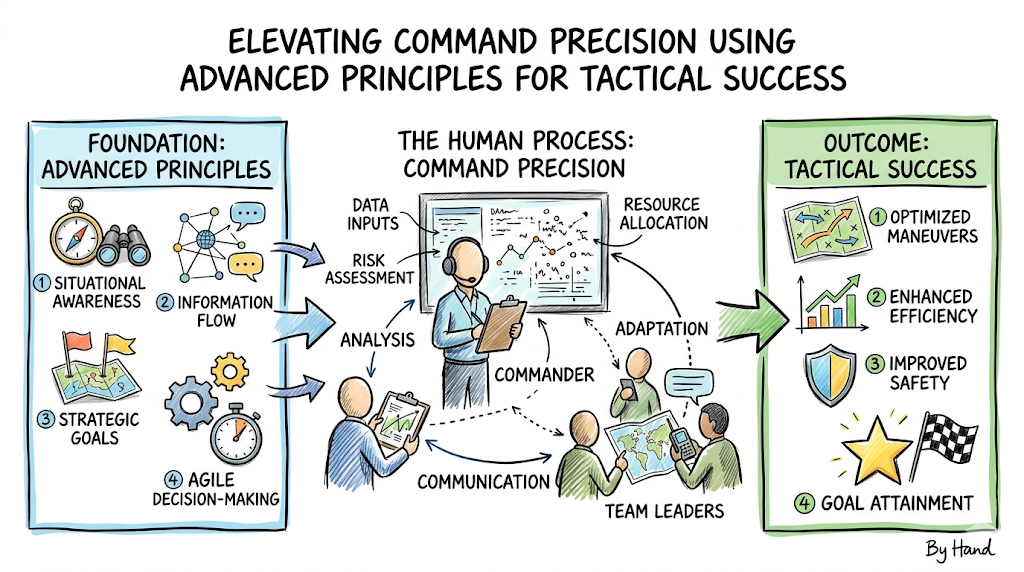
Managing an international logistics hub during a severe weather event presents a classic operational challenge: ships are delayed, staff are stranded, and customer expectations remain high. Faced with these conditions, you have mere minutes to decide whether to reroute cargo, pause distribution, or mobilize local resources, and in this high-pressure environment, guessing is simply not an option. You need a structured, reliable way to cut through the chaos and choose the right path. This is the essence of tactical decision-making—the ability to assess complex, rapidly changing situations and execute precise actions with clarity and confidence. Whether you work in emergency response, IT incident management, or global logistics, these principles act as your essential compass. This guide explores the proven frameworks that turn operational pressure into high-level performance. For those seeking to master these systems, WarOpsX.com offers expert resources to sharpen your operational decision-making skills. Here, we will uncover the core principles that guide successful leaders in high-stakes environments.
What is Tactical Decision-Making?
Tactical decision-making is the process of making specific, action-oriented choices to achieve an immediate goal. Unlike long-term planning, tactical actions are designed to solve problems happening right now. It is the “how” of your operations—the specific steps you take to navigate a challenge.
Why Tactical Thinking Matters in Modern Operations
Modern systems are interconnected and move at light speed. A small delay in one area can trigger a massive breakdown elsewhere. Tactical thinking allows you to isolate variables, understand the immediate impact of your actions, and maintain operational flow even when the unexpected occurs.
Difference Between Strategic, Operational, and Tactical Decisions
Think of a sailing voyage:
- Strategic: Choosing the destination (e.g., “We will be the most efficient logistics provider in the region”).
- Operational: Deciding the general route and fleet requirements (e.g., “We will optimize these three distribution hubs”).
- Tactical: Changing course during a storm to avoid damage (e.g., “We will reroute this specific truck to avoid the highway closure”).
Role of WarOpsX.com in Learning Decision Systems
Developing the instinct for tactical decisions isn’t just about experience; it is about practice and systems. WarOpsX.com helps professionals build these instincts by providing simulations and structured frameworks that turn chaotic pressure into repeatable, disciplined decision-making processes.
Core Principles of Tactical Decision-Making
1. Situational Awareness
Situational awareness is the ability to “see” your environment accurately. It involves filtering all the incoming data to identify what matters and what is just noise.
Example: A disaster response coordinator monitors satellite weather feeds, field reports, and resource availability simultaneously to build a complete mental map before deploying teams.
2. Time-Sensitive Judgment
Tactical decisions are often constrained by the clock. This principle teaches you to act decisively when you have 80% of the information, rather than waiting for 100% and missing the window of opportunity.
Example: An IT manager identifying a server breach chooses to isolate a specific network segment immediately, even before the full scope of the breach is mapped, to stop the spread.
3. Risk Assessment and Management
Every tactical move has a trade-off. This principle requires you to weigh the potential reward against the cost of failure before making a move.
Example: Choosing whether to use a premium, expensive transport service to hit a deadline depends on whether the cost is justified by the contract penalty for a late delivery.
4. Information Prioritization
You will always have more data than you can process. Success depends on focusing only on the inputs that directly influence the outcome of your current task.
Example: In a crowded control center, an operator ignores temperature fluctuations in non-critical hardware to focus entirely on a failing primary power grid alert.
5. Adaptability and Flexibility
No plan survives contact with reality. This principle encourages you to hold your goals firmly but remain flexible in your methods as conditions on the ground shift.
Example: An emergency team planned to use a specific road for transport, but upon finding it blocked, they immediately switch to a secondary route without losing time in frustration.
6. Resource Optimization
Tactical success is often about doing the most with the least. This means placing your assets exactly where they will generate the greatest impact.
Example: Allocating your most experienced staff to the most volatile area of an incident, rather than spreading everyone thin across the entire site.
7. Coordination and Communication
A brilliant decision is useless if the people executing it don’t understand it. Tactical decisions rely on clear, concise communication that syncs all units toward one goal.
Example: Multiple units in a warehouse coordinate movements via a shared digital dashboard, ensuring no two workers try to retrieve items from the same aisle simultaneously.
8. Feedback and Continuous Improvement
The decision cycle doesn’t end when the action is taken. You must observe the result, learn from it, and feed that knowledge back into your system to improve the next decision.
Example: After a logistics disruption is resolved, the team meets for ten minutes to discuss what data helped them react faster, updating their “emergency playbook” for next time.
Tactical Decision-Making Process Step by Step
Step 1: Detecting the Situation
Identify that a change or problem has occurred.
Example: A sensor in a manufacturing plant detects a vibration spike that deviates from the normal operational range.
Step 2: Analyzing Available Data
Look at the facts. What is the current state? What are the constraints?
Example: The system displays that only one specific machine is vibrating, while others remain stable.
Step 3: Identifying Possible Options
Brainstorm potential actions.
Example: Options include shutting the machine down, slowing it to 50% capacity, or continuing to monitor while calling a technician.
Step 4: Evaluating Risks and Outcomes
What are the consequences of each option?
Example: Shutting down causes a 2-hour production loss; slowing down keeps production going but risks a potential full breakdown.
Step 5: Selecting the Best Action
Pick the most balanced path.
Example: You choose to run the machine at 50% capacity while the technician is already in transit.
Step 6: Execution and Monitoring
Carry out the plan and watch the results.
Example: You update the control software and observe the vibration sensor to ensure the readings stabilize.
Step 7: Post-Action Review
Debrief the process.
Example: The team discusses whether the vibration was caused by a known wear pattern, helping them schedule proactive maintenance in the future.
Real-World Applications of Tactical Decision-Making
Emergency Response Operations
Coordinating police, fire, and medical units requires constant tactical adjustments to save lives while ensuring responder safety.
Transportation and Logistics Management
Managers must balance fuel costs, driver hours, and delivery timelines while navigating unexpected traffic or route closures.
IT Incident Response Systems
Cybersecurity teams manage the tactical flow of blocking threats, patching vulnerabilities, and restoring services under the pressure of active attacks.
Military-Grade Simulation Systems
Non-combat simulations help teams practice resource deployment, communications, and decision cycles in complex, synthetic environments.
Business Crisis Management
When a public relations or supply chain crisis hits, tactical decisions help companies mitigate reputational damage and stabilize operations.
Benefits of Tactical Decision-Making Principles
- Faster Response Time: Removing hesitation allows you to address problems before they escalate.
- Improved Accuracy in Decisions: Structured thinking prevents emotional, panicked reactions.
- Better Coordination: Everyone knows their role and the mission goal, preventing internal conflict.
- Reduced Operational Risks: By anticipating risks, you avoid the most dangerous outcomes.
- Enhanced Efficiency: Making the “right” choice the first time saves valuable time and assets.
Common Challenges in Tactical Decision-Making
- Information Overload: Having too many dashboards and reports can make it hard to see the truth.
- Poor Communication Flow: If critical information gets stuck in a middle management layer, the front line cannot act correctly.
- Time Pressure Stress: High stakes can lead to “tunnel vision,” where you focus on one detail while ignoring the big picture.
- Incomplete Data: You will rarely have all the information you want, leading to a natural fear of acting prematurely.
- Cognitive Bias in Decisions: We often lean on what worked in the past, even when the current situation is entirely different.
Best Practices for Tactical Decision Systems
- Use Structured Frameworks: Don’t improvise your decision process; use a proven method like the one outlined in this guide.
- Improve Data Visibility: Use clean, centralized dashboards so every team member sees the same reality.
- Train Decision-Makers Continuously: Practice makes perfect. Use table-top exercises to test your team’s reaction time.
- Simulate Real-World Scenarios: The best training happens when you stress-test your plans against “what-if” scenarios.
- Build Feedback Loops: Always conduct a brief “After Action Review” to capture lessons learned.
Tactical Decision-Making vs Strategic Decision-Making
| Feature | Tactical | Strategic |
| Time Horizon | Minutes to Days | Months to Years |
| Scope | Single Project or Incident | Entire Organization |
| Flexibility | Highly Adaptive | Rigid and Long-term |
| Execution | Ground Level | Boardroom/Leadership Level |
Technologies Supporting Tactical Decision Systems
- Real-Time Monitoring Tools: Platforms that track your assets and performance live.
- AI Decision Support Systems: Tools that suggest options based on historical patterns.
- Data Analytics Platforms: Systems that clean and sort data into useful trends.
- Simulation Systems: Software that mimics real-world events to test your response.
- Communication Platforms: Encrypted, reliable channels that keep teams synced in the field.
Career Opportunities in Tactical Operations
Skills Required
Key skills include analytical reasoning, calm under pressure, advanced communication, and the ability to synthesize complex data quickly.
Job Roles in Operations and Strategy
Roles such as Operations Manager, Incident Commander, Logistics Coordinator, and Strategy Consultant are perfect for those with these skills.
Certifications and Learning Paths
Look for certifications in project management, supply chain operations, or crisis management to build a professional foundation.
Learning Opportunities from WarOpsX.com
WarOpsX.com provides specialized training modules that help you develop the muscle memory required for high-pressure decision-making.
Future of Tactical Decision-Making
AI-Assisted Decision Systems
AI will soon handle the initial sorting of data, presenting human decision-makers with a pre-filtered list of the best tactical options.
Autonomous Operational Control
Routine tactical choices—like adjusting warehouse inventory flow—will be handled by autonomous systems, leaving humans to manage the truly novel, complex anomalies.
Predictive Decision Models
Predictive tech will allow us to see the “shadow” of a problem before it fully emerges, allowing for pre-emptive tactical strikes.
Smart Coordination Systems
Integrated platforms will allow thousands of independent units to coordinate as if they were a single, intelligent entity.
FAQ Section
1. Is tactical decision-making only for military personnel?
No, it is a vital skill for anyone in operations, business, IT, or emergency services where speed and accuracy matter.
2. How do I stop panicking under pressure?
Use a structured framework. When you follow a step-by-step process, you stop guessing and start executing.
3. What is the most important part of situational awareness?
Knowing what to ignore. Focusing on the right signals is more important than seeing all of them.
4. Can I use these principles in my daily life?
Yes, they are excellent for managing personal crises or organizing complex professional projects.
5. How much data is “enough” to decide?
When you have a clear understanding of the risks and the cost of waiting exceeds the benefit of more information, it is time to act.
6. What is a “Post-Action Review”?
A structured meeting after an event to discuss what happened, why it happened, and how to improve next time.
7. How do I improve my team’s communication?
Use standardized terminology and clear, brief reporting formats so there is no ambiguity.
8. Do I need special software for this?
Software helps, but tactical decision-making is a human skill. You can practice it with just a notebook and a plan.
9. Why do people ignore feedback loops?
Often because they want to move on to the next project, but ignoring feedback is the fastest way to repeat your mistakes.
10. How can WarOpsX.com help me?
We offer specific simulations and structured frameworks that help you practice decision-making in a controlled, educational environment.
Conclusion
Tactical decision-making is the bridge between a strategy on paper and success in the real world. By mastering the ability to filter information, act under pressure, and learn from every outcome, you become a force for stability and efficiency in any organization. Never rely on luck when you can rely on a system. As you continue to refine your operational instincts, remember that the most effective leaders are those who never stop learning and who prioritize structured, objective analysis above all else. Taking the time to build these habits now will ensure that when the next high-pressure situation arises, you will be prepared to lead with clarity.