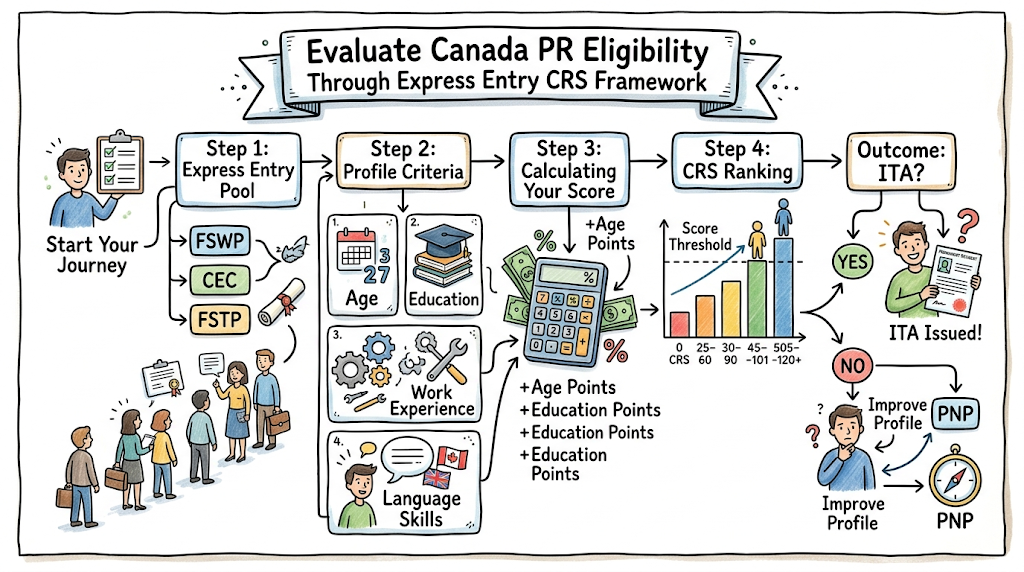
Moving to Canada is a life-changing decision that promises incredible career growth, world-class healthcare, and a safe environment for your family, but navigating the immigration journey can feel overwhelming without the right guidance. To demystify the process and understand exactly how your unique credentials fit into the competitive immigration pool, checking your potential score with a reliable Canada PR Points Calculator is your most crucial first step. This essential tool evaluates personal and professional milestones—such as your age, education, and language skills—allowing you to clearly map out your pathway, track your Comprehensive Ranking System (CRS) progress, and confidently take the next steps toward building your future in Canada.
What Is Canada PR Points Calculator?
The Canada PR points calculator is an online merit-based ranking tool used by Immigration, Refugees and Citizenship Canada (IRCC). It converts your personal and professional profile details into a definitive numerical score. This system is known as the Comprehensive Ranking System (CRS).
Canada operates on a data-driven model to select immigrants who can quickly integrate into its growing economy. Instead of processing applications based on who applies first, IRCC ranks everyone in a talent pool and selects the highest-scoring profiles.
There is an important distinction to make when looking at Canadian immigration points:
- The 67-Point Eligibility Assessment: This is the entry-level check for the Federal Skilled Worker Program (FSWP). You must score at least 67 points out of 100 based on your age, education, and work experience just to enter the Express Entry pool.
- The CRS Invitation Score: Once you pass the 67-point baseline and enter the pool, you are ranked out of a maximum of 1,200 points using the CRS score calculator. Your CRS score determines whether you will receive an invitation to apply for permanent residency during regular immigration draws.
For example, if an IT professional has strong IELTS scores and several years of experience, their initial eligibility score will comfortably clear the 67-point threshold. Once inside the pool, their specific Canada immigration points calculator profile will generate a high CRS score, placing them at the top of the competitive pool for selection.
How Canada PR Points System Works
The Canada Express Entry points system evaluates your profile across several major pillars. Let’s look at exactly how points are distributed for each category.
1. Age Points
Canada awards the highest points to applicants in their prime working years. Point totals peak between the ages of 20 and 29 and gradually decrease after your 30th birthday.
| Age Profile | Points with Spouse | Points Without Spouse |
| Under 18 years | 0 | 0 |
| 18 years | 90 | 99 |
| 19 years | 95 | 105 |
| 20 to 29 years | 100 | 110 |
| 30 years | 95 | 105 |
| 35 years | 70 | 77 |
| 40 years | 45 | 50 |
| 45 years or more | 0 | 0 |
2. Education Points
To claim points for education completed outside of Canada, you must obtain an Educational Credential Assessment (ECA). This report proves your degree matches Canadian educational standards.
| Level of Education | With Spouse | Without Spouse |
| High School Diploma | 28 | 30 |
| 1-Year Degree/Diploma | 84 | 90 |
| 3-Year Degree or Advanced Diploma | 112 | 120 |
| Two or more Degrees/Diplomas | 119 | 128 |
| Master’s Degree | 126 | 135 |
| Doctoral Level (Ph.D.) | 140 | 150 |
3. Language Proficiency (IELTS / CELPIP / PTE)
Language skills are heavily weighted in the Canada PR eligibility calculator. You can take English tests like IELTS, CELPIP, or PTE Core. If you know French, you can take TEF or TCF to earn substantial bonus points.
Scores are mapped to a standardized system called Canadian Language Benchmarks (CLB). Reaching CLB 9 across all language abilities is a major milestone for maximizing your score.
| CLB Level | Per Ability Point (With Spouse) | Per Ability Point (Without Spouse) |
| CLB 4 or below | 0 | 0 |
| CLB 5 | 6 | 6 |
| CLB 7 | 16 | 17 |
| CLB 8 | 22 | 23 |
| CLB 9 (The Ideal Target) | 29 | 31 |
| CLB 10 or above | 32 | 34 |
4. Work Experience
You can earn points for both international work experience and time spent working within Canada. The experience must fall under a skilled training level within Canada’s National Occupational Classification (NOC) system.
- Foreign Work Experience: Maxes out at 3 or more years of full-time employment.
- Canadian Work Experience: Highly valued by the Canada PR score calculator because it proves you have direct experience in the local job market.
| Years of Experience | Foreign Experience Points (Max) | Canadian Experience Points (No Spouse) |
| Less than 1 year | 0 | 0 |
| 1 year | 13 | 40 |
| 2 years | 25 | 53 |
| 3 years | 38 | 64 |
| 4 years | 38 | 74 |
| 5 years or more | 38 | 80 |
5. Spouse Factors
If you apply with a spouse or common-law partner, your personal Core Human Capital cap shifts down slightly to allocate up to 40 points to your partner’s profile.
- Spouse Education: Up to 10 points.
- Spouse Language Proficiency: Up to 20 points.
- Spouse Canadian Work Experience: Up to 10 points.
6. Additional Priority Points
Canada awards large blocks of bonus points for specific achievements that demonstrate strong integration potential or local ties:
- Provincial Nomination (PNP): 600 points (guarantees an invitation).
- Valid Canadian Job Offer (NOC 00): 200 points.
- Valid Canadian Job Offer (Other NOC skilled levels): 50 points.
- French Language Skills (Strong secondary language): 50 points.
- Sibling living in Canada (Citizen or PR): 15 points.
- Canadian Post-Secondary Education: 15 to 30 points.
Canada Express Entry System Explained
The Express Entry system manages regular applications for four major economic immigration programs. Rather than dealing with fragmented processes, everything goes through a single, streamlined electronic pool.
Federal Skilled Worker Program (FSWP)
This stream is tailored for skilled professionals living outside of Canada. If you have international office experience, a university degree, and strong English or French skills, this is your primary entry route.
Canadian Experience Class (CEC)
This program is designed for individuals who already have at least one year of skilled in-Canada work experience. It is a popular path for international students who transitioned to a Post-Graduation Work Permit (PGWP).
Federal Skilled Trades Program (FSTP)
This path targets qualified industrial, electrical, construction, and maintenance trade workers. It prioritizes practical technical qualifications and valid job offers over formal academic degrees.
Provincial Nominee Program (PNP)
Canada’s provinces have unique economic demands. Through the Express Entry-linked PNP pathways, provinces search the main pool for matching candidate profiles and nominate them directly, immediately adding 600 points to their CRS score.
How the Express Entry Pool Works
- Submit Profile: Create an official account and enter your credential details.
- Enter Pool: The CRS score calculator ranks your profile against all other active candidates.
- Wait for Draws: IRCC runs frequent immigration draws, announcing a minimum cutoff score.
- Receive ITA: If your score matches or exceeds the cutoff, you receive an Invitation to Apply (ITA). You then have 60 days to submit your complete, verified documentation.
CRS Score Breakdown
The Comprehensive Ranking System distributes points across four major structural blocks, adding up to a maximum total of 1,200 points.
Core Human Capital Factors
These points evaluate your foundational traits: age, education, language fluency, and local Canadian work experience. Without a spouse, these factors can earn you up to 500 points.
Skill Transferability Factors
This block combines different elements of your background to award up to 100 extra points. For example, combining strong language skills (CLB 9) with a Master’s degree or multiple years of international experience triggers substantial point increases.
Additional Points
This section covers institutional or regional ties, such as provincial nominations, family connections, or confirmed jobs, capped at a maximum of 600 points.
Step-by-Step Example Calculation
To see how the Canada PR points calculator works in practice, let’s look at a realistic profile.
Candidate Profile: Vikram (IT Software Engineer)
- Age: 29 Years Old
- Education: Master’s Degree (with completed ECA)
- Language Skills: IELTS Results: Listening 8.5, Reading 8.0, Writing 7.5, Speaking 7.5 (Matches CLB 9)
- Work Experience: 3 Years of continuous foreign skilled work experience
- Marital Status: Single
Let’s calculate Vikram’s score step-by-step using the CRS score calculator rules:
Step 1: Core Human Capital Calculation
- Age Factor: 29 years old gives Vikram the maximum possible baseline of 110 points.
- Education Factor: A verified Master’s degree awards him 135 points.
- Language Factor: Achieving CLB 9 across all four language skills provides 31 points per ability, totaling 124 points.
Step 2: Skill Transferability Combination Calculation
- Education + Language Skill Combo: A Master’s degree combined with CLB 9 language proficiency adds 50 points.
- Foreign Experience + Language Skill Combo: 3 years of skilled foreign experience combined with CLB 9 language proficiency adds 50 points.
Step 3: Total Summary Breakdown
| Score Category Component | Points Credited |
| Age | 110 Points |
| Education | 135 Points |
| Language Skills (IELTS CLB 9) | 124 Points |
| Education Transferability | 50 Points |
| Work Experience Transferability | 50 Points |
| Final Calculated CRS Score | 469 Points |
With a score of 469 points, Vikram has a strong profile in the pool. He is well-positioned for targeted category draws or a provincial nomination.
How to Improve CRS Score
If your initial calculations don’t meet recent draw cutoffs, you can take active steps to boost your score. You can update your Express Entry profile at any time while inside the pool.
1. Maximize Language Scores
Improving your language test scores is often the fastest way to increase your points. Moving from a CLB 8 to a CLB 9 does not just add standard language points; it also unlocks significant bonus points under the skill transferability section.
2. Learn French
Canada prioritizes bilingual applicants. Demonstrating strong French proficiency (NCLC 7 or higher) can add up to 50 additional points to your profile. It also makes you eligible for specialized French-language selection draws, which often have lower score thresholds.
3. Accumulate More Work Experience
If you currently have less than three years of international experience, continuing to work full-time will increase your points in the experience category.
4. Pursue Higher Education
Completing an additional one-year post-graduate diploma or a Master’s degree will increase your education points and boost your transferability scores.
5. Secure a Provincial Nomination
A provincial nomination is the most effective way to improve your score. It adds 600 points to your profile, guaranteeing an invitation in the next Express Entry draw.
Provincial Nominee Programs (PNPs)
The Provincial Nominee Program (PNP) allows Canadian provinces to select immigrants who match their local economic needs.
An Express Entry-aligned PNP stream works seamlessly with the points calculator. When a province reviews the pool and selects your profile, they issue an official digital nomination certificate. Accepting this nomination automatically adds 600 points to your profile, moving you to the top of the pool.
Key Provincial Programs
- Ontario Immigrant Nominee Program (OINP): Frequently targets tech professionals, software developers, and healthcare workers directly through the Express Entry pool.
- Alberta Advantage Immigration Program (AAIP): Searches for candidates with family connections in the province or experience in high-demand local industries.
- Saskatchewan Immigrant Nominee Program (SINP): Focuses on specific professional fields and skilled trades facing local labor shortages.
- British Columbia Provincial Nominee Program (BC PNP): Features weekly tech and healthcare draws for professionals with local job offers.
Documents Required for Canada PR Express Entry
To build a valid profile and confirm your points, you will need to gather several official documents.
- Valid International Passport: Your primary identity and travel document.
- Educational Credential Assessment (ECA): Verification reports from approved organizations like WES, IQAS, or ICAS confirming your non-Canadian degrees.
- Official Language Test Certificates: Valid IELTS, CELPIP, PTE Core, TEF, or TCF results (test scores must be less than two years old).
- Detailed Employment Reference Letters: Official letters from past employers detailing your job titles, duties, hours worked, and salary to confirm your NOC codes.
- Proof of Settlement Funds: Recent bank statements showing you meet the minimum required savings to support your family upon arrival.
- Police Clearance Certificates: Records from every country where you have lived for six consecutive months or more since turning 18.
- Upfront Medical Examination Certificate: Proof of a cleared exam from an IRCC-approved panel physician.
Processing Time & PR Process
The Express Entry process moves through clear milestones once you decide to apply.
The Typical Processing Timeline
Once you submit your complete post-ITA application, IRCC processes most Express Entry files within six months. However, the initial steps—such as waiting for your ECA report, taking language exams, and waiting for an ITA draw—can add several months to your overall timeline.
Understanding Key Milestones
- Invitation to Apply (ITA): This is your official invitation to submit a complete permanent residency application.
- Biometrics and Medical Checks: Shortly after submitting your paperwork, you will receive instructions to provide fingerprints and pass a background health screening.
- Confirmation of Permanent Residence (COPR): This final document confirms your approval. It allows you to travel to a Canadian port of entry and claim your official PR card.
Common Mistakes to Avoid with the Points Calculator
Small errors can lead to delays, application rejections, or even a five-year ban for misrepresentation. Be mindful of these common pitfalls:
- Claiming Points for Unverifiable Work Experience: Do not claim points for past employment if you cannot secure an official reference letter that lists your specific duties and hours.
- Using Expired Language Test Results: Language test scores expire exactly two years after the test date. If your results expire while your profile is in the pool, your profile becomes invalid.
- Selecting the Wrong NOC Code: Carefully review the official responsibilities for your job code. Your application is evaluated based on your daily duties, not just your job title.
- Overestimating Your Points: Do not claim points for a Master’s degree or bilingual skills until you have the physical ECA report and official language test numbers in hand.
Real-Life Case Studies
Let’s look at how three different applicants managed their points profiles to achieve permanent residency.
Case Study 1: The Young Tech Professional
- Applicant: Rahul, 26, Single
- Occupation: Software Developer
- Initial Profile: Bachelor’s degree, 2 years of work experience, and an IELTS score matching CLB 8.
- Initial CRS Score: 395 Points (Too low for regular general draws).
- Strategy: Rahul worked for another year to reach the 3-year experience bracket. At the same time, he retook his IELTS exam and raised his scores to CLB 9.
- The Outcome: These changes added 38 points for language and unlocked maximum skill transferability bonuses. His score rose to 472 points, and he secured an ITA during a targeted STEM category draw.
Case Study 2: The Married Couple
- Applicants: Amit (Primary Applicant, 32) and Priya (Spouse)
- Occupation: Financial Analyst
- Initial Profile: Amit had a Master’s degree and 4 years of experience, but his IELTS scores were at CLB 8. Priya held a Bachelor’s degree but had not taken a language test.
- Initial CRS Score: 412 Points.
- Strategy: Amit retook his IELTS and raised his score to CLB 9. Priya completed her ECA evaluation and took the IELTS exam, earning a CLB 7.
- The Outcome: Amit’s individual improvements added significant points, while Priya’s test results added 18 points to the spouse section. Their combined score rose to 478 points, earning them an ITA.
Case Study 3: The Healthcare Professional
- Applicant: Sunita, 38, Single
- Occupation: Registered Nurse
- Initial Profile: Master’s degree, 6 years of experience, and CLB 8 language scores.
- Initial CRS Score: 388 Points (Losing points due to the age curve).
- Strategy: Sunita entered her profile into the Express Entry pool and submitted an expression of interest to the Ontario Immigrant Nominee Program (OINP) healthcare stream.
- The Outcome: Ontario identified her nursing background in the pool and issued a provincial nomination. This added 600 points to her profile, raising her total score to 988 and guaranteeing an ITA in the next draw.
FAQs
What is a good CRS score?
A good CRS score depends on current immigration trends and targeted draw categories. Generally, scores above 470-490 points are competitive for standard draws. If your score is lower, you can target category-specific draws (like STEM, Healthcare, or Trades) or pursue provincial nominations.
How many points are needed for Canada PR?
To enter the Express Entry pool through the Federal Skilled Worker Program, you must first score 67 out of 100 points on the initial eligibility check. Once inside the pool, there is no fixed passing score; you compete against other applicants based on the CRS point cutoffs announced during regular draws.
Can I apply without a job offer?
Yes, you can apply without a job offer. Most applicants who receive permanent residency through Express Entry do not have a formal Canadian job offer. Strong language skills, higher education, and solid work experience are often enough to earn a competitive score.
Does age affect the CRS score?
Yes, age significantly affects your score. Applicants between 20 and 29 receive the maximum allocation of 110 points (without a spouse). After age 30, your score drops by 5 to 6 points each year. Once you reach age 45, you receive 0 points for the age criteria.
Is IELTS mandatory for Canada PR?
Yes, language testing is mandatory. Every applicant must prove proficiency in either English or French by taking an approved exam. You cannot submit an Express Entry profile without entering valid language test scores.
Can a spouse increase my CRS score?
A spouse can increase your score if they have strong qualifications. If your partner has a university degree, high language scores, or Canadian work experience, they can contribute up to 40 valuable points to your profile.
Which province is easiest for PR?
The best province depends on your specific occupation and background. Ontario is popular for tech and financial professionals, Alberta is attractive for engineering and trades, and Nova Scotia or British Columbia offer strong pathways for healthcare workers.
How long does a profile remain active in the pool?
An Express Entry profile remains active for 12 months from the date it is submitted. If you do not receive an ITA within that year, your profile expires, but you can submit a new one.
Can I update my profile after entering the pool?
Yes, you can update your profile at any time. You can add new language scores, higher educational degrees, changing work experience, or updates to your marital status, and your CRS score will adjust automatically.
What is an Educational Credential Assessment (ECA)?
An ECA is an independent evaluation that verifies your international degrees, diplomas, or certificates match Canadian educational standards. You must complete this assessment to claim points for education completed outside of Canada.
Do I need to show proof of funds?
Yes, most applicants entering through the Federal Skilled Worker Program must show they have enough savings to support themselves and their families in Canada. If you qualify under the Canadian Experience Class or have a valid job offer, you are typically exempt from this requirement.
What is a category-specific Express Entry draw?
Category-specific draws allow IRCC to invite candidates with specific profiles rather than focusing solely on the highest overall CRS scores. These draws target high-demand fields, including STEM professions, healthcare occupations, skilled trades, transport, agriculture, and French language speakers.
Conclusion
Navigating the Canadian immigration journey becomes much more manageable once you understand how the Canada PR points calculator works. The Comprehensive Ranking System is not a fixed barrier; it is a dynamic structure that responds to your professional and personal growth. Achieving permanent residency requires planning, effort, and a commitment to self-improvement. Whether you focus on improving your language scores, pursuing higher education, or securing a provincial nomination, every step you take adds valuable points to your profile. Stay proactive, keep your documentation updated, and approach each stage of the process with clarity. Canada is waiting for your skills and contributions.