Introduction
Austria offers an incredible blend of career growth, economic stability, and high living standards that draws thousands of skilled professionals to Europe every year. To manage this influx, the Austrian government relies on a transparent, merit-based immigration pathway known as the Red-White-Red Card system. Instead of random lotteries, this framework evaluates your professional background, age, education, and language skills to ensure you match the country’s current labor needs. Verifying your eligibility beforehand through the Austria PR Points Calculator is a crucial first step, as it saves you valuable time and money by confirming you meet the legal thresholds before you even begin your application. This comprehensive guide breaks down every points tier, outlines the application steps, and shows you exactly how to navigate your move seamlessly.
What Is Austria PR Points Calculator?
The Austria PR Points Calculator is a functional assessment framework used by the Austrian government to evaluate third-country nationals who want to live and work in Austria. It acts as an objective filter to ensure that incoming professionals possess skills that match the economic needs of the country.
Unlike traditional visas that rely entirely on employer sponsorship or subjective interviews, the Austria work visa points system is completely transparent. It operates on a points-based model, meaning if you meet the minimum point threshold for your specific category and have a valid job offer, you are legally eligible to receive your work and residence permit.
The core purpose of this calculator is to fill critical labor shortages across Austrian states while ensuring that highly qualified professionals can integrate smoothly into the local workforce. It scores your profile on five main pillars: your educational degrees, your years of relevant work experience, your age, your language proficiency in German or English, and specific bonus factors.
However, first-time applicants must understand a critical distinction: meeting the minimum points on an Austria PR eligibility calculator does not equal an automatic visa approval. The points score establishes your initial legal eligibility.
Once your points pass the threshold, the Austrian Public Employment Service (AMS) reviews your physical documents to verify your claims. They will check the authenticity of your employment letters, the accreditation of your university, and the validity of your job contract before granting final authorization.
Austria PR Points System Explained
The points framework is divided into clear criteria categories, and every category rewards specific elements of your background. Let us examine exactly how these points are distributed so you can score your own profile accurately.
Education Points
Your educational qualifications form the baseline of your point score. The system heavily rewards advanced academic achievements, technical diplomas, and qualifications in fields experiencing structural shortages.
For instance, completing a basic vocational training program in a high-demand industry can grant you substantial baseline points. Moving up the ladder, a three-year or four-year university degree from an accredited institution provides a major point boost.
If your degree falls under the MINT category—which stands for Mathematics, Informatics, Natural Sciences, and Technology—you receive an automatic premium. A PhD or a post-doctoral qualification awards the highest possible point value in this segment.
Work Experience Points
The Austrian government values hands-on, practical expertise that can be directly applied to their economy. You receive points for every half-year or full year of professional experience that you have accumulated.
Crucially, this experience must align with your educational qualifications and your intended job role in Austria. The system awards points for global experience, but it gives a significant mathematical advantage to individuals who have prior work experience gained directly inside Austria.
Age Factor
Demographics play a clear role in the point structure. Austria uses its immigration policy to balance an aging workforce, which means younger applicants receive higher point allocations.
The maximum points for age are awarded to individuals who are under 30 or 35 years old, depending on the visa category. As you move into your late 30s and 40s, the allocated points gradually decrease, though you can easily offset this drop if you possess extensive work experience and higher language abilities.
Language Skills (German and English)
Communication is essential for long-term integration and workplace safety. The system allows you to claim points for both German and English language skills, backed by certified exams like Goethe, ÖSD, IELTS, or TOEFL.
Points scale up according to the Common European Framework of Reference for Languages (CEFR), starting from basic A1 up to advanced B1 or B2 levels. If you are applying for a role where the primary corporate operating language is English, proving your English proficiency can provide a major point boost.
Bonus Points
Certain categories offer extra points to give specific profiles a competitive edge. These include study periods completed at Austrian universities, specialized research or innovation activities, and recognized patents or international awards.
For example, if an IT specialist has a Master’s degree in Computer Science plus three years of verified work experience, they will secure a higher baseline score than someone with a general bachelor’s degree and no language certifications. This structured setup ensures that every asset on your resume counts toward your immigration goal.
Red-White-Red Card System
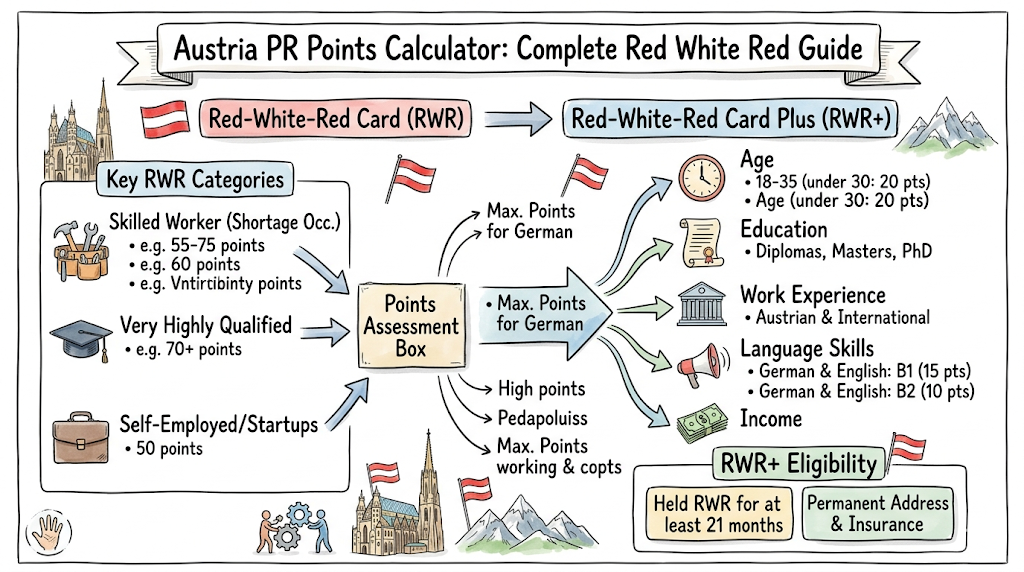
The Red-White-Red Card (RWR Card) is the primary combination work and residence permit for non-EU citizens in Austria. It is named after the colors of the Austrian flag and grants you the right to reside in the country and work for a specific employer.
The RWR Card is not a single, one-size-fits-all visa. It is divided into distinct operational categories, each tailored to different professional backgrounds and labor market needs. Let us explore the four main streams:
Very Highly Qualified Workers
This stream is designed for top-tier global professionals, scientists, researchers, and senior corporate executives. It is unique because it allows you to apply for a 6-month “Job Seeker Visa” even if you do not have an Austrian job offer yet. If you score enough points, you can enter the country to look for a job.
Skilled Workers in Shortage Occupations
If your profession is listed on Austria’s official annual Shortage Occupations List (Mangelberufe), this is your pathway. The list covers fields like software engineering, mechanical techniques, electrical trades, healthcare, and specialized construction roles. It features a lower point threshold to help companies fill critical vacancies rapidly.
Other Key Workers
This category accommodates professionals whose jobs are not on the shortage list but who bring valuable expertise to Austrian companies. To qualify under this stream, you must meet a legally mandated minimum monthly gross salary threshold, and the employer must pass a labor market test.
Startup Founders
Austria welcomes innovative entrepreneurs who want to establish scalable businesses that boost the local economy. Instead of a standard corporate job offer, your qualification is assessed based on a detailed business plan, committed investment capital, and a points system focused on entrepreneurial skill.
To help you see the differences at a glance, here is a breakdown of how these categories compare:
| Category | Minimum Points Required | Total Points Possible | Job Offer Required? | Primary Requirement Highlights |
| Very Highly Qualified Workers | 70 points | 100 points | No (Can use Job Seeker Visa) | MINT degree, senior salary background, research awards |
| Skilled Workers in Shortage Occupations | 55 points | 90 points | Yes | Qualification must match the official shortage list |
| Other Key Workers | 55 points | 90 points | Yes | High minimum salary, passing the local market test |
| Startup Founders | 50 points | 85 points | No (Requires Business Plan) | €50,000+ capital, innovative business model |
How Austria PR Points Are Calculated
Calculating your point score involves identifying your specific category and checking your profile elements against the official statutory scoring grids. Let us look at how the government calculates points for the two most popular tracks: Skilled Workers in Shortage Occupations and Very Highly Qualified Workers.
1. Points Grid for Skilled Workers in Shortage Occupations
This stream operates on a maximum scale of 90 points, plus 5 bonus points for English corporate environments. You need a minimum of 55 points to pass.
- Qualifications (Maximum 30 Points):
- Completed vocational training in the shortage occupation: 30 points
- General university entrance qualification (Matura/Abitur equivalent): 25 points
- Graduation from a 3-year university or tertiary institution: 30 points
- Work Experience (Maximum 20 Points):
- General relevant work experience: 1 point per half-year (2 points per full year)
- Work experience gained inside Austria: 2 points per half-year (4 points per full year)
- Language Skills (Maximum 25 Points):
- German language competency: A1 level = 5 points | A2 level = 10 points | B1 level = 15 points
- English language competency: A2 level = 5 points | B1 level = 10 points
- French, Spanish, or Bosnian/Croatian/Serbian language competency: B1 level = 5 points
- Age Factor (Maximum 15 Points):
- Up to 30 years of age: 15 points
- Up to 40 years of age: 10 points
- Up to 50 years of age: 5 points
- Company Language Bonus:
- Extra points if the company’s language of instruction is English: 5 points
2. Points Grid for Very Highly Qualified Workers
This elite stream operates on a maximum scale of 100 points. You need a minimum of 70 points to pass and qualify for the Job Seeker Visa or direct RWR Card.
- Special Qualifications and Skills (Maximum 40 Points):
- Graduation from a 4-year higher education institution: 20 points
- Degree completed in a MINT subject area: 30 points
- Post-doctoral qualification (Habilitation) or PhD: 40 points
- Gross annual salary from a senior management role in the previous year: €50,000 to €60,000 = 20 points | €60,000 to €70,000 = 25 points | Over €70,000 = 30 points
- Research and innovation activities (patents, publications): 20 points
- Recognized international prizes or awards: 20 points
- Work Experience (Maximum 20 Points):
- General matching senior experience: 1 point per half-year
- Work experience built directly inside Austria: 10 points for 6 months
- Language Skills (Maximum 10 Points):
- German or English proficiency: A1 level = 5 points | A2 level = 10 points
- Age Factor (Maximum 20 Points):
- Under 35 years of age: 20 points
- Under 40 years of age: 15 points
- Under 45 years of age: 10 points
- Austrian Academic Studies (Maximum 10 Points):
- Completed a full Bachelor’s and Master’s program in Austria: 10 points
Real-Life Sample Profile Calculation
Let us trace a calculation for an imaginary applicant named Carlos to see how these numbers apply in a real scenario.
- Applicant Profile: Carlos is 32 years old, holds a 4-year Bachelor’s degree in Electrical Engineering (a listed shortage occupation), has 4 years of verified international experience, holds a German A2 certificate, and holds an English B1 certificate. His prospective employer operates primarily in English.
- Category Evaluated: Skilled Workers in Shortage Occupations
Let us calculate his points item by item:
- Education: His degree matches his technical shortage field perfectly, giving him 30 points.
- Work Experience: 4 years of experience translates to 8 half-years. At 1 point per half-year, he scores 8 points.
- Age: Being 32 puts him in the “Up to 40” tier, awarding him 10 points.
- Language: His German A2 level gives him 10 points. His English B1 gives him another 10 points. The system takes the highest language score within a language, capped at a maximum allowable category ceiling of 25. He scores 20 points total for languages.
- Company Language Bonus: The company uses English as its core language, giving him an additional 5 points.
Total Points Score: 30 + 8 + 10 + 20 + 5 = 73 Points.
Since 73 points is well above the required 55-point minimum threshold for shortage occupations, Carlos is legally eligible to proceed with his Red-White-Red Card application.
Step-by-Step Application Process
Navigating the Austrian immigration pathway requires following a specific sequence of administrative steps. Missing a step or completing them out of order can lead to processing delays or application rejections.
Step 1: Check Your Initial Eligibility
Before taking action, map out your profile components. Use an online calculator or point tables to check your score against the required thresholds. Identify whether your profile fits best under Shortage Occupations, Key Workers, or Very Highly Qualified Workers.
Step 2: Collect and Legalize All Documents
Gather all supporting paperwork, including academic degrees, language test certificates, and detailed employer reference letters. Ensure that documents written in languages other than German or English are translated by a certified translator, and obtain necessary apostilles or embassy legalizations.
Step 3: Secure a Binding Job Offer
Unless you qualify for the Very Highly Qualified Job Seeker Visa, you must have a binding job offer from an employer registered in Austria. The job offer must state your exact responsibilities, working hours, and a gross salary that meets the legal minimum standards for that occupation.
Step 4: Submit Your Official Application
You can submit your application yourself at the competent Austrian embassy or consulate in your home country. Alternatively, your future Austrian employer can file the application directly with the local immigration office (such as MA 35 in Vienna) inside Austria on your behalf.
Step 5: The Public Employment Service (AMS) Evaluation
Once received, the immigration office forwards your files to the AMS. The AMS checks if your degree matches your job description, verifies your point claims, and runs a labor market test if your visa category requires one. This assessment is the most critical stage of the entire process.
Step 6: Approval and Visa Issuance
If the AMS issues a positive recommendation, the immigration office approves your Red-White-Red Card. You will receive a notification to collect your D-Visa to enter Austria, or you can pick up your physical residence card directly if you are already inside the country legally.
Documents Required
When applying for your Red-White-Red Card, providing clear, verifiable evidence for every point you claim on the calculator is vital. The authorities will not award points based on self-declarations; they require official paperwork.
Make sure you compile a complete application file containing these essential documents:
- Valid Passport: A current passport that remains valid for the entire initial duration of your residency period.
- Birth Certificate: Your official birth document, complete with certified translations and necessary international legalizations.
- Passport-Sized Photographs: Recent biometric photos taken within the past six months according to European visa specifications.
- Academic and Training Degrees: Your diplomas, university transcripts, vocational course completions, and official recognition certificates.
- Detailed Work Experience Letters: Reference letters from previous employers stating your exact job titles, start and end dates, and daily responsibilities.
- Language Certificates: Test results from recognized institutions (such as Goethe-Institut, ÖSD, IELTS, or TOEFL) that are less than five years old.
- Signed Employment Contract: A signed contract or a formal employer declaration (Arbeitgebererklärung) outlining your role and salary details.
- Proof of Local Accommodation: A lease agreement or accommodation contract showing where you will reside once you arrive in Austria.
- Valid Travel Health Insurance: Comprehensive medical insurance coverage valid from your date of entry until your local Austrian public insurance activates.
Processing Time & Validity
Processing Time
The official statutory processing window for an Austrian Red-White-Red Card application is roughly 8 weeks. This timeline starts from the moment your complete application file—with all required documents—is submitted to the authorities.
However, if the immigration office or the AMS needs to request additional documents or clarifications, the clock pauses, which can extend the processing time to 3 or 4 months.
Visa Validity
The initial Red-White-Red Card is valid for exactly 24 months (two years). It is legally tied to the specific employer and the exact job role described in your original application. If you want to change jobs during these first two years, you must file a new application with the authorities first.
Path to Permanent Residency (RWR Card Plus)
After working for at least 21 months out of those initial 24 months under your RWR card, you become eligible to upgrade to a Red-White-Red Card Plus. This upgraded card gives you unrestricted access to the Austrian labor market.
This means you can change employers, move across states, or start your own business without needing a new points evaluation. Holding the RWR Card Plus paves the way for you to secure long-term permanent residency (Settlement Permit) after five years of continuous residence, and eventually apply for Austrian citizenship.
How to Increase Your Austria PR Points
If your initial calculations show you are just a few points short of the passing threshold, do not worry. The points system is dynamic, meaning you can take specific steps to strengthen your profile and reach your target score.
Consider these practical strategies to boost your points total:
- Learn and Improve Your German Language Skills: This is often the fastest and most reliable way to gain extra points. Moving from no German knowledge to an A2 or B1 level can add 10 to 15 points to your file, while helping you stand out to local employers.
- Gain More Verified Work Experience: If you are close to the threshold, working for another 6 to 12 months in your home country can add valuable points to your experience section.
- Target Shortage Occupations Explicitly: Check the annual Shortage Occupations List. If your background spans multiple roles, tailor your job hunt toward the specific positions facing severe shortages, as they feature a more accessible 55-point passing threshold.
- Secure an English Corporate Language Declaration: If you find a role at an international or tech firm where English is the primary language, ensure your employer notes this clearly in their declaration to help you secure the 5-point corporate bonus.
- Pursue Continuing Education or Certifications: Completing a relevant postgraduate diploma, advanced technical certification, or degree program can elevate your qualifications score to the next tier.
Common Mistakes Applicants Make
Even highly qualified professionals can face application rejections due to simple oversights. Being aware of these common mistakes can help you keep your application process on track:
- Selecting the Wrong Application Category: Applicants often apply under “Other Key Workers” when their job is actually on the shortage list, or they try to claim points for the “Very Highly Qualified” stream without meeting its strict criteria.
- Submitting Incomplete Work Experience Proof: Sending a basic appointment letter that does not describe your day-to-day duties is a frequent pitfall. The AMS needs to see detailed responsibilities to verify that your experience matches your job role.
- Presenting Expired or Unrecognized Language Tests: Language certificates must be less than 5 years old when you submit your application. Additionally, they must come from accredited providers like IELTS or Goethe; general institute certificates will not be accepted.
- Forgetting Document Legalization (Apostilles): Failing to obtain required apostilles or embassy stamps for your degrees and birth certificates can cause your application to be returned immediately, resulting in significant delays.
- Applying Without a Valid Job Offer: Unless you hold a specific 6-month Job Seeker Visa for Very Highly Qualified Workers, you cannot apply for an RWR Card without a confirmed job contract from an Austrian employer.
Real-Life Examples
Let us look at three realistic examples of how different applicants navigate the Austria PR points system based on their specific backgrounds.
Example 1: The IT Professional Seeking an Austria Skilled Worker Visa
- Profile: Priya is a 29-year-old software developer from India. She holds a 4-year Bachelor’s degree in Computer Science (a MINT subject) and has 3.5 years of experience in web development. She has a confirmed job offer from a tech firm in Vienna with an English-speaking office. She holds an English B1 certificate but does not speak German.
- Points Estimation:
- Education: 30 points (Shortage occupation matching degree)
- Work Experience: 7 half-years = 7 points
- Age: 29 years old = 15 points
- Language: English B1 = 10 points
- Bonus: Corporate English language environment = 5 points
- Total Points Score: 30 + 7 + 15 + 10 + 5 = 67 Points
- Outcome: Priya passes the 55-point threshold for shortage occupations with ease. Her application is approved, and she moves to Vienna on a Red-White-Red Card.
Example 2: A Skilled Trades Worker with Moderate Experience
- Profile: Marco is a 38-year-old industrial electrician from South America. He has a verified vocational training certificate in electrical systems and 8 years of international experience. He holds a German A2 language certificate and has received a job offer from an engineering firm in Graz.
- Points Estimation:
- Education: 30 points (Completed vocational training in a listed shortage occupation)
- Work Experience: Maxed out at 20 points (16 half-years)
- Age: 38 years old = 10 points
- Language: German A2 = 10 points
- Total Points Score: 30 + 20 + 10 + 10 = 70 Points
- Outcome: Marco easily clears the 55-point minimum requirement. Because his vocational credentials align with the shortage list and his experience is well-documented, his RWR card is issued smoothly.
Example 3: A Non-EU Student Transitioning to a Work Visa
- Profile: Lin is a 25-year-old Chinese national who just completed her Master’s degree in International Business at an Austrian university in Vienna. She has found an entry-level position at a logistics firm offering a salary that matches local collective agreements for graduates.
- Points Estimation:
- Special Path: As a graduate of an Austrian university, Lin’s application is exempt from the standard points calculator grid.
- Outcome: Lin does not need to calculate points. Because she found a job within 12 months of graduating that matches her educational level and meets the minimum salary standard, she transitions directly to a Red-White-Red Card.
FAQs
- What is Austria PR Points Calculator?
The Austria PR Points Calculator is a points-based evaluation grid used by immigration authorities to grade your education, experience, age, and language skills for the Red-White-Red Card.
2. Is German required for Austria PR?
No, German is not mandatory for every stream. You can qualify using English skills if your job role and corporate environment support it, though knowing German provides valuable extra points.
3. How many points are needed?
You need a minimum of 55 points out of 90 for the Shortage Occupations and Key Workers streams, and at least 70 points out of 100 if you apply as a Very Highly Qualified Worker.
4. Can I apply without job offer?
Only applicants who qualify under the “Very Highly Qualified Workers” stream can apply for a 6-month Job Seeker Visa without a job offer. All other categories require a binding job offer first.
5. How long does RWR Card take?
The standard processing time is approximately 8 weeks once a complete application with all supporting documents is submitted to the immigration office.
6. Can I convert RWR to PR?
Yes, after holding the initial Red-White-Red Card for 21 months and maintaining continuous employment, you can upgrade to an RWR Card Plus, which serves as your direct bridge to permanent residency after 5 years.
7. What counts as a shortage occupation in Austria?
Shortage occupations include roles facing local labor deficits, such as software engineers, mechanical technicians, nurses, doctors, electricians, and various specialized construction trades.
8. Are university graduates from Austria subject to the points system?
No, third-country nationals who graduate from an Austrian university are exempt from the points system, provided they secure a matching job offer within 12 months of graduation.
9. How long is the initial Red-White-Red Card valid?
The card is issued for a duration of 24 months (2 years) and is tied directly to the employer specified in your visa application.
10. Can I bring my family members to Austria with me?
Yes, holders of a Red-White-Red Card are entitled to bring their spouse and dependent minor children to Austria through family reunification streams, and family members receive unrestricted work rights.
Conclusion
Navigating a move to Europe can feel complex, but the Austria Red-White-Red Card system makes the process clear, predictable, and manageable. By using a merit-based points framework, Austria gives you total clarity over your immigration pathway. You can see exactly how your education, skills, and hard work translate into legal residency. Taking the time to evaluate your profile with an Austria PR eligibility calculator allows you to plan your journey with confidence. Whether you need to improve your language skills, gather more detailed employment references, or target specific shortage roles, knowing your points position gives you the power to make informed decisions. Austria offers an exceptional quality of life, robust economic stability, and a wonderful environment to grow both personally and professionally. Step forward with confidence, organize your documentation carefully, and start your journey toward building a rewarding career and life in the heart of Europe.