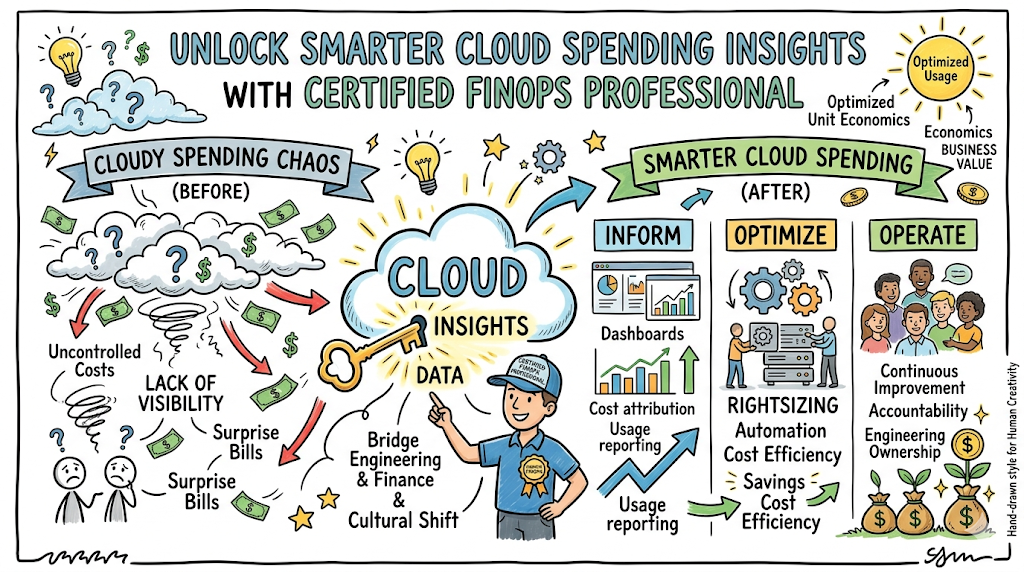
The Certified FinOps Professional is an advanced accreditation designed for individuals who have moved beyond basic cloud literacy and are now tasked with managing complex cloud financial ecosystems. This guide is written for engineers, financial analysts, and platform leaders who need to bridge the gap between variable cloud spending and business value. In the modern landscape of DevOps and platform engineering, financial accountability is no longer a separate function but a core engineering discipline. This guide provides a clear roadmap to help professionals navigate the certification process and make informed decisions about their career trajectory in cloud financial management at Finopsschool.
What is the Certified FinOps Professional?
The Certified FinOps Professional represents the gold standard for practitioners who need to implement FinOps frameworks in large-scale, production environments. Unlike entry-level certifications that focus on terminology, this program emphasizes the operationalization of the Inform, Optimize, and Operate phases within an enterprise. It exists because cloud waste has become a critical business risk, and organizations require experts who can align engineering velocity with fiscal responsibility.
It aligns perfectly with modern workflows by treating “cost” as a first-class metric, similar to performance or security, ensuring that cloud-native architectures remain sustainable. The curriculum focuses on driving a culture of accountability where every engineer understands the financial impact of their infrastructure choices. This certification validates that a professional can handle the complexities of multi-cloud billing, shared cost allocation, and unit economics at an expert level.
Who Should Pursue Certified FinOps Professional?
This certification is specifically built for cloud architects, SREs, and DevOps engineers who are responsible for infrastructure costs, as well as finance professionals and procurement officers who need to understand technical nuances. It is equally valuable for engineering managers who must justify department budgets and technical leaders who are building internal platform teams. It serves as a bridge for professionals moving from traditional finance into the world of variable, consumption-based cloud spending.
From a global perspective, and particularly within the rapidly expanding tech hubs in India, there is a massive shift toward “cost-aware” engineering. Whether you are a beginner looking for a niche or a veteran manager aiming for executive roles, this certification provides the necessary credibility to lead financial transformations. It is ideal for those who want to move beyond administrative tasks and into a strategic role that directly impacts the company’s bottom line.
Why Certified FinOps Professional is Valuable and Beyond
The demand for FinOps expertise is skyrocketing as enterprises realize that moving to the cloud does not automatically result in cost savings without active management. As companies move past the initial migration phase, the focus has shifted toward long-term longevity and maximizing the return on investment for every dollar spent on cloud providers. This certification helps professionals stay relevant even as specific cloud tools evolve, because it teaches the underlying principles of financial accountability.
It offers a high return on career investment by positioning you as a strategic asset who understands both the technical command line and the financial profit and loss statement. Organizations are actively seeking experts who can prevent “bill shock” and ensure that cloud growth remains profitable. By mastering these skills, you ensure your career path remains stable and lucrative, regardless of shifts in specific vendor technologies or market fluctuations.
Certified FinOps Professional Certification Overview
The program is delivered via the official Certified FinOps Professional course and hosted on the Finopsschool platform. It is structured as a rigorous assessment of a practitioner’s ability to drive cultural change and technical optimization across an entire organization. The certification levels range from foundational understanding to professional mastery, focusing on the ownership of cloud spend across different business units and engineering teams.
It uses a practical approach, requiring candidates to demonstrate how they would handle real-world scenarios such as unallocated shared costs and commitment-based discount management. The assessment verifies that you can not only identify savings but also implement the governance needed to maintain those savings over time. It is designed to be highly operational, moving beyond theory to ensure practitioners can deliver immediate value to their organizations through improved fiscal transparency.
Certified FinOps Professional Certification Tracks & Levels
The certification hierarchy begins with a Foundation level that introduces the core principles and terminology of the FinOps framework. The Professional level, which is the primary focus of this guide, delves into deep operational strategies, complex reporting, and cross-functional leadership. These tracks are designed to align with career progression, allowing an engineer to move from individual contributor roles to leadership positions where they manage the financial health of the entire cloud organization.
Advanced levels often involve specialization in specific cloud providers or complex multi-cloud environments where consolidated billing and global discounts are managed. These tracks ensure that a professional can grow their expertise as the organization’s cloud maturity increases. By following these levels, practitioners can build a comprehensive skill set that covers everything from simple cost reporting to advanced automated cloud governance and strategic financial planning.
Complete Certified FinOps Professional Certification Table
| Track | Level | Who it’s for | Prerequisites | Skills Covered | Recommended Order |
| FinOps Core | Foundation | New Practitioners | Basic Cloud Knowledge | FinOps Principles, Lifecycle | First |
| FinOps Core | Professional | Experienced Leads | Foundation Cert + Exp | Unit Economics, Tooling | Second |
| Specialized | Advanced | Architects / Directors | Professional Cert | Multi-cloud, Governance | Third |
| Executive | Leadership | Finance Directors | Professional Cert | Strategic Planning, KPIs | Optional |
Detailed Guide for Each Certified FinOps Professional Certification
Certified FinOps Professional – Foundation
What it is
This certification validates a foundational understanding of the FinOps lifecycle and its core principles. It ensures the candidate understands how to bring financial accountability to the variable spend model of the cloud.
Who should take it
This is suitable for junior cloud engineers, project managers, and finance teams who are new to cloud financial management. It is the perfect entry point for anyone wanting to speak the language of cloud economics and understand basic billing structures.
Skills you’ll gain
- Understanding the 6 FinOps Principles.
- Knowledge of the Inform, Optimize, and Operate phases.
- Ability to define key FinOps personas and their responsibilities.
- Understanding cloud billing models and commitment discounts.
Real-world projects you should be able to do
- Create basic cost allocation tags for a small project.
- Generate monthly spend reports using native cloud provider tools.
- Identify immediate “low-hanging fruit” for cost savings, like unattached storage.
Preparation plan
- 7-14 Days: Review official glossary and attend introductory webinars to understand the core lifecycle.
- 30 Days: Complete the self-paced foundation course and practice quizzes to solidify technical terms.
- 60 Days: Participate in community forums and review basic case studies of cloud cost migrations.
Common mistakes
- Focusing too much on technical optimization and ignoring the cultural/financial aspects.
- Memorizing definitions without understanding how they apply to the FinOps lifecycle.
Best next certification after this
- Same-track option: Certified FinOps Professional.
- Cross-track option: Cloud Practitioner (AWS/Azure/GCP).
- Leadership option: Project Management Professional.
Certified FinOps Professional – Professional
What it is
This is the flagship certification that proves an individual can lead a FinOps team and implement complex cost management strategies. It validates deep expertise in cloud financial operations and cross-functional stakeholder management.
Who should take it
Senior DevOps engineers, Cloud Architects, and FinOps Practitioners with hands-on experience. This is for those who are responsible for the financial health of production-scale environments and long-term cloud strategy.
Skills you’ll gain
- Designing enterprise-wide tagging and account structures.
- Managing Reserved Instances and Savings Plans portfolios.
- Implementing automated cost anomaly detection.
- Communicating unit economics and business value to executives.
Real-world projects you should be able to do
- Build a cross-provider cost dashboard using third-party or custom tools.
- Negotiate and manage a multi-million dollar cloud commitment strategy.
- Establish a “showback” or “chargeback” model for a large engineering org.
Preparation plan
- 7-14 Days: Deep dive into advanced commitment strategies and discount logic across multiple vendors.
- 30 Days: Review case studies on organizational change and building a FinOps culture.
- 60 Days: Hands-on implementation of automated guardrails and reporting in a production-like lab environment.
Common mistakes
- Underestimating the complexity of shared cost allocation in containerized environments.
- Failing to account for the human element of getting engineers to prioritize cost over speed.
Best next certification after this
- Same-track option: FinOps Specialized Certifications.
- Cross-track option: Certified Kubernetes Administrator.
- Leadership option: Engineering Manager Certification.
Choose Your Learning Path
DevOps Path
The DevOps professional focuses on integrating financial feedback loops directly into the CI/CD pipeline. By achieving this certification, a DevOps engineer learns how to use cost data as a deployment gate, ensuring that new features do not accidentally exceed the budget. This path emphasizes automation, where cost metrics are treated like performance metrics, allowing for automated scaling that is fiscally responsible. It bridges the gap between infrastructure as code and cost as code, making the engineer a more versatile asset.
DevSecOps Path
In this path, the focus is on the intersection of security, compliance, and cost management. Professionals learn how security configurations, such as data retention policies or high-availability setups, impact the total cost of ownership. The certification helps these practitioners find the balance between a hardened, secure environment and a cost-optimized one. They learn to identify where redundant security tools or oversized logging may be inflating cloud bills without adding defensive value.
SRE Path
Site Reliability Engineers use this certification to balance the “Error Budget” with the “Financial Budget.” The SRE path focuses on the cost of reliability, helping engineers understand when over-provisioning for uptime becomes a case of diminishing returns. It enables SREs to build more efficient systems by identifying the financial impact of architectural choices like multi-region failover. This ensures that the platform is both reliable and economically sustainable for the business in the long run.
AIOps Path
For those specializing in AIOps, this certification is vital for managing the costs associated with the heavy compute power required for AI-driven operations. It focuses on optimizing the cost of running large-scale data ingestion and automated monitoring systems. Practitioners learn to apply FinOps principles to the specific billing nuances of observability tools and automated remediation platforms. This ensures that the automation itself does not become an unmonitored and expensive overhead.
MLOps Path
The MLOps path addresses the unique financial challenges of machine learning lifecycles, from training expensive models to deploying them at scale. Certified professionals learn how to optimize GPU utilization, manage data egress costs during model training, and choose the most cost-effective serving architectures. Since ML workloads can be incredibly volatile in terms of cost, this path provides the specialized knowledge needed to ensure that innovation in AI remains profitable and scalable for the enterprise.
DataOps Path
DataOps practitioners use this certification to manage the costs of massive data lakes, warehouses, and transformation pipelines. They learn to distinguish between high-value data and “dark data” that is costing money to store but providing no insights. This path focuses on storage tiering, query optimization, and the financial implications of different data processing frameworks. It empowers data engineers to build pipelines that are as efficient in their resource consumption as they are in their delivery.
FinOps Path
This is the dedicated path for those who want to specialize exclusively in cloud financial management as their primary career. It covers the full spectrum of the discipline, from technical optimization to financial reporting and organizational culture. These practitioners become the central hub of communication between the engineering, finance, and executive teams. They are responsible for the overall success of the FinOps practice and driving the continuous improvement of cloud value across the entire global enterprise.
Role → Recommended Certified FinOps Professional Certifications
| Role | Recommended Certifications |
| DevOps Engineer | Foundation, Professional |
| SRE | Professional |
| Platform Engineer | Foundation, Professional |
| Cloud Engineer | Foundation |
| Security Engineer | Foundation |
| Data Engineer | Foundation, Professional |
| FinOps Practitioner | Foundation, Professional, Advanced |
| Engineering Manager | Foundation, Professional |
Next Certifications to Take After Certified FinOps Professional
Same Track Progression
For those looking to deepen their specialization, the logical next step is to pursue advanced certifications that focus on multi-cloud governance or specific provider expertise. This allows you to combine high-level FinOps strategy with deep technical knowledge of specific cloud ecosystems like AWS, Azure, or GCP. You might also look into specialized certifications for cloud billing tools and third-party management platforms to broaden your technical toolkit and reporting capabilities.
Cross-Track Expansion
If you want to broaden your skills, consider certifications in container orchestration, such as the Certified Kubernetes Administrator. Since Kubernetes introduces significant complexity to cost allocation, having a deep understanding of the underlying technology is a massive advantage. Alternatively, look toward cloud security certifications, as the intersection of cost and security is a major area of concern for modern enterprises looking to protect their financial and data assets.
Leadership & Management Track
For those transitioning into leadership, a project management certification or an MBA can complement your technical and financial expertise. The ability to speak both “engineer” and “CFO” is a rare skill set that is highly valued in senior management. Leadership tracks focus on the organizational change aspects of FinOps, such as building teams, setting long-term strategy, and driving a culture of accountability across different departments and global offices.
Training & Certification Support Providers for Certified FinOps Professional
DevOpsSchool
DevOpsSchool provides a comprehensive ecosystem for professionals looking to master the technical and financial aspects of cloud operations. Their training programs are designed to be hands-on, ensuring that students do not just learn the theory but also the practical application of tools like Terraform and FinOps frameworks. With a strong presence in the training industry, they offer a blend of live sessions and recorded content tailored for working professionals. Their curriculum is updated frequently to reflect the latest industry shifts, making them a reliable partner for upskilling.
Cotocus
Cotocus specializes in high-end consulting and technical training, focusing on niche areas like SRE, FinOps, and Platform Engineering. They are known for their mentor-led approach, where experienced industry veterans guide students through complex real-world scenarios. Their training is highly interactive and designed to help professionals transition into high-paying roles by bridging the skill gap between traditional IT and modern cloud-native practices. Cotocus provides a robust platform for learning the nuances of cloud financial management and strategic governance.
Scmgalaxy
Scmgalaxy has been a staple in the software configuration management and DevOps community for years, providing a wealth of resources, blogs, and tutorials. Their training programs are deeply rooted in practical engineering, covering everything from version control to cloud economics. They offer specialized tracks for FinOps that help engineers understand the financial impact of their code and infrastructure decisions. By leveraging their extensive library of community-driven content, candidates can gain a well-rounded perspective on how FinOps integrates with the software delivery lifecycle.
BestDevOps
BestDevOps focuses on delivering streamlined, high-impact training for modern engineering roles. Their approach is centered on “learning by doing,” providing students with access to labs and sandboxes where they can practice cost optimization techniques in a safe environment. They offer specialized coaching for various cloud certifications, including FinOps tracks, ensuring that candidates are well-prepared for both the exam and the actual job. Their focus on practical outcomes makes them an excellent choice for engineers who want to quickly gain actionable skills.
Devsecopsschool.com
This provider is the go-to resource for professionals who want to integrate security into every stage of the lifecycle, including financial operations. They provide specialized courses that explore the relationship between secure architectures and cost efficiency. Their training covers how to manage the financial overhead of security tools and how to build “secure-by-design” systems that are also cost-optimized. By focusing on this critical intersection, they help professionals develop a unique skill set that is in high demand in regulated industries.
Sreschool.com
This platform focuses on the principles of site reliability and how they translate to business value. Their training programs emphasize the importance of balancing system performance and availability with financial constraints. They offer courses that teach SREs how to use FinOps data to inform their reliability strategies, such as determining the cost of high availability. This provider offers a unique perspective on how to manage the trade-offs between technical excellence and fiscal responsibility, ensuring that platforms are built to be both resilient and economically viable.
Aiopsschool.com
This school provides cutting-edge training in the field of artificial intelligence for IT operations. Their curriculum covers how to use AI and machine learning to automate complex tasks, including cost anomaly detection and predictive billing. They help professionals understand the financial implications of deploying AI at scale and how to optimize the underlying infrastructure for cost. Their focus on the future of operations makes them an ideal choice for forward-thinking engineers who want to combine FinOps principles with intelligent systems.
Dataopsschool.com
This provider addresses the growing need for financial management within data engineering and analytics teams. Their training programs focus on the specific challenges of data egress, storage costs, and the financial impact of different data architectures. They teach DataOps practitioners how to apply FinOps frameworks to large-scale data projects, ensuring that insights are delivered without exceeding the budget. By providing a deep understanding of data-specific cloud billing, they prepare candidates to take a lead role in their data ecosystem.
This is the primary authority and hosting site for the Certified FinOps Professional program. They offer the most direct and comprehensive path to certification, with curriculum developed by the pioneers of the FinOps movement. Their training is designed to cover every aspect of the discipline, from the foundational principles to advanced operational strategies. By learning directly from the source, candidates ensure they are getting the most accurate and up-to-date information available in the industry.
Frequently Asked Questions (General)
- How difficult is the certification?The Foundation level is relatively accessible for those with basic cloud knowledge, but the Professional level is quite challenging, requiring a deep understanding of both engineering and finance.
- How much time does it take to prepare?Most professionals spend 2-4 weeks for the Foundation and 2-3 months for the Professional level, depending on their existing hands-on experience with cloud billing and architecture.
- Are there any mandatory prerequisites?The Foundation exam usually has no prerequisites, but the Professional level often requires either the Foundation certification or a certain amount of documented experience in the field.
- Is there a strong ROI for this certification?Yes, FinOps is one of the fastest-growing niches in cloud. Certified professionals often see significant salary bumps and are recruited for high-level strategic and leadership roles.
- Do I need to be good at math?You don’t need to be a mathematician, but you should be comfortable with basic financial concepts, percentages, and analyzing data in spreadsheets or dashboards.
- Does this certification focus on one cloud provider?No, it is designed to be cloud-agnostic, focusing on the principles of FinOps that apply to AWS, Azure, Google Cloud, and even hybrid environments.
- How long is the certification valid?Most certifications in this field are valid for two or three years, after which you must renew by passing an update exam or earning continuing education credits.
- Can a non-engineer take this certification?Absolutely. It is highly valuable for finance, procurement, and business analysts who work closely with cloud-consuming engineering teams and need to understand technical billing.
- Is the exam proctored?Yes, most professional-level exams are proctored online or at a testing center to ensure the integrity and global recognition of the certification.
- Are there practice exams available?Yes, most training providers and the official hosting site offer practice tests to help you get used to the question format and the strict timing of the exam.
- How does this differ from a cloud architect certification?Architect certs focus on “how to build” a technical solution, while FinOps certs focus on “how to build efficiently and manage the ongoing cost” of that solution.
- Can I take the exam in India?Yes, the certification is available globally and is highly sought after by major tech firms, startups, and global capability centers based in India.
FAQs on Certified FinOps Professional
- What is the primary focus of the professional level exam?The exam focuses heavily on your ability to handle complex scenarios like container cost allocation and managing global commitment-based discounts at scale.
- Does the certification cover third-party tools?While the exam is cloud-agnostic, you are expected to understand the capabilities of various third-party platforms and how they integrate with native cloud provider billing tools.
- How does FinOps integrate with Agile methodologies?FinOps enables Agile teams to take ownership of their costs by providing real-time financial feedback, allowing them to adjust their resource consumption as quickly as they develop code.
- Is the certification recognized by major cloud providers?Yes, major cloud providers recognize the FinOps framework as the industry standard for cloud financial management and often refer to these principles in their own documentation.
- What is the passing score for the Professional exam?Passing scores vary by version but typically require a high level of proficiency across all domains, including the cultural, technical, and financial aspects of the framework.
- Can this certification lead to a Director-level role?Yes, many organizations are now creating “Director of Cloud FinOps” roles, and this certification is a key requirement for those moving into executive-level cloud management.
- How does the certification handle multi-cloud environments?The curriculum specifically addresses the challenges of multi-cloud, including consolidated reporting, data egress management, and normalizing billing data across different vendors.
- Is there a community for certified professionals?Yes, being certified gives you access to a global network of practitioners who share best practices, case studies, and job opportunities in the FinOps space.
Final Thoughts: Is Certified FinOps Professional Worth It?
If you are looking for a way to differentiate yourself in a crowded DevOps and cloud engineering market, the Certified FinOps Professional is absolutely worth the effort. It moves you from being a person who simply builds systems to a professional who understands the business value and sustainability of those systems. My advice as a mentor is to treat this not just as a test to pass, but as a discipline to master.
The world doesn’t just need more people who can spin up servers; it needs people who can manage them wisely. This certification gives you the framework to do exactly that, making you an indispensable part of any modern engineering organization. It is an investment in your ability to lead, optimize, and deliver real financial impact in a cloud-first world.