Introduction
The Certified FinOps Engineer represents a critical shift in how modern enterprises manage their cloud infrastructure. As cloud environments scale, the complexity of billing and resource management often leads to significant financial waste, making specialized financial operations knowledge essential for technical teams. This guide is designed for software engineers, DevOps practitioners, and managers who want to transition from simply building in the cloud to building with financial accountability. By following this roadmap, professionals can align their technical skills with business value, ensuring their organizations optimize every dollar spent on cloud resources at Finopsschool. This comprehensive overview will help you navigate the certification landscape and make informed decisions about your career trajectory in the evolving world of cloud-native engineering.
What is the Certified FinOps Engineer?
The Certified FinOps Engineer is a professional credential that validates an individual’s ability to apply financial management principles to the technical architecture of cloud computing. It exists to bridge the gap between traditional engineering and corporate finance, ensuring that the variable cost model of the cloud is managed effectively. Instead of focusing solely on theoretical knowledge, this certification emphasizes real-world application, such as implementing automated cost-optimization scripts and interpreting complex billing data from major cloud providers.
This program aligns perfectly with modern enterprise practices where cloud spending is no longer a fixed cost but a dynamic variable that impacts the bottom line. It teaches engineers how to integrate cost-awareness into their daily workflows, from selecting the right instance types to managing storage lifecycles. By focusing on production-level practices, the certification ensures that professionals can contribute to a culture of accountability where engineering decisions are informed by financial impact.
Who Should Pursue Certified FinOps Engineer?
This certification is highly beneficial for a wide range of roles, including DevOps engineers, Site Reliability Engineers (SREs), and Cloud Architects who are responsible for maintaining large-scale infrastructure. It is also an excellent choice for Engineering Managers and CTOs who need a strategic understanding of how cloud costs affect project budgets and company profitability. Security and Data professionals find value here as well, particularly when dealing with the high costs associated with data egress and security tooling.
The relevance of this program is global, with a particularly high impact in tech hubs across India and North America where enterprise cloud adoption is at an all-time high. For beginners, it provides a unique specialization that sets them apart in a competitive job market. For experienced professionals, it offers a way to validate their expertise in cost-optimization and governance, making them indispensable assets to any organization looking to improve its cloud margins and operational efficiency.
Why Certified FinOps Engineer is Valuable Today and Beyond
In the current landscape of enterprise technology, the demand for cloud efficiency has never been higher, as companies move away from unchecked growth toward sustainable profitability. This certification ensures longevity in a career because while specific cloud tools or providers may change, the fundamental need to manage costs and maximize value remains constant. It provides engineers with a strategic mindset that goes beyond simple coding, allowing them to participate in high-level business discussions.
The longevity of this skill set is backed by the increasing adoption of FinOps frameworks by Fortune 500 companies and startups alike. By earning this credential, you demonstrate a commitment to professional growth and an understanding of the return on investment for the time spent on learning. It prepares you to handle the financial complexities of next-generation technologies like serverless computing, edge networks, and massive-scale AI clusters, ensuring you remain a relevant and high-value contributor for years to come.
Certified FinOps Engineer Certification Overview
The program is delivered via the official training portal and is hosted on the primary website dedicated to financial operations education. It is structured to provide a clear progression from foundational knowledge to advanced technical implementation, ensuring that learners can grow their skills at a manageable pace. The assessment approach is designed to be practical, often requiring candidates to solve scenarios that mirror the challenges faced by real-world cloud teams.
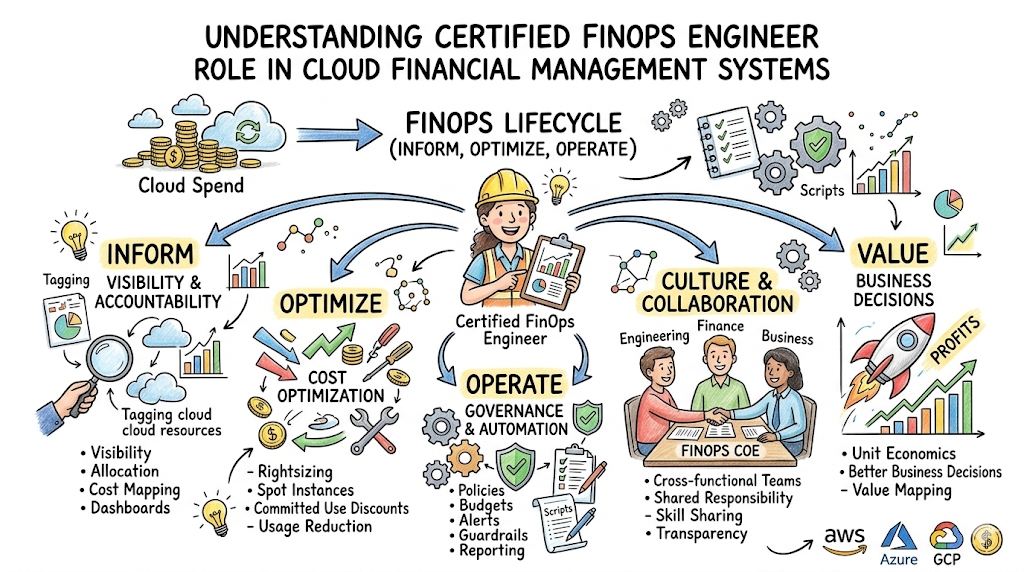
The certification structure focuses on the three main phases of the FinOps lifecycle: Inform, Optimize, and Operate. This approach ensures that ownership of cloud costs is shared across the organization rather than being siloed in the finance department. By completing the program, professionals gain a comprehensive framework for resource tagging, cost allocation, and performance benchmarking. This structured learning ensures that every participant leaves with a toolkit ready for immediate application in their professional environment.
Certified FinOps Engineer Certification Tracks & Levels
The certification is organized into three distinct levels: Foundation, Professional, and Advanced. The Foundation level is intended for those new to the domain, establishing a common language and understanding of cloud financial concepts. It is the baseline for anyone involved in cloud procurement or basic resource management. This level ensures that all stakeholders, from finance to engineering, are aligned on the core objectives of financial operations.
The Professional level is where the technical deep dive occurs, focusing on specialization tracks for DevOps, SRE, and Platform Engineering roles. At this level, candidates learn the specifics of automation, Kubernetes cost management, and advanced reporting techniques. The Advanced level is geared toward leadership and organizational strategy, teaching professionals how to build a FinOps Center of Excellence and drive cultural change across large enterprises. These levels provide a clear ladder for career progression within the cloud ecosystem.
Complete Certified FinOps Engineer Certification Table
| Track | Level | Who it’s for | Prerequisites | Skills Covered | Recommended Order |
| FinOps Foundation | Associate | Beginners, Managers | Basic Cloud Knowledge | Lifecycle, Tagging | 1st |
| Cloud Engineering | Professional | DevOps, SREs | Foundation Level | Automation, Optimization | 2nd |
| Platform Ops | Professional | Platform Engineers | Foundation Level | Governance, Scale | 3rd |
| Data & AI | Professional | Data Engineers | Foundation Level | Storage Cost, ML Ops | Optional |
| Enterprise Strategy | Advanced | Architects, Leads | Professional Level | Policy, CoE Building | 4th |
Detailed Guide for Each Certified FinOps Engineer Certification
Certified FinOps Engineer – Foundation Level
What it is
This certification validates a candidate’s basic understanding of the cloud billing model and the primary principles of financial operations. It serves as an entry point for professionals to prove they understand how to navigate cloud costs.
Who should take it
It is suitable for junior developers, non-technical managers, and finance professionals who work closely with engineering teams. It is ideal for anyone needing to speak the language of cloud finance.
Skills you’ll gain
- Understanding the difference between CapEx and OpEx.
- Mastering the “Inform, Optimize, Operate” lifecycle.
- Basic competency in reading cloud provider invoices.
- Ability to implement simple resource tagging strategies.
Real-world projects you should be able to do
- Create a basic cost visibility dashboard for a small development team.
- Identify unallocated cloud spend in a monthly billing report.
- Explain the financial impact of variable cloud pricing to a project manager.
Preparation plan
- 7-14 days: Review the core terminology and the official framework documentation.
- 30 days: Engage with online training modules and participate in community webinars.
- 60 days: Apply the concepts to a mock environment or a small personal cloud project.
Common mistakes
- Focusing only on technical skills and ignoring the cultural change aspects.
- Underestimating the importance of clear tagging and labeling policies.
Best next certification after this
- Same-track option: Professional Certified FinOps Engineer.
- Cross-track option: Cloud Practitioner (AWS/Azure/GCP).
- Leadership option: Certified FinOps Practitioner.
Certified FinOps Engineer – Professional Level
What it is
The Professional level is a technical certification that focuses on the actual implementation of cost-saving measures through code and automation. It proves you can build systems that manage themselves financially.
Who should take it
This is designed for DevOps engineers, SREs, and Sytems Administrators who have hands-on experience in cloud environments and want to specialize in technical efficiency.
Skills you’ll gain
- Writing automation scripts for resource scheduling and rightsizing.
- Managing Kubernetes cost allocation and namespace-level reporting.
- Implementing automated alerts for cost anomalies and budget thresholds.
- Designing advanced commitment models like Reserved Instances and Savings Plans.
Real-world projects you should be able to do
- Build an automated “clean-up” bot that deletes unattached storage volumes and elastic IPs.
- Deploy a cost-monitoring solution inside a production Kubernetes cluster.
- Optimize a high-traffic database environment by rightsizing based on actual utilization metrics.
Preparation plan
- 7-14 days: Focus on cloud-native billing APIs and CLI tools.
- 30 days: Build and test automation scripts in a sandbox environment.
- 60 days: Lead a cost-reduction initiative within your professional team.
Common mistakes
- Automating without proper safeguards, leading to accidental resource deletion.
- Failing to account for data transfer costs in microservices architectures.
Best next certification after this
- Same-track option: Advanced FinOps Architect.
- Cross-track option: Kubernetes Administrator (CKA).
- Leadership option: Engineering Management credentials.
Certified FinOps Engineer – Advanced Level
What it is
The Advanced certification focuses on the strategic and governance side of cloud finance at an enterprise scale. It validates your ability to lead large-scale financial transformations.
Who should take it
This is for Principal Engineers, CTOs, and Architects who are responsible for the overall cloud strategy and governance of an organization.
Skills you’ll gain
- Designing and implementing a global cloud governance framework.
- Establishing a FinOps Center of Excellence (CoE) within an organization.
- Negotiating enterprise-level cloud contracts and discount programs.
- Advanced forecasting and multi-cloud budget management.
Real-world projects you should be able to do
- Draft a comprehensive cloud usage policy for a multi-national corporation.
- Implement a full chargeback or showback system for various business units.
- Conduct a high-level review of cloud vendor contracts to identify savings opportunities.
Preparation plan
- 7-14 days: Study enterprise case studies on successful FinOps implementations.
- 30 days: Network with other senior leaders to understand different governance models.
- 60 days: Develop a long-term financial roadmap for your company’s cloud infrastructure.
Common mistakes
- Ignoring the political challenges of implementing chargeback systems.
- Focusing too much on the tools rather than the organizational processes.
Best next certification after this
- Same-track option: Executive FinOps Fellowship.
- Cross-track option: Master of Business Administration (MBA).
- Leadership option: CTO Leadership Certification.
Choose Your Learning Path
DevOps Path
The DevOps path focuses on making cost a standard metric in the software delivery pipeline. Engineers on this path learn to integrate cost checks into CI/CD workflows, ensuring that expensive infrastructure changes are caught before they reach production. This path is ideal for those who want to automate financial governance at the code level. It empowers developers to take responsibility for the resources they provision.
DevSecOps Path
In the DevSecOps path, the focus is on the financial efficiency of security measures. Professionals learn to balance the cost of security tooling with the actual risk levels, ensuring that compliance doesn’t break the budget. This path also covers detecting cost anomalies that might indicate security breaches, such as unauthorized mining. It bridges the gap between security, finance, and operations.
SRE Path
Site Reliability Engineers use this path to link system reliability with fiscal responsibility. By understanding the cost of uptime, SREs can make better decisions about redundancy and failover strategies. This path emphasizes the “Operate” phase of FinOps, ensuring that highly available systems are also highly efficient. It teaches engineers how to manage “Error Budgets” alongside financial budgets.
AIOps Path
The AIOps path leverages machine learning to predict and manage cloud spending patterns. Professionals in this track focus on using artificial intelligence to detect cost spikes and automate the response to usage trends. This path is highly data-driven and requires an understanding of both machine learning models and cloud billing APIs. It represents the future of automated, intelligent financial management.
MLOps Path
MLOps focuses specifically on the massive costs associated with machine learning model training and inference. This path teaches engineers how to optimize GPU utilization and manage the high price of data storage for training sets. Given the high cost of AI infrastructure, this path is critical for organizations scaling their data science capabilities. It ensures that innovation remains affordable and sustainable.
DataOps Path
The DataOps path addresses the financial impact of data pipelines and large-scale data storage. Professionals learn how to manage data egress costs and optimize queries in environments like Snowflake or BigQuery. As data volumes grow, these skills become essential for preventing runaway costs in data lakes. This path is vital for any organization that relies on big data for decision-making.
FinOps Path
The dedicated FinOps path is for those who want to make cloud financial management their primary career focus. It moves through all certification levels, building a deep expertise in cloud economics and organizational change. This path leads to specialized roles like FinOps Analyst or Cloud Financial Manager. It is the most direct route for professionals who enjoy combining technical knowledge with business strategy.
Role → Recommended Certified FinOps Engineer Certifications
| Role | Recommended Certifications |
| DevOps Engineer | Foundation + Professional (Engineering Track) |
| SRE | Foundation + Professional (Reliability Track) |
| Platform Engineer | Foundation + Professional + Advanced |
| Cloud Engineer | Foundation + Professional (Automation Track) |
| Security Engineer | Foundation + Specialized DevSecOps modules |
| Data Engineer | Foundation + DataOps specialization |
| FinOps Practitioner | Foundation + Professional + Advanced |
| Engineering Manager | Foundation + Advanced (Strategy Track) |
Next Certifications to Take After Certified FinOps Engineer
Same Track Progression
Once you have mastered the engineering side of FinOps, the natural progression is toward more specialized vendor-specific certifications. This includes deep dives into the billing and cost management tools of AWS, Azure, or Google Cloud. Focusing on advanced certifications in these specific platforms allows you to apply the general principles of FinOps with high precision. You can also look into specialized Kubernetes cost management certifications that are emerging in the cloud-native ecosystem.
Cross-Track Expansion
Expanding your skills across different domains makes you a more versatile professional. If you have a FinOps background, pursuing a technical certification like the CKA (Certified Kubernetes Administrator) or a Cloud Architect Professional credential is a smart move. This combination proves that you not only understand the cost of the architecture but also have the technical chops to build it. Being able to speak both “finance” and “deep tech” is a rare and highly rewarded skill set.
Leadership & Management Track
For those looking to move into senior leadership, pairing your FinOps certification with management or business credentials is recommended. This could involve certifications in project management (like PMP) or even a Master of Business Administration (MBA). Understanding the financial health of the cloud is a great bridge to becoming a CTO or a Director of Infrastructure. These roles require a broad view of how technology impacts the corporate balance sheet and overall business strategy.
Training & Certification Support Providers for Certified FinOps Engineer
DevOpsSchool
DevOpsSchool is a leading provider of technical training that offers comprehensive programs in DevOps, Cloud, and FinOps. Their approach is heavily focused on hands-on labs and project-based learning, which is essential for mastering the technical side of the Certified FinOps Engineer exam. They provide access to industry experts who can help students navigate the complexities of cloud billing and automation. Their curriculum is designed to be practical, ensuring that participants can immediately apply their new skills in a professional setting. They are a great choice for teams looking for structured, instructor-led training.
Cotocus
Cotocus specializes in providing high-quality, boutique-style training for modern IT certifications. They are known for their deep technical expertise in cloud-native technologies and their ability to simplify complex topics like resource optimization and governance. Their training modules are often customized to the needs of the learner, providing a more personalized experience. For those looking for a focused and intensive learning environment, Cotocus provides the resources and mentorship needed to succeed in the Professional and Advanced FinOps levels. Their commitment to student success is reflected in their high certification pass rates.
Scmgalaxy
Scmgalaxy is a community-driven platform that has been a cornerstone of the DevOps and SCM world for many years. They offer a wide range of free and paid resources, including blogs, tutorials, and structured certification courses. Their FinOps training is built on real-world scenarios and the collective knowledge of thousands of practitioners. For engineers who prefer a community-oriented learning style, Scmgalaxy provides a wealth of information and support. Their focus on open-source tools and community best practices makes them a unique and valuable resource for anyone in the cloud space.
BestDevOps
BestDevOps focuses on providing clear and concise training paths for IT professionals looking to advance their careers. Their FinOps programs are designed to be accessible and straightforward, removing much of the jargon that can make the field seem intimidating. They provide a solid foundation for the Associate level and offer a clear bridge to the more technical tracks. Their training is ideal for working professionals who need to upskill quickly without sacrificing depth. They emphasize the most important “must-know” topics that will have the biggest impact on your daily work.
Devsecopsschool.com
Devsecopsschool.com is the go-to resource for professionals who want to integrate security into their DevOps and FinOps workflows. Their training programs highlight the financial impact of security decisions and how to build “secure-by-design” cloud environments that are also cost-effective. They offer specialized modules that are perfect for cross-track expansion. Their instructors are experts in the intersection of security and cloud operations, providing a perspective that is often missing from more general training. For those in security-conscious industries, this is a top-tier choice for FinOps education.
Sreschool.com
Sreschool.com focuses specifically on the needs of Site Reliability Engineers, providing training that emphasizes stability, scalability, and efficiency. Their FinOps content is integrated into their broader SRE curriculum, showing how financial accountability is a core part of system reliability. They teach engineers how to use data to drive decisions and how to build automated systems that respond to both performance and cost signals. For SREs who want to broaden their impact within their organization, Sreschool.com offers the specialized training required to master the financial side of reliability.
Aiopsschool.com
Aiopsschool.com is at the forefront of the next wave of IT operations, focusing on the application of artificial intelligence and machine learning. Their FinOps training is unique because it explores how to use AI to solve the complex challenges of cloud billing at scale. They provide advanced courses for engineers who want to lead the way in automated financial management. If you are interested in the future of “autonomous” cloud finance, Aiopsschool.com provides the specialized knowledge and tools to get you there. Their programs are highly technical and data-driven.
Dataopsschool.com
Dataopsschool.com addresses the specific needs of data engineers and architects who are struggling with the high costs of big data in the cloud. Their FinOps training covers topics like data lifecycle management, query optimization, and storage tiering. They help professionals build data architectures that are performant yet fiscally responsible. As data becomes the lifeblood of the modern enterprise, the skills taught here are becoming increasingly critical. For anyone working with large-scale data sets, this provider offers the specialized FinOps knowledge needed to keep costs under control.
Finopsschool.com
Finopsschool.com is the primary authority and hosting site for the certification program itself. They provide the official training materials, study guides, and exams that define the standard for the industry. Learning directly from the source ensures that you are getting the most accurate and up-to-date information possible. They offer a range of resources for all levels, from beginners to advanced practitioners. By engaging with the school, you also gain access to a global network of FinOps professionals, providing ongoing opportunities for learning and career growth.
Frequently Asked Questions (General)
1. How difficult is the Certified FinOps Engineer exam?
The difficulty varies by level. The Foundation level is accessible to most with some study, while the Professional and Advanced levels require significant hands-on experience and a deep understanding of technical optimization.
2. Is there a specific background required to start?
A basic understanding of cloud computing (how servers, storage, and networking work in the cloud) is recommended, but you do not need to be a senior coder to start with the Foundation level.
3. How long is the certification valid?
Like most technical certifications, it is generally valid for two to three years, after which you will need to recertify to prove you are up to date with the latest cloud billing changes.
4. Can I take the exam online?
Yes, the exams are typically offered through online proctored platforms, allowing you to take them from the comfort of your home or office anywhere in the world.
5. How much does the certification cost?
The price varies depending on the level and any training packages you choose, but it is a standard professional investment comparable to other major cloud certifications.
6. Does the certification cover AWS, Azure, and Google Cloud?
Yes, the principles are cloud-agnostic, meaning they apply to all major providers, though specific examples from the “big three” are often used in the training.
7. Is there a lot of math involved?
There is some basic arithmetic involved in calculating savings and unit costs, but you do not need to be a mathematician; a clear understanding of logic and percentages is more important.
8. What is the passing score for the exam?
While it can vary, the passing score is usually around 70 percent to 75 percent, requiring a high level of competency across all the domains covered.
9. How many people are currently certified?
The community is growing rapidly, with thousands of professionals worldwide now holding some level of FinOps credential as enterprise demand spikes.
10. Are there any study groups available?
Yes, there are many community forums and Slack channels dedicated to FinOps where you can find study partners and get advice from those who have already passed.
11. Does the exam include performance-based questions?
At the Professional and Advanced levels, you may encounter scenario-based questions that test your ability to make decisions in a real-world technical or business context.
12. How does this help me in a job interview?
It provides concrete proof that you can save a company money, which is one of the most compelling arguments you can make during the hiring process.
FAQs on Certified FinOps Engineer
1. What is the primary focus of the Certified FinOps Engineer program?
The focus is on the technical implementation of financial accountability in the cloud, teaching engineers how to build and maintain cost-efficient systems.
2. Does the program cover Kubernetes cost management?
Yes, managing container costs is a significant part of the Professional track, as Kubernetes is a major driver of cloud spending in many enterprises today.
3. Can I skip the Foundation level and go straight to Professional?
While some people with extensive experience may attempt this, it is highly recommended to start with the Foundation level to ensure you have the correct terminology and framework.
4. How does this certification help with “Cloud Waste”?
It teaches you specific techniques for identifying and eliminating idle or over-provisioned resources, which is the primary cause of cloud waste.
5. Is there an emphasis on automation in the curriculum?
Yes, the Engineering track heavily emphasizes using code and cloud-native tools to automate the optimization process, rather than relying on manual checks.
6. How do I prove the ROI of this certification to my employer?
You can demonstrate that the skills you gain will lead to direct, measurable savings on the company’s monthly cloud bill, often paying for the certification many times over.
7. Does the program teach me how to negotiate with cloud vendors?
The Advanced level covers the basics of understanding and negotiating enterprise discount programs and contracts with vendors like AWS and Microsoft.
8. Is there a specific “FinOps Tool” I need to learn?
The certification focuses on the principles and practices rather than a single tool, but you will learn how to use both native cloud tools and popular third-party platforms.
Final Thoughts: Is Certified FinOps Engineer Worth It?
As someone who has seen the cloud evolve from a simple hosting alternative to a complex global utility, I can say that financial operations is the “missing link” for many engineering careers. For too long, engineers were told to build fast and ignore the bill, but those days are over. In the current market, the most valuable engineer is the one who can build high-performance systems that are also fiscally sustainable.
Earning this certification is about more than just adding a badge to your profile; it’s about changing your perspective on how software and infrastructure interact with the business. It gives you the confidence to lead discussions on budget, strategy, and efficiency. If you want to move into leadership or simply become a more effective individual contributor, this path is an excellent choice. It is a practical, high-impact investment that will serve you well for the rest of your career.