Introduction
In the current era of distributed computing, the role of a Certified Site Reliability Architect has shifted from a niche specialty to a core requirement for any engineering organization. At its heart, this path is about moving away from reactive firefighting and toward a proactive, engineering-led approach to system stability. By leveraging the structured curriculum provided by Sreschool, professionals can master the delicate balance between rapid feature deployment and the rigorous demands of 24/7 uptime. This guide serves as a comprehensive roadmap for those ready to lead the charge in building self-healing systems that can withstand the pressures of global traffic. We will look past the hype of specific tools to focus on the architectural principles that define the next generation of cloud-native leadership.
What is the Certified Site Reliability Architect?
The Certified Site Reliability Architect is a professional designation that signifies a deep understanding of how to build and maintain high-performance, resilient systems. It is not merely a test of knowledge regarding specific software, but a validation of an engineer’s ability to apply architectural patterns to solve complex operational problems. This program exists because modern enterprises require a standardized framework for managing reliability that transcends individual cloud providers or toolsets. It provides a common language for teams to discuss risk, error budgets, and the automation of operational tasks that usually lead to human error.
Focusing on production-ready engineering, the curriculum forces candidates to think about the entire service lifecycle from the perspective of an architect. This means designing for observability, scalability, and disaster recovery from day one, rather than trying to bolt these features on after a system is already in production. By aligning with modern enterprise practices, this certification ensures that graduates are capable of reducing organizational technical debt while increasing the speed of innovation. It represents a shift in thinking where operations is treated as a software engineering problem.
Who Should Pursue Certified Site Reliability Architect?
This certification is aimed at professionals who have moved past the initial learning curve of cloud infrastructure and are now looking to master the art of reliability at scale. It is particularly beneficial for DevOps engineers who want to specialize in the operational health of services and software developers who want to take ownership of their code in production. Cloud engineers and infrastructure leads will find the architectural focus invaluable for designing multi-cloud or hybrid environments that are both robust and cost-effective. Even security and data professionals can benefit by understanding how reliability principles impact their specific domains.
In terms of experience, the program caters to a broad spectrum, from intermediate engineers looking for a structured career path to seasoned veterans who want to formalize their years of on-the-ground experience. For engineering managers, pursuing this track provides the technical insight needed to lead high-performing SRE teams and make data-driven decisions about feature velocity versus stability. Given the massive digital transformation occurring in India and globally, this certification is a critical asset for anyone aiming for senior leadership roles in platform engineering. It bridges the gap between individual technical skills and organizational strategy.
Why Certified Site Reliability Architect is Valuable and Beyond
The value of becoming a Certified Site Reliability Architect lies in the long-term career stability it provides in an industry that changes almost weekly. While specific tools like Kubernetes or Prometheus might eventually be replaced by newer technologies, the underlying principles of distributed systems and reliability engineering are permanent. Organizations are increasingly looking for architects who can navigate these changes without compromising on the uptime that their customers expect. This certification proves that you have the mental models required to adapt and thrive regardless of which tools are currently in fashion.
Furthermore, the demand for reliability experts is outstripping the supply of qualified professionals, leading to significant career growth opportunities and higher compensation packages. By focusing on enterprise-wide adoption of SRE practices, this certification makes you a key player in any company’s digital strategy, helping them avoid the catastrophic costs of downtime. It offers a clear return on investment by providing you with the skills to reduce toil, improve observability, and foster a blameless culture that attracts and retains top talent. In the long run, it transforms you into a strategic advisor rather than just a technical implementer.
Certified Site Reliability Architect Certification Overview
The program is meticulously organized and delivered via Certified Site Reliability Architect, with all primary learning resources hosted on the Sreschool platform. The certification is structured to guide a professional through various levels of expertise, starting from the basics of reliability and moving toward complex system design. Each level is designed to be a practical assessment of the candidate’s ability to handle real-world scenarios, including traffic spikes, database failures, and deployment errors. This hands-on approach ensures that the certification holds significant weight in the eyes of hiring managers and technical leaders.
Ownership and maintenance of the certification are handled by industry practitioners who are actively involved in managing some of the world’s most complex systems. This keeps the curriculum relevant and grounded in the actual challenges faced by modern engineering teams. The assessment methodology goes beyond simple rote memorization, requiring candidates to demonstrate their ability to design monitoring strategies and automate incident response. In practical terms, this program acts as a rigorous filter that separates those who merely understand the theory of SRE from those who can actually execute it in a production environment.
Certified Site Reliability Architect Certification Tracks & Levels
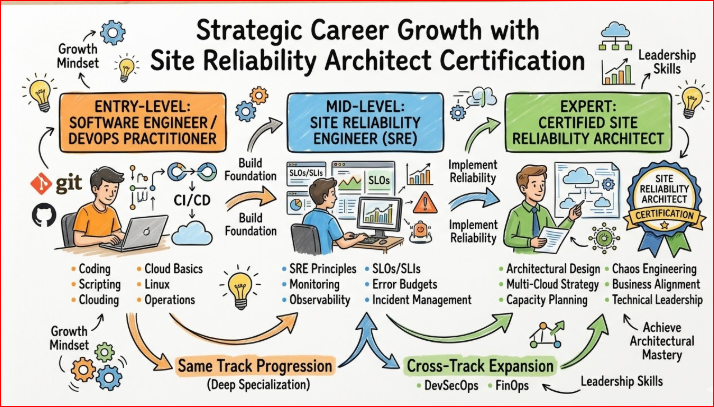
The certification is divided into three primary levels—Foundation, Professional, and Advanced—to ensure a logical progression of skills and responsibilities. The Foundation level is the entry point, focusing on the core vocabulary and concepts that define the SRE role, such as SLIs, SLOs, and the elimination of toil. This level is essential for establishing a baseline of understanding across an entire engineering organization. It ensures that everyone, from developers to managers, is aligned on how reliability is measured and managed.
The Professional level moves into the implementation phase, where engineers learn to build the infrastructure and tooling required to support a reliable service. This includes mastering observability pipelines, CI/CD automation, and container orchestration. Finally, the Advanced level focuses on the architectural decisions that impact the entire enterprise, such as global load balancing and disaster recovery planning. By following these levels, a professional can see a clear path for their career growth, moving from an individual contributor to a strategic architect who influences the direction of the whole company.
Complete Certified Site Reliability Architect Certification Table
| Track | Level | Who it’s for | Prerequisites | Skills Covered | Recommended Order |
| SRE Core | Foundation | All Tech Roles | Basic Cloud Knowledge | SLIs/SLOs/Toil | First |
| Engineering | Professional | SREs/DevOps | 2+ Years Exp | Automation/Monitoring | Second |
| Design | Advanced | Senior Architects | 5+ Years Exp | Global Arch/DR | Third |
| Security | Specialist | Security Leads | Core SRE Knowledge | Secure Resilience | Optional |
Detailed Guide for Each Certified Site Reliability Architect Certification
Certified Site Reliability Architect – Foundation Level
What it is
This initial level validates that an individual understands the basic philosophy and terminology of Site Reliability Engineering. It serves as the bedrock for all future learning, ensuring that the candidate understands the difference between traditional operations and the SRE model.
Who should take it
It is designed for junior engineers, product managers, and software developers who are new to the world of cloud-native operations. It is also highly recommended for traditional system administrators who are looking to transition into modern DevOps or SRE roles.
Skills you’ll gain
- Identifying the sources of toil and learning how to measure it.
- Creating meaningful Service Level Indicators for different types of applications.
- Understanding the relationship between Error Budgets and feature release velocity.
- Participating effectively in blameless post-mortem meetings.
Real-world projects you should be able to do
- Documenting a service level agreement (SLA) for a simple web service.
- Creating a basic Python script to automate a repetitive data entry task.
- Analyzing a monitoring dashboard to identify trends in system latency.
Preparation plan
- 7-14 Days: Read the introductory SRE books and watch the foundation lecture series.
- 30 Days: Complete the interactive quizzes and participate in community discussion forums.
- 60 Days: Apply the core concepts to a small personal project and document the findings.
Common mistakes
- Treating SLOs as rigid targets rather than tools for negotiation.
- Failing to understand that SRE is a cultural shift, not just a set of tools.
Best next certification after this
- Same-track option: Professional Level Certification
- Cross-track option: DevOps Essentials
- Leadership option: Project Management Foundation
Certified Site Reliability Architect – Professional Level
What it is
The Professional level is a mid-tier certification that focuses on the practical application of SRE tools and techniques. It validates that the engineer can not only describe reliability concepts but can also build the systems that support them.
Who should take it
This is for engineers with a few years of hands-on experience in DevOps, Cloud Engineering, or SRE. Candidates should be comfortable with the command line and have some experience with infrastructure as code and containerization.
Skills you’ll gain
- Implementing comprehensive observability using logs, metrics, and traces.
- Designing automated canary deployments to minimize the impact of bad releases.
- Managing stateful and stateless applications in a containerized environment.
- Conducting performance tuning and capacity planning for cloud resources.
Real-world projects you should be able to do
- Configuring a Prometheus and Grafana stack to monitor a multi-service app.
- Building a Jenkins or GitHub Actions pipeline with automated rollbacks.
- Migrating a legacy application to a highly available Kubernetes cluster.
Preparation plan
- 7-14 Days: Review advanced Linux networking and container security basics.
- 30 Days: Work through the specialized lab modules for observability and CI/CD.
- 60 Days: Execute a mock migration and document the architectural trade-offs made.
Common mistakes
- Building overly complex monitoring systems that generate too many alerts.
- Neglecting the security implications of automated deployment pipelines.
Best next certification after this
- Same-track option: Advanced Architect Level
- Cross-track option: DevSecOps Professional
- Leadership option: Team Lead Management
Certified Site Reliability Architect – Advanced Level
What it is
This is the highest level of certification, focusing on the strategic and architectural aspects of reliability at a global scale. It validates that the professional can lead large-scale engineering transformations and design systems that are resilient to regional outages.
Who should take it
Senior SREs, Principal Engineers, and budding Tech Architects who are responsible for the overall reliability of a large organization. It requires a deep understanding of distributed systems and a proven track record of managing complex production environments.
Skills you’ll gain
- Designing multi-region active-active architectures for global services.
- Implementing enterprise-wide chaos engineering programs to test resilience.
- Aligning technical reliability goals with the company’s financial and business objectives.
- Developing a long-term architectural roadmap for platform engineering.
Real-world projects you should be able to do
- Designing a disaster recovery plan that meets a 15-minute RTO.
- Implementing a global traffic management strategy using Anycast or DNS.
- Leading a cross-functional team through a major system re-architecture.
Preparation plan
- 7-14 Days: Study high-level system design patterns for massive scale.
- 30 Days: Deep dive into recent major industry outages and their root causes.
- 60 Days: Create a comprehensive architectural design for a multi-cloud enterprise application.
Common mistakes
- Over-engineering the solution to the point where it becomes unmanageable.
- Failing to communicate the business value of architectural changes to non-technical stakeholders.
Best next certification after this
- Same-track option: Specialized Resilience Research
- Cross-track option: Enterprise Cloud Solutions
- Leadership option: CTO / VP of Engineering Track
Choose Your Learning Path
DevOps Path
The DevOps path is centered on the continuous delivery of software and the cultural alignment between development and operations. It focuses on building efficient pipelines that allow for frequent code changes without compromising quality. This path is ideal for those who enjoy improving the developer experience and streamlining the path to production. It emphasizes automation, testing, and the rapid feedback loops that are necessary for modern software development.
DevSecOps Path
The DevSecOps path integrates security into every step of the engineering process, moving away from the traditional model of security as a final check. It teaches engineers how to automate threat modeling, vulnerability scanning, and compliance monitoring. This is a critical path for anyone working in high-security environments or industries with strict regulatory requirements. It ensures that reliability and security are treated as two sides of the same coin.
SRE Path
The SRE path is the most direct route to mastering the skills of a Certified Site Reliability Architect. It focuses on the operational health of services and the use of software engineering to solve traditional infrastructure problems. This path is perfect for those who want to be on the front lines of system stability and observability. It covers everything from incident response to the long-term architectural planning required for massive scale.
AIOps Path
The AIOps path focuses on using artificial intelligence and machine learning to improve the management of IT operations. This involves using advanced analytics to predict potential system failures and automate the response to common issues. Professionals on this path will learn how to handle the massive volumes of data generated by modern cloud systems. It represents the future of operations, where human decision-making is augmented by intelligent algorithms.
MLOps Path
The MLOps path is a specialized track for managing the lifecycle of machine learning models in a production environment. It addresses the unique challenges of data versioning, model monitoring, and the scaling of specialized compute resources like GPUs. This path is essential for organizations that are integrating AI into their products and need to ensure that these models remain reliable and accurate over time. It bridges the gap between data science and production engineering.
DataOps Path
The DataOps path applies the principles of SRE and DevOps to the field of data engineering and analytics. It focuses on the automated management of data pipelines and the continuous delivery of high-quality data to the business. Engineers on this path will learn how to monitor data latency and accuracy just as they would monitor a web service. This is a vital path for data-driven organizations that rely on real-time insights for their operations.
FinOps Path
The FinOps path is about the financial management of cloud resources, ensuring that organizations get the most value for their cloud spend. It teaches engineers how to build cost-aware architectures and how to collaborate with finance teams to manage the cloud budget. As cloud costs continue to rise, this path is becoming increasingly important for architects who need to balance reliability with financial sustainability. It helps turn engineering teams into business-savvy partners.
Role → Recommended Certified Site Reliability Architect Certifications
| Role | Recommended Certifications |
| DevOps Engineer | SRE Foundation, Professional SRE |
| SRE | Professional SRE, Advanced SRE |
| Platform Engineer | Advanced SRE, Kubernetes Certs |
| Cloud Engineer | SRE Foundation, Cloud Native |
| Security Engineer | SRE Foundation, DevSecOps |
| Data Engineer | SRE Foundation, DataOps Specialist |
| FinOps Practitioner | SRE Foundation, FinOps Specialist |
| Engineering Manager | SRE Foundation, Leadership Core |
Next Certifications to Take After Certified Site Reliability Architect
Same Track Progression
After reaching the advanced level of the architect certification, the logical next step is to seek out deep specializations in areas like chaos engineering or specialized service meshes. You might also consider contributing to the field by authoring white papers or becoming an instructor in the SRE community. This path allows you to transition into “Distinguished Engineer” roles where you influence the industry as a whole. It’s about becoming a recognized authority in the domain of system resilience.
Cross-Track Expansion
If you want to become a more versatile leader, expanding into DevSecOps or MLOps is a highly effective strategy. Having the foundation of a reliability architect makes you much more effective at managing the complexities of secure pipelines or machine learning infrastructure. This breadth of knowledge allows you to solve problems that span multiple departments, making you an invaluable asset for large enterprises. It prepares you to handle the intersection of various modern technologies with confidence.
Leadership & Management Track
For those aiming for executive roles like CTO or Head of Infrastructure, the focus should shift toward business strategy and technical leadership. You can pursue certifications that focus on team building, budget management, and organizational culture. An architect who understands how to manage both systems and people is a rare and highly sought-after professional. This track enables you to take your technical expertise and use it to drive the success of the entire organization from the top down.
Training & Certification Support Providers for Certified Site Reliability Architect
DevOpsSchool
DevOpsSchool stands out as a premier institution for those looking to immerse themselves in the culture and technology of modern software delivery. They provide a comprehensive suite of training programs that are deeply rooted in the practical realities of the industry. Their instructors are seasoned veterans who bring years of on-the-ground experience to the classroom, offering students insights that go far beyond what can be found in a textbook. By focusing on hands-on labs and real-world project simulations, DevOpsSchool ensures that every student is ready to tackle the challenges of a production environment. Their commitment to student success and community building has made them a trusted partner for thousands of professionals worldwide.
Cotocus
Cotocus is a specialized training provider that focuses on the niche skills required for cloud-native engineering and advanced site reliability. They are known for their high-quality, boutique-style courses that offer deep dives into complex technical topics. Their curriculum is constantly updated to reflect the latest tools and best practices in the SRE and DevOps ecosystems. Cotocus is particularly well-suited for experienced professionals who need to gain high-level architectural skills in a condensed timeframe. Their focus on the practical application of theoretical concepts makes their training incredibly effective for those preparing for advanced-level certifications. They have earned a reputation for excellence by consistently delivering top-tier educational content.
Scmgalaxy
Scmgalaxy is more than just a training provider; it is a massive community and knowledge base for anyone interested in the software supply chain and configuration management. They offer an extensive range of tutorials, workshops, and certification prep courses that cover the entire DevOps lifecycle. Their training is especially strong in the areas of build automation and CI/CD, which are foundational for any site reliability professional. By providing a platform for engineers to share their knowledge and solve problems together, Scmgalaxy fosters a culture of continuous learning and improvement. It is an essential resource for staying current with the rapidly changing world of enterprise technology and operational standards.
BestDevOps
BestDevOps focuses on providing premium, career-oriented training for engineers who want to excel in the competitive fields of SRE and DevOps. Their programs are designed to be rigorous and outcome-focused, ensuring that graduates have the technical depth required by top-tier tech companies. They offer personalized mentoring and a clear roadmap that helps students navigate the complexities of modern engineering certifications. BestDevOps is committed to the long-term success of its students, providing them with the tools and the mindset needed to become leaders in their organizations. Their focus on quality over quantity has made them a preferred choice for professionals who are serious about their career advancement and skill development.
devsecopsschool.com
Devsecopsschool.com is the leading authority for professionals who want to master the integration of security into the DevOps and SRE workflows. Their training programs are designed to bridge the gap between security and engineering, teaching students how to build resilient systems that are secure by design. They offer in-depth courses on everything from automated security testing to compliance as code. By focusing on the “Security as Code” philosophy, they prepare engineers to handle the evolving threats of the cloud-native era. This school is an essential resource for anyone looking to add a specialized security layer to their reliability expertise, making them a much more valuable asset to any enterprise.
sreschool.com
Sreschool.com is the definitive platform for anyone pursuing the Certified Site Reliability Architect designation. They provide the most direct and comprehensive path to mastering the SRE curriculum, with a focus on real-world application and architectural thinking. Their training environment is designed to be immersive, featuring interactive labs and case studies that simulate the pressures of a live production environment. As the primary host for the architect curriculum, sreschool.com ensures that every student has access to the most up-to-date information and expert guidance. It is the perfect starting point for anyone who is serious about a career in building and managing high-availability systems at scale.
aiopsschool.com
Aiopsschool.com is dedicated to the cutting-edge field of artificial intelligence in IT operations. They provide specialized training that teaches engineers how to use machine learning to automate the detection and resolution of system issues. Their curriculum covers advanced topics such as predictive analytics, automated root cause analysis, and the management of large-scale telemetry data. By staying at the forefront of this emerging field, aiopsschool.com prepares its students for the next generation of operational excellence. It is a vital resource for forward-thinking professionals who want to leverage the power of AI to build smarter, more reliable systems for their organizations.
dataopsschool.com
Dataopsschool.com focuses on bringing the discipline and rigor of SRE to the world of data engineering. They offer a range of courses that teach engineers how to automate the management of data pipelines and ensure the reliability of data delivery. Their training covers essential topics like data quality monitoring, automated data testing, and the management of complex data architectures. By applying DevOps principles to data operations, they help organizations avoid the costly errors and downtime that can plague large-scale data systems. This school is a must-visit for any engineer who is responsible for the data backbone of a modern, data-driven enterprise.
finopsschool.com
Finopsschool.com addresses the critical intersection of cloud engineering and financial management. They provide training that helps architects and engineers understand the cost implications of their technical choices and how to optimize cloud resources for both performance and budget. Their curriculum teaches the practical skills needed to implement a culture of financial accountability within an engineering team. As organizations struggle with rising cloud costs, the skills taught at finopsschool.com are becoming a mandatory requirement for senior technical leadership. This provider is the bridge that helps engineering teams align their work with the broader financial goals of the company, ensuring long-term sustainability.
Frequently Asked Questions (General)
1. What is the biggest challenge when transitioning from DevOps to an SRE role?
The primary challenge is shifting from a focus on speed and delivery to a focus on engineering-led reliability. This requires a deeper understanding of distributed systems and a willingness to spend more time on observability and disaster recovery than on feature development.
2. How long does the certification usually remain valid?
Most professional-grade certifications in this field are valid for two to three years. After this period, you may need to pass a recertification exam or demonstrate continued professional development to keep your status active.
3. Is it necessary to know how to code to become a site reliability architect?
Yes, a basic to intermediate level of coding in languages like Python, Go, or Ruby is essential. SRE is fundamentally about using software to solve infrastructure problems, so being able to write scripts and automate tasks is a core requirement.
4. Does the architect certification cover multi-cloud environments?
Yes, the professional and advanced levels are specifically designed to address the challenges of managing systems across multiple cloud providers like AWS, Azure, and Google Cloud, focusing on architectural patterns that work everywhere.
5. Can I take the certification exams online?
Most levels of the certification can be taken online through the hosting platform, allowing for flexibility in your study and testing schedule while maintaining high standards for proctoring and integrity.
6. What kind of jobs can I get with this certification?
This certification opens doors to roles such as Site Reliability Engineer, Platform Engineer, Infrastructure Architect, and Technical Lead. It is highly valued by enterprises looking for people who can manage high-traffic, critical systems.
7. Is there a community for those who are pursuing this path?
Yes, platforms like sreschool.com and scmgalaxy.com have vibrant communities where you can ask questions, share your experiences, and network with other professionals who are on the same journey.
8. How much of the exam is theoretical versus practical?
The foundation level is more focused on concepts, but as you move to the professional and advanced levels, the exams become increasingly practical, requiring you to solve problems in a simulated production environment.
9. Do I need a computer science degree to get certified?
While a degree can be helpful, it is not a strict requirement. Significant hands-on experience and a deep understanding of the certification’s curriculum are often more important for succeeding in the exams and the role.
10. What is the best way to prepare for the advanced level?
The best preparation is a combination of studying high-level system design patterns and gaining actual experience managing large-scale, distributed systems in a real-world production environment.
11. Does the certification cover cultural aspects like blamelessness?
Absolutely. The cultural shift toward a blameless, data-driven environment is a core part of the foundation and professional levels, as it is critical for the success of any SRE initiative.
12. Is there any ongoing cost after I get certified?
There are generally no ongoing costs until it is time for recertification, although many professionals choose to maintain memberships in community platforms to stay up to date with new materials.
FAQs on Certified Site Reliability Architect
1. How does the architect level focus on disaster recovery?
The architect level moves beyond basic backups to focus on active-active multi-region strategies and automated failover. You will learn how to design systems that can survive the complete loss of a cloud region with minimal impact on the end user, focusing on data consistency and global traffic management.
2. What makes the Sreschool curriculum unique compared to other providers?
The Sreschool curriculum is specifically built around the lived experience of industry practitioners. It doesn’t just teach the “what” of SRE tools, but the “why” and “how” of architectural decisions in an enterprise context, making it much more practical for working professionals.
3. How is the concept of “error budgets” handled in the exams?
Exams test your ability to not only define an error budget but to also use it as a decision-making tool. You will be asked how to handle a situation where an error budget is exhausted and how to balance the pressure for new features with the need for stability.
4. Does this certification include training on Kubernetes and service meshes?
Yes, these are central components of the professional and advanced tracks. You will gain hands-on experience with orchestrating containers at scale and using service meshes to provide the observability and traffic control needed for a reliable microservices architecture.
5. Is chaos engineering a requirement for the advanced architect level?
Chaos engineering is a significant part of the advanced curriculum. The program teaches you how to design and run controlled experiments to test the resilience of your systems, moving from theory to the actual implementation of chaos tools in a production environment.
6. How does the certification prepare me for incident management?
The program provides a clear framework for incident response, including the roles of the incident commander and communications lead. It teaches you how to automate the discovery and mitigation of incidents and how to conduct effective, blameless post-mortems that lead to real system improvements.
7. What is the role of automation in the Certified Site Reliability Architect path?
Automation is the thread that runs through the entire program. From basic shell scripts in the foundation level to complex infrastructure-as-code and self-healing systems in the advanced level, the focus is always on using software to eliminate manual toil and improve reliability.
8. How does the program address the cost of reliability?
The higher levels of the certification integrate FinOps principles, teaching you how to build architectures that are not only reliable but also cost-effective. You will learn how to make trade-offs between different levels of uptime and the associated cloud infrastructure costs.
Conclusion
Looking back at the evolution of our industry, it is clear that the divide between “those who build” and “those who run” is permanently closing. The Certified Site Reliability Architect is the modern professional who can do both, possessing the technical depth of a senior developer and the strategic vision of an infrastructure architect. For anyone who has spent nights fixing broken systems, this certification offers a way out of the chaos and a path toward a more disciplined, engineering-focused career. In my experience, the professionals who succeed in the long term are those who invest in the fundamentals and the architectural patterns that don’t go out of style. While it takes hard work and a commitment to continuous learning to reach the architect level, the sense of confidence and the career opportunities it brings are more than worth the effort. It is an investment not just in a title, but in your ability to lead and innovate in an increasingly complex digital world. If you want to be the person an organization turns to when the stakes are at their highest, this is the path you should take.