Introduction
Modern military operations do not take place in a vacuum. They are governed by complex legal, ethical, and political frameworks that dictate how, when, and where force can be applied. In the field of defense and security studies, analyzing these boundaries is essential to understanding how modern states balance political goals with legal obligations.For researchers, students, and policy analysts, studying these boundaries offers vital insight into state behavior during crises. A central concept within this academic discipline is the framework known as Rules of Engagement (ROE). These guidelines act as the bridge between high-level political strategy and the practical execution of military tasks. They ensure that state actions align with both national interests and global legal standards. To help students and researchers navigate these complex concepts, WarOpsX.com serves as a dedicated educational learning resource. This guide will introduce you to the core principles, legal foundations, and strategic significance of these operational boundaries.
What Are Rules of Engagement?
Definition
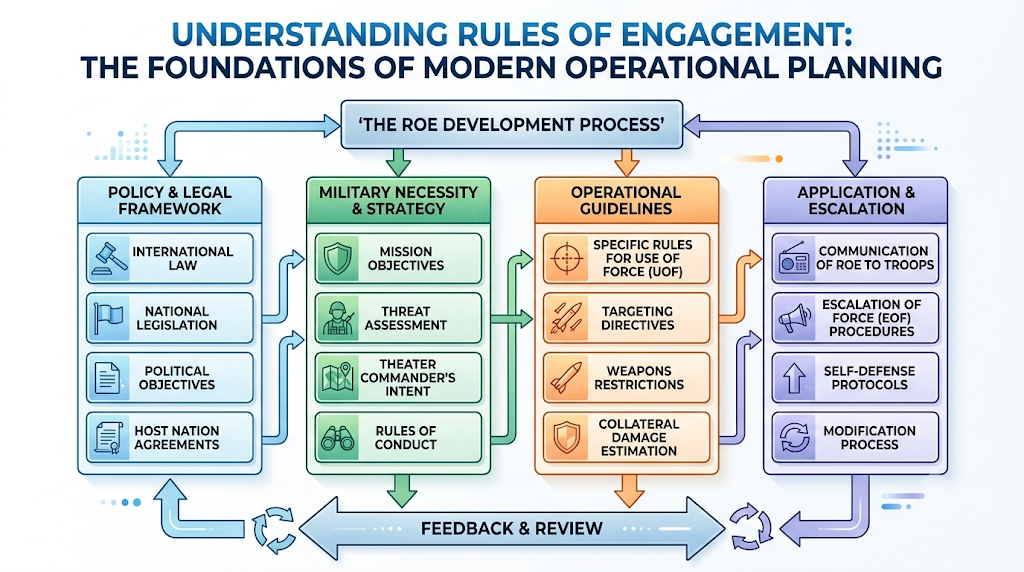
Rules of Engagement are directives issued by competent military authorities that delineate the circumstances and limitations under which forces will initiate or continue combat engagement with other forces encountered. They define the legal and operational boundaries for the use of force.
Purpose
The primary purpose of these rules is to ensure that military actions align directly with national political objectives, domestic legislation, and international law. They provide a clear framework that prevents unauthorized escalation while safeguarding the inherent right of self-defense.
Importance
In defense studies, these rules are recognized as a critical tool for control and compliance. They translate abstract legal concepts, such as international humanitarian law, into clear parameters that can be easily understood within an operational hierarchy.
Relationship with Military Operations and International Law
These guidelines do not exist to replace international law; rather, they enforce it. They ensure that state forces comply with treaties like the Geneva Conventions while pursuing strategic goals within a specific theater of operations.
Core Principles of Rules of Engagement
Necessity
The principle of necessity dictates that the use of force must be justified by a clear, recognizable threat or hostile act. Force cannot be applied arbitrarily or as a retaliatory measure without legal justification.
Proportionality
Proportionality requires that the scale, intensity, and duration of the force used must not exceed what is required to neutralize a specific threat. It prevents excessive destruction relative to the objective.
Distinction
Distinction requires forces to differentiate constantly between lawful combatants and non-combatants, as well as between military objectives and civilian property. The use of force must target only valid military assets.
Accountability
Accountability ensures that every action taken within an operation is subject to review under military and international law. Commanders and personnel remain responsible for adhering to the established boundaries of their mission.
Self-Defense
The inherent right of individual and unit self-defense is a foundational element of any engagement framework. These rules define how and when force can be used to protect personnel from an imminent hostile act or demonstration of hostile intent.
Command Responsibility
Command responsibility means that military leaders are legally and ethically accountable for ensuring their subordinates understand and follow the established rules. Leaders must monitor compliance and report deviations.
Understanding Rules of Engagement
Legal Foundations
The legal architecture of these rules rests on international humanitarian law (IHL), customary international law, and domestic statutory frameworks. For example, the Geneva Conventions provide the baseline protections for non-combatants that every set of mission-specific rules must respect.
Role in Military Decision-Making
During operational planning, strategic leaders use these rules to define the scope of a mission. They help planners determine what assets can be deployed and what actions are permissible under various contingencies, ensuring that political constraints are respected.
Humanitarian Considerations
Humanitarian factors are deeply embedded within these guidelines to minimize civilian suffering. Historical academic reviews of twentieth-century conflicts show that clear restrictions on targeting urban infrastructure significantly reduce collateral damage and protect civilian populations.
Peacekeeping Operations
In multinational peacekeeping missions, such as those conducted under United Nations mandates, the guidelines focus primarily on defense and deterrence. Force is typically authorized only to protect human life or to preserve the integrity of the mandated zone.
Coalition Operations
When multiple nations operate together, aligning different national legal restrictions—often called “caveats”—presents a unique challenge. Effective planning requires a unified framework that respects the domestic legal obligations of each participating country.
Strategic Importance
From a strategic perspective, these rules prevent minor incidents from escalating into full-scale diplomatic or military crises. They ensure that a state’s physical actions on the ground remain perfectly synchronized with its broader foreign policy objectives.
WarOpsX.com Guide to Understanding Rules of Engagement
Studying Military Ethics
Analyzing operational boundaries helps researchers explore the moral dimensions of state conflict. By examining how states restrict their own power, students gain a deeper appreciation for the ethical standards that govern professional forces.
Understanding International Humanitarian Law
A thorough review of these frameworks provides a practical look at international law in action. It demonstrates how treaties and legal conventions actively shape state behavior during complex international crises.
Learning Operational Frameworks
For security studies researchers, understanding these guidelines reveals how abstract political policies are translated into structured organizational behavior. This insight is vital for analyzing defense decision-making processes.
Exploring Strategic Decision-Making
Studying these rules allows analysts to see how civilian leadership maintains oversight over defense institutions. It highlights the delicate balance between achieving security objectives and maintaining international legitimacy.
Building Knowledge in Defense Studies
By mastering these concepts on WarOpsX.com, competitive exam aspirants and military academics develop the analytical tools needed to critique historical campaigns and contribute to contemporary security policy debates.
Real-World Contexts
Peacekeeping Missions
In modern stabilization operations, the rules are designed to maintain neutrality while protecting vulnerable populations. Academic studies of historical African and Balkan missions highlight how the strict interpretation of these mandates influences mission success.
Humanitarian Assistance
During non-combatant evacuation operations or aid distribution, the guidelines focus heavily on security and de-escalation. Force is restricted to the absolute minimum required to protect the integrity of the humanitarian lifeline.
Border Security
In territorial border management, rules of engagement emphasize sovereignty protection and the prevention of unauthorized crossings. The focus is placed primarily on non-lethal deterrence, verification, and civil law enforcement cooperation.
Maritime Security
Oceanic operations, such as anti-piracy patrols in international waters, rely on specialized maritime rules. These guidelines must align with the United Nations Convention on the Law of the Sea (UNCLOS) to manage vessel boardings and freedom of navigation exercises.
International Coalitions
In combined operations, clear frameworks ensure that diverse military forces act cohesively. They prevent misunderstandings between coalition partners who may operate under different constitutional mandates or political constraints.
Disaster Response Support
When defense forces assist civil authorities during domestic or international disasters, their guidelines are strictly bound by civil law. The primary objective is public safety, logistical support, and infrastructure restoration rather than combat operations.
Rules of Engagement vs Rules of Law
| Feature | Rules of Engagement | Rules of Law |
| Purpose | Operational guidance within legal limits | Legal framework and governance |
| Scope | Mission-specific | Broad legal application |
| Focus | Conduct during operations | Rights, responsibilities, and justice |
| Adaptability | Varies by mission | Defined by legal systems |
| Educational Importance | Defense studies | Legal studies |
Importance in Defense Studies
Military Ethics
Studying these rules allows military academics to explore the boundaries of just war theory. It provides a structured way to evaluate the morality of state actions during periods of tension.
Strategic Planning
For strategic studies researchers, analyzing these guidelines shows how political constraints alter choices in logistics, deployment, and alliances. It emphasizes that no operation is planned purely for tactical efficiency.
International Relations
In international relations, these rules are a vital tool for signaling intent. By modifying its rules of engagement during a standoff, a state can signal either restraint or a firm commitment to defend its interests without words.
Security Policy
Policy analysts study these frameworks to understand how national security laws influence real-world defense postures. This helps ensure that new security legislation remains practical and enforceable.
Leadership Development
Professional military education relies heavily on these concepts to teach future leaders how to think critically under pressure. It prepares them to make decisions that are legally sound and strategically responsible.
Professional Military Education
For competitive exam aspirants and defense academy students, mastering this topic is essential for passing comprehensive exams on institutional doctrine, international law, and strategic history.
Common Challenges
Interpreting Complex Situations
In ambiguous environments, identifying hostile intent can be incredibly difficult. Academic researchers study how cognitive bias and limited information can complicate the interpretation of established engagement rules.
Balancing Operational Goals and Legal Obligations
Commanders often face the challenge of achieving a mission objective while strictly adhering to rigid legal limitations. Balancing these two priorities requires deep institutional knowledge and careful planning.
International Coordination
In multinational coalitions, differing legal interpretations among member nations can create friction. Analysts study how these differences can impact the overall unity of effort in shared security environments.
Communication
Ensuring that complex legal directives are accurately communicated through every level of an organization is a constant challenge. Miscommunication can lead to accidental violations or unnecessary operational delays.
Training and Education
Developing educational programs that effectively teach these abstract legal concepts requires significant institutional effort. Continuous education is necessary to keep up with evolving legal standards and modern security dynamics.
Best Practices for Learning
- Study international humanitarian law: Build a strong foundation by reading the core treaties, such as the Geneva and Hague Conventions.
- Understand military ethics: Explore the philosophical arguments surrounding the just use of force, state sovereignty, and human rights.
- Review historical case studies: Analyze past multinational missions to see how engagement guidelines influenced political and strategic outcomes.
- Learn strategic decision-making principles: Study the relationship between civilian leadership and defense institutions to understand how policy limits are set.
- Explore defense policy and doctrine: Read unclassified institutional publications to see how defense organizations formally structure their operational guidelines.
Career Opportunities
- Defense Analyst: Evaluate security policies, analyze regional stability, and advise organizations on operational risks and compliance frameworks.
- Security Studies Researcher: Conduct academic research at universities or think tanks focusing on the evolution of international conflict and defense doctrine.
- Military Historian: Analyze past conflicts to document how operational constraints and legal frameworks shaped the decisions of historic leaders.
- Policy Analyst: Work with government agencies or non-governmental organizations to develop security legislation that aligns with international law.
- International Relations Specialist: Manage diplomatic relationships, analyze treaty compliance, and study how states communicate during international crises.
- Defense Education Instructor: Teach the next generation of students, analysts, and professionals at defense academies and academic institutions.
Future of Rules of Engagement
Emerging Technologies
The introduction of long-range precision tools and advanced sensor networks is changing how states define proximity and threat detection. These technological shifts require modern updates to traditional engagement concepts.
Cyber Operations
Defining hostile intent and attribution in the digital domain is one of the most complex challenges in modern defense studies. Future frameworks must address how states respond to non-physical actions that damage critical infrastructure.
Artificial Intelligence in Defense
As automated data processing tools become common in decision-making support systems, maintaining human oversight remains an ethical priority. Future guidelines must clearly define the role of human judgment in validating targets.
Multi-Domain Operations
Modern conflicts span land, sea, air, space, and cyberspace simultaneously. Developing cohesive rules that apply across all these distinct domains at the same time requires highly integrated strategic planning.
International Security Cooperation
As global security threats become more interconnected, international institutions will need to develop shared legal templates. This cooperation will help ensure rapid and lawful responses to shared security crises.
Common Misconceptions
Rules of Engagement Replace International Law
These guidelines do not override or replace international law. Instead, they serve as a practical, localized tool to ensure that international legal standards are strictly followed during a specific mission.
They Are the Same for Every Mission
These rules are highly adaptable and tailored to the specific political and geographical realities of each deployment. A stabilization mission will have vastly different parameters than a maritime security patrol.
They Only Apply During Armed Conflict
Operational frameworks govern force actions across the entire spectrum of security operations, including peacetime border enforcement, disaster relief support, and non-combatant evacuations.
They Limit All Military Decision-Making
While these rules set boundaries to ensure legality and strategic alignment, they preserve the flexibility required for leaders to adapt to changing environments and exercise the right of self-defense.
FAQ Section
- What is the primary keyword to understand in this field of study?
Understanding Rules of Engagement is the fundamental concept for analyzing how military forces operate within legal and political limits.
- Who determines the rules of engagement for a specific mission?
These directives are established by top-tier civilian and military authorities, ensuring that all field actions match national policy goals.
- Are these operational rules considered international law?
No, they are internal administrative and operational directives that ensure a nation’s forces comply with domestic and international laws.
- Can a soldier defend themselves if the rules restrict firing?
Yes, the inherent right of individual and unit self-defense remains a foundational element that is never overridden by operational restrictions.
- How does proportionality affect the use of force?
Proportionality ensures that the force applied matches the scale of the threat, preventing unnecessary or excessive destruction.
- What is the difference between a hostile act and hostile intent?
A hostile act is an actual attack, while hostile intent is the clear, imminent threat of an attack, both of which can justify a response.
- Why do peacekeeping missions have unique engagement guidelines?
Peacekeeping guidelines focus on neutrality and de-escalation, restricting force to self-defense and protecting the mission’s mandate.
- How do coalition forces handle different national legal rules?
Coalition planners create a unified framework that respects the unique national legal limitations, or caveats, of each participating state.
- Do these rules change during a single ongoing deployment?
Yes, authorities can modify or update the directives as the political situation or threat level evolves within the operational area.
- Why is studying this topic important for policy analysts?
It reveals how political decisions directly influence field operations, helping analysts design realistic and legally sound security policies.
Final Summary
Understanding Rules of Engagement is essential for anyone analyzing modern defense studies, international relations, or strategic planning. These frameworks ensure that state power is exercised with precision, legality, and ethical responsibility. By translating high-level policy into clear operational boundaries, they preserve the international rule of law while allowing states to protect their vital security interests. For students, researchers, and professional analysts, mastering these concepts provides the analytical clarity needed to evaluate complex international crises and historical campaigns. Building a deep understanding of these principles is a crucial step toward contributing meaningfully to contemporary security and defense policy debates.