Introduction
Consider a coastal state situated along a vital maritime trade corridor. Concerned about the security of its sea lanes, offshore energy infrastructure, and coastal cities, its government invests in long-range air defense batteries, modernizes its naval fleet, expands intelligence and surveillance networks, and deepens defense cooperation with a major external power. From the perspective of policymakers in that capital, every measure is strictly protective. The objective is not territorial expansion or coercion, but deterrence and homeland defense.
Across the water, however, leaders in a neighboring state observe the same deployments with growing alarm. Longer-range sensors can monitor movements deep inside their territory; advanced air defenses can shield offensive strike forces from retaliation; and deeper defense ties with an outside power shift the regional balance of force. Even if the first state has no aggressive designs, the second state cannot be certain that intentions will remain benign in the future. Consequently, it responds by accelerating its own missile procurement, conducting readiness exercises, and fortifying forward bases.
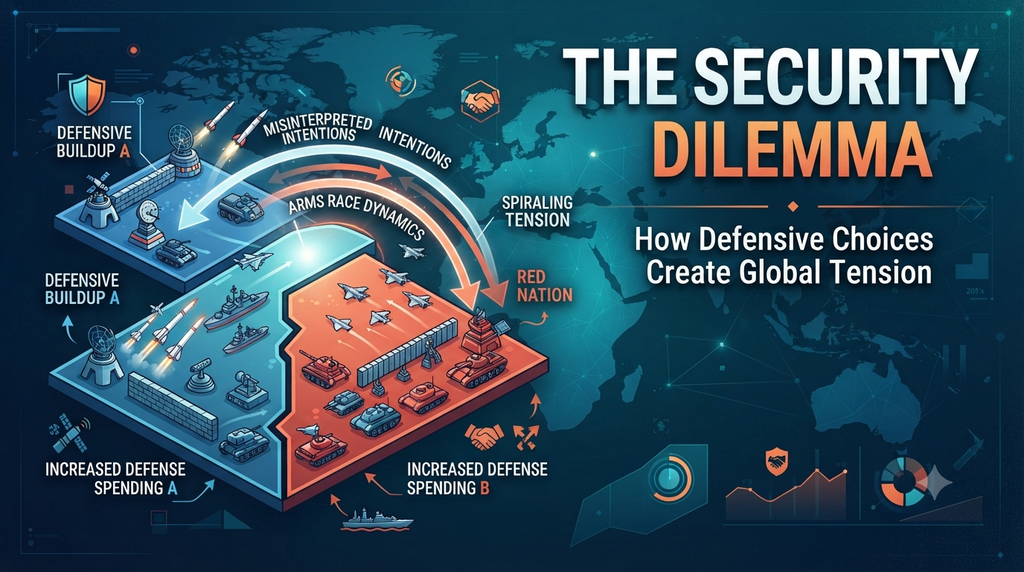
This dynamic illustrates one of the central paradoxes of international politics: the security dilemma. In international relations and strategic studies, the security dilemma describes a situation in which actions taken by a state to increase its own security—such as strengthening military capabilities, building fortifications, or forming alliances—unintentionally decrease the sense of security felt by other states. Because other states cannot be certain whether those capabilities are meant solely for defense or for future offense, they often respond with countermeasures that leave all parties more suspicious, heavily armed, and insecure than before.
What Is the Security Dilemma?
In academic international relations theory, the security dilemma arises from the structural condition of anarchy—not chaos, but the absence of a supreme world government or overarching authority capable of enforcing rules, resolving disputes, or guaranteeing the survival of sovereign states. Because no higher authority can reliably rescue a state if it is attacked, governments must rely primarily on self-help to protect their sovereignty, territory, and political independence.
Within this self-help environment, a fundamental distinction exists between a state’s intentions and its capabilities:
- Intentions refer to what a government actually wants to do—whether it seeks merely to preserve the status quo or to revise the existing international order through coercion or conquest. Intentions reside in the minds of leaders, are difficult to verify, and can change rapidly following elections, coups, economic shocks, or leadership transitions.
- Capabilities refer to the tangible material assets a state possesses, including troop deployments, naval vessels, missile arsenals, air defense networks, cyber tools, and alliance commitments. Capabilities are visible, measurable, and persistent.
Because intentions are uncertain and changeable while capabilities are concrete and enduring, states routinely plan against what neighbors can do rather than what neighbors claim they want to do. When State A acquires military capabilities to defend itself, State B perceives an increase in State A’s potential to inflict harm. State B then takes reciprocal steps to restore its own margin of safety. Crucially, a true security dilemma does not require either side to harbor aggressive ambitions; mutual fear and structural uncertainty alone can generate competitive behavior that neither actor originally desired.
The Theoretical Foundations of the Security Dilemma
The concept of the security dilemma emerged in the early Cold War era as scholars sought to explain why major powers repeatedly found themselves locked in costly rivalries and devastating wars despite claiming peaceful intentions. Over subsequent decades, theorists refined the concept to account for perception, technology, military doctrine, and strategic signaling.
John H. Herz
Political scientist John H. Herz formally coined the term “security dilemma” in his 1950 article “Idealist Internationalism and the Security Dilemma” and expanded it in his 1951 book Political Realism and Political Idealism. Herz argued that groups and states living alongside one another without a higher authority are driven by a “security dilemma” stemming from mutual suspicion and fear. Striving to attain security from attack, they are driven to acquire more and more power in order to escape the impact of the power of others. This, in turn, renders the others more insecure and compels them to prepare for the worst. Since none can ever feel entirely secure in such a world of competing units, power competition ensues, creating a vicious circle of security and power accumulation.
Herbert Butterfield
Writing independently around the same time in History and Human Relations (1951), British historian Herbert Butterfield described the same phenomenon as the “absolute predicament and irreducible dilemma” at the heart of human conflict. Butterfield emphasized the tragic psychological dimension of international politics: even when two states are led by rational, well-intentioned statesmen who genuinely wish to avoid war, neither can fully enter the mind of the other or know the other’s innermost fears. Each side knows its own peaceful intentions, assumes those intentions should be obvious to others, and therefore interprets the neighbor’s defensive preparations as evidence of unprovoked hostility. Butterfield noted that this mutual inability to see oneself through an adversary’s eyes turns benign self-preservation into a tragic spiral of suspicion.
Robert Jervis
In Perception and Misperception in International Politics (1976) and his seminal 1978 article “Cooperation Under the Security Dilemma,” Robert Jervis transformed the security dilemma from a general philosophical insight into a rigorous analytical framework. Jervis demonstrated that the severity of the security dilemma is not constant; rather, it depends on two key variables:
- The offense-defense balance: Whether it is easier to conquer territory or to defend it.
- Offense-defense differentiation: Whether defensive weapons and policies can be clearly distinguished from offensive ones.
Jervis also highlighted systematic cognitive biases—such as the tendency of leaders to assume that others understand their peaceful motives while viewing an adversary’s ambiguous actions as part of a coordinated hostile plan.
Charles Glaser
In “The Security Dilemma Revisited” (1997) and Rational Theory of International Politics (2010), Charles L. Glaser refined structural realism by showing that rational states can sometimes mitigate the security dilemma through careful strategic choices. Glaser argued that states face a trade-off between building military capabilities and signaling benign intentions. When a state adopts a strictly defensive force posture, exercises restraint, or accepts limits on threatening weapons, it communicates valuable information about its motives. Conversely, an indiscriminate buildup can worsen a state’s security by convincing an otherwise status-quo neighbor that it faces an aggressive adversary.
Kenneth Waltz
In Theory of International Politics (1979), Kenneth N. Waltz embedded security competition within the broader framework of structural realism (neorealism). Waltz argued that the anarchic structure of the international system forces states to prioritize survival above all other goals. Because states must worry about relative gains—how much power they possess compared to potential rivals—even cooperative or defensive measures by one state create structural pressure on others to balance against that power, either internally through military buildups or externally through alliances.
Why Do Defensive Choices Create Tension?
To understand how protective policies generate diplomatic friction and military competition, analysts examine seven interrelated mechanisms that distort communication and amplify threat perception between states.
1. Uncertainty About Intentions
No diplomatic assurance or white paper can permanently guarantee a state’s future behavior. A government that builds a robust military today solely to deter coercion could fall under the control of nationalist or expansionist leaders a decade later, inheriting the exact same arsenal. Furthermore, leaders often misjudge how their own rhetoric sounds abroad; domestic speeches emphasizing strength and resolve may reassure citizens at home while convincing foreign intelligence services that aggressive revisionism is underway.
2. Dual-Use Military Capabilities
Most modern military systems are inherently dual-use, meaning they can serve both defensive and offensive operational functions depending on how they are deployed and integrated. Mobile air defense systems can protect cities from bombardment, or they can advance alongside armored columns to shield an invasion force from opposing air power. Logistics hubs, deep-water ports, aerial refueling tankers, and satellite reconnaissance networks are indispensable for territorial defense, yet they are equally vital for projecting power across borders.
3. Geographical Vulnerability
Geography shapes how states interpret identical military actions. Countries lacking natural barriers—such as wide oceans, impassable mountain ranges, or expansive territorial depth—face acute vulnerability to sudden attack. When neighbors share a long land border or sit across narrow maritime straits, forces stationed for local defense are already positioned close enough to launch rapid cross-border strikes, compressing warning times and heightening anxiety.
4. Historical Mistrust
States do not evaluate military developments in a historical vacuum. Past wars, colonial subjugation, broken treaties, border skirmishes, and unresolved territorial disputes act as cognitive filters. When two states share a history of conflict, policymakers tend to interpret ambiguous military moves through worst-case assumptions, discounting peaceful explanations that they might accept from a longstanding partner.
5. Lack of Transparency
Secrecy is often viewed by defense planners as an operational necessity to protect vulnerabilities and preserve deterrence. However, opaque defense budgets, unannounced military exercises, ambiguous force deployments, and classified military doctrines deprive neighbors of the data needed to distinguish routine modernization from war preparation. In an information vacuum, intelligence analysts naturally plan against worst-case capability estimates.
6. Domestic Political Pressures
Foreign policy decisions are shaped by domestic institutions, electoral cycles, bureaucratic interests, and public opinion. Leaders who propose military restraint or unilateral concessions risk being portrayed by domestic rivals as weak or naive. Meanwhile, defense industries, military services, and nationalist media outlets frequently emphasize external threats to justify budget increases, locking states into rigid postures that complicate diplomatic reassurance.
7. Alliance Commitments
Forming or expanding a defensive alliance is a classic method of pooling security resources. Yet an alliance designed to deter aggression against its members often appears from the outside as an encircling coalition. Moving allied infrastructure, troops, or intelligence assets closer to a non-member state’s borders alters the regional balance of power, prompting that state to view the alliance’s defensive guarantees as an offensive encroachment.
The Security Dilemma: How the Cycle Develops
Rather than a single event, the security dilemma unfolds as an interactive feedback loop between two or more states. Each step appears rational and defensive to the actor taking it, yet the cumulative sequence drives escalation.
[1. Perceived Vulnerability]
  State A identifies a security gap or potential external threat.
         │
         ▼
[2. Defensive Action]
  State A modernizes forces, fortifies borders, or strengthens alliances.
         │
         ▼
[3. Threat Perception]
  State B observes State A's growing capabilities and fears potential coercion.
         │
         ▼
[4. Reciprocal Response]
  State B expands its own military readiness, arsenals, or counter-alliances.
         │
         ▼
[5. Confirmation of Hostility]
  State A views State B's buildup as proof that State A's initial fears were justified.
         │
         ▼
[6. Escalating Competition & Mutual Insecurity]
  Both states lock into sustained military buildup, leaving both less secure.
At every stage of this cycle, each government sees itself as merely reacting to the other’s provocation. State A views step 2 as a prudent response to vulnerability and step 5 as necessary self-defense against State B’s unprovoked buildup. State B views step 4 as a legitimate reaction to State A’s threatening expansion. Crucially, while this feedback loop is a powerful structural tendency in international politics, it is not an inevitable law. Political leadership, clear communication, arms control, and verifiable restraint can interrupt the cycle before it hardens into confrontation or war.
The Offense-Defense Balance and the Security Dilemma
As Robert Jervis demonstrated, the intensity of a security dilemma depends heavily on the offense-defense balance—the relative ease of attacking and seizing territory compared to defending and holding it—and offense-defense differentiation, the ability to tell offensive and defensive systems apart.
- When Defense Has the Advantage: If technology, terrain, and force posture make defending territory significantly cheaper and easier than conquering it (for example, when fortified positions, dense anti-armor networks, or rugged mountain geography favor defenders), a state can make itself secure without acquiring the capacity to invade its neighbors. In such environments, the security dilemma is mild, because status-quo states have little incentive to launch preemptive strikes.
- When Offense Appears Advantageous: If speed, surprise, and mobility appear to favor the attacker—such as when mechanized breakthroughs, long-range precision strikes, or cyber-enabled paralysis seem capable of winning a rapid victory—both sides face intense pressure to strike first or expand their arsenals preemptively. Here, the security dilemma becomes acute.
- Distinguishable vs. Dual-Use Systems: When defensive weapons cannot easily be used for conquest—such as fixed coastal fortifications, short-range point air defenses, or mine-clearing equipment—neighbors can verify that a buildup is protective. Conversely, when states rely on long-range strike aircraft, amphibious assault ships, or mobile ballistic missiles, neighbors cannot separate defensive deterrence from offensive power projection.
- Military Doctrine and Force Posture: Hardware alone does not determine perception; how forces are organized, trained, and positioned matters equally. A military configured around forward-deployed logistics, rapid mobilization, and offensive counter-air doctrine signals far greater threat than an identically sized force structured around territorial defense in depth.
Scholars widely debate how reliably policymakers can measure the offense-defense balance in real time. Technologies rarely favor offense or defense uniformly across all domains, and leaders frequently misjudge whether new weapons favor attackers or defenders—as European general staffs tragically did prior to 1914 when they overestimated the power of rapid offensive mobilization. Consequently, the offense-defense balance is best understood as a diagnostic tool for analyzing perceptions rather than a fixed mathematical formula.
Historical Examples of the Security Dilemma
Examining historical rivalries demonstrates both the explanatory power of security dilemma theory and its analytical limits. In each case, genuine security concerns interacted with capability buildups, misperceptions, and broader political ambitions.
1. Anglo-German Naval Competition Before World War I
In the late nineteenth and early twentieth centuries, Imperial Germany embarked on a major naval expansion under Admiral Alfred von Tirpitz, passing the Naval Laws of 1898 and 1900 to build a High Seas Fleet. German leaders argued that a growing industrial and trading nation required a strong navy to protect its maritime commerce, overseas colonies, and diplomatic standing against potential British naval blockades.
To Great Britain, whose island security and global empire depended entirely on naval supremacy, Germany’s fleet-building program represented an existential threat. Unlike the British Royal Navy, which was dispersed worldwide to guard imperial sea lanes, Germany’s fleet was concentrated in the North Sea directly across from British shores. Britain responded by reorganizing its fleets, launching the revolutionary HMS Dreadnought in 1906, accelerating battleship construction, and deepening diplomatic ententes with France and Russia. Germany, in turn, viewed British naval acceleration and diplomatic alignments as an effort to encircle and contain German power.
- Analytical Limits: While security dilemma dynamics vividly explain the Anglo-German naval spiral, historians emphasize that World War I cannot be reduced to a security dilemma alone. German elite ambitions for continental hegemony, Austro-Hungarian fears of Slavic nationalism in the Balkans, Russian imperial prestige, and rigid alliance commitments all played decisive roles.
2. Cold War US-Soviet Rivalry
Following World War II, the United States and the Soviet Union emerged as rival superpowers with incompatible political systems and acute memories of devastating surprise attacks—Pearl Harbor for Washington and the 1941 German invasion for Moscow. Soviet leaders established a buffer zone of compliant regimes across Eastern Europe, viewing control over the region as vital territorial insurance against future Western invasions.
Washington and Western European capitals interpreted Soviet domination of Eastern Europe, the Berlin Blockade, and large conventional Red Army deployments not as defensive insulation, but as the first phase of ideological and territorial expansion. The United States responded with the Marshall Plan, the creation of NATO, nuclear weapons expansion, and global containment alliances. Moscow perceived these Western steps—particularly the rearmament of West Germany and forward-based US nuclear bombers—as encirclement designed to roll back Soviet security, prompting further Soviet conventional and nuclear buildups.
- Analytical Limits: The Cold War was not purely a misunderstanding between two status-quo powers. Ideological hostility, Soviet authoritarian repression in Eastern Europe, and active competition for influence across the Global South meant that genuine conflicts of political interest reinforced structural insecurity.
3. NATO and the Warsaw Pact
During the Cold War, European security became organized around two heavily armed military blocs: the North Atlantic Treaty Organization (NATO, founded in 1949) and the Warsaw Pact (formed in 1955 following West Germany’s accession to NATO). Each bloc structured its posture around deterring aggression from the other.
NATO planners faced a massive Soviet conventional advantage in Central Europe and therefore relied on forward defense, rapid reinforcement plans, and extended nuclear deterrence to prevent a Warsaw Pact breakthrough across the North German Plain. From Moscow’s perspective, NATO’s forward-deployed tactical nuclear weapons, advanced air power, and large-scale military exercises—such as the 1983 Able Archer command-post exercise—looked dangerously close to preparations for a disarming first strike. Conversely, Warsaw Pact tank armies positioned in East Germany and offensive operational doctrines convinced NATO planners that Soviet forces were configured for rapid westward conquest rather than homeland defense.
- Analytical Limits: Competing narratives of strategic encirclement versus collective defense coexisted throughout the Cold War, yet the institutional symmetry of the two blocs cannot obscure the political reality that Warsaw Pact forces were also used internally to suppress reform movements within member states, such as in Hungary (1956) and Czechoslovakia (1968).
4. India-Pakistan Security Competition
Since partition in 1947, relations between India and Pakistan have been shaped by recurring crises, wars, and territorial disputes, most notably over Kashmir. Both states have pursued military modernization to safeguard their sovereignty, yet each side’s protective measures have routinely heightened the other’s insecurity.
India’s larger geographic scale, economy, and strategic focus—which includes balancing against China alongside managing security along its western border—lead New Delhi to maintain substantial conventional forces, modern air and naval capabilities, and a credible minimum nuclear deterrent. Pakistan, facing a significant asymmetry in geographic depth and conventional military size, views India’s conventional modernization and doctrinal concepts—such as rapid, limited conventional mobilization—as existential threats. To offset conventional inferiority, Pakistan developed tactical nuclear weapons, asymmetric capabilities, and diversified missile arsenals. India, in turn, perceives Pakistan’s reliance on nuclear-backed deterrence and sub-conventional proxies as destabilizing coercion, motivating investments in ballistic missile defense and precision strike capabilities.
- Analytical Limits: Attributing the India-Pakistan rivalry solely to a security dilemma oversimplifies the conflict. Asymmetric strategic priorities, unresolved territorial claims, domestic political narratives, and distinct civil-military decision-making structures mean the two states do not share identical threat perceptions or strategic goals.
5. Russia and NATO Security Tensions
Following the end of the Cold War, European security debates increasingly centered on the relationship between the Russian Federation and NATO. From the perspective of Central and Eastern European states and NATO members, the post-1991 enlargement of NATO was a voluntary, defensive process driven by sovereign democracies seeking collective security guarantees and institutional stability after decades of Soviet domination.
From Moscow’s perspective, successive waves of NATO enlargement eastward, the deployment of missile defense installations in Romania and Poland, and expanding Western security partnerships with post-Soviet states eroded Russia’s strategic buffer and brought rival military infrastructure closer to Russian borders. Russia responded by modernizing its nuclear and conventional forces, conducting large-scale snap exercises near NATO borders, and asserting a privileged sphere of influence in its neighborhood.
- Analytical Limits: Analysts must carefully distinguish security dilemma dynamics from legal and normative responsibility for aggression. While NATO enlargement and Russian military responses illustrate classic reciprocal threat perceptions regarding spheres of influence and military posture, Russia’s 2014 annexation of Crimea and 2022 full-scale invasion of Ukraine constituted deliberate, large-scale violations of state sovereignty and the UN Charter rather than involuntary defensive reactions.
Historical Case Study Comparison
| Historical Case | Core Security Concern | Defensive Measure Taken | Threat Interpretation by Rival | Analytical Limit of Security Dilemma |
| Anglo-German Naval Rivalry (1898–1914) | German desire to protect trade and colonies; British need for maritime supremacy | German High Seas Fleet expansion; British Dreadnought program and ententes | Britain saw a concentrated North Sea invasion/blockade threat; Germany saw encirclement | Balkan nationalism, alliance rigidity, and German continental ambitions also drove 1914 |
| Cold War US-Soviet Rivalry | Mutual fear of surprise attack and ideological/geopolitical vulnerability | Soviet buffer in Eastern Europe; US containment, Marshall Plan, and nuclear deterrence | US saw expansionism; USSR saw capitalist encirclement and nuclear threat | Genuine ideological rivalry and political repression went beyond pure misperception |
| NATO and Warsaw Pact | Fear of conventional or nuclear surprise attack across Central Europe | NATO forward defense and nuclear umbrella; Warsaw Pact armored divisions | Each side interpreted the other’s forward posture and exercises as offensive preparation | Warsaw Pact forces also policed internal political conformity within member states |
| India-Pakistan Competition | Territorial disputes, asymmetric conventional balance, and border security | Indian conventional/nuclear modernization; Pakistani tactical nuclear and missile systems | Pakistan feared rapid conventional invasion; India feared nuclear-shielded coercion | Asymmetric strategic priorities (including China) and unresolved territorial claims |
| Russia and NATO Tensions | Sovereign security guarantees for Eastern Europe vs. Russian desire for strategic depth | NATO eastward enlargement and missile defense; Russian force modernization | Russia perceived strategic encirclement; NATO members feared Russian coercion | Russia’s 2014 and 2022 invasions of Ukraine represent deliberate aggression, not mere reaction |
Security Dilemma vs. Arms Race vs. Deterrence
In public debate, terms like security dilemma, arms race, and deterrence are frequently used interchangeably. In strategic studies, however, they describe distinct analytical mechanisms.
| Concept | Main Meaning | Central Dynamic |
| Security dilemma | Defensive actions taken by one state unintentionally create insecurity for others | Reciprocal suspicion, misperception, and unintended insecurity |
| Arms race | Two or more states actively compete to expand, modernize, or improve military capabilities | Competitive military accumulation and qualitative/quantitative escalation |
| Deterrence | Preventing an adversary from taking an unwanted action through the expectation of unacceptable costs or denial of gains | Threat-based prevention and credibility signaling |
| Security competition | Broader geopolitical rivalry over strategic influence, regional alignment, and relative capabilities | Long-term structural and diplomatic rivalry |
| Aggression | Deliberate use of armed force or coercion to conquer, subjugate, or revise the status quo against another state | Intentional hostile action |
These concepts frequently interact in practice, yet they are not synonymous. A security dilemma can trigger an arms race when reciprocal fear drives sustained increases in defense spending and weapons procurement. However, an arms race does not automatically prove that a security dilemma exists; an arms race can also occur when an expansionist state deliberately builds offensive forces to conquer territory and a status-quo state rearms to stop it. Similarly, deterrence is a deliberate policy strategy aimed at preventing attack, whereas the security dilemma is an emergent relational dynamic that can complicate deterrence when defensive preparations look like offensive preparation.
The Role of Nuclear Weapons and Deterrence
The advent of nuclear weapons fundamentally altered—but did not eliminate—the security dilemma. Because nuclear war carries catastrophic destructive potential, nuclear-armed rivals face unique pressures regarding vulnerability, deterrence, and strategic stability.
At the core of nuclear deterrence is mutual vulnerability backed by a secure second-strike capability—the ability of a state to absorb a nuclear attack and still retaliate with devastating force. When two nuclear rivals both possess survivable second-strike forces (for example, through hardened silos, mobile launchers, or ballistic missile submarines), neither side can achieve a meaningful victory by striking first. In theory, this condition promotes strategic stability, reducing incentives for preemptive war during a crisis.
However, measures taken to protect or enhance nuclear deterrence frequently reintroduce security dilemma dynamics:
- Force Modernization and Counterforce: When a state improves missile accuracy, deploys multiple warheads, or advances antisubmarine warfare capabilities to ensure its own deterrent remains credible, its adversary may fear that its second-strike retaliatory force is becoming vulnerable to a disarming first strike.
- Missile Defense Debates: Ballistic missile defense systems are designed to intercept incoming warheads and protect populations or military sites. Yet from an adversary’s viewpoint, an effective missile shield combined with offensive nuclear forces could allow the defending state to launch a first strike and intercept the weakened retaliatory response, undermining mutual deterrence.
- Extended Deterrence: When a nuclear-armed power pledges to defend non-nuclear allies under a “nuclear umbrella,” those allies gain reassurance and avoid developing their own nuclear weapons. Simultaneously, rival powers often view forward-deployed nuclear assets and allied bomber rotations as provocative encroachments near their borders.
- Miscalculation and Escalation Risks: Because nuclear weapons compress decision-making timelines, ambiguous early-warning data, dual-capable delivery systems (missiles that can carry either conventional or nuclear warheads), or military exercises near sensitive borders can trigger dangerous misperceptions during crises.
Modern Security Dilemmas Beyond Conventional Military Power
In the twenty-first century, security dilemma dynamics have expanded well beyond tanks, warships, and artillery into emerging technological and economic domains characterized by rapid innovation and severe dual-use ambiguity.
1. Cybersecurity
In cyberspace, the boundary between defense and offense is exceptionally blurred. To defend critical infrastructure and military networks, states conduct continuous threat hunting, map foreign network vulnerabilities, and maintain persistent digital access to detect intrusions early. To an outside observer, active cyber defense and intelligence reconnaissance look virtually identical to pre-positioning malware for a disruptive cyberattack. Because digital tools can be repurposed rapidly and attribution is often uncertain, routine cyber defense can fuel suspicion of impending sabotage.
2. Space Security
Modern militaries rely heavily on orbital satellites for communications, navigation, missile warning, and intelligence gathering. At the same time, commercial and scientific space technologies—such as satellites equipped with robotic arms for on-orbit refueling, debris removal, or satellite servicing—are inherently dual-use. A spacecraft capable of inspecting or repairing a friendly satellite in orbit could potentially be maneuvered to disable or interfere with another nation’s critical national security satellites, creating acute uncertainty about orbital intentions.
3. Missile Defense
Advanced regional and strategic missile defense architectures, supported by space-based infrared sensors and high-speed interceptors, are procured to shield cities, bases, and allies from coercive missile threats. Nevertheless, rivals frequently interpret the deployment of powerful radar arrays and interceptor batteries near their borders as both an intelligence-gathering platform capable of peering deep into their airspace and an effort to neutralize their strategic deterrent.
4. Military Artificial Intelligence and Autonomous Systems
The integration of artificial intelligence (AI), machine learning, and autonomous unmanned vehicles into military command, surveillance, and targeting systems introduces new sources of instability. States invest in AI to process vast sensor data faster and reduce human error. However, rivals fear that algorithms operating at machine speed could compress crisis decision windows, create unpredictable interactions between competing autonomous systems, or incentivize preemptive strikes before an adversary’s automated defenses lock down an operational theater.
5. Maritime Security
Across contested seas and vital maritime chokepoints, states routinely deploy coast guard vessels, naval patrols, undersea sensor cables, and dual-use port infrastructure to protect trade routes, fisheries, and offshore resources. When coastal states construct artificial islands, expand naval bases, or increase patrol frequencies, neighbors often view these steps not as routine maritime governance, but as incremental efforts to assert unilateral sea control and restrict freedom of navigation.
6. Economic and Technological Security
Economic statecraft has become deeply intertwined with national security. Governments restrict exports of advanced semiconductors, artificial intelligence hardware, and critical minerals, screen foreign investments, and diversify supply chains to reduce strategic vulnerability to coercion. While policymakers frame these steps as defensive “de-risking” and resilience building, targeted states frequently interpret them as coordinated economic containment designed to stifle their technological development, prompting retaliatory trade restrictions and industrial subsidies. Analysts must remain cautious, however: not every trade dispute, tariff, or regulatory disagreement constitutes a security dilemma, as ordinary economic competition and domestic protectionism often drive commercial friction without existential security fears.
Can the Security Dilemma Be Reduced?
While the anarchic structure of international politics cannot be abolished, states have developed practical mechanisms to manage uncertainty, clarify intentions, and dampen the spiral of mutual suspicion.
- Military Transparency and Doctrine Clarity: Publishing detailed defense white papers, clarifying defensive operational doctrines, and disclosing defense budgets help neighbors assess whether military spending aligns with legitimate territorial protection rather than offensive power projection.
- Confidence-Building Measures (CBMs): Agreements requiring advance notification of major military exercises, troop movements, and missile launches—alongside reciprocal invitations for international observers—reduce the risk that routine training is mistaken for imminent attack.
- Arms Control and Verification: Bilateral and multilateral treaties that cap specific weapon categories, ban destabilizing deployments, and establish on-site inspections or satellite verification regimes provide hard evidence of restraint.
- Crisis Communication and Hotlines: Direct, reliable communication channels between political leaders and military commands allow governments to clarify ambiguous incidents, airspace infringements, or false early-warning alerts before they escalate into military clashes.
- Military-to-Military Dialogue: Regular professional exchanges between senior defense officials and operational commanders build familiarity, establish rules of behavior for unplanned encounters at sea or in the air, and reduce miscalculation.
- Defensive Force Postures: Deliberately structuring forces around non-provocative defense—prioritizing fixed or short-range defensive systems over long-range offensive strike platforms and forward-deployed logistics—signals benign intent while preserving the ability to repel an invasion.
- Regional Diplomatic Forums: Inclusive regional security institutions provide regular venues for multilateral dialogue, dispute mediation, and norm-building even when bilateral relations are strained.
Limitations of Risk-Reduction Measures
None of these instruments can completely eliminate security dilemma dynamics. Verification regimes cannot penetrate every secret laboratory or predict future political shifts; hotlines only work if leaders choose to answer them honestly during a crisis; and confidence-building measures cannot resolve deep-seated territorial disputes or ideological hostility. When a state genuinely harbors expansionist ambitions, transparency and arms control may even be exploited to lull neighbors into complacency.
Why the Security Dilemma Does Not Always Lead to Conflict
Despite the persistence of international anarchy, most bilateral relationships between states do not end in war. Several stabilizing factors routinely prevent mutual insecurity from escalating into open armed conflict:
- Reliable Communication and Diplomacy: Continuous diplomatic engagement allows governments to test assumptions, negotiate compromises, and separate genuine security concerns from political posturing.
- Economic Interdependence: Deep trade, financial, and supply-chain ties raise the economic cost of military conflict, giving domestic coalitions strong incentives to favor peaceful dispute management.
- Shared Security Interests: Common threats—such as transnational terrorism, maritime piracy, nuclear proliferation, pandemics, or climate-driven disasters—often compel rival states to cooperate despite underlying strategic mistrust.
- Clear Defensive Capabilities: When geography and military technology favor defense, states can achieve high confidence in their territorial security without threatening their neighbors.
- Institutionalized Arms Control and Crisis Management: Established rules of the road, such as incidents-at-sea agreements and nuclear risk-reduction centers, contain localized friction before it spirals out of control.
- Prudent Political Leadership: Leaders capable of strategic empathy—recognizing how their own defensive policies appear from an adversary’s capital—can calibrate force postures to reassure neighbors while maintaining credible deterrence.
Ultimately, the severity of a security dilemma varies widely depending on context, information availability, leadership intentions, and the strength of diplomatic institutions.
Common Misunderstandings About the Security Dilemma
Because the security dilemma is a subtle theoretical concept, it is frequently misapplied in political commentary. Clarifying what the concept does—and does not—mean is essential for rigorous analysis:
- Misunderstanding 1: Every military buildup is a security dilemma. Not true. When an expansionist state builds offensive forces to conquer territory and its neighbors rearm to defend themselves, the resulting tension is driven by deliberate aggression rather than an unintended security dilemma.
- Misunderstanding 2: Defensive intentions are always obvious to other states. Leaders routinely fall prey to an “illusion of transparency,” assuming their peaceful motives are self-evident while failing to see how threatening their capabilities appear from across the border.
- Misunderstanding 3: The security dilemma means both sides are equally responsible. Identifying reciprocal threat perceptions does not imply moral or legal equivalence. One state may initiate destabilizing actions or violate international law while another responds defensively.
- Misunderstanding 4: An arms race and a security dilemma are the same thing. A security dilemma is a causal dynamic rooted in uncertainty and mutual fear; an arms race is an observable pattern of competitive military accumulation that may stem from a security dilemma, domestic politics, or predatory expansionism.
- Misunderstanding 5: Defensive military capabilities cannot threaten another state. Because many weapons are dual-use and strong defenses can shield an attacker from retaliation, capabilities labeled “defensive” can still alter the strategic balance and alarm neighbors.
- Misunderstanding 6: The security dilemma always leads to war. Most security dilemmas produce managed competition, diplomatic friction, or negotiated arms control rather than armed conflict.
- Misunderstanding 7: Diplomacy can completely eliminate uncertainty. In an anarchic international system, diplomacy can reduce mistrust and clarify current policies, but it can never permanently guarantee how a state will use its capabilities in the future.
- Misunderstanding 8: The security dilemma excuses deliberate aggression. Scholars explicitly warn against misusing the security dilemma to rationalize unprovoked invasions, territorial annexation, or coercion against weaker neighbors.
Analytical Framework: How to Identify a Security Dilemma
When evaluating a contemporary geopolitical rivalry or military buildup, students and policy analysts can apply a seven-step diagnostic framework to determine whether a genuine security dilemma is operating:
- Identify the original security concern: What specific vulnerability, border issue, or strategic threat prompted the initial policy decision?
- Examine the defensive measure adopted: What military capabilities, deployments, doctrines, or alliances were introduced, and are they dual-use or strictly defensive?
- Evaluate how another state interpreted the measure: Did neighboring states perceive the action as a threat to their territorial integrity, deterrence, or regional standing?
- Identify the response it produced: Did the observing state adopt reciprocal military buildups, counter-alliances, or heightened readiness postures?
- Assess whether reciprocal actions increased insecurity: Did the cycle of action and reaction leave both sides more vulnerable, suspicious, or crisis-prone than before?
- Examine the actors’ intentions: Was the initiating state genuinely motivated by status-quo self-preservation, or did it pursue revisionist, expansionist, or coercive objectives?
- Consider alternative explanations: Could domestic political pressures, nationalist mobilization, bureaucratic competition, or predatory ambition better explain the rivalry than mutual fear alone?
Applying these steps systematically prevents analysts from lazily labeling every military dispute a security dilemma simply because defense budgets are rising on both sides.
Frequently Asked Questions
1. What is the security dilemma in international relations?
The security dilemma is a foundational concept in international relations describing how actions taken by one state to strengthen its own security—such as expanding its military, modernizing weapons, or forming alliances—can unintentionally make other states feel less secure, prompting reciprocal countermeasures that leave all parties worse off.
2. Who developed the concept of the security dilemma?
Political scientist John H. Herz formally coined the term “security dilemma” in 1950–1951, while British historian Herbert Butterfield independently analyzed the same dynamic in 1951. Later scholars, notably Robert Jervis, Charles Glaser, and Kenneth Waltz, expanded the theory by examining perception, the offense-defense balance, strategic signaling, and international anarchy.
3. Why can defensive military actions create tension?
Defensive actions create tension because states live in an international system without a central governing authority and cannot verify another country’s future intentions. Since many military capabilities—such as air defenses, surveillance networks, and naval vessels—can support both defense and offense, neighbors often plan against worst-case capability estimates rather than peaceful assurances.
4. What is the difference between a security dilemma and an arms race?
A security dilemma is an underlying dynamic in which defensive measures unintentionally trigger mutual suspicion and insecurity. An arms race is an active, competitive buildup of weapons and military capabilities between two or more states. A security dilemma can cause an arms race, but an arms race can also be driven by deliberate aggression or domestic politics.
5. How does the offense-defense balance influence the security dilemma?
The offense-defense balance measures whether military technology and geography make conquering territory easier than defending it. When defense is clearly stronger and defensive weapons are easily distinguishable from offensive ones, the security dilemma is mild. When offensive strikes appear advantageous or weapons are dual-use, fear of surprise attack intensifies the dilemma.
6. What role does mistrust play in security dilemma dynamics?
Mistrust—often rooted in historical conflicts, unresolved disputes, and lack of military transparency—causes states to interpret ambiguous actions by neighbors through worst-case assumptions. When mistrust is high, leaders discount peaceful explanations and treat defensive preparations as evidence of hostile intent.
7. Can nuclear deterrence create a security dilemma?
Yes. While secure second-strike nuclear forces can promote stability through mutual vulnerability, efforts to strengthen deterrence—such as deploying ballistic missile defenses, improving missile accuracy, or expanding extended deterrence commitments—can make rivals fear that their retaliatory capability is being neutralized, triggering new nuclear buildups.
8. Does the security dilemma always lead to war?
No. While acute security dilemmas can raise the risk of crises and miscalculation, most are managed without war. Diplomacy, economic interdependence, confidence-building measures, crisis hotlines, and arms control agreements frequently allow states to stabilize competition and avoid armed conflict.
9. How can countries reduce security dilemma tensions?
States can reduce security dilemma tensions by increasing military transparency, providing advance notification of exercises, establishing direct crisis communication hotlines, negotiating verifiable arms control agreements, adopting clearly defensive force postures, and maintaining regular diplomatic and military-to-military dialogue.
10. Is the security dilemma still relevant in modern international politics?
Yes. Beyond conventional military deployments and nuclear modernization, security dilemma dynamics are increasingly visible in cybersecurity, outer space operations, missile defense, military artificial intelligence, maritime patrols, and strategic technology controls, where dual-use capabilities make intentions especially difficult to verify.
Conclusion
The security dilemma captures an enduring tragedy of international politics: in a world of sovereign states without an overarching guarantor of safety, prudent measures taken to protect a nation can unintentionally alarm its neighbors and ignite the very hostility they were meant to prevent. Because capabilities are visible while intentions remain uncertain and changeable, defensive modernization, alliance building, and technological innovation routinely generate reciprocal fear.
Yet recognizing the security dilemma does not mean accepting conflict as inevitable. By distinguishing genuine aggression from defensive insecurity, accounting for dual-use ambiguity, and exercising strategic empathy, policymakers and analysts can better understand how mistrust escalates. Above all, sustained transparency, reliable crisis communication, verifiable arms control, and restrained force postures remain essential tools for breaking cycles of suspicion and preserving international stability.