Introduction
Running a good business is not only about making money. It is also about guessing what could go wrong and stopping it before it hurts you. Think about a car trip. You check the fuel, the tires, and the map before you leave. You do this because you do not want to get stuck on the road. A business needs the same kind of checking.
Many owners and managers only think about sales and profit. They forget that one bad day can wipe out months of hard work. A machine can stop. A worker can make a big mistake. A supplier can close down without warning. If you have no plan, these small problems can turn into big ones very fast. You can learn more about smart operations and risk planning at Waropsx.
In this guide, you will learn the basics of operational risk assessment in very simple words. You do not need a business degree. You only need to be curious. By the end, you will know what operational risk is, how to check for it, and how to build a team that spots trouble early.
What is Operational Risk Exactly?
Operational risk is the chance that something goes wrong in the daily work of a business. It is not about the market or the economy. It is about the small, everyday things that keep the company running. A key machine may break down. An employee may send money to the wrong person. A supplier may not deliver on time. Each of these is an operational risk.
Let us make it even simpler. Imagine you run a small bakery. Your oven is the heart of your shop. If the oven stops working on a busy Saturday morning, you lose sales. You also lose customers who may never come back. That one broken oven is a risk to your daily operations. Now picture the same idea in a big factory with hundreds of machines. The idea is the same, only the size is bigger.
Experts say there are four main causes of operational risk. The first is people. Workers can make honest mistakes, forget a step, or sometimes break the rules on purpose. The second is processes. A process is just the steps you follow to do a job. If the steps are unclear or outdated, things go wrong. The third is systems. This means computers, software, and machines. When they crash, work stops. The fourth is outside events, like floods, storms, fires, or power cuts that you cannot control.
The good news is that most of these risks can be reduced. You cannot stop every storm or every mistake. But you can get ready for them. That is the whole point of operational risk assessment. You look at your business, find the weak spots, and make a plan before trouble shows up.
A Simple 4-Step Framework to Assess Risk
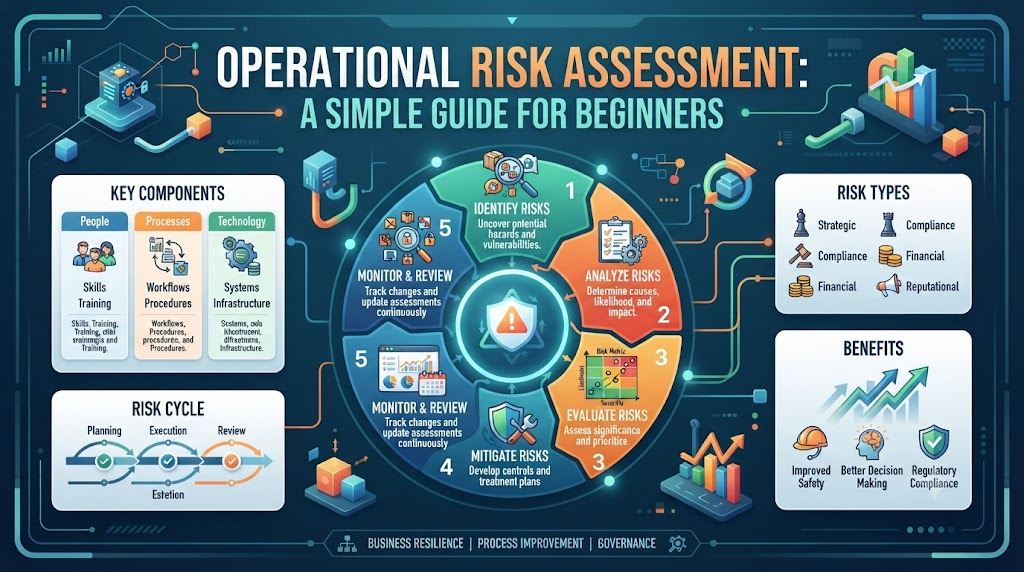
Risk assessment sounds like a big and scary idea. It is not. Any manager can do it with four easy steps. Think of it as a loop that you repeat again and again. You spot the danger, measure it, make a plan, and then keep watching. Let us go through each step slowly.
Step 1: Spotting the Danger
The first step is to find out what could go wrong. Sit down with your team and ask simple questions. What parts of our work are most important? What would happen if each part stopped for one day? What has gone wrong in the past? Write every answer down, even the small ones.
A good trick is to walk through your work from start to end. Follow one order from the moment a customer asks for it until the moment it is delivered. At each step, ask, “What could break here?” You may find that one person holds all the passwords. You may find that only one supplier gives you a key part. These are hidden dangers, and now you can see them.
Talk to the people who do the real work. The worker on the floor often knows about problems that the boss has never seen. Their ideas are gold. A short chat over tea can show you more than a long report.
Step 2: Measuring the Impact
Now you have a list of dangers. But not every danger is equal. Some are small, and some are huge. In this step, you ask two questions for each danger. How likely is it to happen? And how bad would it be if it did?
You can use a simple scale of low, medium, and high. A power cut in a city with weak electricity may be highly likely. A fire may be unlikely but very bad. When a danger is both likely and very bad, it goes to the top of your list. When it is rare and small, it can wait.
This step helps you use your time and money wisely. You cannot fix everything at once. By ranking your risks, you work on the biggest ones first. This is how smart managers avoid wasting effort.
Step 3: Creating a Backup Plan
Now comes the action part. For each big risk, you make a plan. There are a few easy choices. You can stop the risk, like fixing a broken wire before it starts a fire. You can reduce the risk, like training two people to do the same job. You can share the risk, like buying insurance. Or you can accept the risk if it is very small.
A good backup plan is clear and short. It says who does what, and when. For example, “If our main supplier fails, call our second supplier within one hour.” Everyone should know where this plan is kept. A plan that sits in a locked drawer helps no one.
Practice makes the plan strong. Run a small test once or twice a year. Pretend the main computer has crashed and see how fast your team can recover. You will quickly find the gaps and fix them.
Step 4: Keeping a Watchful Eye
The last step is to keep watching. Your business changes all the time. New workers join, new machines arrive, and new suppliers come in. Each change can bring a new risk. So your risk list should never be a one-time job.
Set a regular time, maybe once a month, to review the list. Ask what has changed. Ask which plans worked and which did not. Then go back to Step 1 and start the loop again. This is why we call it a loop. The more you repeat it, the safer your business becomes.
Comparing Proactive Risk Assessment vs. Reactive Panic
Some companies check for risks every day. We call them proactive. Other companies do nothing until something breaks. We call them reactive. The difference between the two is huge. Here is a simple table to show it.
| What We Compare | Proactive Company (Checks Risks Daily) | Reactive Company (Waits for Things to Break) |
|---|---|---|
| Stress Levels During a Crisis | Low. The team knows the plan and stays calm. | Very high. People shout, guess, and run around. |
| Money Saved/Lost | Saves money by fixing small problems early. Losses stay small. | Loses a lot of money on rush repairs, delays, and lost sales. |
| Customer Trust | Strong. Customers get their orders on time, even during trouble. | Weak. Late orders and broken promises make customers leave. |
| Speed of Recovery | Fast. A backup plan is ready to go. | Slow. The team has to invent a plan in the middle of the crisis. |
| Team Mood | Confident and united. | Tired, blamed, and afraid. |
Look at the first row. In a crisis, a proactive manager says, “We have seen this before. Let us follow the plan.” A reactive manager says, “What do we do now?” That one moment of confusion can cost hours, and hours can cost thousands.
Think of two factory managers. Both have a key machine that suddenly stops. The first manager did not prepare. She has to shut down the whole factory, call for emergency help, and pay extra for fast repairs. Workers sit idle while orders pile up. The second manager prepared months ago. He keeps spare parts nearby and has a second machine ready. He switches over in minutes, and customers never notice a thing.
The table also shows that being proactive does not cost much. It takes time and care, not a huge budget. Yet it protects your money, your name, and your peace of mind. Customer trust is hard to earn and very easy to lose. A company that stays steady in hard times earns a loyal fan base for years.
The True Cost of Ignoring the Risks
Let us look at a realistic example. Picture a medium-sized retail store with an online shop. It stores the names, phone numbers, and orders of two hundred thousand customers on its own servers. The owner sets up a backup system years ago. He then forgets about it. No one checks it, and no one tests it.
One night, the main server fails. The team calmly says, “No problem, we have a backup.” Then they open the backup and find it has been broken for eight months. It has not saved a single new record. All the customer data from those months is gone. Orders, payment records, and addresses have disappeared.
The damage spreads fast. The store cannot ship pending orders because it does not know who ordered what. Customers are angry and ask for refunds. News spreads on social media, and new shoppers stay away. The store spends weeks and a huge amount of money to rebuild its records, and some data can never be saved. In the end, the loss reaches millions when you add lost sales, refunds, repair costs, and a damaged name.
Here is the sad part. A simple risk assessment could have stopped all of it. One person checking the backup once a month would have found the problem in minutes. A small test restore, which takes an hour, would have shown the backup was broken. The fix would have cost almost nothing. The lesson is clear: a small check today can save you from a giant loss tomorrow.
How to Build a Risk-Aware Culture in Your Team
Tools and plans are useful, but people make the real difference. A company can have the best risk list in the world, and still fail if the team does not care. A risk-aware culture means everyone thinks about problems and feels free to speak up. It starts with the boss, but it must spread to every person.
The biggest rule is simple: never punish people for reporting a problem. If a worker says, “I think this machine sounds strange,” thank them. If you shout at them, they will stay quiet next time. Silence is the best friend of a hidden risk. When people fear getting fired, they hide mistakes, and small mistakes grow into disasters. When people feel safe, they tell you early, and early news is cheap to fix.
Training helps a lot. Teach your team what risks look like in their own jobs. Use real stories from your own business or from others. Show them how to report a problem, who to tell, and what happens next. Keep it simple, with a short form or a quick message. If reporting is hard, people will not do it.
Finally, make it clear that risk assessment is everyone’s job, not only the boss’s. The cleaner may spot a wet floor. The driver may notice a weak tire. The new hire may see a step that makes no sense. Celebrate these catches. Say a public thank you or give a small reward. When people see that spotting risks is valued, they start doing it without being asked.
FAQs
1. What is operational risk in simple words?
Operational risk is the chance that something goes wrong in the daily work of a business. It can be a broken machine, a human mistake, a computer crash, or a storm. It is about the everyday things that keep a company running.
2. Why is operational risk assessment important?
It helps you find problems before they grow big. This saves money, time, and customer trust. A business that checks its risks stays calm when trouble comes.
3. What are the four main causes of operational risk?
The four causes are people, processes, systems, and outside events. People can make mistakes. Processes can be unclear or old. Systems like computers can crash. Outside events include floods, fires, and power cuts.
4. How often should a business check its risks?
A full review once a month or once every three months works well for most teams. Also check when something big changes, like a new machine, new software, or a new supplier. Small daily checks are even better for key tasks.
5. Do small businesses need risk assessment too?
Yes, absolutely. Small businesses often have fewer backups, so one problem can hurt them more. A simple list of risks and a few backup plans can protect a small shop very well.
6. What is the difference between a proactive and a reactive company?
A proactive company looks for problems early and makes plans before trouble starts. A reactive company waits for things to break and then rushes to fix them. Proactive companies usually lose less money and stay calmer.
7. How do I rank which risks to fix first?
Ask two questions for each risk. How likely is it to happen, and how bad would it be? Fix the risks that are both likely and very bad first. Leave small and rare risks for later.
8. What is a backup plan?
A backup plan is a clear set of steps that tells your team what to do when something goes wrong. It says who does what and when. A good plan is short, easy to find, and tested often.
9. How can I get my employees to report problems early?
Make it safe. Never punish people for speaking up, and thank them when they do. Teach them how to report, keep the process easy, and reward good catches. When people feel safe, they share problems quickly.
10. Do I need expensive software to assess risk?
No. You can start with a simple notebook or spreadsheet. Write down the risks, rate them as low, medium, or high, and note your backup plans. Tools can help later, but the habit matters more than the software.
Conclusion
Operational risk is just the chance that something goes wrong in your daily work. It can come from people, processes, systems, or outside events. You cannot remove every risk, but you can be ready for the big ones. That readiness is what separates a calm business from a panicked one.
The four-step loop is easy to remember. Spot the danger, measure the impact, create a backup plan, and keep a watchful eye. Repeat it often, and your business gets stronger each time. As the table showed, proactive companies save money, keep customers happy, and stay calm in a crisis. Reactive companies pay for it later, often with much more.
The story of the store with the broken backup shows what is at stake. One small check could have saved millions. And the best part is that you can start today. Make a short list of what could go wrong in your work. Talk to your team. Build a culture where people speak up without fear. Small steps, taken often, protect everything you have built.