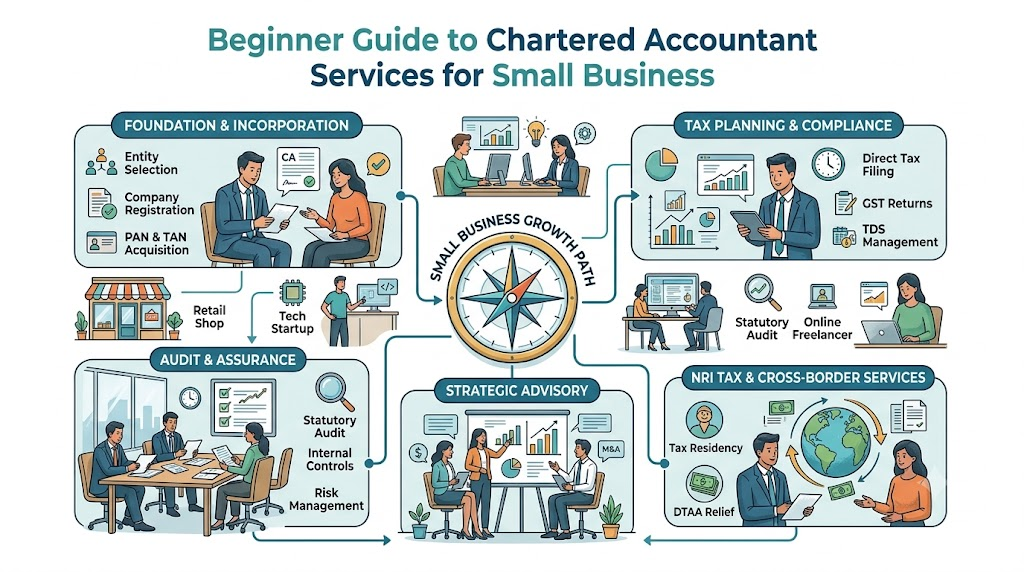
Navigating personal taxes, corporate regulatory frameworks, and complex bookkeeping requirements demands rigorous technical proficiency and proactive strategic foresight. Whether you are running a technology startup, managing an established enterprise, operating as a freelancer, or handling investments as a Non-Resident Indian (NRI), securing expert financial guidance through an Online CA Consultation helps you effortlessly navigate direct taxation, indirect taxation, statutory audits, and corporate law with precision while keeping your business fully compliant.
Understanding the Role of Modern Chartered Accountants
A Chartered Accountant is a qualified financial expert who has completed rigorous technical education, extensive practical training, and mandatory professional examinations administered by recognized statutory bodies, such as the Institute of Chartered Accountants of India (ICAI). Unlike general bookkeepers or uncertified tax preparers, certified financial professionals hold exclusive statutory authorization to perform independent audits, certify official financial statements, represent clients before tax tribunals, and deliver high-level corporate governance strategies.
Modern accounting professionals have evolved far beyond manual record-keeping and basic tax return preparation. Today’s financial advisors act as strategic growth partners. They leverage sophisticated accounting software, enterprise business intelligence tools, and automated compliance trackers to provide real-time visibility into overall financial health. Their interdisciplinary expertise spans corporate finance, legal structure optimization, cross-border tax treaty interpretation, and enterprise risk mitigation.
+-----------------------------------------------------------------------+
|                THE CORE ROLES OF MODERN CA PROFESSIONALS              |
+-----------------------------------------------------------------------+
|                                                                       |
|   +-----------------------+                 +---------------------+   |
|   | Audit & Assurance     |                 | Strategic Advisory  |   |
|   | - Statutory Audits    |                 | - Cash Flow Design  |   |
|   | - Tax Audits          |                 | - Valuation Models  |   |
|   | - Forensic Accounting |                 | - M&A Due Diligence |   |
|   +-----------+-----------+                 +----------+----------+   |
|               |                                        |              |
|               +-------------------+--------------------+              |
|                                   |                                   |
|                     +-------------v---------------+                   |
|                     | Tax & Legal Compliance      |                   |
|                     | - Income Tax & GST Returns  |                   |
|                     | - MCA & ROC Disclosures     |                   |
|                     | - NRI Cross-Border Rules    |                   |
|                     +-----------------------------+                   |
+-----------------------------------------------------------------------+
Understanding the precise differences between certified accounting professionals and general administrative clerks is vital when assigning risk-sensitive financial responsibilities within any scaling organization.
Key Differences: Chartered Accountants vs. Unqualified Bookkeepers
- Statutory Authority: Certified accounting specialists possess legal authorization to conduct statutory audits, sign financial audit reports, and issue official tax audit opinions. Uncertified bookkeepers are restricted strictly to basic ledger entry and record maintenance.
- Regulatory Oversight: Professional CAs are bound by strict ethical codes, statutory oversight, and continuing professional education standards set by governing institutions like ICAI. Uncertified tax preparers operate without uniform professional accountability.
- Scope of Advisory: Certified financial advisors deliver integrated financial planning, corporate structuring, risk mitigation, and legal representation during statutory audit proceedings. Bookkeepers focus primarily on recording historical transactional data.
- Liability and Rigor: Professional CAs maintain rigorous verification standards to prevent compliance failures, whereas general accounting clerks rely on management assertions without independent verification.
Why Professional CA Services Matter for Modern Businesses
Operating a business involves managing complex statutory requirements, strict submission timelines, and shifting regulatory mandates. Failing to comply can result in heavy financial penalties, severe reputational damage, legal notices, or complete operational disruptions. Partnering with experienced corporate tax professionals transforms routine compliance from an administrative burden into a sustainable competitive advantage.
Professional oversight brings structured internal controls, accurate financial reporting, and disciplined risk management to the enterprise. As organizations scale, managing capital allocations, payroll withholdings, input tax credits, and corporate governance becomes increasingly complex. Professional financial managers design robust enterprise architecture that maintains complete transparency while identifying legitimate tax reduction strategies and maximizing bottom-line efficiency.
When evaluating external financial advisory solutions, business leaders must carefully assess how different delivery models match their internal resource constraints, technical needs, and operational complexity.
In-House Accountant vs. External Chartered Accountant Firm
| Feature | In-House Accountant | External Chartered Accountant Firm |
| Core Operational Focus | Daily transactional entries, invoicing, and basic ledger management | Strategic tax planning, statutory audits, complex compliance, and legal advisory |
| Cost Structure | Fixed recurring salary, benefits, office space, software, and training costs | Scalable, engagement-based pricing tailored to specific business milestones |
| Regulatory Expertise | Generally limited to routine accounting and basic filing procedures | Deep specialization across direct tax, GST, corporate law, and international tax |
| Independent Verification | Low; employee internal reviews lack independent objective authority | High; certified independent evaluation suitable for investors and statutory authorities |
| Scalability & Flexibility | Difficult to scale quickly during rapid corporate expansion | Instantly scalable across specialized departments like M&A, international tax, and audits |
Core Financial Services Offered by Chartered Accountants
Comprehensive corporate financial management requires specialized advisory services tailored to individual and organizational needs. Qualified tax consultants offer end-to-end support across critical financial domains:
- Direct Taxation & Income Tax Returns: Filing annual income tax returns for individuals, firms, companies, and trusts. Structuring deductions under statutory tax provisions, managing Tax Deducted at Source (TDS) filings, and representing clients in tax assessments.
- Goods and Services Tax (GST) Advisory: Complete handling of GST registration, monthly and quarterly GST return submissions, Input Tax Credit (ITC) reconciliation, e-way bill generation, and annual GST audit reporting.
- Audit and Assurance Services: Conducting mandatory statutory audits under corporate legislation, tax audits based on revenue thresholds, internal operational audits, and specialized forensic accounting investigations.
- Corporate Secretarial & ROC Compliance: Managing annual filings with the Ministry of Corporate Affairs (MCA), maintaining mandatory corporate registers, filing board resolution notices, and executing capital restructuring procedures.
- Payroll and Statutory Withholdings: Processing monthly payroll calculations, managing Provident Fund (PF) and Employees’ State Insurance (ESI) deductions, generating Form 16 certificates, and ensuring labor law compliance.
+--------------------------------------------------------------------+
|                ENTERPRISE FINANCIAL ADVISORY STACK                 |
+--------------------------------------------------------------------+
|  [Taxation Services]     -> Direct Tax, GST Returns, TDS Relief   |
|  [Corporate Compliance]  -> MCA Filings, ROC Audits, Secretarial   |
|  [Financial Governance]  -> Internal Audits, Risk Mitigation       |
|  [Growth & Advisory]     -> Valuations, M&A Due Diligence         |
+--------------------------------------------------------------------+
Statutory Audit vs. Internal Audit: Understanding the Nuances
| Feature | Statutory Audit | Internal Audit |
| Mandatory Nature | Enforced by law based on entity structure or annual revenue thresholds | Discretionary, ordered by internal management or the board of directors |
| Primary Audience | Shareholders, financial regulators, tax authorities, and public domain | Internal management, executive boards, and internal operational leads |
| Primary Objective | Verify if financial statements represent a true and fair view | Evaluate internal operational controls, detect inefficiencies, and mitigate fraud risk |
| Scope Determination | Governed strictly by statutory regulations and professional audit standards | Defined customly by internal management goals and enterprise risk areas |
| Reporting Frequency | Executed annually following the close of the financial year | Conducted continuously throughout the operational year on a quarterly or monthly basis |
Benefits of Professional Financial Oversight for Businesses and Individuals
Securing certified accounting services provides valuable operational benefits:
- Strategic Tax Optimization: Qualified income tax professionals identify legitimate deductions, statutory exemptions, and incentives to minimize tax liabilities while maintaining full legal compliance.
- Mitigation of Financial Penalties: Automated compliance tracking ensures timely tax filings and regulatory submissions, protecting your business from costly late fees and interest charges.
- Enhanced Credibility with Stakeholders: Audited financial statements signed by a certified practitioner build trust with banking partners, venture capital investors, credit rating agencies, and vendor networks.
- Data-Driven Strategic Planning: Accurate, professionally verified financial reports offer clear insights into gross margins, operating expenses, cash conversion cycles, and capital deployment options.
- Seamless Dispute Resolution: When tax authorities issue inquiries or notices, having a certified professional manage responses ensures clear legal positioning and mitigates administrative escalation risks.
Strategic Financial and Tax Guidance for Startups and MSMEs
Startups and Micro, Small, and Medium Enterprises (MSMEs) face distinct financial challenges. During early growth phases, entrepreneurs must focus intensely on product development, customer acquisition, and team expansion. However, neglecting financial architecture and compliance can create severe liabilities that complicate equity fundraising, grant applications, or debt financing.
Certified financial consultants act as virtual Chief Financial Officers (CFOs) for emerging businesses. They help build cap tables, establish cloud accounting platforms, set up scalable unit economics tracking, and handle startup tax exemptions under government development programs. Additionally, early-stage accounting support helps maintain investor-ready financial records from day one.
+-------------------------------------------------------------------+
|               STARTUP FINANCIAL COMPLIANCE ROADMAP                |
+-------------------------------------------------------------------+
|  Phase 1: Foundation   -> Entity Incorporation, PAN, TAN, GST     |
|  Phase 2: Architecture -> Cloud Accounting & Automated Payroll    |
|  Phase 3: Governance   -> Monthly GST Reconciliation & TDS        |
|  Phase 4: Expansion    -> Valuation Reports & Investor Audits     |
+-------------------------------------------------------------------+
NRI Taxation and Cross-Border Compliance Considerations
Non-Resident Indians (NRIs) face complex tax obligations when managing cross-border income, foreign remittances, real estate investments, and capital gains in India. Misinterpreting tax residency rules or Double Taxation Avoidance Agreements (DTAA) can lead to unexpected tax liabilities or dual taxation.
Specialized NRI tax advisors offer structured cross-border planning:
- Tax Residency Determination: Evaluating physical stay durations during the financial year under statutory rules to determine non-resident status and avoid double exposure.
- DTAA Utilization: Applying treaty relief mechanisms between India and foreign host nations to prevent double taxation on capital gains, dividend yields, and professional service fees.
- Form 15CA and 15CB Certification: Preparing mandatory digital declarations and auditor certifications required by banking institutions before executing outward foreign remittances.
- Property Realization & Repatriation: Navigating tax withholdings under Section 195 on real estate transactions, securing Lower Withholding Tax Certificates, and managing regulatory fund repatriations.
Step-by-Step Company Registration Process in India
Selecting the correct legal entity structure is a fundamental decision when launching a new commercial venture. The legal framework determines founder liability, tax structures, equity allocation models, and statutory compliance demands.
+--------------------------------------------------------------------+
|                   COMPANY INCORPORATION PIPELINE                   |
+--------------------------------------------------------------------+
| [Step 1] Acquire Digital Signature Certificates (DSC)               |
|    |                                                               |
| [Step 2] Reserve Unique Corporate Name via SPICe+ Part A           |
|    |                                                               |
| [Step 3] Draft MOA & AOA Charter Instruments                       |
|    |                                                               |
| [Step 4] Submit SPICe+ Part B Incorporation Filing with MCA        |
|    |                                                               |
| [Step 5] Receive COI, Allot PAN, TAN, & Obtain GST Registration    |
+--------------------------------------------------------------------+
Entity Selection Framework: Sole Proprietorship vs. LLP vs. Private Limited Company
| Feature | Sole Proprietorship | Limited Liability Partnership (LLP) | Private Limited Company (Pvt Ltd) |
| Legal Status | No separate legal entity; owner holds unlimited personal liability | Distinct legal entity; liability limited to agreed partner contribution | Separate corporate entity; shareholder liability limited to unpaid share capital |
| Taxation Rate | Individual income tax slab rates apply to operational profits | Flat corporate tax rate applied to net taxable profits | Flat corporate tax rate with applicable surcharges and health education cesses |
| Compliance Load | Minimal; basic income tax returns and GST disclosures if registered | Moderate; annual LLP disclosures and tax return filings required | Comprehensive; mandatory board meetings, statutory audits, and annual MCA filings |
| Equity Financing | Cannot issue equity shares or bring in external equity investors | Partners can join, but equity shares cannot be issued to outside investors | Highly preferred by angel networks, VC funds, and institutional investors |
| Best Use Cases | Micro-merchants, solo freelancers, and local service providers | Professional services practices, family ventures, and medium partnerships | Tech startups, high-growth companies, and scalability-focused businesses |
Navigating Income Tax and GST Compliance Frameworks
Indirect taxation under the Goods and Services Tax framework demands meticulous monthly and quarterly tracking. Unlike traditional tax frameworks, GST relies on end-to-end digital invoicing networks where tax offsets depend on accurate supplier disclosures.
+-------------------------------------------------------------------+
|               GST INPUT TAX CREDIT (ITC) RECONCILIATION           |
+-------------------------------------------------------------------+
|  Purchase Register Entries  <--->  Auto-Populated GSTR-2B Statement |
|                 |                           |                     |
|                 +-------------+-------------+                     |
|                               |                                   |
|                      [Match Verification]                         |
|                               |                                   |
|              +----------------+----------------+                  |
|              |                                 |                  |
|       [Matched / Valid]                [Mismatch Identified]      |
|              |                                 |                  |
|    Claim Full ITC Offset              Vendor Follow-Up Issued     |
+-------------------------------------------------------------------+
Strategic Comparison: Operating With vs. Without Optional GST Registration
| Comparison Criteria | Registered Under GST Scheme | Operating Unregistered Below Thresholds |
| Business Credibility | High; establishes legitimacy across enterprise business networks | Moderate; enterprise buyers often avoid unregistered vendors |
| Input Tax Credit | Full ability to claim ITC offsets on business expense inputs | Ineligible; paid input GST becomes a non-recoverable operational cost |
| E-Commerce Market Access | Unlocks full eligibility to list and sell on digital marketplace platforms | Restricted from selling goods across interstate digital commerce portals |
| Compliance Overhead | Requires periodic return filings, GSTR-2B reconciliation, and e-invoicing | Zero GST compliance burdens or periodic reporting requirements |
| Cost to Retail Clients | Must charge applicable GST rates on sales to end consumers | Price points exclude GST charges, benefiting non-GST consumer sales |
How to Choose the Right Chartered Accountant for Your Needs
Selecting an ideal accounting advisory partner requires careful evaluation beyond basic geographical proximity or service pricing. Consider these strategic criteria when vetting financial firms:
- Domain Specialization: Ensure the firm has proven expertise in your specific industry sector, such as technology, international trade, real estate, manufacturing, or healthcare.
- Digital Infrastructure Integration: Verify if the firm uses modern cloud accounting platforms, automated communication channels, secure client data vaults, and digital filing systems.
- Firm Scale and Capacity: Assess whether an independent individual practitioner, a mid-sized practice, or a large multi-partner firm best aligns with your current operational scale and future expansion plans.
- Fee Transparency: Request detailed engagement letters outlining specific billing structures, retainer terms, and deliverables to avoid unexpected cost additions.
- Professional Reputation: Confirm valid institutional credentials and review verified client references, case studies, and industry testimonials.
Virtual CA Consultations vs. Traditional In-Person Meetings
| Operational Feature | Virtual Online CA Consultation | Traditional In-Person Meetings |
| Access & Convenience | Instant global connectivity; schedule meetings remotely from anywhere | Dependent on geographic proximity and travel schedules |
| Document Workflows | Secure cloud file vaults, digital signatures, and real-time dashboard sharing | Manual paper document deliveries, physical signatures, and file storage |
| Turnaround Velocity | Rapid resolution for queries via digital communication platforms | Slower turnaround times due to physical scheduling and travel constraints |
| Cost Efficiency | Lower overhead costs translate into transparent, value-oriented pricing | Higher overheads associated with maintaining physical office footprints |
| Best Use Cases | NRI tax planning, busy founders, remote businesses, and quick compliance advice | Complex legal disputes, physical audit inspections, and highly sensitive negotiations |
Best Practices for Financial Management
Establishing robust financial management processes early prevents costly operational disruptions and reduces administrative friction.
+--------------------------------------------------------------------+
|                  FINANCIAL BEST PRACTICES WHEEL                     |
+--------------------------------------------------------------------+
|  1. Separate Accounts  -> Isolate personal and business cash flow  |
|  2. Real-Time Tracking -> Update cloud accounting ledgers weekly   |
|  3. Pre-Filing ITC     -> Reconcile GSTR-2B inputs before filing  |
|  4. Maintain Vaults    -> Store receipts and tax forms securely    |
|  5. Schedule Reviews   -> Conduct quarterly tax planning checks    |
+--------------------------------------------------------------------+
- Isolate Corporate and Personal Cash Flow: Maintain complete separation between business accounts and personal finances to protect limited liability status and simplify tax preparation.
- Adopt Cloud Ledger Systems: Transition from manual spreadsheets to integrated cloud accounting platforms for real-time tracking of receivables, payables, and working capital.
- Conduct Monthly ITC Reconciliations: Perform systematic cross-checks between internal purchase registers and auto-generated GSTR-2B tax statements before locking monthly GST filings.
- Maintain Digital Compliance Repositories: Store signed audit reports, tax filings, board resolutions, and statutory receipts in secure digital repositories organized by financial year.
- Schedule Mid-Year Tax Reviews: Meet with your financial advisor mid-year to evaluate tax projections and adjust advance tax payments to avoid late-interest penalties.
Expert Tips for Maximizing Value from Your CA Relationship
Working effectively with certified accounting advisors requires active collaboration and strategic communication.
- Involve Advisors Early: Consult your financial expert before finalizing major business decisions, such as equity adjustments, property acquisitions, cross-border expansions, or restructuring plans.
- Standardize Invoicing Processes: Implement automated invoicing platforms with built-in GSTIN validation and e-way bill integrations to minimize manual accounting errors.
- Establish Clear Filing Schedule Calendars: Maintain a shared master compliance calendar tracking TDS remittance dates, GST submissions, ROC deadlines, and advance tax cutoffs.
- Automate Bank Feeds: Link business bank accounts directly to cloud accounting software to ensure daily transaction reconciliations and reduce month-end workload.
- Request Periodic Cash Flow Assessments: Ask your advisory team for quarterly working capital assessments to spot burn rate trends, margin compression, or seasonal cash flow gaps early.
Common Financial and Compliance Mistakes to Avoid
Businesses and individual taxpayers frequently make preventable mistakes that expose them to unnecessary risks, financial penalties, and statutory notices:
+-----------------------------------------------------------------------+
|                    CRITICAL COMPLIANCE MISTAKES                       |
+-----------------------------------------------------------------------+
|  [Mistake 1] Delaying Tax Submissions      -> Triggers Interest & Fees|
|  [Mistake 2] Unreconciled Input Credit     -> Unclaimed GST Offsets   |
|  [Mistake 3] Mixed Personal & Business     -> Tax Audit Violations    |
|  [Mistake 4] Low-Fee Engagement Choices    -> Unqualified Over-sights |
+-----------------------------------------------------------------------+
- Delaying Return Submissions Until Cutoff Dates: Waiting until final deadlines often leads to server overloads, system errors, missed statutory disclosures, and automatic late fees.
- Choosing Advisors Solely on Lowest Cost: Selecting financial partners purely based on discounted fees often results in missed deductions, inadequate oversight, and costly compliance errors.
- Ignoring Monthly Input Tax Credit Variations: Failing to verify if vendors have filed their GST disclosures can lead to disallowed input tax credits and unexpected tax liabilities.
- Neglecting Non-Resident Tax Rules: NRIs often make foreign remittances or real estate investments without proper withholding certificates, exposing them to legal disputes under statutory tax provisions.
- Inconsistent Document Archive Management: Incomplete record-keeping of invoices, expense vouchers, bank statements, and tax receipts makes defending tax audits difficult.
The Future of Digital Accounting and Remote CA Consultations
The financial accounting landscape is undergoing a digital transformation. Machine learning tools, cloud architecture, and real-time bank APIs are reshaping how accounting advisors deliver value to clients. Modern digital accounting platforms eliminate traditional geographic barriers, allowing startups, enterprises, and NRIs to access specialized advisory talent remotely.
Automated data extraction, optical character recognition (OCR) for receipts, and algorithmic reconciliation engines have dramatically reduced manual bookkeeping work. This technological shift allows modern accounting professionals to focus on strategic financial planning, forward-looking cash flow modeling, cross-border tax advisory, and enterprise risk management. Choosing digitally native financial platforms ensures your organization benefits from seamless data exchange, real-time reporting, and faster consultation turnarounds.
Why Choose BestCaNow for Your Professional CA Services
Finding an ideal financial advisor with relevant industry experience, verified credentials, and clear pricing can be challenging. BestCaNow solves this problem by providing a modern platform designed to connect individuals, businesses, startups, and NRIs with qualified Chartered Accountants and tax consultants.
BestCaNow simplifies discoverability, offering a transparent directory where clients can evaluate practitioner profiles based on sector specialization, client ratings, location, and years of experience. Whether you need in-person tax assistance or a remote video consultation, BestCaNow provides access to vetted financial experts across India and international markets.
By using BestCaNow’s structured directory, clients can compare service offerings, verify qualifications, and schedule initial consultations with confidence. The platform serves as a trusted bridge between clients seeking reliable financial management and experienced professionals equipped to deliver top-tier advisory services.
Frequently Asked Questions (FAQs)
1. What qualifications distinguish a Chartered Accountant from a general accountant?
A Chartered Accountant completes rigorous professional examinations, mandatory multi-year practical training, and continuous professional education administered by statutory institutions like ICAI. They hold exclusive legal authorization to execute statutory audits, certify official financial statements, and represent clients before tax authorities, whereas general accountants focus primarily on routine ledger bookkeeping.
2. How does online CA consultation work on platforms like BestCaNow?
Online consultations allow clients to connect with verified Chartered Accountants remotely via secure video channels, phone calls, or digital messaging platforms. Clients can share digital documents securely, discuss tax strategies, review compliance requirements, and receive professional advice without physical travel, saving time while accessing specialized expertise nationwide.
3. Which legal structure is best suited for a technology startup in India?
A Private Limited Company is usually the ideal legal structure for tech startups seeking equity investments. It provides limited liability protection, a distinct corporate identity, a clear share issuance framework, and strong credibility with angel investors, venture capital funds, and banking institutions compared to unincorporated structures.
4. Is GST registration mandatory for all businesses?
GST registration is mandatory if your annual turnover exceeds prescribed legal thresholds (generally ₹40 Lakhs for goods suppliers and ₹20 Lakhs for service providers in standard states). Registration is also required regardless of turnover for interstate sellers, e-commerce vendors, non-resident taxable entities, and businesses subject to reverse charge mechanics.
5. What are the key benefits of hiring an income tax consultant near me?
Partnering with a qualified local or digital income tax consultant ensures accurate tax filings, maximum utilization of legal tax deductions, timely compliance updates, and lower risk of receiving statutory notices. Professional tax advisors help design proactive tax management strategies that optimize tax liabilities while ensuring complete legal compliance.
6. What tax compliance mandates apply to Non-Resident Indians (NRIs)?
NRIs are subject to Indian tax regulations on income sourced, earned, or received within India, such as rental returns, capital gains from real estate sales, fixed deposit interest, and dividends. NRIs must maintain proper account structures (NRE/NRO), apply applicable Double Taxation Avoidance Agreements (DTAA), and submit Form 15CA/15CB for foreign remittances.
7. What is the difference between a statutory audit and a tax audit?
A statutory audit is legally mandated under corporate laws to ensure financial statements present a true and fair view of a company’s financial health. A tax audit, governed by statutory income tax provisions, verifies business revenues, expense deductions, and compliance with income tax rules once turnover crosses specific legal thresholds.
8. How often must a business file GST returns?
GST return schedules depend on your chosen scheme and annual business turnover. Regular taxpayers file monthly summaries (GSTR-3B) and sales returns (GSTR-1). Smaller businesses enrolled in quarterly filing schemes submit returns every three months alongside monthly tax payments, while all registered entities must submit an annual return (GSTR-9).
9. Can a startup claim tax exemptions in India?
Yes, startups recognized by DPIIT can apply for statutory income tax exemptions under specialized government development provisions, subject to meeting eligibility requirements. Eligible startups can receive a three-year tax holiday within their first decade of operations, provided they are structured as a Private Limited Company or Limited Liability Partnership.
10. What documents are required to complete company registration?
Company registration requires identity and address proofs for all directors and shareholders (PAN, Aadhaar, Passport, or Voter ID), utility bills or lease agreements for the registered business address, a landlord No Objection Certificate (NOC), and signed Memorandum and Articles of Association charter instruments.
11. What are the consequences of missing GST filing deadlines?
Missing GST filing deadlines results in mandatory daily late fees until the return is submitted. Additionally, delayed payments accrue annual interest charges on net tax liabilities. Prolonged non-compliance can lead to blocked e-way bill generation, suspended GSTIN credentials, and disallowed Input Tax Credit for business customers.
12. Why is Input Tax Credit (ITC) reconciliation important under GST?
Input Tax Credit reconciliation ensures that the tax credits claimed in your financial ledgers match the tax disclosures submitted by your suppliers in their GSTR-2B statements. Discrepancies can lead to disallowed credit claims, unexpected tax demands, interest charges, and statutory inquiries from tax authorities.
13. How do I choose the right CA firm for my business on BestCaNow?
Select an ideal firm on BestCaNow by evaluating practitioner profiles based on industry experience, core service specializations (such as tax advisory, audits, or startup support), client reviews, and communication capabilities. Comparing multiple profiles helps ensure you find an advisor aligned with your operational needs and budget.
14. What are Form 15CA and Form 15CB, and when are they required?
Form 15CA is a self-declaration statement used to track foreign remittances taxable in India, while Form 15CB is a formal tax certificate issued by an independent Chartered Accountant. Banking institutions require these documents before processing outward foreign transfers to ensure proper tax withholdings on foreign payments.
15. Is an internal audit necessary if my company already completes a statutory audit?
Yes, while statutory audits focus primarily on historical financial accuracy for external stakeholders, internal audits evaluate ongoing internal controls, operational efficiency, fraud prevention mechanisms, and risk management practices. Internal audits help management identify and fix operational weaknesses before formal external statutory reviews.
Conclusion
Navigating financial planning, tax management, and statutory compliance requires technical expertise, attention to detail, and a clear understanding of shifting regulatory frameworks. Whether managing personal income tax filings, scaling an emerging startup, structuring cross-border NRI investments, or leading an established enterprise, working with qualified financial experts is essential. Certified Chartered Accountants provide the strategic guidance needed to optimize tax efficiency, maintain statutory compliance, and protect business capital. By adopting structured accounting workflows, leveraging cloud financial platforms, avoiding common compliance errors, and engaging experienced tax advisors, businesses can focus on sustainable growth while mitigating regulatory risks. Investing in professional financial guidance helps ensure long-term stability and business success.