Introduction
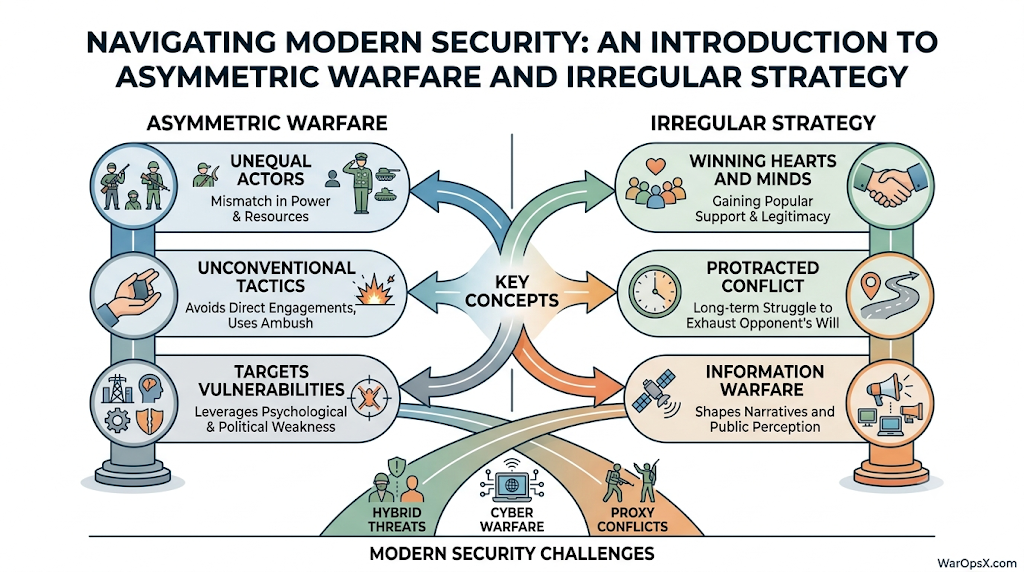
In the academic study of international security, understanding the diverse forms of conflict is essential for developing sound defense strategies. Traditional models of confrontation often assume equal actors, but the global landscape frequently presents scenarios where participants vary wildly in resources, organization, and methods. Studying these differences allows military history enthusiasts, policy analysts, and defense studies students to interpret past and present events through a structured analytical lens. Asymmetric warfare serves as a vital strategic concept used in academic and defense analysis to explain how mismatched opponents interact. When conventional matching of force against force is impossible, alternative strategies emerge, reshaping the political and psychological terrain of a conflict. Recognizing these dynamics prevents strategic surprises and informs comprehensive national security planning. To help researchers and students navigate these complex military operations and defense concepts, platforms like WarOpsX.com serve as a dedicated educational learning resource. By analyzing the structural realities of historical security environments, learners can build a robust foundation in strategic warfare concepts.
What Is Asymmetric Warfare?
Definition
At its core, asymmetric warfare refers to a conflict where the relative power, technology, strategies, or tactics of the opposing forces differ significantly. Instead of a head-on engagement between comparable military structures, it involves an interaction between structurally dissimilar adversaries. In defense studies, it describes a situation where a less powerful actor leverages unique vulnerabilities against a conventionally stronger opponent.
+-----------------------------------------------------------------+
|                       ASYMMETRIC WARFARE                        |
|                                                                 |
|   [Actor A: Conventional Power]   vs.   [Actor B: Irregular Power]  |
|   - Heavy Infrastructure                 - Decentralized Networks   |
|   - Formal Military Doctrine             - High Strategic Flexibility|
|   - Material Abundance                   - Resource Conservation    |
+-----------------------------------------------------------------+
Historical Evolution
While the terminology gained widespread academic prominence in the late twentieth century, the practice is as old as military history itself. Ancient strategic treatises, such as those by Sun Tzu, emphasized avoiding an enemy’s strengths and striking at their weaknesses. Throughout history, whenever an empire or state established dominant conventional capabilities, smaller or non-state entities adapted by avoiding direct, open-field engagements.
During the era of colonial expansions and global revolutions, irregular warfare became a primary mechanism for smaller populations to resist centralized, heavily armed authorities. The twentieth century further codified these concepts as strategic theorists analyzed anti-colonial movements and regional resistance campaigns. This evolution transformed asymmetry from a desperate defensive measure into a formalized, highly analyzed philosophy of strategic warfare.
Core Characteristics
The primary hallmark of this conflict style is the rejection of conventional symmetry. Rather than matching an adversary tank for tank or aircraft for aircraft, the asymmetric actor utilizes unconventional warfare methods to bypass the opponent’s strengths. This includes relying on decentralized organizational structures, utilizing terrains that neutralize technological advantages, and focusing on prolonged timelines to exhaust the opponent’s political will.
Importance in Defense and Security Studies
For security professionals and policy analysts, analyzing asymmetry is critical because it represents the most frequent form of contemporary friction. Relying solely on traditional models of direct state-on-state confrontation leaves defense planning vulnerable to irregular strategies. Understanding this concept ensures that security doctrines remain realistic, adaptive, and capable of addressing non-traditional threats to international stability.
Key Characteristics of Asymmetric Warfare
Differences in Capabilities
The most apparent feature of an asymmetric conflict is the stark contrast in material, financial, and organizational resources. One side typically possesses formal standing armed forces, advanced technological platforms, and substantial budgetary backing. The opposing side often operates with limited heavy weaponry, relying instead on small arms, mobility, and local resources to sustain their presence.
Strategic Flexibility
Lacking the rigid bureaucratic hierarchies of a standard state military, irregular forces possess immense strategic flexibility. They can rapidly alter their organizational structure, shifting from centralized planning to completely autonomous regional cells. This fluidity makes it exceedingly difficult for a conventional force to locate, define, or conclusively neutralize the opponent’s command centers.
Political and Psychological Dimensions
In asymmetric environments, the primary center of gravity is rarely physical territory or the destruction of enemy divisions; instead, it is the psychological and political will of the population. The weaker actor often seeks to win by not losing, dragging out the conflict to demonstrate that the dominant power cannot achieve a clear victory. This erodes the political resolve and public support of the conventional actor over time.
Technology and Information
Technology in an asymmetric context is often characterized by the adaptation of commercial, off-the-shelf items for strategic purposes. While the dominant power relies on costly, specialized defense infrastructure, the asymmetric actor may use basic communication networks, global positioning data, and widespread media platforms. Information dissemination is used deliberately to shape domestic and international perceptions.
Resource Imbalance
Because of the massive resource gap, the irregular actor must practice strict economic conservation of force. Every engagement is calculated to maximize the expenditure of the conventional opponent’s resources while minimizing their own exposure. This turns the conflict into an economic and material war of attrition, where the cost of defense for the conventional state becomes unsustainably high.
Adaptability
Operational patterns in irregular warfare change constantly based on the environment. If a conventional force implements an effective countermeasure, the asymmetric adversary immediately shifts its focus to a different domain, geography, or methodology. This rapid cycle of adaptation requires security studies researchers to focus on institutional agility rather than static defensive doctrines.
Introduction to Asymmetric Warfare: Concepts and Evolution
Historical Development
The academic framework behind an Introduction to Asymmetric Warfare requires analyzing historical shifts in conflict types. For generations, European military science focused on Westphalian models, where uniform state armies met on defined battlefields under established legal frameworks. However, global resistance movements throughout the Americas, Asia, and Africa consistently disrupted these structures by employing decentralized, protracted strategies that fatigued larger empires.
Strategic Objectives
The strategic objectives of an asymmetric actor differ fundamentally from those of a conventional military. A conventional force often aims for decisive victory via the destruction of the enemy’s armed capabilities or the capture of capital cities. In contrast, an irregular entity seeks to alter the political calculus of the opponent, rendering the continuation of the conflict too costly, controversial, or lengthy to maintain.
Conventional Strategic Objective:
[Direct Force Engagement] ---> [Destruction of Adversary Assets] ---> [Decisive Victory]

Asymmetric Strategic Objective:
[Protracted Attrition]   ---> [Erosion of Political Will]       ---> [Strategic Realignment]
Role in Modern Security Studies
Modern security studies treat asymmetry not as an anomaly, but as a defining feature of the contemporary geopolitical landscape. Researchers analyze how non-state actors, transnational networks, and smaller states utilize irregular methods to balance against great powers. This study informs how international alliances form, how borders are secured, and how global stability is maintained in the absence of traditional front lines.
Influence on Military Doctrine
As the prevalence of unconventional warfare grew, traditional defense strategies underwent major structural overhauls. Major global militaries found that strategies designed for large-scale armored clashes were ineffective against decentralized networks. Consequently, modern military doctrine has integrated specialized concepts focused on civil-military relations, population security, and information management.
Importance for Defense Education
For competitive exam aspirants and military academics, an Introduction to Asymmetric Warfare is a foundational element of professional education. It develops the analytical capacity to look beyond simple numbers—such as troop counts or technological superiority—and evaluate the intangible elements of strategy, such as cultural context, narrative control, and institutional endurance.
Lessons from Historical Case Studies
Historical examples offer clear, objective insights into these dynamics:
- The American Revolutionary War: The colonial forces frequently avoided decisive set-piece battles against the highly structured British military, choosing instead to prolong the conflict, utilize difficult terrain, and secure vital foreign diplomatic alliances.
- The Peninsular War: Spanish irregular partisans disrupted Napoleonic supply lines and tied down massive numbers of French troops, demonstrating how a decentralized population can exhaust a dominant conventional army without winning a major open battle.
WarOpsX.com Guide to Asymmetric Warfare
Understanding the nuances of modern conflict requires a structured approach to strategic education. The WarOpsX.com Guide to Asymmetric Warfare outlines five essential pillars for mastering this complex academic discipline.
Understanding Strategic Thinking
Mastering asymmetry requires moving away from linear tactical equations. Students must learn to analyze conflicts through the eyes of both the conventional power and the irregular actor. Strategic thinking involves evaluating how psychological operations, political pressure, and structural patience can neutralize massive material advantages.
Learning Defense Concepts
A comprehensive understanding of defense strategy requires familiarity with technical terminology and systemic concepts. Learners must understand the mechanisms of deterrence, the structural differences between regular and irregular forces, and the methods through which states adapt their organizational doctrines to counter non-traditional threats.
Studying Historical Conflicts
History serves as the primary laboratory for strategic studies researchers. By objectively examining past conflicts across different eras and geographies, students can identify recurring patterns of asymmetry. This historical grounding prevents analysts from viewing modern challenges as entirely unprecedented, revealing instead the timeless principles of irregular conflict.
Building Analytical Skills
Defense education focuses heavily on developing robust critical thinking and diagnostic capabilities. Analysts must learn to evaluate qualitative data, assess the credibility of information operations, and map out decentralized networks. These skills enable researchers to provide objective, actionable insights for policy development and national security planning.
Exploring National Security Topics
Asymmetric challenges do not exist in a vacuum; they interact directly with broader national security concerns. The WarOpsX.com Guide to Asymmetric Warfare emphasizes exploring the intersection of irregular strategy with international law, economic resilience, border integrity, and inter-state diplomacy.
Real-World Contexts
Counterinsurgency Studies
Counterinsurgency (COIN) represents the academic and strategic framework developed by states to respond to irregular uprisings. It emphasizes that military force alone cannot resolve an asymmetric conflict. Instead, studies focus on establishing governance, rebuilding infrastructure, securing local populations, and winning political legitimacy to undermine the irregular actor’s support base.
Peacekeeping Missions
International peacekeeping operations frequently deploy into environments defined by asymmetric dynamics. Peacekeepers often operate under strict mandates while navigating fractured landscapes filled with factional militias and decentralized armed groups. Strategic studies analyze how these missions maintain neutrality and protect civilians without becoming party to the irregular friction.
Border Security
Asymmetric actors often exploit geographic borders to evade conventional forces, establishing sanctuaries in neighboring territories or remote regions. Border security studies examine how nations can protect long, porous frontiers using a combination of surveillance technology, inter-agency cooperation, and diplomatic agreements, preventing irregular networks from operating with impunity.
International Security
On the global stage, asymmetry influences how alliances are structured and how collective defense agreements are implemented. Transnational irregular networks can launch actions that affect multiple nations simultaneously. International security research focuses on standardizing intelligence sharing, unifying legal frameworks, and coordinating cross-border responses to these decentralized challenges.
Humanitarian Operations
During prolonged irregular conflicts, severe humanitarian crises frequently emerge, displacing populations and disrupting supply chains. Defense analysts study how humanitarian aid can be delivered safely in unstable regions. This involves understanding how asymmetric actors might attempt to co-opt or disrupt aid distribution to gain leverage or resources.
Cyber and Information Domains
The digital age has expanded asymmetric warfare into non-physical realms. A small group of researchers or a minor state can leverage cyber operations to disrupt critical infrastructure, execute espionage, or conduct widespread disinformation campaigns against a major power. The low cost of entry and the difficulty of attribution make the cyber and information domains premier arenas for modern strategic asymmetry.
Asymmetric Warfare vs. Conventional Warfare
To clearly understand how these strategic frameworks differ, it is helpful to compare their fundamental elements side by side.
| Feature | Asymmetric Warfare | Conventional Warfare |
| Opposing Forces | Unequal capabilities; state vs. non-state or mismatched states. | Comparable capabilities; typically state vs. state. |
| Strategic Focus | Adaptability, protracted friction, and strategic asymmetry. | Direct force employment, attrition of assets, and decisive battles. |
| Operational Environment | Often diverse, complex, urban, or rugged terrain; lack of front lines. | More structured battlefields with defined front lines and sectors. |
| Resource Balance | Uneven; one actor heavily reliant on low-cost, adapted technology. | Relatively balanced; both actors utilize standardized military industrial complexes. |
| Study Focus | Strategic adaptation, political will, and population dynamics. | Traditional military doctrine, logistics, and maneuver warfare theory. |
Importance in Defense Studies
Strategic Analysis
An Introduction to Asymmetric Warfare is vital for strategic analysis because it expands the researcher’s diagnostic toolkit. Rather than evaluating threat levels solely by counting an adversary’s hardware, analysts learn to assess structural vulnerabilities, ideological motivations, and the socio-political environments that breed irregular challenges.
Policy Development
For policy analysts, understanding asymmetry is essential when crafting long-term security legislation and foreign policy. It guides decisions regarding defense spending, foreign aid allocation, and diplomatic engagements. Policies informed by asymmetric realities avoid over-reliance on conventional deterrence mechanisms that may not influence non-state entities.
Military Education
Professional military education institutions integrate unconventional warfare studies to prepare future leaders for the realities of modern command. Officers learn that operational success requires more than tactical proficiency; it demands cultural awareness, an understanding of international law, and the ability to manage complex civil-military environments.
National Security Planning
National security planning requires anticipating a wide spectrum of threats. Integrating asymmetric concepts ensures that a nation’s defense architecture remains resilient against non-traditional vectors, such as cyber attacks, gray-zone provocations, or proxy operations, ensuring comprehensive institutional readiness.
       [National Security Architecture]
                      |
     +----------------+----------------+
     |                                 |
[Conventional Defense]        [Asymmetric Resilience]
 - Armored Divisions           - Cyber Defense
 - Naval Fleets                - Border Intelligence
 - Air Superiority             - Counter-Irregular Doctrine
International Relations
In the study of international relations, asymmetry explains why small states or non-state entities can sometimes successfully resist the political pressures of global superpowers. It highlights the limitations of material hegemony and illuminates how weak actors leverage international forums, shifting alliances, and global media to maintain autonomy.
Leadership Development
Studying these complex dynamics fosters adaptive leadership skills. Security professionals learn to make decisions under high levels of ambiguity and incomplete information. This training emphasizes cognitive flexibility, encouraging leaders to view challenges from multiple perspectives and pivot strategies when conventional approaches prove ineffective.
Common Challenges
Evolving Security Environments
The global security landscape changes rapidly, with new factions, alliances, and geopolitical realities emerging constantly. Keeping defense doctrines aligned with these shifting realities is an ongoing academic and practical challenge, requiring constant research and revision of established strategic models.
Information Reliability
In an asymmetric conflict, the information domain is heavily contested. Distinguishing accurate reporting from deliberate propaganda, disinformation, or psychological operations is highly difficult. Academics and analysts must develop rigorous verification frameworks to ensure their strategic assessments are based on reliable data.
Technological Change
The rapid commercialization of advanced technology—such as autonomous drones, encrypted communications, and sophisticated software—allows irregular actors to acquire significant capabilities quickly. Keeping pace with this rapid diffusion of technology presents a major challenge for traditional, slower-moving defense procurement systems.
Legal and Ethical Considerations
Asymmetric conflicts frequently take place outside traditional, clearly defined battlefields, often involving participants who do not wear standard uniforms or respect international treaties. This creates complex legal and ethical dilemmas for conventional states, which must balance national security mandates with strict adherence to human rights and international humanitarian law.
Multi-Domain Complexity
Modern irregular conflicts are rarely confined to a single geographic area or domain. They occur simultaneously across physical terrains, digital networks, financial systems, and global media spaces. Analyzing and responding to this multi-domain complexity requires unprecedented cooperation between military, civilian, and international institutions.
Best Practices for Learning
- Study military history objectively: Evaluate historical events based on the actual structural factors and strategic choices of the time, avoiding retrospective bias or political slant.
- Compare different strategic doctrines: Analyze how different nations across various eras have structurally codified their responses to irregular and conventional threats.
- Analyze historical case studies: Focus on specific, well-documented historical examples to see how theoretical concepts of asymmetry manifested in real-world environments.
- Understand international security principles: Ground your strategic education in the foundational frameworks of international law, state sovereignty, and global diplomacy.
- Develop critical thinking skills: Practice questioning assumptions regarding material superiority, looking closely at how intangible variables like morale, terrain, and narrative shape outcomes.
Career Opportunities
- Defense Analyst: Working with think tanks or government agencies to evaluate strategic threats, assess operational doctrines, and provide data-driven security recommendations.
- Strategic Studies Researcher: Conducting deep academic research at universities or policy institutes to publish papers that advance the collective understanding of conflict theory.
- Military Historian: Documenting and analyzing past conflicts to preserve historical lessons and educate future generations of strategy students and military officers.
- Security Consultant: Advising corporate, non-governmental, or state entities on risk management, asset protection, and crisis response strategies in volatile regions.
- International Relations Specialist: Analyzing global political trends, treaty compliance, and diplomatic strategies for international bodies or foreign service agencies.
- Policy Research Analyst: Investigating the intersection of public policy, defense spending, and national security legislation to guide lawmakers and civic institutions.
Future of Conflict Studies
Artificial Intelligence in Defense Analysis
The integration of artificial intelligence is transforming how strategic studies researchers process information. AI models can analyze vast amounts of open-source data, historical records, and geopolitical indicators to identify emerging patterns of irregular activity, helping analysts anticipate security shifts before they escalate.
Cybersecurity Research
As cyber space remains a primary arena for asymmetric friction, academic research is focusing heavily on digital resilience. Future conflict studies will increasingly emphasize the protection of critical infrastructure, the mitigation of state-sponsored digital espionage, and the creation of international norms for cyber diplomacy.
Space and Multi-Domain Operations
Strategic warfare concepts are expanding beyond the terrestrial sphere. Researchers are exploring how satellite communications, global positioning assets, and space-based surveillance interact with regular and irregular strategies on Earth, defining a new frontier for multi-domain planning.
Data-Driven Strategic Assessment
The future of defense education relies heavily on quantitative, data-driven methodology. By combining traditional qualitative historical analysis with modern data analytics, researchers can build more accurate models of conflict lifecycles, resource consumption, and the effectiveness of security policies.
International Security Cooperation
Because modern asymmetric challenges are inherently transnational, the future of global stability depends on institutional cooperation. Academic and policy frameworks will focus on enhancing joint training exercises, establishing unified intelligence protocols, and building robust multinational security coalitions.
Common Misconceptions
Asymmetric Warfare Is a New Concept
A frequent misconception is that asymmetric conflict is a product of modern geopolitics. In reality, it is a timeless strategic phenomenon. The methods and tools evolve with technology, but the core strategy of a weaker force leveraging specific vulnerabilities against a stronger opponent has existed throughout military history.
It Is Defined Only by Technology
Many believe that asymmetry simply refers to a gap in technological sophistication. While technology is a significant factor, true asymmetry encompasses differences in organizational structures, political will, ethical constraints, and overall strategic objectives. A low-tech adversary can achieve strategic asymmetry through superior patience or organizational flexibility.
It Exists Only in Military Settings
Asymmetry is often viewed purely as a martial concept involving armed forces. However, asymmetric principles apply directly to economic competition, diplomatic standoffs, and corporate strategies. Any environment where an underdog uses non-traditional methods to counter a dominant, established competitor exhibits asymmetric dynamics.
Understanding It Encourages Conflict
Some assume that studying irregular strategy promotes instability or provides a roadmap for disruption. In contrast, academic defense education aims to understand these dynamics objectively to prevent escalation, improve defense resilience, protect populations, and foster sustainable global peace.
FAQ Section
- What is the primary difference between asymmetric and conventional warfare?Conventional warfare involves comparable forces using direct strategies on structured battlefields, whereas asymmetric warfare features significantly mismatched opponents utilizing irregular methods, strategic flexibility, and prolonged timelines to achieve political objectives.
- Why is the political dimension so critical in asymmetric conflicts?Because irregular actors rarely possess the material strength to defeat a conventional military outright, they focus on eroding the political resolve and public support of their opponent, making the continuation of the conflict socially or economically unsustainable.
- How do non-state actors typically organize in an asymmetric environment?Non-state actors usually reject rigid, centralized hierarchies in favor of decentralized, autonomous regional cells. This fluid structure makes it difficult for traditional intelligence and military systems to locate or completely dismantle their command infrastructure.
- Can a state utilize asymmetric warfare strategies?Yes. Smaller or conventionally weaker states often adopt asymmetric strategies, such as investing heavily in cyber capabilities, utilizing proxy networks, or developing rugged, localized defensive doctrines to deter larger, more powerful nations.
- What role does terrain play in irregular warfare concepts?Terrain is a vital equalizer. Asymmetric actors frequently operate in complex environments like dense jungles, rugged mountains, or heavily populated urban centers because these landscapes naturally neutralize the technological, aerial, and armored advantages of conventional forces.
- How has the internet changed modern asymmetric strategy?The internet has lowered the cost of global communication, allowing smaller entities to launch widespread information operations, execute low-cost cyber attacks, recruit globally, and shape international narratives instantly without requiring traditional media infrastructure.
- What is counterinsurgency in defense studies?Counterinsurgency is the academic and strategic framework designed to counter irregular uprisings. It combines targeted security measures with civil-military operations, governance improvements, and infrastructure development to address the root causes of instability.
- Why is historical context important when studying asymmetry?Historical context reveals that the underlying principles of irregular strategy are timeless. By analyzing past conflicts objectively, students can separate temporary technological trends from enduring strategic realities, improving their analytical capabilities.
- What career paths benefit from studying strategic warfare concepts?This study directly benefits individuals pursuing careers as defense analysts, strategic studies researchers, military historians, international relations specialists, policy advisors, and corporate security consultants.
- How do educational resources like WarOpsX.com assist students in this field?Platforms like WarOpsX.com act as dedicated educational resources that break down complex military history, strategic doctrines, and international security topics into objective, beginner-friendly learning modules for deeper analytical development.
Final Summary
The study of asymmetric warfare is a cornerstone of modern strategic education, offering critical insights into how mismatched adversaries interact within the global security environment. By moving beyond simple comparisons of material force, this analytical framework highlights the crucial roles that strategic flexibility, psychological endurance, and narrative control play in determining the outcomes of conflicts. Ultimately, comprehensive national security planning and effective policy development depend on an objective, thorough understanding of these irregular dynamics. Grounding this knowledge in historical context and international security principles ensures that future analysts, historians, and defense professionals can approach complex geopolitical challenges with analytical clarity and strong ethical awareness.