Introduction
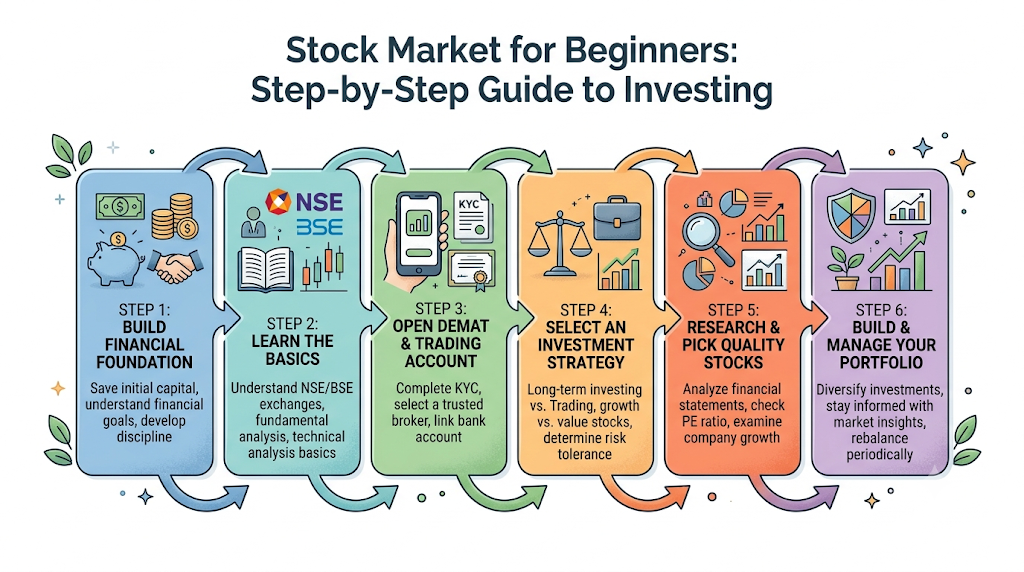
The modern financial landscape offers everyone a pathway to financial independence, provided they possess the right framework. Relying on guesswork or hot tips turns investing into gambling; true financial empowerment stems from structured, accessible stock market education. For those just starting out, mastering the share market for beginners is about shifting from a consumer mindset to an owner mindset. Navigating the Indian stock market requires understanding how businesses leverage public capital. When you learn stock market fundamentals, you learn how to evaluate the engine of economic growth. By looking at the mechanics of public listing via the National Stock Exchange (NSE) and Bombay Stock Exchange (BSE), this guide equips retail investors, students, and working professionals with the baseline metrics needed for objective, long-term stock market research.
What Is Stock Market Investing?
When looked at conceptually, stock market investing is the process of acquiring fractional, legally protected partnerships in real businesses. A single share acts as a contract of ownership. As the underlying business scales its operations, secures market share, and improves its operational efficiencies, the value of that business grows. Public equity markets adjust to this commercial success by driving up the market price of individual shares.
For everyday retail investors, public stock exchanges act as democratic platforms for capital allocation. Rather than leaving your savings vulnerable to currency depreciation caused by inflation, equity investing allows capital to actively participate in corporate productivity. It is a systematic mechanism designed to transform personal savings into compounding economic assets.
Key Concepts Every Beginner Must Know
To evaluate investments efficiently, you must first master the architectural building blocks of the financial system:
- The Public Gateways (NSE & BSE): These are stringently monitored, completely transparent clearinghouses where equity shares change hands. The BSE offers deep historical roots, while the NSE provides the liquidity infrastructure powering modern electronic trading volume.
- The Corporate Scale (Market Capitalization): This metric represents the total valuation a public market assigns to an active enterprise. By multiplying outstanding shares by the current market price, businesses fall neatly into Large-cap (stable market anchors), Mid-cap (aggressive challengers), or Small-cap (niche pioneers) categories.
- The Market Barometers (Indices): Indices serve as shorthand measurements for broader economic health. The Sensex tracks 30 legacy giants on the BSE, while the Nifty 50 acts as a weighted basket of the 50 most vital, highly liquid corporate leaders on the NSE.
Comprehensive Comparison Tables
Table 1: Investing vs. Trading
| Feature | Investing | Trading |
| Core Approach | Acquiring equity based on long-term corporate viability. | Explating brief, sentiment-driven price imbalances. |
| Advantages | Collects passive dividends and benefits from compound growth. | Capitalizes rapidly on short-term market volatility. |
| Limitations | Requires significant patience and structural discipline. | Demands continuous attention; high risk of emotional fatigue. |
| Best For | Professionals, passive savers, and wealth builders. | Full-time market specialists and risk-tolerant individuals. |
| Risk Level | Low to Moderate (when diversified over long horizons). | Exceptionally High. |
Table 2: Fundamental Analysis vs. Technical Analysis
| Feature | Fundamental Analysis | Technical Analysis |
| Core Approach | Dissecting operational health and intrinsic balance sheet values. | Map-making human behavior via historical price action charts. |
| Advantages | Isolates robust, mispriced businesses with clear moats. | Validates optimal timing parameters for entries and exits. |
| Limitations | Doesn’t tell you when the market will realize value. | Susceptible to unexpected news shocks and false chart breakouts. |
| Best For | Value-oriented buyers and long-term equity investors. | Active momentum participants and short-term traders. |
| Risk Level | Conservative; relies on underlying asset safety. | Aggressive; highly dependent on immediate market execution. |
Table 3: Growth Stocks vs. Value Stocks
| Feature | Growth Stocks | Value Stocks |
| Core Approach | Backing companies expanding revenues faster than average. | Targeting steady companies trading below historical valuations. |
| Advantages | Significant upside potential during economic booms. | Offers a substantial margin of safety and stable yield. |
| Limitations | High premium valuations leave little room for operational errors. | Can turn into a “value trap” if the industry stagnates. |
| Best For | Long-term investors targeting capital appreciation. | Defensive, cash-flow focused income investors. |
| Risk Level | High. | Moderate. |
How to Analyze Stocks: Two Core Approaches
Developing consistent analytical habits requires learning how to read the data using two core methods:
Fundamental Analysis of Stocks
Fundamental analysis strips away market noise to study the internal engine of a company. Investors begin by examining the Balance Sheet to make sure assets comfortably outweigh liabilities. They then look at the Income Statement to check for stable revenue trends and healthy net profit margins, and review the Cash Flow Statement to confirm that accounting numbers match real cash coming in.
A common starting point for evaluating a stock’s valuation is the PE Ratio (Price-to-Earnings), which measures the price paid against the actual profits generated per share.
Technical Analysis for Beginners
Technical analysis skips corporate disclosures entirely to analyze the psychology of market participants through price charts. Beginners use candlestick charts to view a clear visual record of supply and demand over specific periods.
By tracking where buying interest historically steps in to halt a drop (support) and where selling pressure consistently caps a rally (resistance), you can make objective trading decisions based on actual market structure.
Real-World Investment Scenarios
To understand how these concepts apply to everyday life, let’s look at two contrasting approaches:
- Scenario A (The Long-Term Investor): A professional spots a consumer company with reliable 18% annual profit growth, zero net debt, and a reasonable PE ratio relative to its sector. Recognizing a high-quality business, they buy shares and hold them for several years, ignoring temporary market drops, while the company continues to expand its retail footprint.
- Scenario B (The Swing Trader): A market enthusiast notices an auto stock consistently bouncing every time it touches its ₹800 support zone. They buy near ₹805 with a defensive stop-loss set just below support at ₹785, planning to exit for a tidy profit once the stock climbs back toward its clear ₹880 resistance level.
What Is IPO Analysis?
An Initial Public Offering (IPO) occurs when an expanding, privately owned company opens its doors to the public for the first time. This transition allows the business to raise fresh capital directly from the public markets to pay off existing debt, fund research, or fuel new infrastructure projects.
Conducting proper IPO analysis requires a careful look at the company’s regulatory filings, specifically the Draft Red Herring Prospectus (DRHP). Because there are no historical stock charts to look at, you have to assess the business’s fundamentals: how the management plans to use the new capital, the track record of the founders, and whether the offer price is fair or overly expensive compared to similar companies already trading on the market.
Common Beginner Mistakes to Avoid
- Relying on Speculative Tips: Entering positions based on unverified internet chatrooms or casual advice without doing any independent research.
- Underestimating Risk Exposure: Deploying critical everyday savings or capital needed for emergencies into high-risk, speculative stocks.
- Overtrading out of Emotion: Buying and selling shares continuously due to short-term market swings, which drains capital through unnecessary transaction costs.
- Concentrating Capital Too Heavily: Putting your entire investment into a single hot sector or stock, leaving your financial future vulnerable to sudden industry downturns.
Best Practices for New Investors
- Build a Diversified Portfolio: Spread your investments across distinct economic sectors like consumer goods, financial services, technology, and healthcare to reduce industry-specific risks.
- Automate Your Capital Allocation: Set up fixed, systematic monthly investments to build a disciplined investing habit and smooth out your purchase costs across market cycles.
- Secure an Emergency Buffer: Keep at least six months of living expenses in highly liquid accounts before investing long-term capital into the stock market.
- Focus on Ongoing Education: Stay informed by regularly reviewing macroeconomic indicators, reading business news, and continually refining your market knowledge.
Expert Tips for Market Success
- Treat Every Stock as a Real Business: Before buying a single share, ask yourself if you would buy the entire company if you had the capital. If the underlying business model is weak, do not hold its stock.
- Maintain an Investment Log: Document the core reasons behind every buy and sell decision. Reviewing these notes six to twelve months down the road offers irreplaceable lessons on your own investing behavior.
- Scale Up Gradually: Start your investing journey with small amounts of money. Experiencing real market fluctuations with small stakes helps you build emotional discipline before managing larger sums of capital.
Strategic Market Research Tips
- Source Data directly from Exchanges: Use official websites like the NSE and BSE to gather clean, accurate corporate filings, shareholder patterns, and financial data.
- Keep an Eye on Broad Economic Trends: Monitor interest rate cycles, inflation metrics, and GDP growth figures, as these macro shifts guide the overall direction of the markets.
- Run Peer-Group Comparisons: Always evaluate a company alongside its direct competitors. Comparing operating margins and debt levels helps you identify which business holds a true competitive advantage.
Why Learn with Stocks Mantra?
Developing a successful, long-term approach to the stock market requires structured learning free from sensationalized news. Stocks Mantra provides a clean, independent educational environment tailored specifically for modern retail investors. By prioritizing objective data, clear logic, and practical frameworks over speculative trends, the platform helps beginners develop into independent, confident analysts. Whether you want to learn how to read balance sheets, interpret candlestick charts, or evaluate upcoming IPOs, Stocks Mantra offers the clear, foundational resources you need to build long-term investing discipline.
Frequently Asked Questions
What is the absolute minimum capital required to start investing?
There is no large entry barrier for modern retail investors. You can start by buying a single share of a company, which can cost less than a few hundred rupees. Starting early with small amounts to build a consistent habit is far more important than waiting for a large sum of capital.
How can a beginner choose their very first stock?
Beginners should focus on established, large-cap companies that produce essential products they use and understand in daily life. Look for clear signs of financial health, such as consistent profitability and low debt levels, which provide a reliable safety buffer for new portfolios.
What makes the NSE and the BSE different from each other?
The Bombay Stock Exchange is Asia’s oldest exchange, established back in 1875, and uses the Sensex as its primary index. The National Stock Exchange opened in 1992, pioneering fully electronic trading in India, and uses the Nifty 50 as its benchmark index.
How does short-term trading differ from long-term investing?
Investing focuses on buying shares in solid businesses and holding them for years to benefit from corporate growth and compounding. Trading focuses on capturing quick profits from short-term price movements over days, hours, or minutes, requiring constant market monitoring and higher risk tolerance.
What exactly does the PE ratio tell an investor?
The Price-to-Earnings ratio shows the relationship between a company’s stock price and its actual earnings per share. It tells you how much the market is willing to pay for each rupee of profit the company generates, helping you see if a stock is cheap or expensive.
Why is portfolio diversification so important for beginners?
Diversification means spreading your money across different companies and unrelated sectors. This protects your overall capital because if an unexpected event hits one industry hard, the steady performance of your other investments helps keep your portfolio stable.
What documentation do I need to open a demat account?
To open a Demat and trading account in India, you need standard identity and address proofs, including your PAN card, Aadhaar card, a recent bank statement, and a cancelled cheque to complete the online Know Your Customer registration process securely.
Is it possible to lose all your money in equities?
While all investments carry market risk, completely losing your capital typically only happens if you speculate on low-quality penny stocks or financially troubled companies. Investing in high-quality, diversified large-cap companies makes catastrophic losses highly unlikely.
What should I look for when analyzing an IPO?
When reviewing an Initial Public Offering, look closely at the Draft Red Herring Prospectus. Focus on understanding the company’s historical financial performance, its competitive advantages, the background of its management team, and exactly how they intend to spend the raised funds.
How long should an investor hold onto their shares?
To fully experience the benefits of corporate compounding, a long-term investment horizon should ideally span between five to ten years. This gives high-quality businesses enough time to execute their growth strategies and ride out short-term economic cycles comfortably.
What do support and resistance mean on a stock chart?
Support is a price level where buying interest historically turns strong enough to stop a stock from falling further. Resistance acts as a price ceiling where selling pressure routinely overpowers buying momentum, making it difficult for the stock to climb higher in the short term.
Why are quarterly corporate earnings announcements so critical?
Public companies are legally required to report their financial results every three months. Tracking these updates allows investors to check if a company’s revenue and margins are still on track, ensuring their original investment thesis remains valid.
What is a dividend investing strategy?
Dividend investing involves buying shares in mature, highly profitable companies that regularly share a portion of their earnings directly with investors. This provides a steady stream of passive income alongside standard long-term growth in the stock’s price.
How do interest rate changes affect the stock market?
When central banks raise interest rates to cool down inflation, corporate borrowing costs go up. This can slow down business expansion plans and squeeze profit margins, which often leads to short-term downward pressure on stock market valuations.
Can busy students and working professionals invest effectively?
Yes, quite easily. By using automated systematic investment plans, individuals can invest fixed amounts each month into chosen stocks or index funds. This removes the need to watch daily price movements, making it a perfect strategy for busy schedules.
Conclusion
Building a successful investment portfolio requires moving away from speculative shortcuts and committing to a solid stock market education. By learning the mechanics of fundamental and technical analysis, recognizing common mistakes, and following disciplined risk management habits, you create a dependable foundation for long-term wealth.
Investing successfully is a journey that rewards patience, objective research, and continuous learning. Approach the market with an analytical mindset, focus on the real corporate metrics driving the numbers, and let your market knowledge grow alongside your investments over time.