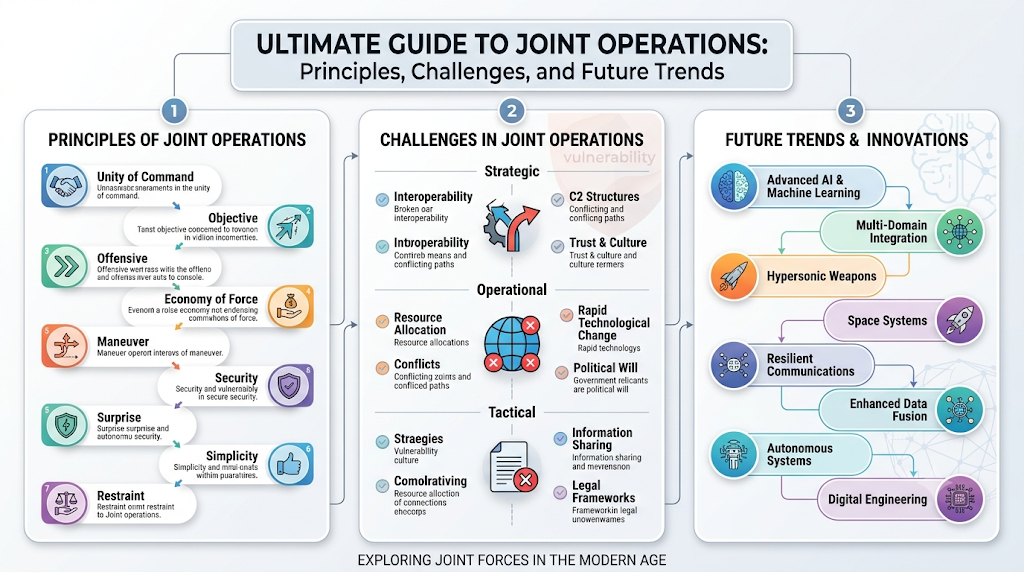
Introduction
The landscape of modern warfare demands absolute integration. No single military branch—whether army, navy, or air force—can win a complex conflict alone. Isolation on the battlefield leads to operational vulnerabilities and fragmented strategies, making comprehensive coordination a structural necessity.
Modern militaries increasingly rely on integrated forces to address multi-dimensional security threats. This approach maximizes combat power, eliminates redundancies, and ensures that all branches move toward a singular objective. Navigating this operational shift requires specialized education, which platforms like WarOpsX.com provide by breaking down advanced doctrines for strategic professionals.
This guide explores the foundational frameworks, tactical advantages, and future trajectories of integrated military coordination. Readers will gain a clear understanding of command structures, multi-domain capabilities, and the strategic planning processes that drive successful joint force operations.
3. What Are Joint Operations?
A Joint Operation is a military action conducted by a unified force comprising significant elements of two or more military departments operating under a single joint force commander. It represents the structural blending of distinct service cultures, capabilities, and tactics into a cohesive weapon system.
                  ┌──────────────────────────────┐
                  │    Unified Joint Command     │
                  └──────────────┬───────────────┘
            ┌────────────────────┼────────────────────┐
            ▼                    ▼                    ▼
     [ Land Forces ]      [ Naval Forces ]     [ Air Forces ]
            ▲                    ▲                    ▲
            └────────────────────┼────────────────────┘
                  ▼                    ▼
         [ Cyber Domain ]     [ Space Domain ]
The core concept relies on teamwork and synergy. Instead of individual branches executing isolated strategies, they pool their unique resources to create a more capable force than the sum of its parts.
The military significance of this model lies in its ability to eliminate operational blind spots. Strategically, joint activities aim to project overwhelming power, achieve rapid dominance, and secure national security objectives with minimized asset loss.
4. History and Evolution of Joint Operations
Early military coordination was rudimentary and plagued by communication lag. Armies and navies functioned as separate entities, occasionally crossing paths during coastal blockades or amphibious landings but rarely sharing a unified operational plan.
The evolution of integrated warfare accelerated rapidly during global conflicts where massive logistics and cross-domain movements became mandatory. The necessity of storming fortified positions from the sea while under air cover forced services to formalize cooperative doctrines.
This led to the rise of unified command structures, legal frameworks that stripped individual branches of independent operational control during deployments. Command was consolidated under a singular leader to ensure a streamlined flow of directives.
Today, modern military transformation focuses on digitizing these structures. The focus has shifted from simple de-confliction—ensuring forces do not hit each other—to deep, instantaneous synchronization across every available theater of war.
5. Why Joint Operations Matter
- Operational Efficiency: Eliminates duplicate supply lines, standardizes fuel and ammunition requirements, and prevents different branches from wasting resources on identical targets.
- Resource Optimization: Allows commanders to apply the exact tool needed for a specific threat, such as deploying a precise naval strike instead of an expensive, prolonged land artillery campaign.
- Unified Command and Control: Establishes a clear, singular chain of command, removing bureaucratic friction and preventing conflicting orders from confusing ground units.
- Enhanced Battlefield Effectiveness: Forces adversaries to defend against simultaneous threats from multiple directions, overwhelming their decision-making cycles and defensive capabilities.
6. Core Principles of Joint Operations
Unity of Effort
All participating forces must coordinate their actions toward a common strategic goal. Even if individual branches use radically different tactics, their ultimate operational achievements must directly support the primary mission objective.
Interoperability
Different military branches, communications systems, and equipment types must be capable of working together seamlessly. This ensures that an air force radar can feed targeting data directly to an army missile battery without technical delays.
Synchronization
The precise arrangement of military actions in time, space, and purpose to produce maximum relative combat power. It ensures that airstrikes, artillery barrages, and ground movements occur at the exact moments necessary to exploit enemy weaknesses.
Flexibility
The ability to rapidly alter operational plans to exploit unexpected opportunities or counter sudden threats. A joint force can quickly shift its primary effort from a land assault to a naval blockade if the battlefield situation changes.
Information Sharing
The continuous, unhindered flow of intelligence and data across all participating service branches. Breaking down intelligence silos prevents surprises and builds a comprehensive picture of the operational area.
Integrated Planning
Developing operational strategies with representatives from all services present from day one. This guarantees that the limitations and specialized capabilities of every branch are accounted for before troops move.
7. Components of Joint Operations
┌─────────────────────────────────────────────────────────────────────────┐
│                       JOINT FORCE COMPONENTS                            │
├──────────────┬──────────────┬──────────────┬─────────────┬──────────────┤
│  Land Units  │  Naval Units │  Air Units   │ Space Units │ Cyber Units  │
├──────────────┼──────────────┼──────────────┼─────────────┼──────────────┤
│ Hold Ground  │ Sea Control  │ Air Superior │ Navigation  │ Network Def  │
│ Close Combat │ Power Proj   │ Deep Strike  │ Sat Comms   │ Electronic   │
└──────────────┴──────────────┴──────────────┴─────────────┴──────────────┘
Land Forces
Comprising infantry, armor, and mechanized units, land forces are responsible for seizing terrain, controlling populations, and physically holding the ground necessary to achieve permanent political or strategic outcomes.
Naval Forces
Naval elements project power from the sea to the shore, secure vital sea lanes, establish maritime blockades, and launch precise cruise missile strikes deep into enemy territory.
Air Forces
Air units establish air superiority, protect ground installations from aerial attack, conduct reconnaissance, and deliver rapid, devastating strikes against high-value strategic targets.
Space Operations
Space infrastructure provides navigation data, missile warning systems, secure global communications, and weather tracking that enables all other forces to navigate and strike accurately.
Cyber Operations
Cyber units defend friendly military networks from disruption while actively degrading or neutralizing the digital command, control, and communication systems of the adversary.
Special Operations Forces
Highly specialized units that conduct unconventional warfare, deep reconnaissance, and precision raids, serving as an agile force multiplier for the larger conventional joint architecture.
8. Joint Command Structure Explained
A Joint Force Command is organized under a single Joint Force Commander (JFC), who receives authority directly from national leadership. The JFC does not micromanage individual squads; instead, they establish the overarching intent and allocate resources to specific component commanders.
The operational planning process relies on joint staffs divided into functional directorates (e.g., J-2 for Intelligence, J-3 for Operations, J-4 for Logistics). This structure guarantees that every aspect of a campaign is reviewed by experts from all services.
Decision-making balances speed and inclusivity. The JFC retains ultimate authority, but relies on a collaborative matrix where information is synthesized from every domain to make rapid, informed choices.
Coordination mechanisms include liaison officers embedded within different branch headquarters. These specialists translate branch-specific jargon and technical realities, keeping operations smooth and preventing communication breakdowns.
9. Multi-Domain Operations and Joint Warfare
Modern joint warfare has evolved into Multi-Domain Operations (MDO), where the goal is to create dilemmas for an enemy across five distinct spaces simultaneously.
- Land Domain: The physical foundation where human populations live and where final victory is traditionally consolidated through physical presence.
- Sea Domain: The global maritime commons that facilitate international trade, troop transport, and long-range power projection via carrier strike groups.
- Air Domain: The atmospheric space that grants speed, global reach, and the ability to strike targets anywhere on Earth within hours.
- Space Domain: The high-altitude orbital environment that dictates global positioning, strategic early warning, and modern command-and-control functionality.
- Cyber Domain: The man-made virtual environment where data manipulation, network intrusion, and electronic warfare can paralyze an adversary’s infrastructure without firing a physical shot.
10. Planning and Executing Joint Operations
Mission Analysis
Commanders review the directives given by national authorities to identify the core problem. They define the end state, isolate operational constraints, and evaluate enemy centers of gravity to determine what must be accomplished.
Resource Allocation
The joint staff calculates the exact forces required to execute the mission. Units from different branches are assigned to specific roles based on their specialized capabilities, ensuring no single service is overburdened.
Operational Coordination
Establishing clear boundaries, time schedules, and communications networks. Fire support coordination lines are drawn to ensure artillery and aircraft can strike targets safely without hitting friendly forces.
Execution and Assessment
The plan is set in motion. As operations unfold, the joint staff continuously monitors progress against specific metrics, adjusting the strategy in real time to counter enemy reactions.
11. Real-World Examples of Joint Operations
- Humanitarian Assistance Missions: Following major natural disasters, joint forces deploy hospital ships (Navy), establish airfields for cargo planes (Air Force), and distribute clean water using heavy transport vehicles (Army).
- Disaster Response Operations: Domestic search-and-rescue efforts require military helicopters to spot survivors, logistics units to manage distribution centers, and engineering corps to clear blocked roads.
- Peacekeeping Missions: International stability efforts utilize joint forces to monitor borders via satellite, patrol demilitarized zones with ground troops, and maintain naval observation points off the coast.
- Large-Scale Military Campaigns: Major multi-national interventions rely on complex amphibious landings, where air superiority shields naval assets while they drop land forces onto contested shores under cyber cover.
12. Benefits of Joint Operations
- Faster Response Capability: Having pre-coordinated command structures allows military forces to deploy around the globe within hours, bypassing service-level bureaucracy.
- Improved Coordination: Shared training reduces operational friction, ensuring that different branches react predictably and cohesively during chaotic combat situations.
- Better Situational Awareness: Merging radar, satellite, and human intelligence feeds creates a single, highly accurate picture of the entire theater of war.
- Greater Operational Effectiveness: The combination of varied service capabilities creates a highly lethal, resilient force capable of overcoming complex defensive networks.
13. Challenges and Limitations
- Communication Barriers: Different branches often use proprietary radio frequencies, encryption protocols, or technical terminology that can hinder real-time data exchange.
- Inter-Service Coordination Issues: Deeply ingrained institutional rivalries and cultural differences between the army, navy, and air force can slow down unified planning.
- Technology Integration Challenges: Older, legacy equipment used by one branch may be completely incompatible with the cutting-edge digital systems of a newly modernized branch.
- Logistics Complexity: Managing different fuel types, mechanical spare parts, and ammunition calibers across multiple branches creates immense strain on supply chains.
14. Common Mistakes in Joint Operations Planning
- Poor Coordination: Failing to establish clear operational boundaries between branches, which can lead to friendly fire incidents or abandoned objectives.
- Lack of Interoperability: Purchasing specialized equipment for one service without checking if it can communicate with the rest of the joint force architecture.
- Insufficient Intelligence Sharing: Hoarding critical operational data inside branch-specific intelligence agencies instead of distributing it to the wider force.
- Weak Command Structures: Creating ambiguous chains of command where multiple leaders hold overlapping authorities, resulting in hesitation and mixed signals during crises.
15. Best Practices for Successful Joint Operations
To counter these operational challenges, modern defense organizations implement structured protocols designed to ensure seamless integration on the battlefield.
- Joint Training Exercises: Regularly forcing different branches to train together in realistic, high-stress environments to build trust and uncover technical friction points before an actual deployment.
- Standardized Procedures: Developing universal military doctrines that dictate exactly how air support is requested, how casualties are evacuated, and how data is categorized across all services.
- Shared Communication Systems: Investing in secure, software-defined radios and cloud-based network architectures that are natively accessible by land, air, and sea assets.
- Continuous Operational Assessment: Conducting real-time, objective evaluations of ongoing missions to quickly identify and fix breakdowns in inter-service coordination.
16. Future of Joint Operations
The future of integrated warfare is defined by data processing speeds and algorithmic support. AI-assisted decision-making systems will soon analyze millions of battlefield data points in milliseconds, suggesting optimized deployment options to the Joint Force Commander.
Autonomous systems, including drone swarms operating on land, at sea, and in the air, will be integrated directly into joint frameworks. These unmanned systems will handle high-risk reconnaissance and logistics, shielding human troops from initial waves of conflict.
Multi-domain warfare will become completely automated. Cyber attacks will instantly sync with orbital jamming windows and ground maneuvers, creating a single, fluid operational rhythm that leaves no reaction time for an adversary.
17. Career Opportunities in Defense Operations and Strategy
┌────────────────────────────────────────────────────────────────────────┐
│                      STRATEGIC CAREER PATHS                            │
├───────────────────────────┬────────────────────────────────────────────┤
│ Role                      │ Primary Focus                              │
├───────────────────────────┼────────────────────────────────────────────┤
│ Joint Operational Planner │ Designs multi-branch campaign strategies.  │
│ Defense Strategy Analyst  │ Evaluates geopolitical risks and doctrine. │
│ Command & Control Expert  │ Manages communications and data networks.  │
│ Logistics Coordinator     │ Synchronizes complex global supply chains. │
└───────────────────────────┴────────────────────────────────────────────┘
The growing complexity of unified warfare has created a high demand for specialized professional paths. Defense students and strategic analysts can pursue rewarding careers as Joint Operational Planners, designing multi-branch campaign strategies within national military headquarters.
Geopolitical research institutions and defense contractors frequently employ Defense Strategy Analysts to evaluate changing military doctrines. Additionally, technical experts can find vital roles as Command and Control Systems Engineers or Joint Logistics Coordinators, managing the advanced networks and global supply chains that keep integrated forces operational.
18. FAQ Section
- What is the difference between joint operations and combined operations? Joint operations involve cooperation between two or more branches of the same nation’s military. Combined operations involve military coordination between two or more different countries, such as international coalitions or alliances.
- Who commands a joint military operation? A Joint Force Commander (JFC) heads the operation. This individual is a senior officer appointed by national defense leadership and holds absolute operational authority over all assigned land, naval, air, space, and cyber forces.
- How does interoperability affect joint warfare success? Interoperability ensures that different branches can communicate, share critical targeting data, and utilize standardized logistics networks without delay. Without it, the joint force fragments into isolated, inefficient units susceptible to defeat.
- What role do cyber operations play in joint forces? Cyber operations protect friendly networks from disruption while actively neutralizing the communications, radars, and digital command systems of the adversary, opening windows of advantage for land, sea, and air forces.
- Why is unity of effort critical in defense planning? Unity of effort ensures that all participating military units coordinate their movements toward a single strategic objective. This alignment prevents contradictory actions and maximizes the overall impact of combat power.
- What is a joint force component commander? A component commander is a specialist leader responsible for a specific domain within the joint framework, such as the Joint Force Land Component Commander (JFLCC) directing ground movements.
- How do space assets support integrated warfare? Space infrastructure provides global positioning, weather tracking, secure communications, and early missile warning data that allow modern forces to navigate, coordinate, and strike targets with high precision.
- What are the main logistics challenges in joint operations? The main challenges involve managing and distributing vastly different types of fuel, specialized mechanical spare parts, and varying ammunition calibers across multiple branches with differing supply chain systems.
- How do joint training exercises improve battlefield readiness? They allow different services to test technical compatibility, practice shared operational doctrines, break down cultural rivalries, and fix communication errors before actual combat deployments begin.
- How will artificial intelligence change future joint operations? AI will rapidly process massive streams of multi-domain intelligence data, automate routine logistics coordination, and present real-time tactical options to help commanders make faster decisions than their adversaries.
19. Final Summary
Joint operations represent the peak of modern military capability, transforming isolated service branches into a highly synchronized, multi-domain force. By prioritizing unity of effort, clear command structures, and technical interoperability, modern defense organizations can effectively counter sophisticated security threats.
As technological advancements integrate AI, autonomous systems, and advanced cyber capabilities, the importance of unified planning will only expand. Cultivating a deep, analytical understanding of these evolving doctrines remains essential for security professionals, policy makers, and strategic analysts worldwide.